Terre Pruitt's Blog

In the realm of health, wellness, fitness, and the like, or whatever inspires me.

  • I teach yoga, Nia, and stretch online!

    ALL CLASSES ARE ON ZOOM AT 10:00 AM PDT

    Tuesday Gentle Yoga 

    Wednesday Nia

    Thursday Stretch

    Please see my website for details!

    I am also available for private Nia / yoga / Personal Training all virtual, of course!

  • Unknown's avatar

  • Enter your email address to subscribe to this blog and receive notifications of new posts by email.

  • My Bloggey Past

  • ******

    Chose a month above to visit archives, or click below to visit a page.

Posts Tagged ‘Balance Pose’

Extended Hand To Big Toe Pose

Posted by terrepruitt on March 31, 2025

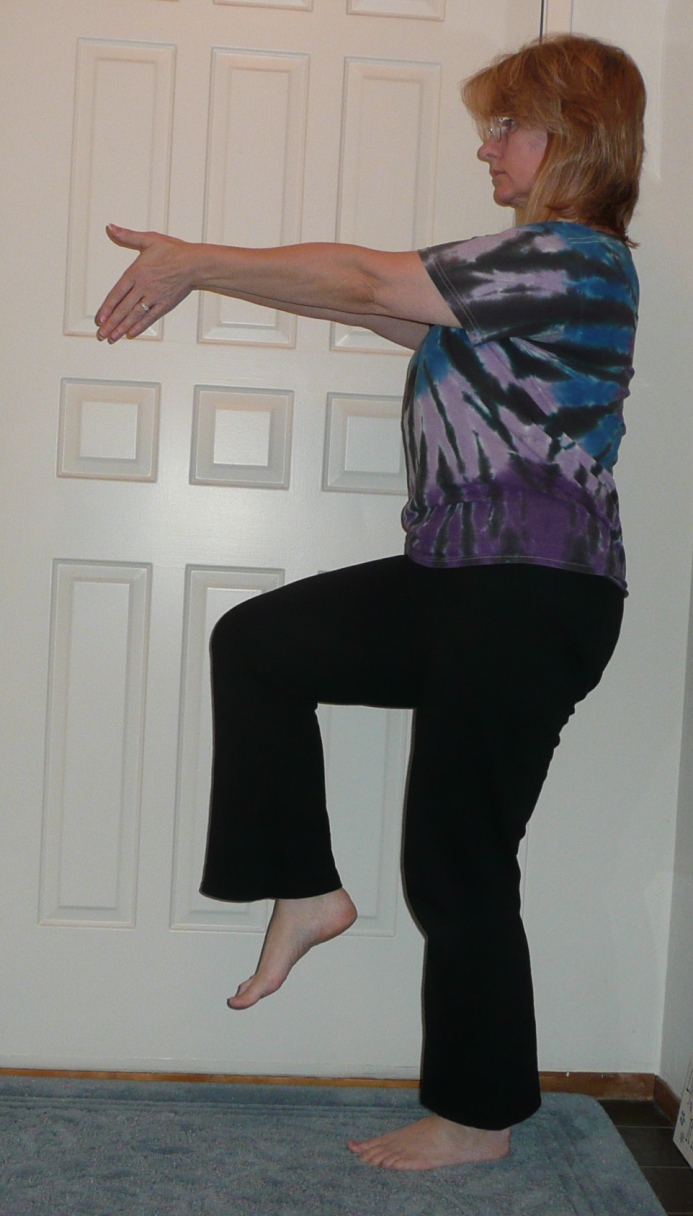
In my yoga classes I always remind my students that they can keep both feet on the ground when we practice standing balance poses. In addition to instructing that students can keep both feet down I do always remind them they can use something for stability (a wall, a table, a chair, etc.). Balance practice does not require you to be ONLY on ONE foot even when doing a “one-legged balance pose”. For many reason some people may not want to or be able to take a foot off the ground. While the pose may be “designed” to be done on one leg the body is still practicing balance when you have all of your weight distributed on one leg, but have the other foot down just for whatever reason. I say ALL of our balance poses can be done like this, except one and this is the one.

With this one, Extended Hand To Big Toe Pose/Utthita Hasta Padangusthasana, I ask that they try to stand on one foot. Again, if they need to, they hold onto something, or have something close. We usually merge into it, doing it three times. The first modification is just to hold the leg up, then hold it higher, or out a little, then the third time they can just hold it out for a second or as long as they can.  It is an option, of course, to try the progression.

Traditionally the asana is done with the index and middle finger wrapped around the big toe from between the big toe and second toe . . . I usually hold my foot from the arch side of the foot. I instruct my students to go with tradition or anyway they feel comfortable.

The outstretched leg is usually directly out to the side or directly in front. I find my comfort spot to be more at a diagonal. Traditionally the outstretched leg is straight, but allowing for modifications, students can bend their knee as needed.

I always remind my students that keeping a tall spine, being more in “mountain” then rounding over is more important the holding the toe, having a straight leg, or having the leg be high. Some people may have leg lengths that may not allow them to hold the toe without rounding so we are always working with our unique bodies.  Pictured are different ways to hold the leg and different ways students can modify.

Extended Hand To Big Toe Pose/Utthita Hasta Padangusthasana

–Start in Mountain Pose, with a lengthening spine, relaxed shoulders
–Easing into it the first time just hold a leg up, anyway, using the same side hand as leg
–The second time get more precise with the hold.  Hold the leg as we would (fingers around the big toe) if it were straight, even with the leg still bent, in preparation for when the leg is straight
–The third time hold the leg out straight, or just kick it out quickly if a second is all that can be done

Maybe use a chair.

In between each Extended Hand To Big Toe Pose stand in Mountain Pose. And while we are in the pose keep the spine long and shoulders relaxed.

Posted in Yoga/PiYo/Pilates | Tagged: , , , , , , , , , , | 2 Comments »

Half Moon Pose

Posted by terrepruitt on November 3, 2021

I thought I had posted about this pose a long time ago because it is one of my favorite poses. We do it in the gentle yoga classes I teach. It is somewhat of an advanced pose because there is a lot going on. The class is gentle not beginner, but a lot of modifications are provided so that it can be done to the individual’s ability. As with many asana there is more than one pose that can be done to transition into it. The name of the pose is Half Moon Pose/Ardha Chandrasana.

I feel it is important to warm up the glutes and do a bit of balance practice before having my students do this pose.
In the photo I am doing a modified version with my hand on a block. The full version is without a block and looking at the skyward hand. I have only managed to balance without the block a few times and only for a few seconds.

What tends to happen when students get into this pose is the supporting foot moves. The supporting foot is to be in line with the body, but as soon as the leg comes up, the foot moves to an angle. One must really focus to keep that foot pointing in the right direction.

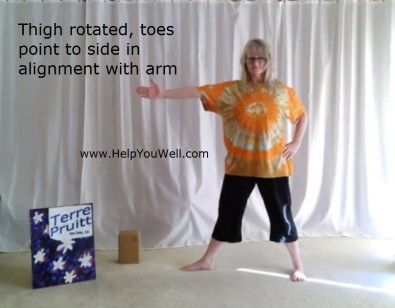
I often have students go from a Warrior 2 to a Half Moon, so if you start out in a Warrior 2 . . .

(doing the left side) the thigh is rotated out to the left with the toes pointing to the left, the knee is bent and the knee is over the ankle, the hips and chest are pointing forward, the arms are out, and the right leg is straight with toes pointed forward. . . (here, getting into half moon)

take a little hop to the left with the right foot so the weight can begin to shift to the left leg
as the weight shifts over to the left the leg begin to straighten it — here is where one must be mindful of the toes – they are to remain pointing out to the left
the left hand seeks out the floor, a block, or a chair, and we stand on a straight left leg
Note:  the block is about 6 inches (or more) away from the foot AND to the right
shoulders are stacked with chest to the front
hips points are stacked with pelvis facing front
right leg is in alignment with torso and hip, toes and knee facing forward
right foot is flexed

Other things to keep in mind in addition to the shoulders and hips remaining stacked, is to not bow into the low back, keep a neutral spine with the core engaged.

One can look up at the right hand.

Getting out is just like getting in there are many places to go from here. I like to have my students practicing using control and coming into the Warrior 2 again . . . gently.

As you can see a chair can be used instead of a block.  Hand can be on the seat or the back of the chair.  There are many things that can be used for stability as long as it is stable and safe.

This pose has a lot going on as I mentioned previously, it requires balance practice, strength, and even flexibility.

Are you familiar with this pose?  Do you like it?

Posted in Yoga/PiYo/Pilates | Tagged: , , , | Leave a Comment »

Adding A Challenge To A Pose Mastered

Posted by terrepruitt on November 30, 2016

I teach two gentle yoga classes.  Gentle yoga doesn’t necessarily mean beginner yoga.  It can if the class is a beginner yoga class, but “gentle” doesn’t mean beginner.  The way I make the yoga class gentle is we don’t hold the poses for a long time.  We also don’t flow through a long combination of poses.  I usually do a sequence of two, three poses at the most, but the class is not a flow.  In my two regularly scheduled gentle yoga classes we actually just stop and get down (or stop and get up) because I feel that being able to get up off of the floor is very important.  We don’t use downward facing dog, forward folds, planks, or poses to get down and up.  We go at a comfortable pace slowly moving through poses.  The classes are not beginner classes because I have been teaching some of the same students for years.  So they are not beginners.  They know many poses and they know what their bodies should be doing in those poses, but they like to do yoga gently.  But we still need to add some challenge to some of the poses.  So, for a small group of students in my gentle yoga classes we have added a challenge to one of the poses that they have down.  For those that can balance fine, we have added the challenge of closing our eyes.

We are still doing the pose, but we close our eyes to add to the pose.  Just the simple act of closing our eyes causes us to get a little wobbly and therefore work more at standing upright.  Just like with our eyes open one side is easier than the other.  But this simple act gives the pose a new spin.

The inner ear plays a huge role in our balance, but so do our eyes.  Once we take vision out of the equation it makes balancing more challenging.  I believe practicing balancing with our eyes closed will allow us to get better at it over time.  While we are practicing we will be using those stabilizing muscles and that will help us be better balanced.  Just as practicing balance with your eyes open.

This is a fun thing to add to the balance practice because, as I said, my students can do this pose well, so it is kind of surprise that just closing one’s eyes makes it as if they can’t do the pose.  There are some “whoas” and “what the . . ” and giggles because it is just so funny that a pose we can do all of a sudden we can’t do it (as well).

For now we are only closing our eyes when doing the Stork pose, but once we have that down AND have more stability in some of our other balances poses we will add “eyes closed” to them.

So if you come to one of my regularly scheduled yoga classes you might experience this.  If you come to one I am subbing, I usually do things a little differently.  That is one thing that is so great about teaching yoga, it can be adjusted and modified so it is not always the same.  With the adjustments and modifications, hopefully, they are helping you improve your stability, flexibility, and strength.  Sometimes all it takes is something so simple as closing your eyes.

Did you try it?  Just standing with your eyes closed?  How about standing on one leg with your eyes closed?

Posted in Yoga/PiYo/Pilates | Tagged: , , , , , , , , , , , , | Leave a Comment »