Terre Pruitt's Blog

In the realm of health, wellness, fitness, and the like, or whatever inspires me.

  • I teach yoga, Nia, and stretch online!

    ALL CLASSES ARE ON ZOOM AT 10:00 AM PDT

    Tuesday Gentle Yoga 

    Wednesday Nia

    Thursday Stretch

    Please see my website for details!

    I am also available for private Nia / yoga / Personal Training all virtual, of course!

  • Unknown's avatar

  • Enter your email address to subscribe to this blog and receive notifications of new posts by email.

  • My Bloggey Past

  • ******

    Chose a month above to visit archives, or click below to visit a page.

Archive for the ‘Yoga/PiYo/Pilates’ Category

Extended Hand To Big Toe Pose

Posted by terrepruitt on March 31, 2025

In my yoga classes I always remind my students that they can keep both feet on the ground when we practice standing balance poses. In addition to instructing that students can keep both feet down I do always remind them they can use something for stability (a wall, a table, a chair, etc.). Balance practice does not require you to be ONLY on ONE foot even when doing a “one-legged balance pose”. For many reason some people may not want to or be able to take a foot off the ground. While the pose may be “designed” to be done on one leg the body is still practicing balance when you have all of your weight distributed on one leg, but have the other foot down just for whatever reason. I say ALL of our balance poses can be done like this, except one and this is the one.

With this one, Extended Hand To Big Toe Pose/Utthita Hasta Padangusthasana, I ask that they try to stand on one foot. Again, if they need to, they hold onto something, or have something close. We usually merge into it, doing it three times. The first modification is just to hold the leg up, then hold it higher, or out a little, then the third time they can just hold it out for a second or as long as they can.  It is an option, of course, to try the progression.

Traditionally the asana is done with the index and middle finger wrapped around the big toe from between the big toe and second toe . . . I usually hold my foot from the arch side of the foot. I instruct my students to go with tradition or anyway they feel comfortable.

The outstretched leg is usually directly out to the side or directly in front. I find my comfort spot to be more at a diagonal. Traditionally the outstretched leg is straight, but allowing for modifications, students can bend their knee as needed.

I always remind my students that keeping a tall spine, being more in “mountain” then rounding over is more important the holding the toe, having a straight leg, or having the leg be high. Some people may have leg lengths that may not allow them to hold the toe without rounding so we are always working with our unique bodies.  Pictured are different ways to hold the leg and different ways students can modify.

Extended Hand To Big Toe Pose/Utthita Hasta Padangusthasana

–Start in Mountain Pose, with a lengthening spine, relaxed shoulders
–Easing into it the first time just hold a leg up, anyway, using the same side hand as leg
–The second time get more precise with the hold.  Hold the leg as we would (fingers around the big toe) if it were straight, even with the leg still bent, in preparation for when the leg is straight
–The third time hold the leg out straight, or just kick it out quickly if a second is all that can be done

Maybe use a chair.

In between each Extended Hand To Big Toe Pose stand in Mountain Pose. And while we are in the pose keep the spine long and shoulders relaxed.

Posted in Yoga/PiYo/Pilates | Tagged: , , , , , , , , , , | 2 Comments »

Some Transfer You Might Not Want On Your Face

Posted by terrepruitt on October 9, 2023

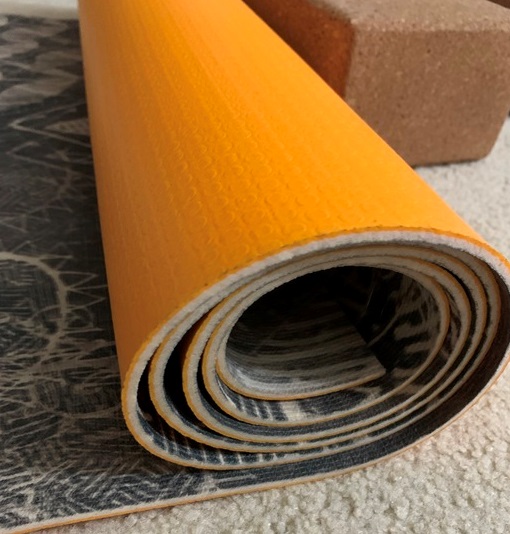
When I was attending yoga classes regularly I was fortunate enough to be doing so in a “no-shoe” studio. And I know that the floors were cleaned regularly because, at one point, I was the one cleaning them. But I have often questioned how I roll my yoga mat and it occurred to me that I should be doing it a different way. Not all places where yoga is practiced is shoe free and sometimes floors could use some cleaning. So why is it standard to roll a yoga mat? The part that is on the floor – in some cases where participants don’t even want to step their feet – gets rolled onto the part where we put our head and our face.

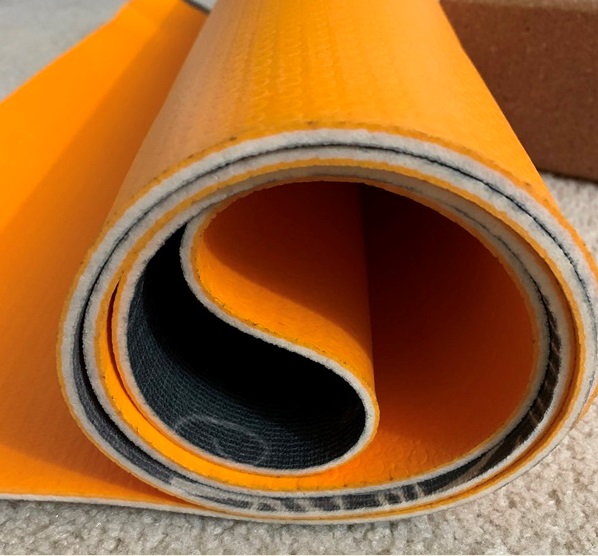
I have to remember to fold then roll. If I fold my mat in half then roll it, the “back” or part that touches the floor, doesn’t end up on the “front/top” where my face and head go. And folding then rolling will limit the amount of transfer of dirt, grime, sand, grass, or whatever onto the “front/top” of the mat.

I happen to have a mat that has two distinct sides AND that has black transfer on it that can simulate dirt, so it makes a great example. It took me a minute to figure out what that black actually is . . . it is rubber from dumbbells. This can give an idea of the fold and roll method.  The orange side that is on the ground gets rolled right up onto the patterned side where I put my face, unless I fold it first.

Most places probably have clean enough floors, but I know some do not so I am going to keep this method in mind.  Also could work for when I take my mat outside.  What do you think?


Posted in Yoga/PiYo/Pilates | Tagged: , , , , , , , , , | Leave a Comment »

Which Yoga Blocks To Get

Posted by terrepruitt on June 28, 2023

Recently I was asked about yoga blocks, someone was asking about which ones to get. Yoga blocks are a prop used in yoga for different things. In many cases they “bring up the floor”. I did a post showing some of the ways yoga blocks can be used. To me the first thing to think about when considering which yoga blocks to buy is how are you going to use them?

If you are not going to be putting a lot of weight on them and requiring them for stability and you don’t need them to be very sturdy the foam ones are probably sufficient. The foam ones may be more comfortable if you are going to be sitting on them. I believe foam yoga blocks are less expensive than cork yoga blocks. So that can always be a factor when deciding to purchase something.

I opted for cork yoga blocks because I use them in one of my favorite poses – half moon – and I prefer the solid feeling and stability in a cork block. Also at the time of purchase, I was practicing a pose where I was standing on the blocks and again, I like the firm solid support of a cork block. I also opted for cork for its antibacterial properties.

I am sure there are some very solid and firm foam blocks available, but at the time, I had not experienced any.

There are also different size yoga blocks so if you are shopping online be sure that you are getting the size you want. When I bought mine they came in two sizes 9X6X3 and 9X6X4. Either way it allows you to use three different heights.

Yoga blocks are like yoga mats and yoga clothes. It really depends on what you want and what you like. I prefer the cork yoga blocks, but every once in awhile I wish I had a set of foam ones but not often enough to want to get some.

Do you use yoga blocks in your practice? Which kind do you prefer?

Posted in Yoga/PiYo/Pilates | Tagged: , , , , , | 4 Comments »

Not Flexible Enough To Do Yoga

Posted by terrepruitt on July 11, 2022

So, I had the conversation again, you may be familiar with it, in fact you may have had the same thoughts yourself.  I have people tell me all the time they are not flexible enough for yoga.  This comment makes me so sad.  And, to be honest, it is rubbish.  The comment makes no sense at all, but it may stem from the fact that people don’t understand yoga or they want to be further along in the practice than is reasonable.  I have a question to answer when presented with that statement, but I seldom remember it, my question is:  “Would you go to the gym only if you were strong?”  

Most people don’t start resistance training when they are strong, they start it to GET strong or improve their strength.  Why is it people don’t approach yoga the same way?  One does not walk into their first yoga class knowing all the moves and being able to do them all.  Yoga is a practice.  I posted once about how I was taught yoga was actually originally created for yogis . . . people that wanted to spend their entire lives learning yoga . . . not only the poses, but all the other things involved.  So with that alone, it proves that people cannot just do the poses from the very first time they try.  Some take years of “doing” to be able to “do” them.

So I think the statement is rubbish because YOGA MEETS YOU WHERE YOU ARE!  That is the thing about yoga.  Since it is a practice you do it as you can.  If you can lie in shavasana for ONLY 1 minute at first – LIE THERE FOR ONE MINUTE!  Then next time it might be 3 minutes, but then the next time it might be 30 seconds . . . that is ok.  If you can’t touch your toes in a forward bend, do what you can.  BE where you are.  If you want to be “flexible enough to do yoga” (not my words, I don’t agree with that statement) – DO YOGA.

One does not get strong by NOT lifting weights.  One does not get flexible by not doing yoga.  If you want to do yoga, do it.  It is not meant to look a certain way, but to allow one to get into their body.  In addition, it could be that your body will never get into a pose like you see on Instagram or in Yoga Journal, I have another post that talks about body design – that is a whole other story.  Yoga is a practice and the only way to do it is to “do” it.

I hope this allows you to realize that you don’t need to be anything when you practice yoga, yoga can help you discover what you ARE, yoga accepts you, and gives you space to adjust and just be.

Posted in Yoga/PiYo/Pilates | Tagged: , , , , , , , , , , | 5 Comments »

Garland Or Malasana Or Squat

Posted by terrepruitt on November 17, 2021

Whatever you call it, it is generally good for you. I say “generally” because I am sure there are some people who have some issues where this would not be good for them.  But like most yoga poses they were created to be practiced by healthy individuals and they have been modified and have many variations so that the general public can do them.  The Garland or Malasana or Squat requires flexibility in several muscles and a large range of motion in several joints.

For ideas on helping you “Get Down On It” 🙂 you can click to my post with that name (I had the song in my head at the time of writing).  Like with many, many things in life it may take some practice in order to get into this pose.  And also, like many, many, many things in life it takes continued practice to continue to be able to do it.  So have patience if you can’t do it YET, and keep doing it if you can.

Here is a photo of Garland/Malasana/Squat and two separate ways to modify:

This is also one of those poses that can be done throughout the day.  There are many reasons one may need to squat so practicing this does not have to be a set-time-aside-to-do-it type of thing.

This is an addition to the specific post about this pose and also the post I wrote in 2014 about my favorite poses.

Is those pose part of your practice?  Do you squat to do things during your day?

Posted in Yoga/PiYo/Pilates | Tagged: , , , , , , , , | Leave a Comment »

Picturing Cobra And Updog

Posted by terrepruitt on November 15, 2021

Continuing on with adding to my post from 2014 about favorite poses. I am posting pictures of Cobra and Upward Facing Dog (Updog). Keep in mind these are photos of modified Cobra and Updog. These poses look similar and sometimes if I am taking a fast flow class I may end up doing a hybrid of both, but they are different poses using different energy.

I have a Cobra post, and in my Updog post there is a link to a video which I think has a great explanation of the two poses. The video is still up and available on Youtube, but I couldn’t find any information regarding the place that posted it and the link to the person goes to something else now.

In short I think of cobra as being done more from the back with hands further forward than Updog. And I think of Updog as more of a front body opener than Cobra.  In using muscles from the back, my cobra tends to be what so me call baby cobra.

Here are my photos for both.


Do you include either of these in your practice?

Posted in Yoga/PiYo/Pilates | Tagged: , , , , , | Leave a Comment »

Picture The Great Sphinx

Posted by terrepruitt on November 10, 2021

In 2014 I wrote a post about a list of favorite poses and mentioned how I would post further about them. Well, I was talking about additional posts with additional poses, but here I am in this post revisiting a post and an asana. This post along with the next few are here to add pictures to instructional posts.

I think of the Sphinx pose as a regal pose. Cats are regal and the Great Sphinx of Giza looks regal to me. I think of that 66 feet high, 240 feet high statue when I practice this pose. I try to elude that regalness.

Keeping the shoulders down and not sinking into the chest is the key.  This is a very achievable backbend for many.  I did a post on it Regal Pose.

Are you familiar with the Sphinx pose?

Posted in Yoga/PiYo/Pilates | Tagged: , , , , , | Leave a Comment »

Gate, Locust – Pictures May Help

Posted by terrepruitt on November 8, 2021

In 2014 I wrote a post about a list of favorite poses and how I wanted to do them everyday. I also mentioned how I would post further about them. Well, neither happened. I know I didn’t do the poses everyday and I can’t find that I made any additional posts except the one I just posted recently primarily to assist my students in learning the Half Moon Pose which was on my list but not in that post. This post along with the next few are just to add to the post from 2014 and the posts about the poses.

In the 2014, Working On My Favorite Yoga Poses, I mentioned the gate pose. I sometimes see it called Crossed Gate. Parighasana or Gate pose is an intense side stretch done on one knee that tends to also make it a balance pose. It may be that when thinking of balance poses we think standing and primarily on one foot, well since the body is stretching over to one side which also requires the engagement of muscles that we use to balance, it is somewhat of a balance pose. There may be a smidge of clicking involved for you to get the whole picture (for instructions on how to do it click Finding Balance In The Gate) but I wanted to post an actual picture as I decided it may be helpful in doing the pose.

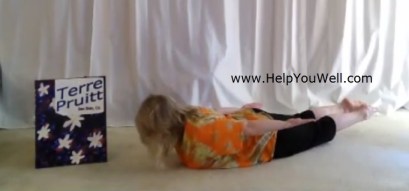
Also mentioned in my 2014 post is Locust (Salabhasana). This is a prone pose (lying on the belly) that is excellent at engaging many muscles on the back side of the body (trapezius, deltoids, triceps, lats, erector spinae, glutes, hamstrings, and calf muscles). It is back bend, that for many people is small, like with all poses everyone does it different and it can be bigger, but as with all back bends it opens the front of the body. I prefer to do it with my arms behind me palms up and my feet together. As with all the asana there are many variations and modifications that can be done. I still think of it as “Icky Name, Great Pose” (where you can click for instructions). I figure a picture might be helpful.

Do you include either of these poses in your practice?

Posted in Yoga/PiYo/Pilates | Tagged: , , , , , , , , , , , , , , , | Leave a Comment »

Half Moon Pose

Posted by terrepruitt on November 3, 2021

I thought I had posted about this pose a long time ago because it is one of my favorite poses. We do it in the gentle yoga classes I teach. It is somewhat of an advanced pose because there is a lot going on. The class is gentle not beginner, but a lot of modifications are provided so that it can be done to the individual’s ability. As with many asana there is more than one pose that can be done to transition into it. The name of the pose is Half Moon Pose/Ardha Chandrasana.

I feel it is important to warm up the glutes and do a bit of balance practice before having my students do this pose.
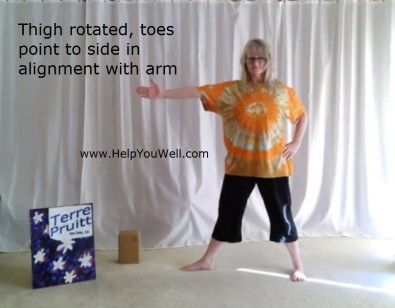
In the photo I am doing a modified version with my hand on a block. The full version is without a block and looking at the skyward hand. I have only managed to balance without the block a few times and only for a few seconds.

What tends to happen when students get into this pose is the supporting foot moves. The supporting foot is to be in line with the body, but as soon as the leg comes up, the foot moves to an angle. One must really focus to keep that foot pointing in the right direction.

I often have students go from a Warrior 2 to a Half Moon, so if you start out in a Warrior 2 . . .

(doing the left side) the thigh is rotated out to the left with the toes pointing to the left, the knee is bent and the knee is over the ankle, the hips and chest are pointing forward, the arms are out, and the right leg is straight with toes pointed forward. . . (here, getting into half moon)

take a little hop to the left with the right foot so the weight can begin to shift to the left leg
as the weight shifts over to the left the leg begin to straighten it — here is where one must be mindful of the toes – they are to remain pointing out to the left
the left hand seeks out the floor, a block, or a chair, and we stand on a straight left leg
Note:  the block is about 6 inches (or more) away from the foot AND to the right
shoulders are stacked with chest to the front
hips points are stacked with pelvis facing front
right leg is in alignment with torso and hip, toes and knee facing forward
right foot is flexed

Other things to keep in mind in addition to the shoulders and hips remaining stacked, is to not bow into the low back, keep a neutral spine with the core engaged.

One can look up at the right hand.

Getting out is just like getting in there are many places to go from here. I like to have my students practicing using control and coming into the Warrior 2 again . . . gently.

As you can see a chair can be used instead of a block.  Hand can be on the seat or the back of the chair.  There are many things that can be used for stability as long as it is stable and safe.

This pose has a lot going on as I mentioned previously, it requires balance practice, strength, and even flexibility.

Are you familiar with this pose?  Do you like it?

Posted in Yoga/PiYo/Pilates | Tagged: , , , | Leave a Comment »

Sitting Uncomfortably

Posted by terrepruitt on September 20, 2021

I have my students do a pose/stretch that I used to call the “icky pose”. Yeah not quite a technical name but a very apt one. I did not recall actually learning it anywhere or having anyone have named it and it was very icky so I called it that. Eventually, through my study of Yin Yoga, I learned the name. And, then one day when I was teaching Yin Yoga a student asked for the actual name. It actually is considered a Yin Yoga pose it was called the toe squat. It took me a bit to actually adjust to calling it that. One thing that helped me transition to its proper name is that it stopped being icky.

Like many stretches, poses, and exercises it became less icky the more I did it. It is one pose/stretch that I consider vital for one’s health, yet when we first try to do it, it is so uncomfortable many people stop.
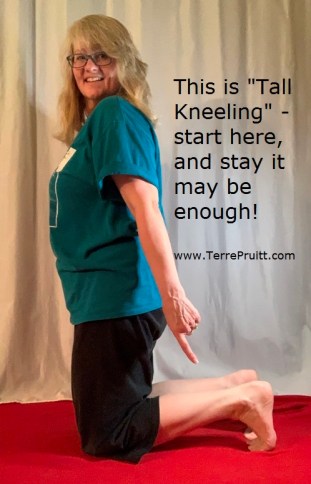
I instruct my students to curl their toes – being mindful of the pinky because sometimes it does not bend the proper way – but to not sit on their heels at first. One can work into sitting on their heels. It could be that they have to practice just curling their toes. One gets to control the actual pressure they put on the toes. It could be they are able to sit on them but only for a second or two, then the more they practice the longer they can tolerate it.


Basically you are kneeling with your toes curled and you sit back on your heels.

There are ways to modify it to make it more tolerable and to ease into it. I just recommend remaining tall kneeling and not even put an additional pressure on the toes.  Or doing one foot at a time may be more tolerable.  This IS an icky pose while your feet are getting used to doing it.  But it can give you immediate benefit.  And if you do it often, it will get easier.

As with any stretch, pose, or exercise you should get clearance from a medical professional.  Make certain your body is able to do said stretch, pose, or exercise.

Again . . . this is really one of those poses/stretches that most of us have to work into and it could take a long time. Just like any stretch, pose, or exercise, the more you will benefit from it.

Do you sit on your heels with your toes curled (doing a toe squat)?

Posted in Yoga/PiYo/Pilates | Tagged: , , , , , | Leave a Comment »