Terre Pruitt's Blog

In the realm of health, wellness, fitness, and the like, or whatever inspires me.

  • I teach yoga, Nia, and stretch online!

    ALL CLASSES ARE ON ZOOM AT 10:00 AM PDT

    Tuesday Gentle Yoga 

    Wednesday Nia

    Thursday Stretch

    Please see my website for details!

    I am also available for private Nia / yoga / Personal Training all virtual, of course!

  • Unknown's avatar

  • Enter your email address to subscribe to this blog and receive notifications of new posts by email.

  • My Bloggey Past

  • ******

    Chose a month above to visit archives, or click below to visit a page.

Posts Tagged ‘Eight limbs of yoga’

The Second Is Truthfulness

Posted by terrepruitt on February 10, 2016

So, yoga is more than just poses.  Yoga has eight limbs which I listed in my post More To Yoga Than Just Asana.  The first two limbs are rules, restrictions, guidelines things of that nature.  Things to help you along the path to the divine.  The first limb is about the yamas and the second is about the niyamas, I listed them in my post Yoga’s First Two Limbs.  Now I am going through and writing a post about each one.  I wrote about Ahimsa in Ahimsa And Yourself, which I probably should have title Ahimsa and MYself.  I write about this not because I have mastered them but because I am examining yoga ideas and ideals.  So if you hear me saying something harmful, please know I am still learning.  The next yama is satya.  Satya is truthfulness.
Dance Exercise, Nia, Nia in the City of San Jose, Nia classes in the South Bay, Nia Teacher, Nia Class, San Jose Nia, Nia San Jose, Nia workout, Nia, Gentle Yoga, Group Ex classes, YMCA, Zumba, PiYo, Nia Technique, SJ City Fit, SJCityFitSatya or truthfulness can be applied to so many things, right?  I mean if I go back to the exercise I mentioned I did recently and think about satya on the mat that can apply in so many ways.  Am I really being truthful with myself about what I can do?  Am I really being truthful that I am concerned with only myself?  I mean, if we are not concerned about what others think about what we are doing in class, does it really matter if we don’t do the advance version of the pose?  Can we really do it without causing injury to our self?

And that can carry to off the mat, huh?  Are we going to brag (why?) that we did more than we actually did in class?  Are we going to tell the truth in all of our dealings?

Satya could be applied to teachers.  Not just yoga teachers but to any teacher or profession that sets fees.  We need to be truthful and upfront about our fees.  Now this could help some of us that feel shy when talking about money and fees.  Yoga teachers can use satya to help them feel confident stating the fees upfront.  Things should be discussed openly and honestly.  A client should not be left to wonder about fees for a service.

Also satya can apply to marketing.  We don’t need to get caught up on all the hype that is used in a lot of marketing, making promising, and stating unsupported facts just to get people to come to our classes.  If we make false claims and that is what attracted the student then they probably aren’t really going to get a lot out of yoga and they are more than likely NOT going to be satisfied.  Then, as a teacher, you aren’t either, so no one wins in that situation.

As I stated in my Ahimsa post, I am just barely touching the surface on these things.  I think there could be volumes written about them . . . and there probably are.  They can be applied to many thing in so many ways.

I think truthfulness is one of the easiest ones to understand.  It might not be one of the easiest ones to do in thoughts, words, and actions.  But, here we all are . . . on a path of learning.

What do you think?  One of the easy yamas to understand?
Posted in Yoga/PiYo/Pilates | Tagged: , , , , , , , , | 2 Comments »

Ahimsa And Yourself

Posted by terrepruitt on February 5, 2016

Recently I posted a bit about the eight limbs of yoga.  Basically a list of the limbs and a sentence about each.  Then I followed up with a list of the yamas and niyamas which are the first two limbs of yoga.  I am sure each limb can and does have volumes written about them.  And I am sure that each of the yamas and niyamas have volumes written about them.  I thought I would just do a post on each yama and niyama.  I was taught the yamas are restraints or restrictions, while the niyamas are observances or rules.  Ethical principles and spiritual practices, respectively.  I mentioned one way to look at it is our attitudes toward our environment and our attitudes towards ourselves.  Well, this is a bit about Ahimsa.  A way to look at Ahimsa.  Not the only way, just one way.  And not even the entire way, just a bit.

Ahimsa is non-violence, non-harming, and/or non-injury.  Now for me, the first thing I think of is non-violence as a physical act.  I think of hitting, punching, stabbing, shooting – something physical and VIOLENT.  I don’t actually do any of those things.  So I think, “I’m good.”  I bet a lot of us are.  But then when I remember that the idea is to have it apply to our thoughts, our words, and our actions, I realize, “I’m not so ‘good'”.  How often do we say that all too common phrase, “I wanna kill . . .” or “I could kill for a . . . ” even though I never really would, am I practicing ahimsa when I say it?  I don’t think so.  I am not sure that this type of talk is not harmful.

Another way we can look at ahimsa is as compassion.  So if we are compassionate we are non-violent, non-harmful, and/or with not cause injury.  And this could be applied to ourselves.  Are we compassionate with ourselves?  Do we get down on ourselves when we don’t do as we expected?

An exercise I participated in recently had us examining how we practice ahimsa when it came to ourselves.  Ahimsa and our self on and off the yoga mat.  In regards to Ahimsa with myself off the mat I realized I say – to myself – I am stupid a lot.  Because of my habit of getting to bed so late the first think I think of on Monday morning is  “Oh, I’m so stupid.”  I think, “Every Sunday since you don’t have to teach on Mondays you stay up too late and then it is so difficult to get up on Monday.  And it sets the tone of being tired for the rest of the week.”  What about you?  Do you ever find yourself saying things not in keeping with ahimsa in regards to yourself?

On the mat or in any exercise situation, we could apply ahimsa.  It could be as simple as not being violent with oneself.  It could be as simple as not causing harm – don’t do anything that will harm you or cause you injury.  But sometimes it is the compassion that is the challenge.  The compassion that says, “You need to be gentle with your body today, right now.”  We so often have that other voice saying, “You are here, get the MOST out of your workout.  Work harder.  Burn more calories.”  Perhaps even chiding you for something you ate and so feeling like you were “bad” for eating something “bad” you have to punish yourself with a really hard workout.  That is not ahimsa from many angles.  Sometimes it is difficult to be compassionate with yourself on the mat or in a workout situation.

It could just be a matter of, as Aadil Palkhivala said, not pushing when we should be pulling back, not fighting when we need to surrender, not forcing our bodies to do things they are not yet ready to do. So sometimes it is not just “not doing” more, but surrendering or not fighting.

As with all the Yamas, there is a lot of room for me to improve in practicing them.  I am not posting about them because I have them all figured out and I practice them perfectly.  I am writing about them to help me remember them.  I think I have a lot to work on when it comes to ahimsa in thought and even words.

What about you?  Just in regards to Ahimsa towards yourself?  How are you with that?  How does it differ on and off the mat?

Posted in Yoga/PiYo/Pilates | Tagged: , , , , , , , | 4 Comments »

Yoga’s First Two Limbs

Posted by terrepruitt on January 25, 2016

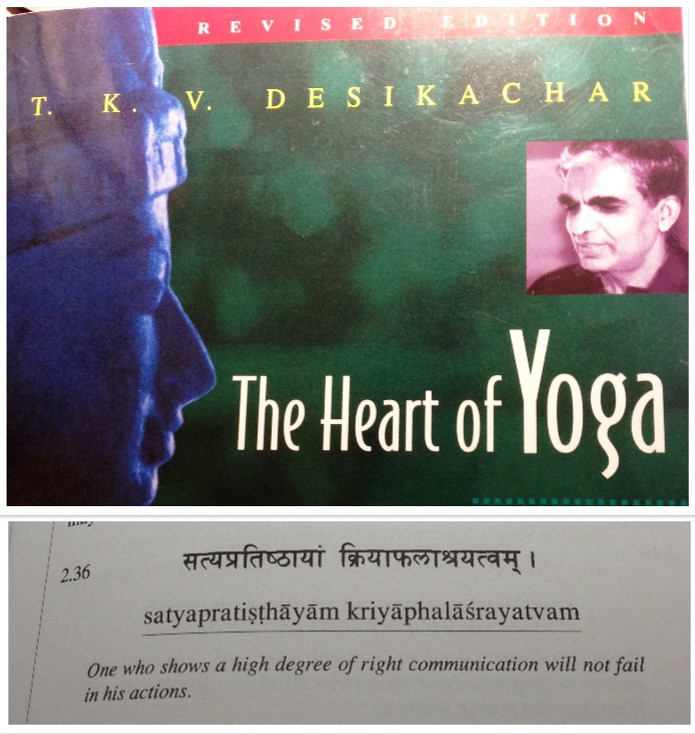
Dance Exercise, Nia, Nia in the City of San Jose, Nia classes in the South Bay, Nia Teacher, Nia Class, San Jose Nia, Nia San Jose, Nia workout, Nia, Gentle Yoga, Group Ex classes, YMCA, Zumba, PiYo, Nia Technique, SJ City Fit, SJCityFitIn my post earlier this month about there being More To Yoga Than Just Asana, I listed the eight limbs of yoga.  Two of those limbs, the first two limbs have five principles or observances associated with them.  The first limb is the yamas and they, as I mentioned in the other post, are sometimes thought of as restrictions.  The second limb, the niyamas, are sometimes thought of as rules.  But to me rules and restrictions are somewhat the same things.  Many rules seem to be made to restrict people from doing things.  So I am not sure that is a clear enough distinction for me.  Yoga is so ancient and many of the text have been lost, so there are many translations to things.  Another way of looking at the first two limbs: are the yamas are our attitudes toward our environment and the niyamas are our attitudes towards ourselves.  That is from T.K.V. Desikachar’s translation of the Yoga Sutra in The Heart of Yoga.

The five yamas are:

Ahimsa – non-violence, non-harming
Satya – truthfulness
Asteya – non-stealing
Brahmacharya – celibacy, chastity
Aparigraha – non-possessiveness, non-coveting, non-hoarding, non-clinging

The five niyamas are:

Sauca – purity, cleanliness
Santosha – contentment
Tapas – discipline
Svadhyaya – study of self
Ishvara Pranidhana – surrender to the Divine

These rules, restrictions, attitudes, whatever you choose to think of them as, are meant to be applied to our thoughts, our words, and our actions.  So, I am not really even sure there needs to be a distinction between whether it is a rule or a restriction.  But I do like the idea that one is related to an attitude towards our environment and one is related to an attitude towards oneself.  Although, I think all ten can be related to both.  Sigh.  I guess I will just stick to there really doesn’t need to be a distinction.

Each of these can be talked about in detail.  I am definitely going to be writing more posts on these.  Whether it is one post for all the yamas and one post for the niyamas, is yet to be seen, but I do want to share some of the ideas that were shared with me regarding them.  I would like to shed some light on how they can be applied to life both on and off the yoga mat.

Do you want to share any ideas about them?


Posted in Yoga/PiYo/Pilates | Tagged: , , , , , , , , , , , , , | 2 Comments »

More To Yoga Than Just Asana

Posted by terrepruitt on January 13, 2016

I have often mentioned how Nia is a cardio dance exercise that you can take to another level and make it a practice, like yoga.  Yoga is an exercise that you can take to another level by practicing some of the other limbs of yoga.  Yoga has eight limbs.  These limbs are things that one can work with throughout a lifetime.  They are not necessarily things that one masters – well, not things that I can master.  There could be days when it feels as if they have been mastered and then days when it feels like you had never even heard of them because the ideas or actions were just not present.  So . . . these things get “practiced”.  The physical, exercise part of yoga is just one of the limbs.  While Nia is not as . . . I’ll say, “preachey” as yoga we do have some things that can be practiced outside of the dance class, off the dance floor.  Things like noticing your movement and being aware of your relationship with others and things.  But yoga’s limbs are more like rules to live by.

The eight limbs of yoga are:

1)  The yamas.  There are five yamas.  They are often compared to restrictions.  Some think of them as restraints or ethical principles.

2)  The niyamas.  There are five niyamas.  They are often compared to rules.  Some think of them as observances or spiritual practices.

3)  The asana.  There are thousands of poses.  This is the physical limb of yoga.  This is the exercise that has become very popular.  Not only are there a lot of poses, there are many different types of yoga.  Some are ancient and some are very new.  Some types have created new poses.  And sometimes I think that the ancient text has been translated so many different ways we end up with different poses.

4)  Pranayama.  There are various types of pranayama.  This is the breath work of yoga.  I have posted about two types of pranayama, Ujjayi Breathing and Equal Breath
Since this was originally posted I have posted about additional types of pranayama:
Dirgha 03.12.18, and Sitali 06.19.17


5)  Pratyahara.
  This is the withdrawal of the senses.  The idea is that when the mind has control over the senses, can withdrawal them, then it can focus on the other limbs of yoga without distraction.

6)  Dharana.  This is concentration.  The idea of concentration of the mind on one thing leads to meditation.

7)  Dhyana.  This is meditation.  The idea is to be able to concentrate on one point.  Being able to breathe to a state of withdrawal of the senses.  Having complete control.  Then concentration is pure.  Meditation is supremely focused and then . . .

8)  Samadhi.  This is transcendence.  When one is in control over mind and body.

Each of these could definitely use a blog post of their own.  Not sure I will get to them all.  But, I will at least do a post on the yamas, a post on the niyamas, and a post on pranayama.  Probably multiple posts on each of them.  So, if you are interested stay tuned.

I had heard about the first two, and knew that poses and breathing were apart of yoga.  But was not and am not so familiar with the last four.  Did you know there were eight limbs to yoga?  Which ones are you familiar with?    

Posted in Yoga/PiYo/Pilates | Tagged: , , , , , , , , , , , , , , | 10 Comments »

Church Yoga

Posted by terrepruitt on June 4, 2015

There are so many different types of yoga, it is out of my range to know them all or to even have HEARD of them all.  There are “ancient” types of yoga and types that have been around for a very long time, then there are new ones.  There are some that have popped up rather recently.  I believe many ancient types of yoga have been morphed into different types of yoga.  Then once you become aware of a type of yoga it can still be different from studio to studio and teacher to teacher.  I recently became aware of a type of yoga I had never heard of.  I read the description and I thought, “Ok, I’ll give it a try.”  Because I have to teach throughout the week, I have to be attentive to my energy levels.  I have no qualms about attending a class and, if it is more than I want to do at that time, not doing it at the level that is being instructed.  So if it was more strenuous than I wanted I was planning on just doing it gently.  But the description sounded like exactly what I wanted.  So, I went to this class I had never heard of and I am not sure if the class was a little different because it was a holiday or what, but there was a lot of talking.  It was Kriya Yoga.

Kriya Yoga – Low/Moderate

Kriya Yoga highlights the relationship between the breath and the mind.
Breath influences mind and vice versa. Breath control is self-control.
Techniques include preparing the body with stretching and bending
exercises, practicing meditation, and incorporating breath

Dance Exercise, Nia, Nia in the City of San Jose,  Nia at the San Jose Community Centers, Nia classes in the South Bay, Nia Teacher, Nia Class, San Jose Nia, Nia San Jose, Nia workout, Nia, Gentle Yoga, Group Ex City of San Jose, San Jose Group Ex classes, YMCA, Zumba, PiYoThe description of Kriya Yoga that I read on Wiki, had me thinking that it was the type of yoga where participants would be experiencing two of the eight limbs of yoga; asana and pranayama.  But, the class focus or subject seemed more to throw us into experiencing about six of the limbs.  It was memorial day, and I had stopped looking at Facebook before class because I wanted to go to yoga and have a relaxing time of breathing, stretching, and bending.  I was avoiding all the war stories until after class, but I felt jolted by the homily.  It was like yoga and church rolled into one.

When I got home I discovered there are some descriptions online that describe Kriya yoga as the “spiritual yoga”.  That could explain why I felt as if I was in church.

The class is normally an hour, but this class was an hour and a half, so I don’t know if the extra time was used for talking or if the talking is part of the class.  I have not been in regular attendance in classes where talking and thinking about deep subjects are involved.  It was very interesting.  It was not the type of yoga I had been hoping for, I think it was a bit different than the description. I am not sure I will have the opportunity to get back to it because of scheduling conflicts and the location.  But we will see.  As I said, I think the regular class might be different, but I don’t know.  I wouldn’t mind going back to see.  The next time I will be a bit more prepared and not have the idea in my head that I will just be able to relax and focus on the poses.

I am planning on trying more types of yoga!

Have you ever heard of Kriya yoga?  What types of yoga have you heard of?

Posted in Yoga/PiYo/Pilates | Tagged: , , , , , , , , , , , , , , , , | 4 Comments »

Breath: Quiet And Safe

Posted by terrepruitt on March 14, 2015

There are a lot of different aspects of yoga.  Just like there are a lot of different aspects of Nia.  As I have said before you can do Nia without getting involved in all of the principles and aspects of it.  You can treat it like a workout and not take it any further.  The same goes for yoga.  That is why I always compare the two.  You can go to a yoga class and go through the poses without giving any of the other aspects a second thought.  I believe that both Nia and yoga can be more beneficial, more satisfying when you do think about the other parts of it . . . but we all have different goals and different ideas.  One of the “aspects” of yoga or limbs of yoga – is pranayama.  There are different pranayamas.  A common one – Ujjayi is typically done while doing the yoga poses, and it might be helpful in reducing or stopping snoring.

So, pranayama is the practice of controlling one’s prana (life force) through breath or the practice of controlling one’s breath.  There are many forms of this type of practice and many ways in which to perform them.  But as I said, a common one is ujjayi breathing.  It is what many recommend be done while doing the asanas.  Some call it the Victory Breath, the Warming Breath, the Ocean Breath, Snake-breathing, throat breathing, or even the Darth Vadar Breath.  It is done through the nose, both the inhale and the exhale.  Some of the names stem from the fact that when you do it you may sound like the ocean, a snake, or Darth Vadar.

This breath “exercise” is done by closing the glottis partially on the exhale.  This post is not to get into the mechanic of how to do ujjayi breathing.  But a quick way to give you an IDEA of how to do it, is to think Felix Unger.  Remember him?  Remember that annoying noise he used to make?  Well, that is a lot more sound than you want, but that gives you an idea of what needs to be going on in your throat / nasal area.

I am excited by the prospect that this type of breathing could help stop snoring or even more importantly sleep apnea.  The idea behind this thought process is that the muscles need toning.  People snore because stuff in there gets to relaxed and it makes noise as the person breathes.  So, it kind of makes sense that if it can be toned or trained then it could help stop the snoring or the life threatening sleep apnea.

Yoga Therapy.com says:  “In fact, this snoring is the sound that occurs when air passes through stenosed nasopharynx, caused by vibration in the air flow of compliant structures of the pharynx (tongue, soft palate, etc.). The main reason that causes vibration of the said formations is impairment of muscle tone of the pharynx and soft palate, structural anomalies and functional abnormalities of the pharynx and soft palate.”  Like I said the stuff in there makes noise.

Again, as I said, this makes sense to me . . . as in, why not try it, it can’t really hurt, but if it did help . . . Oh man, for some it would be a life saver.  I think it is worth a try.  Just another reason to practice pranayama.

Do you think a breathing practice is worth trying if it would stop snoring and/or sleep apnea?  Do you know anyone that snores?  Do you know anyone with sleep apnea?


Posted in Yoga/PiYo/Pilates | Tagged: , , , , , , , , , , , , , , , , , , , | 2 Comments »