Posts Tagged ‘asana’
Posted by terrepruitt on March 31, 2025
In my yoga classes I always remind my students that they can keep both feet on the ground when we practice standing balance poses. In addition to instructing that students can keep both feet down I do always remind them they can use something for stability (a wall, a table, a chair, etc.). Balance practice does not require you to be ONLY on ONE foot even when doing a “one-legged balance pose”. For many reason some people may not want to or be able to take a foot off the ground. While the pose may be “designed” to be done on one leg the body is still practicing balance when you have all of your weight distributed on one leg, but have the other foot down just for whatever reason. I say ALL of our balance poses can be done like this, except one and this is the one.
With this one, Extended Hand To Big Toe Pose/Utthita Hasta Padangusthasana, I ask that they try to stand on one foot. Again, if they need to, they hold onto something, or have something close. We usually merge into it, doing it three times. The first modification is just to hold the leg up, then hold it higher, or out a little, then the third time they can just hold it out for a second or as long as they can. It is an option, of course, to try the progression.
Traditionally the asana is done with the index and middle finger wrapped around the big toe from between the big toe and second toe . . . I usually hold my foot from the arch side of the foot. I instruct my students to go with tradition or anyway they feel comfortable.
The outstretched leg is usually directly out to the side or directly in front. I find my comfort spot to be more at a diagonal. Traditionally the outstretched leg is straight, but allowing for modifications, students can bend their knee as needed.
I always remind my students that keeping a tall spine, being more in “mountain” then rounding over is more important the holding the toe, having a straight leg, or having the leg be high. Some people may have leg lengths that may not allow them to hold the toe without rounding so we are always working with our unique bodies. Pictured are different ways to hold the leg and different ways students can modify.
Extended Hand To Big Toe Pose/Utthita Hasta Padangusthasana
–Start in Mountain Pose, with a lengthening spine, relaxed shoulders
–Easing into it the first time just hold a leg up, anyway, using the same side hand as leg
–The second time get more precise with the hold. Hold the leg as we would (fingers around the big toe) if it were straight, even with the leg still bent, in preparation for when the leg is straight
–The third time hold the leg out straight, or just kick it out quickly if a second is all that can be done
Maybe use a chair.
In between each Extended Hand To Big Toe Pose stand in Mountain Pose. And while we are in the pose keep the spine long and shoulders relaxed.


Posted in Yoga/PiYo/Pilates | Tagged: asana, Balance Pose, balance practice, chair for balance, Extended Hand To Big Toe Pose, Extended hand to foot, Extended hand to toe, modifications, one leg balance pose, Utthita Hasta Padangusthasana, Yoga | 2 Comments »
Posted by terrepruitt on May 31, 2024
This is my view when I do Legs-Up-the-Wall(/Viparita Karani). I love the sparkly butterfly.

Do you ever do this pose?
Posted in Friday Photo | Tagged: asana, Friday Photo, Legs Up the Wall, ornament, sparkly butterfly, Viparita Karani, wall, Yoga Pose | 2 Comments »
Posted by terrepruitt on November 17, 2021
Whatever you call it, it is generally good for you. I say “generally” because I am sure there are some people who have some issues where this would not be good for them. But like most yoga poses they were created to be practiced by healthy individuals and they have been modified and have many variations so that the general public can do them. The Garland or Malasana or Squat requires flexibility in several muscles and a large range of motion in several joints.
For ideas on helping you “Get Down On It” 🙂 you can click to my post with that name (I had the song in my head at the time of writing). Like with many, many things in life it may take some practice in order to get into this pose. And also, like many, many, many things in life it takes continued practice to continue to be able to do it. So have patience if you can’t do it YET, and keep doing it if you can.
Here is a photo of Garland/Malasana/Squat and two separate ways to modify:


This is also one of those poses that can be done throughout the day. There are many reasons one may need to squat so practicing this does not have to be a set-time-aside-to-do-it type of thing.
This is an addition to the specific post about this pose and also the post I wrote in 2014 about my favorite poses.
Is those pose part of your practice? Do you squat to do things during your day?
Posted in Yoga/PiYo/Pilates | Tagged: asana, full squat, garland, Get Down On It, good stretch, Malasana, Pose, squat, Yoga Pose | Leave a Comment »
Posted by terrepruitt on November 15, 2021
Continuing on with adding to my post from 2014 about favorite poses. I am posting pictures of Cobra and Upward Facing Dog (Updog). Keep in mind these are photos of modified Cobra and Updog. These poses look similar and sometimes if I am taking a fast flow class I may end up doing a hybrid of both, but they are different poses using different energy.
I have a Cobra post, and in my Updog post there is a link to a video which I think has a great explanation of the two poses. The video is still up and available on Youtube, but I couldn’t find any information regarding the place that posted it and the link to the person goes to something else now.
In short I think of cobra as being done more from the back with hands further forward than Updog. And I think of Updog as more of a front body opener than Cobra. In using muscles from the back, my cobra tends to be what so me call baby cobra.
Here are my photos for both.


Do you include either of these in your practice?
Posted in Yoga/PiYo/Pilates | Tagged: asana, Corbra, favorite poses, Updog, Upward Facing Dog, Yoga Practice | Leave a Comment »
Posted by terrepruitt on November 8, 2021
In 2014 I wrote a post about a list of favorite poses and how I wanted to do them everyday. I also mentioned how I would post further about them. Well, neither happened. I know I didn’t do the poses everyday and I can’t find that I made any additional posts except the one I just posted recently primarily to assist my students in learning the Half Moon Pose which was on my list but not in that post. This post along with the next few are just to add to the post from 2014 and the posts about the poses.
 In the 2014, Working On My Favorite Yoga Poses, I mentioned the gate pose. I sometimes see it called Crossed Gate. Parighasana or Gate pose is an intense side stretch done on one knee that tends to also make it a balance pose. It may be that when thinking of balance poses we think standing and primarily on one foot, well since the body is stretching over to one side which also requires the engagement of muscles that we use to balance, it is somewhat of a balance pose. There may be a smidge of clicking involved for you to get the whole picture (for instructions on how to do it click Finding Balance In The Gate) but I wanted to post an actual picture as I decided it may be helpful in doing the pose.
Also mentioned in my 2014 post is Locust (Salabhasana). This is a prone pose (lying on the belly) that is excellent at engaging many muscles on the back side of the body (trapezius, deltoids, triceps, lats, erector spinae, glutes, hamstrings, and calf muscles). It is back bend, that for many people is small, like with all poses everyone does it different and it can be bigger, but as with all back bends it opens the front of the body. I prefer to do it with my arms behind me palms up and my feet together. As with all the asana there are many variations and modifications that can be done. I still think of it as “Icky Name, Great Pose” (where you can click for instructions). I figure a picture might be helpful.
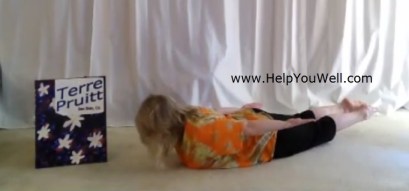
Do you include either of these poses in your practice?
Posted in Yoga/PiYo/Pilates | Tagged: asana, back body muscles, delts, favorite poses, Gate, glutes, Half Moon Posed, lats, locust, Parighasana, Salabhasana, traps, triceps, Working on poses, yoga poses, Yoga Practice | Leave a Comment »
Posted by terrepruitt on January 27, 2020
Last week I asked my Tuesday yoga class if anyone would be interested in trying a yoga pose a day. I clarified that the idea was for me to just text or e-mail a pose a day. There wouldn’t be any instructions or anything. I asked them to either text or e-mail me if they wanted to participate and that I would send the pose the way they requested. A few of them were interested. So the following day I sent out a pose. Then I realized that I had written a post on a few poses and I thought that I could include that in the text and e-mail just to get us started. I would send the link with the first few. I hadn’t looked up all of the posts that I had written regarding asana but I found a back bend post that had links to posts about back bends so I could include those links with the text/e-mail. I haven’t posted about a lot of poses, but tonight I did look through to see what I had done. We will have a few more poses that can have posts attached to them, but the idea was just to send out a quick idea, “Hey, today do xxxx.” I also extended the invitation to my Thursday yoga class. It has been fun so far.
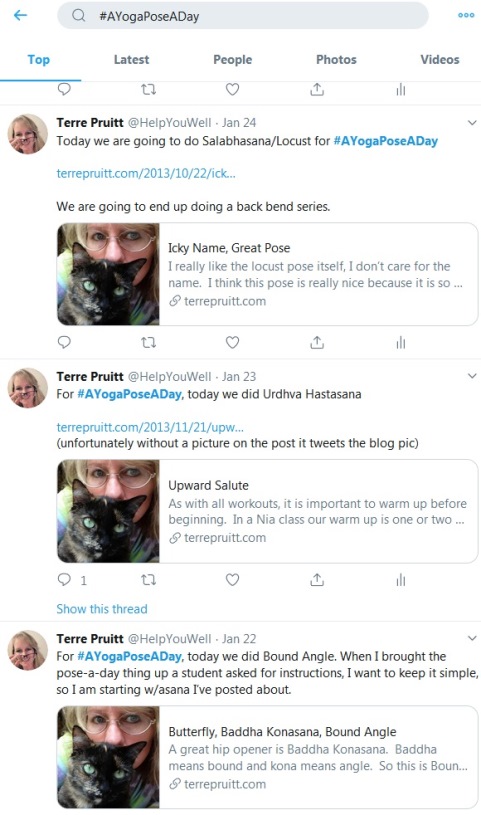 We haven’t even been doing it a week. I am e-mailing some people and texting some people. Some of us are communicating about it. I just thought it would be fun and it is turning out that way.
So far we have done:
01.22.20 – Bound Angle
01.23.20 – Upward Salute (Urdhva Hastasana)
01.24.20 – Locust Pose (Salabhasana)
01.25.20 – Sphinx Pose (Salamba Bhujangasana)
01.26.20 – Cobra (Bhujangasana)
01.27.20 – Upward dog (Urdhva Mukha Svanasana)
01.28.20 – Stork (oh, this is a spoiler 🙂 )
I had been tweeting it, but not all posts have a picture so my gravatar of me and Nessa was being posted so I stopped tweeting because I hadn’t noticed the way to keep that from posting. I was using #AYogaPoseADay. Tweeting could be something I keep up with now that I see I CAN keep the picture from posting by deleting the preview. I mean Nessa is a cutie, but I understand it gets annoying when every tweet has a picture of her and I. And, as I said, not every #AYogaPoseADay will have a post so that will be good.
I love finding simple ways outside of the class to connect with my students (or others, if you want to join us please do. You can follow me on twitter or asked to have the #AYogaPoseADay e-mailed to you).
The idea is just for me to suggest a pose a day . . . perhaps it is all you do or perhaps it gets adding into the practice you have. The instruction we decided upon was 30 seconds or four breaths. I actually suggested that the students time their breaths just to have an idea of how many breaths they do in 30 seconds or how long four breaths is for them. Then you can play with it from there.
Is there something that you do daily? A daily practice that you have?
Posted in Yoga/PiYo/Pilates | Tagged: asana, Bound Angle, cobra, Cypress Community Center, locust pose, Pose, Sphinx, Stork, Twitter, Upward dog, Upward Salute, Willow Glen Community Center, Yoga class, yoga poses | 2 Comments »
Posted by terrepruitt on February 4, 2019
 I believe I have written before about how yoga is somewhat confusing because the asana seem to have different names. I can go to look up an asana and a completely different asana will come up than the one I was thinking of because the names get all wonky. I used to get very frustrated with that, but now I understand that the Sanskrit language originally was just a verbal language. And we all know how that works . . . if you haven’t ever actually played “Telephone” you probably have at least heard how it goes. Where one person tells a story and it gets repeated down the line and then the last person says what they heard and more often than not – depending on how many people the story went through – it is not what it started out to be. Imagine that with a language. And then once they did start writing it down it probably got changed through that process. And THEN there is the process of translation. We know what happens there, right? Things get lost in translation. Well, I have a handful of yoga books and if you were to look at them you will see writing in every one noting what the “actual” name of the pose is. Which is really me just having picked one of the many names and deciding to use it. Not ALL poses have multiple names, but many do. Well, I mention all that because one of the books I have I thought of recently when one of my students asked about a book of poses.
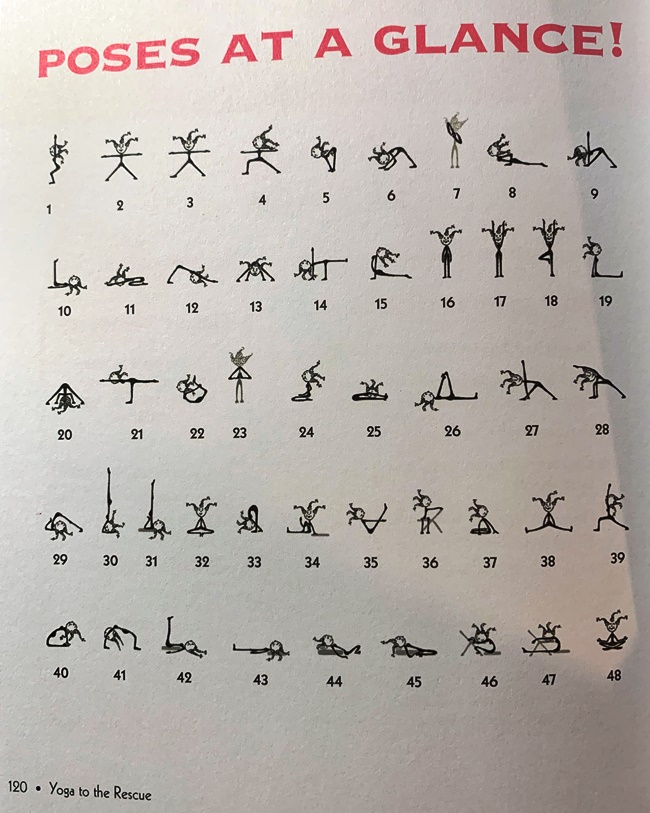 This book came to mind first because I think of it as a simple book. I found it easy to find poses. I like that there are cartoon characters drawn, instead of pictures of people posing. I really like that there is a “Pose At A Glance” page in the back that is just stick figures. So when you want to quickly get the name of a pose you can just flip to that and then look at the reference and then you have it. I never actually used the book as it was intended or at least as one of the intended ways for it to be used.
The book is separated into seven categories (sexy, calm, energy, restore, cleanse, sanity, and ragtime) and has poses that can help with each category in that section. In the front of each section there is even three sequences that one can do to gain benefits to help with that specific category.
For example in the sexy category some of the poses are: Chair, Warrior II, Staff, revolved triangle, and Cow Face Pose. The sequences in the beginning of that section contain some of those poses. So you can pick some of your favorite poses from the sexy category section and do them or you can do one (or more) of the sequences in the front of the section. Of course, the way to use the book is almost endless, just like any yoga book.
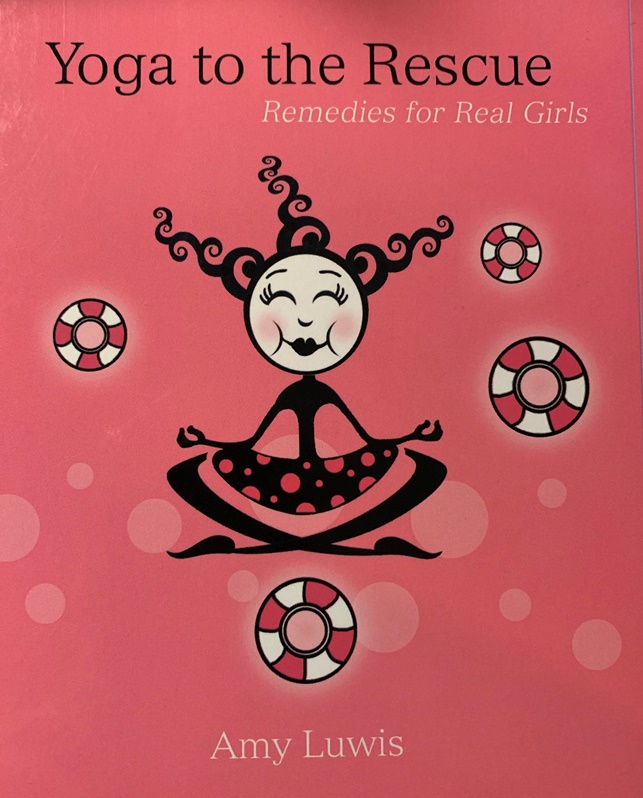
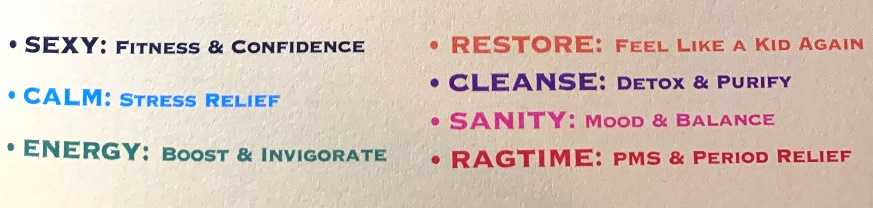 The book is Yoga to the Rescue by Amy Luwis and was originally published in 2007. It is a cute book. Just like with any yoga book, the names of the poses might be different from what you learned and even some of the instructions might be different, too. But I think it is a nice little easy-to-follow-quick-to-get-you-started book. If you really get interested in yoga then you will end up wanting more than this book provides, but it is like a yoga-starter book.
Posted in Yoga/PiYo/Pilates | Tagged: Amy Luwis, asana, Pose at a Glance, stick figure poses, yoga book, yoga poses, Yoga to the Rescue | Leave a Comment »
Posted by terrepruitt on May 16, 2018
The meridians or the channels are the paths that the Qi travels. In the Yin Yoga Teacher Training I am taking we are focusing on the SINEW Meridians. The Jing Well Points are the areas where the meridians begin. The leg meridians begin at the Jing Well Points of the feet. The arm meridians begin at the Jing Well Points of the hand. Just like the leg meridians there are Yin and Yang Arm Meridians. Also, remember that the Jing Well Points and the meridians are bilateral so they are on the left side as well as the right side. The Yin Sinew Arm Meridians are the Lung Sinew Meridian, the Heart Sinew Meridian, and the Pericardium Sinew Meridian.
The Yin Sinew Meridians run up the inner part of the limbs, primarily. So the Yin Sinew Arm Meridians, run up the inner forearm and inner upper arm. The Yang Sinew Arm Meridians travel up the outer part of the arm, crossing over the elbow.
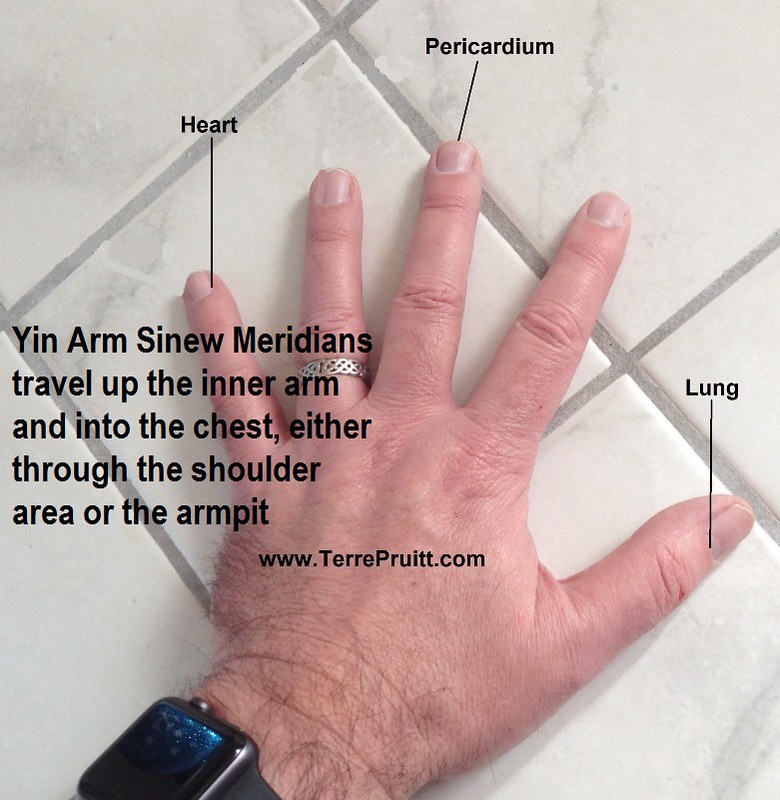 The jing will point for the lung sinew meridian is at the base of the thumb nail. The lung sinew meridian travels up the “back” of the thumb over to the inside of the wrist up the inner forearm up the inner upper arm into the arm pit, continues on to the anterior shoulder spreading out to L1-15. It also branches down to the diaphragm, spreads over the diaphragm ending in the area of the floating rib. Lung Qi has to do with circulation and, of course, respiration. Weak lungs or blocked lung Qi could be evident by signs of skin issues or a poor sense of smell.
The heart sinew meridian starts at the nail bed of the lateral side of the pinky, crosses over to the inside of the palm, travels to the wrist and up the inner side of the arm, over the medial aspect of the elbow. It travels into the chest under the armpit through the diaphragm ending at the belly button. The heart and its Qi has to do with blood and its circulation, it also has to do with spirit. Issues could be presented as anxiety, trouble focusing or settling down.
The Pericardium Sinew Meridian starts at the tip of the middle finger, it travels up the palm, up the inner forearm to the inside elbow and below the armpit. It then disperses out and down over the ribcage. It branches of into the chest at the armpit and down to the diaphragm. Since it has to do with blood circulation to the extremities, having issues with circulations in the extremities could indicate blocked Qi.
Most Yin Yoga poses focus on the lower body, but there are ways to incorporate the arms and affect the arm sinew channels. Yin Yoga asana don’t target only one meridian, they tend to affect more than one at a time. When examining the pathways, it makes sense since they are so close together and sometimes seem to converge. Yin Yoga uses asana to free up sinew meridians.
So there you have the pathways of the Yin Arm Sinew Meridians.
PLEASE NOTE: Nothing you read here should be relied upon to determine a medical diagnosis or courses of treatment. The information on this blog is not intended to replace advice and instruction from a qualified health care professional and is not intended as medical advice.
Posted in Yin Yoga, Yoga/PiYo/Pilates | Tagged: asana, Heart Sinew Meridian, Lung Sinew Meridian, Pericardium Sinew Meridian, poses, Qi, qi channels, qi pathways, Yang Sinew Arm Meridians, Yin Arm Sinew Meridians, Yin Yoga | Leave a Comment »
Posted by terrepruitt on May 7, 2018
The Yin Yoga Teacher Training I am taking has been one weekend a month since February. This month we are going to meet two times. This will be our final month. When we were first introduced to Jing Well Points the introduction was made with the points on both the hands and feet. We went on to learn about the sinew meridians associated with the legs and how they began at the jing well points on the feet. I posted about the Jing Well Points of the Feet first. Then I posted about the Leg Meridians in two separate post as there are Yin Leg Meridians and Yang Leg Meridians. First off, to make sure we are all on the same page, some believe there is Qi or energy moving through the body. The Qi moves through the body via channels or meridians. These meridians have starting points called Jing Well Points. There are many meridians in the body but our teacher training is focusing on the Sinew Meridians. They are less exact and the most superficial. They are the easiest to target by Yin Yoga. My posts about all of this so far has just been a way for me to somewhat sort out all the information I am getting. And to share it with you. These post are brief in the information as there is SO much. This post is about the jing well points in the hand.
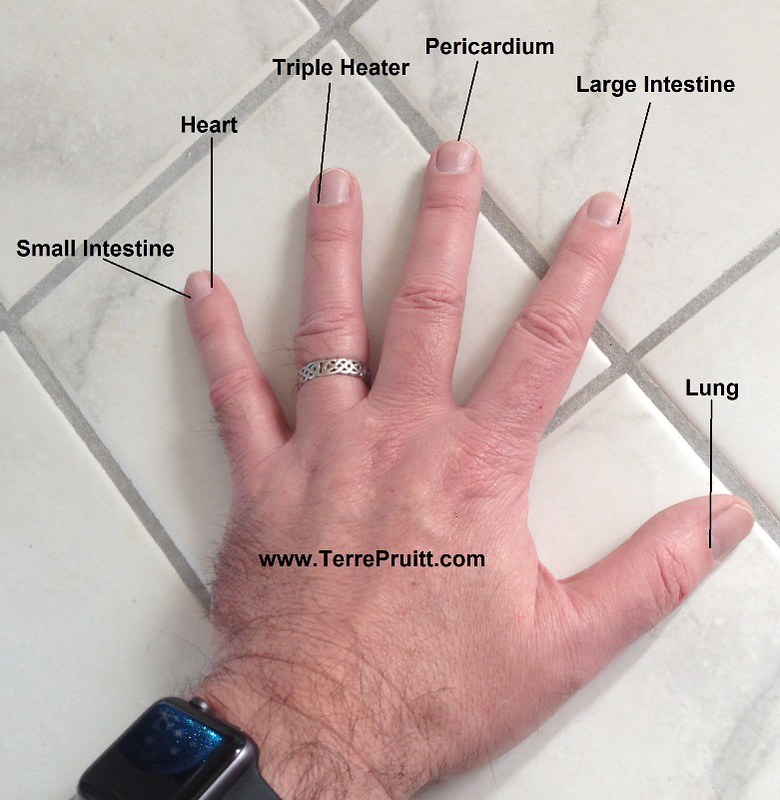 I have to give thanks to my husband who was my hand model. In the training we receive handouts of information, but when posting on my blog I like to post original creations. I don’t like to use other peoples stuff, I have, but I don’t like to so it is rare. So this is my creation, thanks to my hand model.
There are six jing well points on the hand . . . just like the feet. And just like the feet, they are bilateral. So the left AND right thumb have the lung jing well point and so on. The jing well point for the small intestine is at the nail bed on the lateral side of the pinky. At the base of the nail bed of the pinky on the medial side is the heart jing well point. The lateral side of the ring finger at the nail bed is the jing well point of the Triple Heater. The tip of the middle finger is where the jing will point of the pericardium is. The medial side of the index finger at the nail bed is where the jing well point of the large intestine is. And the lungs’s jing well point is at the nail bed of the thumb.
Also, just like the leg sinew meridians there are Yin Arm Sinews and Yang Arm Sinews.
The jing well points can be activated by touch and pressure or movement. So as in my comment on my post about jing well points in the feet, the jing well points in the hands can be affected by acupressure or reflexology.
Most Yin Yoga poses focus on the leg meridians, there are ways to incorporate the arm meridians into the poses. There are a few arm poses, but most of them incorporate the legs meridians too.
Next we will learn the path of the arm meridians. Exciting, yes?
Posted in Yin Yoga, Yoga/PiYo/Pilates | Tagged: acupressure, asana, hand model, Jing Well Points, Qi, Reflexology, sinew meridians, Yang Arm Sinews, Yang Leg Meridians, Yin Arm Sinews, Yin Leg Meridians, yin yoga poses, Yin Yoga Teacher Training | Leave a Comment »
Posted by terrepruitt on May 22, 2017
This is a snapshot of chapter one verse eleven in “An Explanation of Hatha Yoga” or The Hatha Yoga Pradipika. I believe that this is true. I believe that it was originally meant for men that wanted to give up everything and JUST practice yoga. That would be – to me – the only explanation as to how some of the poses described and some of the “states of being” described could be achieved. That is why yoga used to – and actually still does (some poses or things) – seem so impossible to do. A lot of the asana are not just things you can pop into when you practice once a week. Hatha Yoga was also shared with royalty . . . again, what did they have to do, but sit around and work their bodies into these poses that promised longevity and enlightenment?
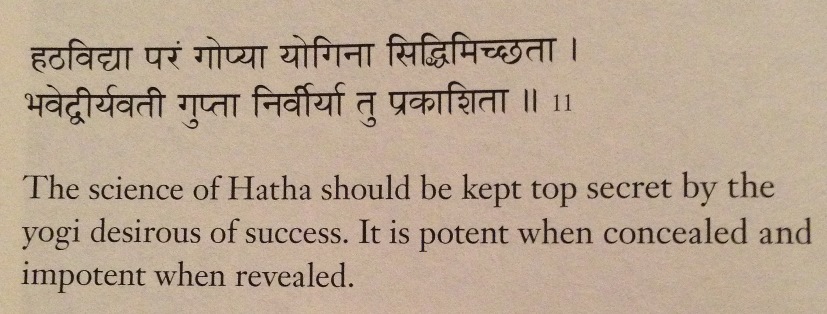
Like many things, in order to make it somewhat possible for the average person, it has morphed over the centuries. It has become – for many, not all – a form of exercise. Still with many poses that cannot be achieved with a once-a-week practice. So I always ask my students to practice ahimsa, where they are gentle with themselves and remember that they might not be able to get into the pose and look like the picture in Yoga Journal because they are just practicing once, twice, or even three times a week (or whatever). They are not devoting their life to it. So I just remind them to do the best they can today and to enjoy what they are receiving.
This post started out as a Friday Photo even though this photo should have actually gone along with my post Yoga Was Supposed To Be A Secret. But when I popped over to that post to remind myself about what exactly I wrote, I was reminded of the current trend in yoga that I am hearing about. Goat yoga. Have you heard about that? It is somewhat like doing yoga at a cat cafe or adoption lounge, except with goats.
“Regular” (whichever type is being offered) yoga classes are held in the presence of goats. And the goats just mill around. Could be they hop on you or not. When I looked it up just now two sites came up and it looks as if the places the sites are about do yoga outside. (One says that is what actually was the motivation for their goat yoga classes.) But the other stories I had seen were inside. I saw a story where the yoga was being done in a barn and another one where it was a room because the goats (they were kids) were hopping all over and their hooves were making clickety-clack noises on the floor. Seems as if there are several different places that it is done. It is really popular.
I am not sure that I would want to have that be a part of my regular practice, but I might try it once. I like the idea of cats better as I don’t think they are as heavy and rowdy as goats. But . . . . I don’t know . . .
What do you think? What is your take on Hatha Yoga starting off as being a secret? Would you be interested in doing yoga around a herd of goats?
Posted in Yoga/PiYo/Pilates | Tagged: An Explanation of Hatha Yoga, asana, cat cafe, Friday Photo, Goat yoga, Hatha yoga, practice yoga, Secret To Goats, snapshot, The Hatha Yoga Pradipika, Yoga Journal, yoga poses, yoga trend, yoga with cats | 6 Comments »

 Terre Pruitt's Blog