Archive for the ‘52 Moves (of Nia)’ Category
Posted by terrepruitt on May 17, 2012
I often have mentioned the 52 Nia Moves. I am taking my time posting about them, but they are in the Nia Technique Book. You could always order a copy from Amazon if you are interested. That is how I started my Nia practice. In the book after the section on the 52 Nia Moves there are pages and pages of other moves too. There is the 13 Joint Exercise, explanations of combinations of some of the 52 Nia Moves, Spinal Melts, and T’ai Chi Sways, and many more. They are organized in the Nia Cycles. The moves that are part of the warm up are in the Warm up section the more active moves are in the Get Moving section. Each move has a “Classic” explanation and an “Athletic” explanation. Nia is done in bare feet so there is no to very little impact, but that does not mean there is no intensity. Intensity comes from BIGGER moves. Bigger moves can be more arm movement either faster or further away from the body or both. Bigger moves can be moving deeper into a move. So the explanation of “Athletic” contains bigger or faster (or both) movements. There are over 75 pages of moves. Each with a set of pictures. Both the classic and the athletic has pictures. If you have the slightest interest in Nia or movement in general I would strongly recommend this book.
I felt I had to share that because there really is so much in the book.
That popped into my head as I was sitting here thinking about going to go make dinner. Here is what we are having:
 Terre’s version of the Rantings of an Amateur Chef’s recipe:
Cauliflower Stuffed Portobello Caps
4 large Portobello mushroom caps
most of an entire head of cauliflower
3 green onions
1/2 C cooked and chopped bacon
1/3 C milk
3/4 C shredded cheddar cheese
1/4 C shredded Gouda cheese
salt, pepper, and garlic powder
Cook the bacon.
Scrape out the inside of the cap to remove the stem and gills.
Chop the green onions.
Preheat oven to 350 degrees.
Cut the cauliflower into large pieces. Steam for 6-8 minutes. Place hot cauliflower into the blender and some of the milk. Blend. Add milk as needed to achieve a mashed potato-like consistency. Mix with bacon and onions.
Fill caps with cauliflower mixture. Sprinkle with salt, pepper, and garlic to taste. Sprinkle with shredded chesses. Put a few onions on top. Place on a cookie sheet. Bake for about 15 minutes on the lowest rack in the oven.
The first time I made this I didn’t use the bacon and I will be doing that version a lot more often. It is really good! But I also wanted to try it with the bacon.
So I am going to go cook, then take pictures and post it all at one time!**
 Do look at the Ranting Chef’s blog as he cooks some amazing things. The difference between his recipe and mine is he did not determine from the get go how many mushrooms. His recipe calls for only one half of the cauliflower head, he used bacon bits out of a package (which is uber smart because it helps keep the recipe easy!), his seasoning is pepper and pepper only, and his instructions are to cook it only for 5 minutes.
I don’t like pepper so what I do is just sprinkle each mushroom individually so that my husband, who likes pepper, can have more of that flavor, while I just barely do a turn of the pepper grinder. I also like my mushrooms more cooked when they are stuffed. I have made stuffed small mushrooms and find that I like to cook them a bit before hand.
It’s your turn. Make this recipe and let me know how you like it. Let me know how you adjusted it.
**Ok, so I didn’t like it with the bacon, but my husband did. I like crisp bacon and putting it in with the cauliflower made it just like bits of meat in the mix. I also forgot to mix the onions IN so ended up with them just on top. The bacon bits from a package might make it worth it, but dealing with bacon was not worth it to me.
Don’t The Cauliflower Stuffed Portobello Caps sound yummy?
Posted in "Recipes", 52 Moves (of Nia), Food, Nia | Tagged: 13 Joint Exercise, 52 Nia Moves, Amazon.com, Bacon, Cauliflower Stuffed Portobello Caps, Gouda cheese, Nia, Nia cycles, Nia Practice, Portobello mushrooms, Rantings of an Amateur Chef, Spinal Melts, T'ai Chi Sways, The Nia Technique book | 2 Comments »
Posted by terrepruitt on May 3, 2012
Nia has a different closed stance than some other dances and exercises I know. In Pilates the stance is heels touching and toes apart. I’ve heard it called a Pilates V. The Pilates V is done in more positions than standing. Sometimes there are exercises done while on the reformer where we will place our feet in Pilates V. It is nice to have positions that are specific. It helps a lot. I as a teacher can just say, “Closed stance.” and the Nia students will know what that means. Instead of forming a V as in the Pilates stance we form more of a rectangle. A basic closed stance is simple. It is stable. Nia’s closed stance is the side of the big toes touching and heels apart. It is as if all four corners of a rectangle are in contact with the edge of the foot. This allows for a very stable base. In the basic closed stance the arms hang. The back is straight, we are standing tall, lengthening the spine. Knees are relaxed as well was the feet. Weight is balanced evenly on both feet. Simple closed stance.
 Closed stance is one of the six stances in the Nia 52 Moves. There is Closed Stance, Open Stance, A Stance, Sumo (or Riding) Stance, Bow Stance, and Cat Stance. I believe that in its basic form closed stance is the easiest. But when other elements are added that might not hold true.
We can practice our agility by walking quickly then stopping in closed stance. We might choose to be in closed stance while we allow just our arms to be agile . . . moving around in a starting and stopping fashion. We could just let our closed stance be stable as our arms are mobile. We could do an entire body dance . . . close stance dance. For some this is a challenge, even though our feet are formed into a rectangle and the idea is of a stable base it is still a practice in balance to have your feet secured to the earth while the rest of your body moves around. As I said, what we do with a close stance might not be so simple.
Practicing walking and stopping in closed stance is a good check to make certain you are not landing in “toes in“. The heels shouldn’t be that far apart as if you are doing toes in. Yet the toes should be touching. Coming from other stances to closed is good for conditioning the legs. Moving from Sumo to closed, or from at to closed is something to practice. Again we don’t want our heels to land too far apart making us pigeon toed.
I know of several routines that have us going through the stances. We start out in closed, then go to open stance, then go to A stance, then go to sumo. In some routines we work back through the stances, but in some we do move right into closed from sumo. I can’t think of one where we go from closed to sumo, but I bet there is one and I just can’t put my finger on it. Nia loves to mix up the moves to get the most out of the workout.
Can you sense the stability in the Nia Closed Stance?
Posted in 52 Moves (of Nia), Nia | Tagged: A Stance, Bow Stance, Cat Stance, closed stance, dance exercise, dance positions, Nia, Nia Dance, Nia Moves, Nia participants, Nia Teacher, Nia workout, Nia's 52 Moves, open stance, Pilates, Pilates reformer, Pilates V, Riding Stance, Sumo Stance, workout | 2 Comments »
Posted by terrepruitt on May 1, 2012
 At this point you might have noticed that I only have a post for 9 of the 52 Moves of Nia. I am going to work on that. I have a Nia friend who is posting about the 52 Moves of Nia on her blog and she has inspired me to continue on. I have the list of the moves on my website. I link the blog post from there so people on my site can click to see a description and possibly a picture. With only 9 post I only have 9 links. This is ten and moving forward.
Nia is a unique cardio dance exercise that combines nine movement forms into a fun and energizing workout. Nia has moves we call the 52 Moves. Many of them are common to other dances. I am posting here about Toes In, Out, and Parallel. I know I have seen these moves in other dances if not done together at least done separately.
 To do the move as one move you start with your feet parallel to each other. They can be hip (joint) width apart. Then turn your toes in to face each other. Turn them in as far as you comfortably can. Then swivel your feet out so the toes are pointing in opposite directions. Again, only do it as far as you can — comfortably.
This is the whole move. There is a routine where we are in A Stance and I have the participants dance toes in then toes out. Which I consider a lot of fun. You can play with this move by trying to walk with toes facing in, then with toes facing out.
I like to play with the move by doing one foot toes in and out. Sometimes just letting one foot do a dance all of its own; in, out, in, out, tapping my toe to the ground with each twist of my leg. I also like to do this move with varying stances. My instructions here say to start in open stance, but it can easily be done in A Stance (as I mentioned I do in my Nia class). You’ll notice that different muscles are used when you change the width of your stance.
Moving the feet in this manner allows for all the bones in the leg to rotate which gets the thigh bones moving in the hip socket. Movement is a way to keep the joints health. Movement helps fluid into the joints. I say “juicy joints.” We move to have juicy joints.
 In addition to helping the hip joint this move helps keep the ankles mobile and the knees flexible.
With healthy hip joints, ankle joints, and knee joints the enables walking and moving in general to be done with ease. So even though this is one of the moves we use in our dance exercise routines that does not mean the use of it is limited to that.
You can decide to walk with toes in for a bit during your day, then with toes out. While standing you can stand with toes in, then out, then parallel. It is an easy exercise to play with and incorporate into your day. And it really does help with the health of your joints.
Are you gonna do it? On your trip from your desk to the coffee pot? While you are going about your day with the kids? Which on in your favorite, in or out?
Posted in 52 Moves (of Nia), Nia | Tagged: 52 Moves of Nia, ankle joints, cardio dance exercise, dance exercise, Dance Workout, energizing workout, hip joint, juicy joints, knee joints, Nia, Nia friend, Nia routines, Nine Movement Forms, Toes In, Toes Out, Toes Parallel | 2 Comments »
Posted by terrepruitt on September 15, 2011
Nia is a cardio dance workout (it is really much more, but on the surface, that is what I call it). As with many cardio workouts done to music there are a lot of moves. Since Nia is basically a dance workout there are a lot of common dance steps and movements that many of us were taught in different forms of dance. Some are even from different forms of martial arts or other exercise classes and modalities. Nia has a base of 52 moves. We call them the 52 Nia Moves. What Nia has done is put them into categories to allow you to see what areas of the body are most associated with the move. One of the most common moves we use in Nia classes is the Open Stance. I have been familiar with the open stance for as long as I can remember. I took ballet and tap when I was young. I have done Jazzercise and other types of dance exercise classes. Many of these types of things have an open stance. From the first time I can remember being taught the open stance it was taught as “feet hip width apart”. Some of you might be familiar with that. Well, I don’t know if other modalities meant it actually that way or if I had been misled, but in Nia the open stance is actually hip JOINT width apart.
 So you might be saying, “What?” Well, go ahead, if you can . . . . stand up and into open stance. I’m going to guess most of you don’t have a mirror in front of you . . . so look at your feet. What do you see? A somewhat wide stance? Are your feet hip WIDTH apart? Probably, because I believe that is the common instruction for “open stance”. Stay there. Touch your hips and thighs. Sense how that stance feels. Make note of the sensation of your leg muscles. Picture your leg bones. Are they at a slight angle?
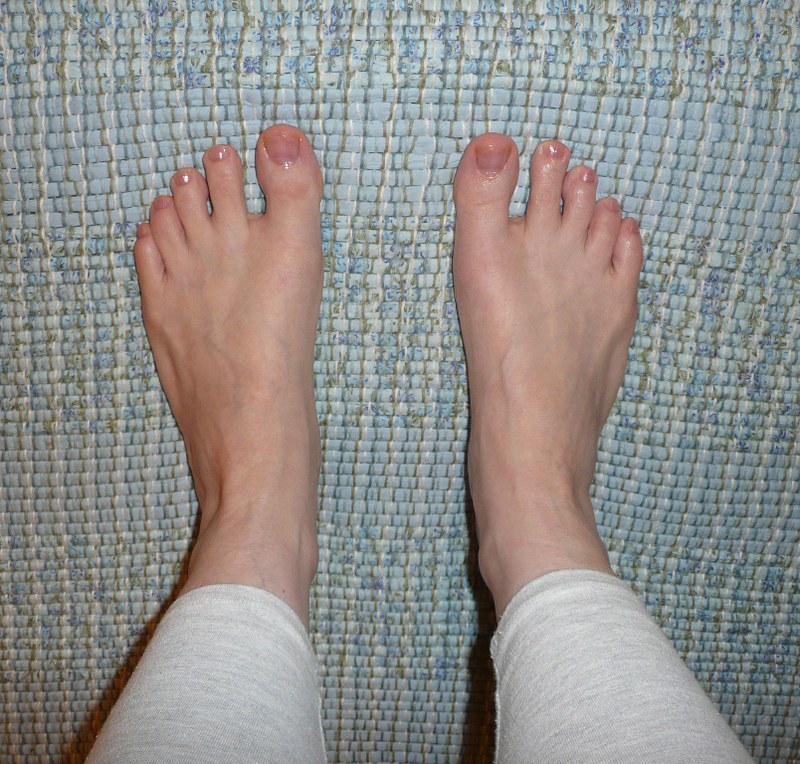
 Now bring your feet closer together. Picture your stance being hip JOINT width apart. Most of us have hips that are larger than where our legs meet our hip socket. Try this: Imagine someone gently lifting you off of your feet by you head, imagine your legs are just hanging down from your hip JOINTS. Then the huge hand that lifted you sets you gently down. Your legs exactly in the same position as when you were hanging. Your leg bones come straight out from your hip joints. That is what Nia open stance is.
For me, it is much more narrow than I was taught open stance was.
My pictures are showing the difference between what I thought was open (the first one) and what I now think of as open (the second one). I stood on the rug so the pattern would help show the difference. Please keep in mind that everyone, everyBODY is different so the width of your feet will differ from mine, but if you keep in mind that open is not really hip WIDTH apart, but hip JOINT width apart then you too, might have an adjustment in your “open stance”.
Well, did you? Were you taught open is hip width apart? If you stand hip width apart is there a noticeable difference when you stand hip JOINT width apart?
Posted in 52 Moves (of Nia), Nia | Tagged: 52 Nia Moves, ballet classes, cardio dance, cardio exercise, cardio workout, dance steps, exercise classes, Jazzercise, Jazzercize, martial art classes, Nia, Nia class, Nia Dance, Nia exercise, Nia Moves, Nia workout, open stance | 6 Comments »
Posted by terrepruitt on February 15, 2011
Nia has a list of 52 moves. A lot of Nia’s moves are moves that are from different forms of dance. I knew a lot of them already because of the different dance I have been involved in. One thing I’ve done before is just rolling around the foot, in Nia we call it Rock Around the Clock. Normally we actually STEP to or on positions as if we are dancing on clock on the ground, but for this move it is rolling on our feet, as if on positions of a clock.
With your knees relaxed and your upper body loose, rock back onto your heels. If going “counter-clockwise” you would rock to the right edge of both your feet–at the same time. Then move to the balls of your feet, rising on your toes. Then rock and roll 🙂 to the left edge of your feet. Both at the same time. The feet roll to 6 o’clock, 3 o’clock, 12 o’clock, then 9 o’clock. Rock around the clock. Don’t forget to rock clock-wise.
This move helps build strength in the ankles and the lower leg. A strong base is a stable base. With this move the muscles in the feet can also be exercised. Since often our feet are encased in shoes that don’t allow them to achieve the movement they are designed for, this move can help with strengthening our feet AND improving flexibility.
Nia’s Rock Around the Clock is a prime example of one of the exercises we do in a Nia class that is easy to do and results in huge benefits. If at first you find this move a challenge to your balance that’s ok, practice it holding onto a table, a chair, a counter then before you know it you will be able to rock around the clock without any help.
Update-ish: On January 15, 2015 I posted about another way to practice this move. Click here to go to Ways To Practice Rock Around The Clock.
Posted in 52 Moves (of Nia), Nia | Tagged: balance exercise, different forms of dance, flexibility exercise, foot exercises, foot flexibility, Nia, Nia Classes, Nia Dance, Nia exercise, Nia flexibility, rock and roll, rock around the clock | 2 Comments »
Posted by terrepruitt on October 5, 2010
I teach Nia in the San Francisco Bay Area. One thing I am trying to do is increase awareness of Nia and also, at the same time, increase my class sizes. So recently I hosted a Playshop in San Jose at the studio in Willow Glen where I hold my Nia classes. My topic for the Playshop was some of the 52 Moves of Nia. It was a success. I felt good about it, even though I put my students to work.

I had spent a day and a half or so preparing what moves I wanted to go over in the Playshop and what Nia katas from the various Nia routines I wanted to use in the Nia Class. I wanted the class routine to include all the various moves we explored in the Playshop. I spend a couple of days between doing other things reviewing to make certain I was comfortable with my presentation and to make certain I could get through it within the allotted time. So I was confident the Playshop and the Nia Class would go smooth. What I was nervous about was being able to get in and set up.
If you are a teacher of almost anything, you know that here is time needed to set up. Showing up early to set up and be ready to greet your students is not always possible with the time allowed in between workout classes. In exercise class situations sometimes there is NO time in between classes. They are scheduled to end on the hour and start at the same time. So I had scheduled 15 minutes in between, but there was still things that needed to be done and I wasn’t wanting to rush the class before us out.
So I came up with an idea . . . . now, I would bet I am not the only one to come up with this and I bet if I were to do minimum research I would find all the “Planning a workshop” information to tell me exactly this, but I am still going share it.
I realized that I could put my students to work! So I did. Most of the time people are more than willing to help. One of my students showed up really early—before me even. So I knew she was ready to do something. So I set her on one task. Then two of my students who I had been plotting to do this work all along were assigned tasks.
This assigning of tasks can also be connected to my post about “If You want something done right“. Because I had to be willing to “let go” and let my students do the tasks. And I have to say they did them beautifully. I was so proud. I was proud of myself for having thought of having them do it and I was proud of myself that I just let them do it. And I was especially proud that they did it so well. I believe they did better than I could have–it was awesome.
It was a great learning experience for me.
My hubby (thanks, Hubby!) also came to help. With him mopping the floor and some of my students setting up the room, I was able to concentrate on the participants coming in that needed to sign waivers and get settled. All of this allowed us to start on time . . . which allowed us to end on time — for the Playshop at least. The Nia routine I put together was a little longer than an hour so we went over on that. But all-in-all it was my students that allowed me to have a successful Playshop.
(Thanks Students!)
Posted in 52 Moves (of Nia), Nia | Tagged: exercise class, katas, Nia 52 moves, Nia class, Nia exercise, Nia exercise class, Nia katas, Nia participants, Nia Playshop, Nia routines, Nia San Francisco, Nia San Jose, Nia students, Nia Teacher, Nia Willow Glen, Nia workout, Nia workshop, San Francisco Bay Area Nia, San Francisco Nia, San Jose Nia, San Jose Nia class, SFBay Nia, Willow Glen Nia, working students, workout class | 4 Comments »
Posted by terrepruitt on June 29, 2010
 We often step on the ball of our foot. We often call it the toe. The Ball of the foot is one of the 52 Moves of Nia. Ballerinas are actually on their toes and they do it in special shoes that have a support in them where their toes are. We usually are stepping onto the BALL of our foot when we step on the “toe”. It is the ball portion of the foot that supports the weight when we are “on our toes”.
This is plantar flexion and assists with keeping the ankle joint flexible. If you are standing on the foot you are flexing it can also assist with strength.
In a Nia workout class we do all types of movement and sometimes we are using the ball of our foot. We could be stepping or standing. The moment might call for us stepping ONTO the ball either forward, back, or even laterally. Or it could be that we are standing and just rising up. This could be a position where we stay either in a display of balance or it could be a display of agility, a temporary place where we quickly move onto another move. Either way it is all part of how the body was designed to be moved.
It might be a nice idea to keep in mind that moving and working the foot in different ways than it is used to being worked might cause some muscle soreness or tenderness through the entire leg. If you are never on your the ball of your feet and suddenly your dancing a few moments on them, your calves might remind you of it later that day or even the next day. Same goes for the whole foot, if you are not in the habit of moving on the whole foot your ENTIRE leg could end up letting you know you worked some leg muscles.
As with the whole foot, the ball of the foot can be used in the stances of Nia.
Just as I have done with the heel lead and the whole foot, I am going to suggest that you take note of this foot position. As you walk notice when your stride gets to the point of the ball of your foot. As you reach for something on the top shelf and you balance on your toes, notice the flex of your foot and the muscles in your calves. As you walk through your day notice the ball of your foot.
Posted in 52 Moves (of Nia), Nia | Tagged: agility, ankle joint flexibilty, ankle strength, balance, Ball of foot, ballerinas, DOMS, felxibilty, leg muscles, Nia, Nia class, Nia Dance, Nia dancing, Nia workout, toe shoes | 10 Comments »
Posted by terrepruitt on June 26, 2010
 Using the whole foot is another one of Nia’s 52 Moves. The whole foot is used for secure stability. It is a powerful base.
Moving on the whole foot or just standing on the whole foot–either on both feet or just one foot allows for the bones in the feet to act as support for the entire body. Stepping or standing on the whole foot can bring rest to either the heel or the ball of the foot. The whole foot stance or movement calls different muscles in the foot and the leg into play. If you are accustomed to standing and/or walking on the balls of your feet, this technique might be a challenge to your leg muscles.
Stepping onto the whole foot encourages a gentle flex in the knee so as to help absorb any shock that might be felt as the whole foot touches the ground.
There are times in a Nia class when we actually dance on the whole foot—you might recognize the whole foot dancing as what Carlos (Rosas now known as AyaRosas) called micro dancing. We use the whole foot to gently slap the earth. Moving around the space. We might stomp, bringing the foot to rest gently on the ground.
The whole foot is the middle of a stride in the heel lead walk. We sometimes will step onto the whole foot instead of the heel or the ball, this as I mentioned, can be a restful for the heel or ball if you normally step on it either. The whole foot can be used in all of the stances.
While you move through your day, be aware of your feet. Notice when you are on your whole foot. Take a moment to shift your weight from foot to foot. Sense the stability and power in your base, in your whole foot.
Posted in 52 Moves (of Nia), Nia | Tagged: Carlos AyaRosas, Carlos Rosas, dance class, Heel lead, micro dancing, Nia, Nia class, Nia Dance, Nia movements, whole foot | 3 Comments »
Posted by terrepruitt on June 24, 2010
Often times in a Nia routine we are stepping or even walking. Since Nia’s movements are based upon the way the body was designed to move a Nia routine is often created with the step to be done with a heel lead. The Heel Lead is one of Nia’s 52 Moves.
 A lot of different types of dancing is done on the ball of the foot, cha-cha, two step, etc. Some dances are done on the toe as in ballet. With Nia we often are using our heel to lead and not the toe or the ball of the foot. This is a challenge sometimes. Sometimes it seems easier to step onto the ball of the foot or the toe. Using the heel lead technique really allows for our ankles to move through the full range of motion.
In addition to allowing the foot to move as it should, stepping on the heel gives the ball of the foot a chance to rest. If it is one’s habit to walk on the ball of the foot it can sometimes become a source of pain. The foot in its very architecture was designed to have the weight (when stepping) borne on the heel not the ball of the foot.
While I am leading a Nia class I frequently say, “Heel lead.” And most times it is to remind myself to use my heel. I tend to start dancing on the balls of my feet.
A lot of women’s high heeled shoes do not allow for a heel lead. In the case of some of the shoes if the heel were to lead and the weight were to be place on it, it would collapse. I know many, many women who love their high heels for so many reasons. I am not saying that people shouldn’t wear them, but I am saying that we dance Nia in bare feet, the routines are designed to allow the body to move as it was created, so embrace the heel lead.
Right now, if you are not wearing shoes that would inhibit the heel lead, try it. As you walk through your day actually consciously, place your heel down (not roughly, just place it down) first then roll through your foot. Notice how your ankle flexes and extends. Practice the heel lead. Enjoy the heel lead.
Posted in 52 Moves (of Nia), Nia | Tagged: bare feet, dance class, Heel lead, high heels, Nia, Nia class, Nia Dance, Nia movements, Nia routine, Nia Techcnique | 10 Comments »
Posted by terrepruitt on January 30, 2010
One thing about a blog on WordPress, I can see search terms. My blog statistics show me terms used in a search that led people to my blog. One thing I noticed was bow stance came up a lot in the search terms. People want to know what it is, how to do it, what is it for, etc.
So I thought I would post another post on the Bow Stance. I am familiar with the stance from other exercises and other exercise classes. It is not unique to Nia, but Nia includes it in the Nia 52 Moves. I feel it can be compared to a lunge.
The bow stance is one leg bent with the foot flat on the ground, the other leg is bent and out behind with the heel lifted and the ball of the foot on the ground. The feet are not aligned, so if you were to bring your back foot forward it would not collide with the foot in front. Can you picture it? It is kind of like a lunge.
The Nia Technique book states that the benefits are conditioning for walking and dealing with changing levels as the body’s center moves up and down.
My feelings about the bow stance are that it is great for working out the lower body and for practicing balance.
The bow stance can be done with many variations. The typical bow stance is that described above, but, when the feet are place wider apart as if on two railroad ties the stance actually becomes more stable, but if you add moving arms to that it become less stable. If you were to raise and lower your entire body, it changes the dynamics yet again. If you were to add motion to the hips, it changes it again. If you were to place the back foot further back it changes it again. Another way to challenge the muscles is to change which foot holds the weight, leaning the weight to the front or to the back.
This stance is used a lot in Nia routines and I imagine that is because it is such a great exercise and it can be used so many different ways. It fits into many different songs and adds to the dance. Sometimes we move in and out of it quickly, sometimes we stay and play. It is a great movement.
Previously I mentioned it being good for the lower body that is because you can see how it is very good for the feet and ankles too. When the back foot it resting on the ball of the foot, it helps with both strength and flexibility of the foot. When movement is added to the stance it helps with both strength and flexibility of the ankle.
So we answered the question originally stated:
—the bow stance is somewhat like a lunge
—one foot is in front flat on the ground, the other is in back with the heel up, both legs are bent
—it helps with strength, balance, and flexibilty
I hope that helps. If you have anything to add or ask, please do so. And, as always thank you for stopping by. If you want to see how the bow stances is added to a dance workout and you want to try it yourself, join me in a class.
Posted in 52 Moves (of Nia), Nia | Tagged: balance exercise, Bow Stance, Dance Workout, exercise class, flexibility exercise strength exercise, Nia, Nia class, Nia exercise class, Nia routines, stability exercise, The Nia Technique, Wordpress blog, workout class | 8 Comments »

 Terre Pruitt's Blog