Terre Pruitt's Blog

In the realm of health, wellness, fitness, and the like, or whatever inspires me.

  • I teach yoga, Nia, and stretch online!

    ALL CLASSES ARE ON ZOOM AT 10:00 AM PDT

    Tuesday Gentle Yoga 

    Wednesday Nia

    Thursday Stretch

    Please see my website for details!

    I am also available for private Nia / yoga / Personal Training all virtual, of course!

  • Unknown's avatar

  • Enter your email address to subscribe to this blog and receive notifications of new posts by email.

  • My Bloggey Past

  • ******

    Chose a month above to visit archives, or click below to visit a page.

Archive for the ‘Yoga/PiYo/Pilates’ Category

Svadhyaya – The Fourth Niyama

Posted by terrepruitt on March 21, 2016

I’m still looking into the Eight Limbs of Yoga (1:  The yamas – restrictions/restraints/ethical principles    2:  The niyamas – rules/observances/spiritual practices    3:  The asana – the poses    4:  Pranayama – breath work    5:  Pratyahara – withdrawal of the senses    6:  Dharana – concentration    7:  Dhyana – meditation and    8:  Samadhi – transcendence)  I am working my way down the list posting about a little bit about each limb.  With the first two limbs there are five of each yama and niyama.  I am working my way through them, too.  Well, this post is about the fourth niyama or rule, observance, spiritual practice.  It is svadhyaya – study of self.
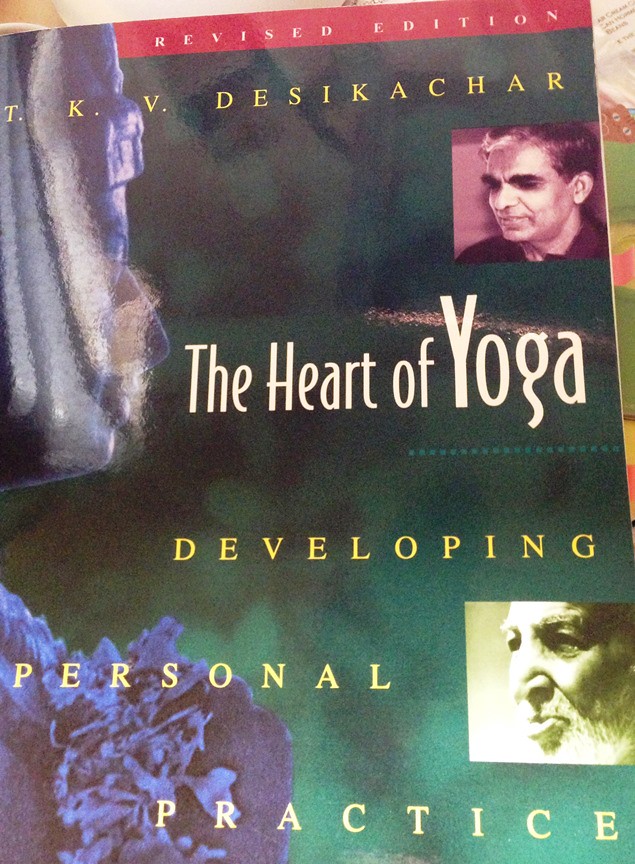
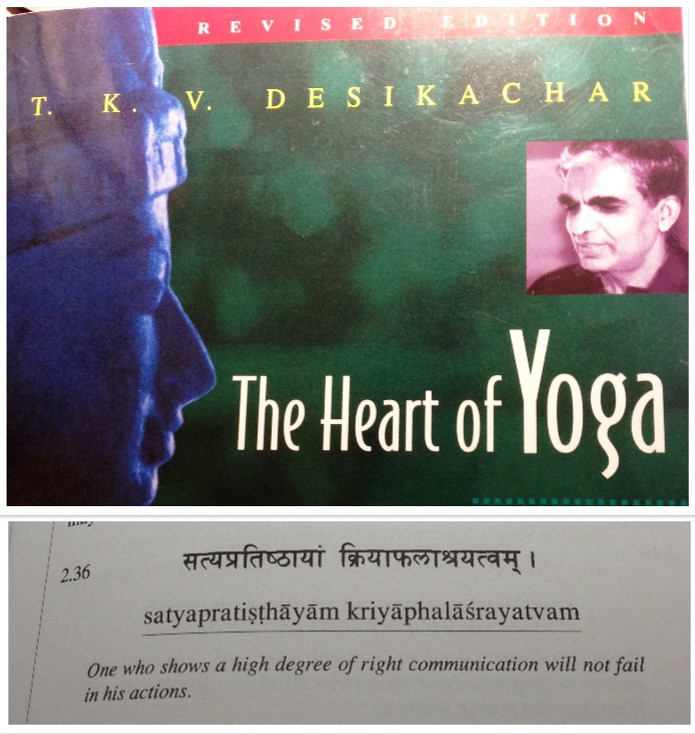
Dance Exercise, Nia, Nia in the City of San Jose, Nia classes in the South Bay, Nia Teacher, Nia Class, San Jose Nia, Nia San Jose, Nia workout, Nia, Gentle Yoga, Group Ex classes, YMCA, Zumba, PiYo, Nia Technique, SJ City Fit, SJCityFitT.K.V. Desikachar’s The Heart of Yoga states that svadhyaya means to get close to yourself or study yourself.  Sva = “self” or “belonging to me” / Adhyaya = “inquiry” or “examination” . . . so self inquiry, self examination.

One can study or examine oneself for various reasons.  One way many are probably familiar with is eating . . . you have probably heard the terms “emotional eater”, “stress eater”, “bored eater” and the idea is to stop and think – examine when you eat so you can identify if you are one of these types of eaters.  These labels could be applied to many things . . . drinker . . . fighter . . . .abuser . . . “neglector” . . . cleaner . . . . smoker . . . whatever the situation, the study has to be done first in order for the behavior to be altered.  WHY is it you are doing what you are doing?  What is it that causes you to do what you do?  With that type of knowledge of self then steps can be taken to change.

A lot of our behaviors are habits and sometimes just acknowledging that and applying a little bit of mindfulness we can change the habit.

If you want to think about svadhyaya in relationship to “on the mat”, the actual practice of the third limb of yoga, the asana, then it can be applied in the sense that it is all about you when you are on the mat.  There is no competition between the person on the mat next to you.  Or you having to do something in order to please or impress the teacher.  It is all about you and what is going on with you at that particular mat time.  This is a great time to practice svadhyaya.  It is when you get to stop all the other thinking and think about things like how your foot is connected to the earth.  It is your whole foot or just the edge?  Are you using the muscles necessary to make certain that it is the whole foot.  Are your shoulders down?  Is your chest open?  Is your spine long?  Is your stance too wide?  Can you tweak your arm/leg/head just a little in order to invite in that sense of relaxed control?  Where you are not sinking into your joints hanging out in a pose, but using your muscles but not over using them?  Are you aware of the placement of your knee?  Are you focused on your breath?   If you study how each pose is sensed by your body it allows you to try to determine if you are in the pose correctly and allows you to get the most out of it.

With the study of self there is knowledge gained about self.  With the knowledge of self one can work to improve or enhance oneself.  With enhancement of self, the idea is that one moves closer to the divine.  Many think of the divine as different things.  But most people agree that we all have areas in which we could grow.  Most people agree there is always room for improvement.  It makes sense that we have to look in and examine, practice svadhaya, before we can change.  This is just one way – and a brief one at that – to look at svadhaya.

What do you think?  Do you think of svadhaya on the mat?

Posted in Yoga/PiYo/Pilates | Tagged: , , , , , , , , | Leave a Comment »

Tapas – The Third Niyama

Posted by terrepruitt on March 11, 2016

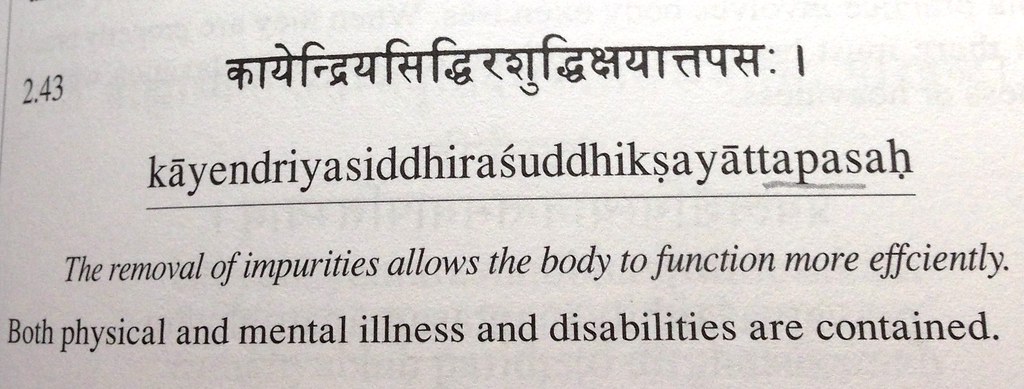
Tapas, no, not the little plates of appetizers in Spanish cuisine.  But that is, honestly, how I remember this niyama.  I think, “What is the third one?  Oh yeah, little plates of food.”  As I have mentioned before, and this word is no different, you will probably see it spelled many different ways.  If you want to not confuse it with the little plates you could spell it Tapahs. Although, the Heart of Yoga, does link Tapas to food.  First he says that it literally means “to heat the body”.  He goes on to say that by doing so we cleanse it.  Another form, he says is “paying attention to what we eat”.  So that does kind of tie in with food.  The book further states that “posture, attention to eating habits, attention to breathing patterns are all tapas.”  I learned tapas as discipline.

Dance Exercise, Nia, Nia in the City of San Jose, Nia classes in the South Bay, Nia Teacher, Nia Class, San Jose Nia, Nia San Jose, Nia workout, Nia, Gentle Yoga, Group Ex classes, YMCA, Zumba, PiYo, Nia Technique, SJ City Fit, SJCityFitSo that would be discipline over your posture, eating habits, and breath.  The idea is that if you have discipline over all of these things you are purifying the body and practicing tapas.  The Heart of Yoga also says, “Tapas is often described as penance, mortification, and a strict diet.”

I like the way Connie Habash, talks about it in her article. She talks about tapas as being that fire that gets you to do things.  The inner flame that motivates you, she says.  That desire or discipline that has you doing chores or a daily workout even when you really don’t want to.  The thing that keeps you on track.  I am way more on board with that then “voluntary self-punishment inflicted as an outward expression of repentance for having done wrong”.

Dance Exercise, Nia, Nia in the City of San Jose, Nia classes in the South Bay, Nia Teacher, Nia Class, San Jose Nia, Nia San Jose, Nia workout, Nia, Gentle Yoga, Group Ex classes, YMCA, Zumba, PiYo, Nia Technique, SJ City Fit, SJCityFitWhich is good because I guess even though “tapas is often described at penance” it doesn’t mean penance or castigation” so it is mentioned later in The Heart of Yoga.  Basically we are disciplined with ourselves.  Not doing something (eating, exercising, working, playing) in excess.  Doing what we need to stay healthy, but not taking it overboard.  While exercising is a good thing it can be done to a point of making the body or mind unhealthy.  And that can be said of many things, as I mentioned work and even play.  If there is too much “play” then there is no balance.  Yoga is all about balance.  Things need to be in balance.  The yin and the yang.

The practice of tapas allows for balance as it is the discipline that keeps everything in check.  So, this is a brief idea of tapas.  Tapas is the third niyama.  There are five niyamas.  Niyamas are the second limb of yoga.  There are eight limbs of yoga.

I have mastered none.  I am just posting about them as a way to familiarize myself with them and a way to keep them and their ideas at my fingertips.  Yoga is a practice so these are things I can process for years to come.  I share them, too, as a way to introduce you to the other aspects of yoga.  Just like I share the principles and other things that make up Nia.

Can you easily see why yoga is called a practice?  🙂

Posted in Yoga/PiYo/Pilates | Tagged: , , , , , , , , , , , , | Leave a Comment »

Being Content – The Second Niyama

Posted by terrepruitt on March 9, 2016

Ahhhh Santosha, the second niyama.  The niyamas and the yamas are the second and first limb of the Eight Limbs of Yoga.  As with many things there is often more to it than what is popular knowledge.  Most people are familiar with yoga, in the sense that they know it has to do with stretching.  Many people will even say, “I am not flexible enough to do yoga.”  Ha . . . that is probably more true than they know.  Tee hee.  But, actually they are just referring to the physical aspect because, again, that is what is popular knowledge.  To me, that is fine, just knowing yoga as a physical practice is fine.  In fact, if that is all you want to do when you think of yoga, that is fine too.  I am not here to say you have to do yoga a certain way or that you have to practice all the limbs or you aren’t doing real yoga — in fact, to say that, in MY opinion — is not practicing “real” yoga.  Ha . . . so intertwined it all is.  But anyway . . Eight Limbs . . . More To Yoga Than Just Asana.  The first two limbs (yama and niyama) are rules and observances.  There are five of each.  I have posted a bit about the five yamas and now I am working my way through the five niyamas.  This post is about the second one — Santosha, contentment.

Ahhhhh.  Sigh.  Sounds so super easy . . . if you consider yourself content.  But it might not be if you look at it.  If you really look at “true” contentment it might be a little bit more difficult than at first glance.  This one is tricky because in some cases it might appear to be laziness or unambitious.  But really it is just being content with where you are.  Again it can be connected to some of the yamas, because we would be content with where we are and not try to “steal” something away from someone else.  We will be content with what we have in that we won’t try to get all that we can (either material-wise or sexually).  We will not try to possess everything and hoard it all.  These are comparisons to the last three yamas.

Santosha extends to worrying.  Worrying is a form of non-contentedness.  We are thinking about the future and not content to be right where we are.  It could be a matter of not trusting that we are where we need to be.  It could be a matter of not focusing on the now.  There might even be an aspect of control to consider.  If we are always trying to control things it could be that we don’t trust what will happen to be the right thing or that we are unable to surrender to it.  Hmmmm . . . .

Dance Exercise, Nia, Nia in the City of San Jose, Nia classes in the South Bay, Nia Teacher, Nia Class, San Jose Nia, Nia San Jose, Nia workout, Nia, Gentle Yoga, Group Ex classes, YMCA, Zumba, PiYo, Nia Technique, SJ City Fit, SJCityFitSo we are to accept what is happening, what is in the present, and what we have.  We are to be content with what is.  Santosha is not to worry about what will be and try not to control everything.  This does not mean we cannot make plans and have ambitions, it just means that we should enjoy what we have and not be too disappointed when it is not the way we think it should be.

Again I will say, I have not mastered this entirely.  I think I am content in some situations, but I might be a little non-Santosha in others.  But, again, it is a practice.

What would you like to share about Santosha?


Posted in Yoga/PiYo/Pilates | Tagged: , , , , , , , | Leave a Comment »

Sauca – The First Niyama

Posted by terrepruitt on March 7, 2016

I teach Nia, you may know that.  You may also know that Nia is a cardio dance exercise.  You can go to class get a workout and not think about it at all.  Or you can take it a little further if you would like and delve into some of the things that Nia likes to do, like connect movement with things in life, practice the 13 Principles of the Nia White Belt in your daily life.  But the 13 Principles of the first level of Nia are things like being Joyful in your movement or doing something in your own time or noticing how your body moves.  Whereas if you are going to practice more than just the physical aspect of yoga you are going to be observing rules and restrictions and practicing breathing techniques and meditating.  So even though I often compare Nia to yoga saying that it is a practice, I don’t think of the Nia practice as rules and restrictions.  With yoga there are the Eight Limbs of Yoga.  I listed them in my post “More To Yoga Than Just Asana“.  I am more familiar with the first four than the last four.  I can say that the first four have more.  As in the first two have five each, the third has hundreds, and I am not even sure how many the fourth has, but I know of at least ten.  The first limb is the yamas.  I have written a brief post on each yama.  Now I am going to skim the surface of the niyamas.

As I mentioned, there are five niyamas.  Some call them rules, some call them observances, some call them spiritual practices.  The first of the niyamas is Sauca . . . . as with many of the Sanskrit words you will probably see it spelled different ways.  While it might be spelled different, it is pretty much agreed upon that this niyama is about cleanliness, purity.

The Heart of Yoga says “Cleanliness, or keeping our bodies and our surroundings clean and neat.”

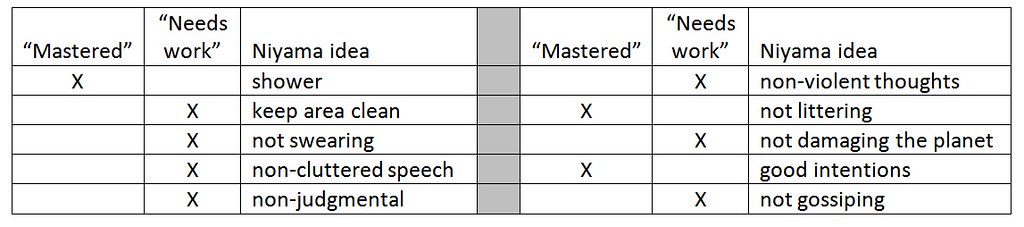
Recently I had the opportunity to examine this niyama by being assigned to write about it.  I decided to take the points that were mentioned in the lecture and make a little table.

Dance Exercise, Nia, Nia in the City of San Jose, Nia classes in the South Bay, Nia Teacher, Nia Class, San Jose Nia, Nia San Jose, Nia workout, Nia, Gentle Yoga, Group Ex classes, YMCA, Zumba, PiYo, Nia Technique, SJ City Fit, SJCityFit

I decided I have showering down.  I believe that I do a good job with my general hygiene.  Although, it has come to my attention that some people don’t consider it “good hygiene” if you are not wearing make-up.  For some people wearing make-up is a very big deal and it had been pointed out to me recently – that make-up should be a part of every woman’s beauty regime.  So, I guess SOME people might not agree that I have the “good hygiene” thing down.

Oh, but if one includes, “dapper new clothes” in that “good hygiene”, yeah, I don’t have that down at all.  While my clothes will be clean, they might be really faded and what many people would think of as “time-to-get-rid-of”.  So just as someone who thinks that having make-up on is part of good hygiene, someone who doesn’t wear or tolerate old and faded clothes might think of me as not having good hygiene.

Keeping things clean is always a “needs work” because SOMETHING is ALWAYS dirty.  I mean, even if I spent all my time cleaning there would still be dirty things.  But I think I do ok with the necessary basics.  Our kitchen is clean, our bathrooms are clean (the showers could always use sand-blasting, but basically they are ok), the cats’ litter boxes are clean (that is a never ending “battle”), our house is basically clean . . . but I can’t keep up with the dust.  And, again, that is me saying it is “clean”, but I will not admit to it not being cluttered.

Who cannot swear with all this clutter around?

And cluttered speech . . . that is funny.  At times I am very aware of this and I can keep the clutter out, but sometimes a story is just so much more fun with all the drama (good drama, as in a play or good story) that clutter causes.  The suspense because you added three more sentences that were not necessary, but your audience is on edge.  Sometimes that is just too fun.

Non-judgmental . . . this kinda reminds me of the Yama, Ahimsa.  Being “non-violent” with oneself.  I could work on judging myself less harshly so as not to judge others so harshly.

Regarding the non-violent thoughts, perhaps with the non-judging, I won’t want to slap the person that didn’t obey the traffic law or show any regard to common sense while driving.  Needs work.

Ok, I think I have the littering one down.  I say, I think because I don’t litter.  I don’t throw things away if it is not in a garbage can or recycle bin.  But there might be something someone else considers littering that I do, that I am not aware of.

Not damaging the planet actually made me laugh.  It should be “work to keep your damage to a minimum”.  Because all of our modern convenience damage the planet.  Driving my car, damages the planet, having a cell phone damages the planet, eating food from our food sources damages the planet . . . . so I try to be good about it.  I take care not to waste water or electricity or even “THINGS”.  I am not a big throw-it-out-and-get-a new-one person . . . . hence all my clutter.

Good intentions.  I try, I am sure it could be better.

I work hard not to gossip.  Not easy . . . but it kind of helps when you don’t have the opportunity.

Again, as with all the limbs, I am just barely touching the surface.  These are not all the ways of sauca, but I think the list/examples we were giving was a good representation.  I am sure there are other ways it can be looked at, but in light of this, what do you think?


Posted in Yoga/PiYo/Pilates | Tagged: , , , , , , , , , , , , , | 2 Comments »

Don’t Be A Hoarder

Posted by terrepruitt on March 2, 2016

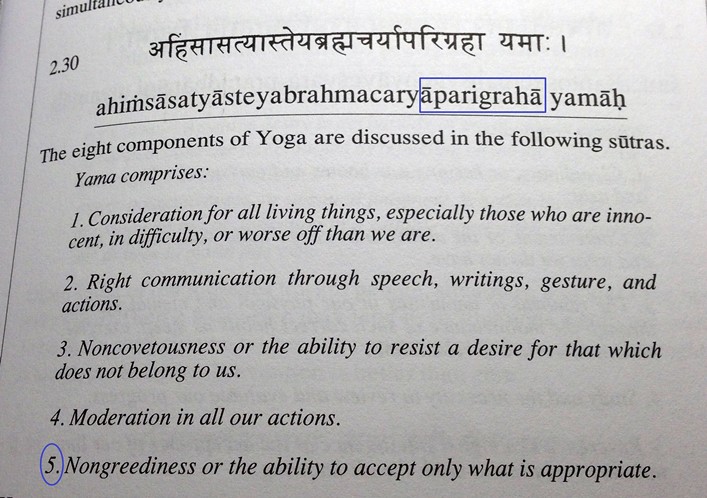
Dance Exercise, Nia, Nia in the City of San Jose, Nia classes in the South Bay, Nia Teacher, Nia Class, San Jose Nia, Nia San Jose, Nia workout, Nia, Gentle Yoga, Group Ex classes, YMCA, Zumba, PiYo, Nia Technique, SJ City Fit, SJCityFitIn reviewing some of the things that actually make yoga yoga, I have been posting about the Eight Limbs of Yoga.  The first two limbs, the yamas and the niyamas are restraints and observances, respectively.  I am working my way through posting about them and I am on the last of the yamas.  The fifth yama is one that probably speaks to many of us. The fifth yama is about non-coveting, non-hoarding, non-clinging, non-possessiveness, non-greediness, non-grasping, etc.  You get the picture.  The fifth yama is aparigraha.

I think this is a big one in our have-to-have-the-latest-and-greatest-of-everything society.  We covet the new electronic gizmo our neighbor has.  We buy more than we need until our closets and garages are over flowing.  We have so much stuff that there are places we can rent to store the stuff that doesn’t fit in our homes.  We cling to the very idea that our lives will be better with more stuff.  We are compelled to consume.  And all of that is if we are just talking about material things.

There are other applications of aparigraha, just like with all the limbs and the other yamas, much could be and has been written about them.  I am just barely scratching the surface.  Another way to think about aparigraha and the “non-clinging” is letting go.  Perhaps we cling to things that no longer serve us, whether they be ideas or habits or even long standing customs.  Does everything we do serve us now?  Could we learn more if we let go of something we have always thought to be?  Would our lives improve if we didn’t do that thing that we have always done?

Dance Exercise, Nia, Nia in the City of San Jose, Nia classes in the South Bay, Nia Teacher, Nia Class, San Jose Nia, Nia San Jose, Nia workout, Nia, Gentle Yoga, Group Ex classes, YMCA, Zumba, PiYo, Nia Technique, SJ City Fit, SJCityFitAnother way it could be applied is to people or relationships whether we look at it as letting go or non-possessing.  We might need to let someone go, a relationship that is no longer serving us.  Perhaps we have just grown apart or we realize that the relationship is just not a healthy thing so we need to let go.  Or, more directly related to teachers in my line of work and students, perhaps we need to let them go.  We need to not think of students as ours, so when they visit other classes we are not offended.  When they move on to different teachers we can practice aparigraha, by not getting hurt because they were “our” student.  No matter the reason they moved on, we can happily let them go to move on to what is best for them.

I liked that example of the fifth yama very much.  It is a great thing for me to remember and try to practice.  I mean I already know about the rest and I seriously need to work on it – as evidence by my closets.  But I liked the different way to look at it, too.  I always feel funny saying “my” students because I don’t mean for it to sound like they are MINE, especially since at the Camden Community Center, where I have a bulk of my classes the students are students to many instructors.

As is the case with all the yamas, I need to work on this one.  I am planning on practicing it big time as I do some Spring cleaning.  Going to try to not-hoard, as is my habit with clothing.  Might (notice I say might) part with more of my mom’s clothing, which I probably never will wear, but I was clinging to – for many reasons.

How about you?  Do you have anything (whether it be a material object or an idea, habit, or custom) that you might practice aparigraha with?


Posted in Yoga/PiYo/Pilates | Tagged: , , , , , , , , , , , , , , , , | Leave a Comment »

The Fourth Yama – Brahmacharya

Posted by terrepruitt on February 29, 2016

This one sounds like a weird one.  Well, I think it sounds weird, but then again, these are the rules of yoga and yoga was actually meant to be for those that were very serious about it.  Those who were pretty much willing to give up everything and willing to follow the Eight Limbs of Yoga.  But since it has been introduced and fed to the masses the ideas have been adjusted a bit. Often times Brahmacharya, the fourth yama is described as celibacy.  I actually like continence better, with it meaning self-restraint or abstinence, especially in regard to sexual activity; temperance; moderation it allows a little leeway in there.

The text talks about how having sex actually releases your life force so it shouldn’t be done just carelessly.  One shouldn’t just have sex to have sex . . . . so opposite the many teachings and attitudes of today.  So many things are geared towards getting more and having more no matter what it is, just doing what feels good with no regard to consequences.

So perhaps in terms of sex we think of Brahmacharya as not having meaningless sex.  Because many of use are not going to be on the path of celibacy.  Since marriage and relationships are part of what make many of us happy.  There are other ways to think about Brahmacharya.   The Heart of Yoga says moderation in all things.  In a lecture about they yamas, Connie Habash, our teacher, said she likes to say that Brahmacharya is a balance of ALL of our energy (not just sex).  She even gave an example of wasting energy as go over things in your head over and over.  Perhaps having a conversation that will never happen, or replaying a situation in your head over and over.  Dwelling on things.  Wasting the energy.  These makes sense to me.

At this time I would like to point out, I am just sharing, it is not that I have mastered this.  I actually kind of think of myself as the queen of going over and over things in my head.  Ha, this is part of what makes things like yoga a practice.  I need to continually remind myself to “let things go”.  And move on.

Energy can be wasted on other things, too, just in the having and doing too much.  This wastes energy.  All of the needing to have keeps us so busy working that we don’t have time for relaxation.  And there are so many other “doings”, we are always on the go, that we don’t have time for just being.  There is so much energy being expending that it seems we just run ourselves down.

Always being on the go and not allowing for time to relax and play is not a balanced situation.  Not having the balance does not lend to a healthy life.  The idea, especially in regards to sex, is to not get so caught up in things that we lose our way.  We lose sight of trying to better ourselves through things that might take time, such as eating well, exercise, relaxation, and meditation.  All of these things take time and should be included in our lives to help us achieve balance and not have us wasting our energy.

Don’t you like the sound of balance and moderation better than celibacy?  Also, do you feel that balance in one’s life IS a good thing?

Posted in Yoga/PiYo/Pilates | Tagged: , , , , , , , , , , | Leave a Comment »

Non-stealing, Got It, Right?

Posted by terrepruitt on February 19, 2016

The Eight Limbs of Yoga, two of which are yamas and niyamas, restraints and observances.  Yamas as ethical principles and niyams as spiritual practices.  The first yama being ahimsa – non-violence, the second being satay – truthfulness.  The third is asteya – non-stealing.  This one kinda lands like the non-violence one.  Seems pretty easy.  But then just like the non-violence yama, it has its in-between-the-lines and fine print.  Non-stealing can mean a lot of things.

In The Heart of Yoga T.K.V. Desikachar’s notes asteya as:

“Noncovetousness or the ability to resist a desire for that which does not belong to us.”

Oh.  A little different that just “non-stealing”.  It is going so far as to say we should not covet things that do not belong to us.  Uh, I think that adds a whole different spin to this yama.  I mean, I will go out on a limb and say most of us are not going to go out and STEAL our neighbor’s whatshehaveit, but we might WANT it.  We might even think about if we had one our self.  We might even imagine us having one and him not.  Or us all having one and using them together.  But we are coveting when we do that.  We are wanting that which is not ours.

He also notes:

“One who is trustworthy, because he does not covet what belongs to others, naturally has everyone’s confidence and everything is shared with him, however precious it might be.”

We can also be stealing other things.  If we are focusing our attention on wanting what is not ours we are “stealing” attention from what we do have.  Possibly from people and things that are deserving of our attention.

One of my teachers mentioned jealous as a cause for stealing.  Dominating someone’s time if we are jealous of attention they are giving to someone else.  She also compares greed to stealing because we are taking more than we need.  So sometimes asteya has a hint of non-hoarding, since some consider taking more than one needs a form of stealing.  It is being taken away from someone else that might need it and then kept and not used.  Some of this might be the more difficult stuff to work on.

But if we work on it we might feel more at peace.  I know that when I am not spending my time thinking about what I don’t have I have more time to enjoy what I do have.  And, as I said, that time is not “stolen” from what is present.

As I said when I started posting about the eight limbs and especially the yamas and the niyamas, they can get pretty deep.  They can be explored and examined at great length.  I am just barely introducing them.  Hopefully giving you something to think about.  I know they have me thinking.

Posted in Yoga/PiYo/Pilates | Tagged: , , , , , , , , , , | 8 Comments »

Try Something Other Than What You Want

Posted by terrepruitt on February 17, 2016

I know I have said that if you are trying an exercise class go at least three times before you decide you don’t like it.  Have you seen me say that before?  I think that in order for you to decide you honestly don’t like it you need to try it at least three times.  I think there are enough factors in a group exercise class that you have to experience it more than once to make an educated decision.  I also think that sometimes what you want is not what you need, so you might want to step out into the unknown.

As I said there are many reasons not to like a class, if you think it is the instructor, don’t condemn the whole modality.  If you go to a Jazzercise class and the instructor runs around the room shouting encouragement at individuals and that is not your style, try a different teacher.  If the Zumba teacher only plays one type of music instead of sticking to the Zumba formula, try a different teacher . . . but it doesn’t seem fair to you nor Zumba if you claim you don’t like Zumba.  If you can, it is really nice to give that instructor another chance, but time is short and so sometimes that might not be the answer.  Every teacher has her own style and it might not be one you like, but that doesn’t necessarily mean you don’t like the exercise.

Also keep in mind that you are only seeing one routine, and those change.  If you go to a Nia class and think you don’t like it, try it again because the routines can be vastly different.  It is good to check out the different routines.  Also, find an appropriate class for your level.  If you take a circuit training class and it is too difficult try a different one or talk to the teacher.

When it comes to yoga, though, I would like to suggest a way to find the appropriate yoga class for you.  Try the opposite of what you WANT.  If you want to lie around on cushions in poses for 5 minutes at a time, try a more active class.  If you want a super aggressive active fast-paced class try a restorative class (lying around on cushions).  If you want gentle yoga try a class that you think might be tough.  You might walk out of class thinking, “Wow!  That was great.  I never would have thought.”

It could be that while you are in the class you are thinking that you wish the torture would end.  And by torture I mean, if you are a very active person and you want to be in a power yoga class and you take a restorative class and are having to lie still for ten minutes . . . that can be torture. If you just wanted to lie around on props and you are having to hold your left leg up for 45 seconds while twisting to the right and grabbing your right foot that might be torture.  But with the right teacher you will be able to do the yoga that is being taught in the class and you will walk out saying, “That is exactly what I needed.”

There are so many different types of yoga and yoga is only regulated when it is trade-marked and there are licenses to teach otherwise yoga class definitions vary.  Classes with the same names can vary greatly.

I am not saying to go to a class that is way beyond your level, but I am suggesting to try something you may not have normally thought of doing.  As I said, you might end up getting what you really need when you don’t go after what you want.

What type of yoga do you normally do?  What classes have your tried?

Posted in Yoga/PiYo/Pilates | Tagged: , , , , , , , , , , , , | Leave a Comment »

Yoga Was Supposed To Be A Secret

Posted by terrepruitt on February 15, 2016

I recently heard that yoga wasn’t meant to be done by the masses.  It was originally supposed to be for a specific type of person.  It was basically supposed to be a secret because not everyone is ready.  Not everyone can do what needs to be done to do yoga.  The eight limbs containing the yamas and the niyams, the Nadis, the bandhas, the Vayus all of the stuff that takes a huge amount of time to learn and perfect.  Having to practice and perfect all of that with the ultimate goal of achieving ascension into the divine or merging with the divine.  It really is for people who can and want to devote their whole life to it.  Just like an athlete wanting to go to the Olympics, they pretty much give up everything to practice, practice, practice, and perfect.  Yogis, just like that.  Giving it all up so that they can devote their life to doing yoga.  That really is the only way anyone could do all of it.

If the translations are accurate with all that one has to do and give up in order to “do” yoga perfectly, you really have to be removed from the things of the world.  In order to cleanse and purify in the way that is referred to in the text one would have to live on a mountain top.  That is why it was supposed to be a secret.  That is why it was not considered something anyone could do without living apart from the modern world (perhaps the Western World).

Once I heard that it made a lot more sense to me.  I felt relieved.  I thought, “Oh, THAT explains a lot.”  That explains why, a long time ago, I remember yoga being associated with people far away on high mountain tops.  That explains why it always seemed to unattainable.  That is why, when I was young it was this super-duper strict/restrictive practice that really didn’t appeal to me.  That is why some of the poses that seem outrageous really are.  They are not meant to be done by a person who has a yoga practice several times a week.  They are truly meant to be done by someone who spends ALL their time doing yoga — and by yoga, I don’t mean the asana, I mean ALL eight limbs.  Those pretzel people don’t work 45/50 hours a week and then just show up to their mat and bend like that.  They are the deep practitioners that do YOGA.

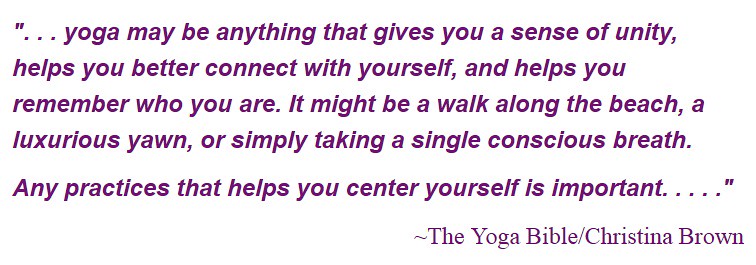
I believe that is why the limbs get rewritten to work with the modern life.  I believe that is why there are so many version and variations and modifications and names to one pose.  Things have been adjusted to fit into a life that is not JUST yoga.  There are still many benefits to doing modern yoga.  Many people don’t think of modern yoga as yoga and I think when compared to ancient yoga, I could agree.  I don’t think of a lot of the yoga that happens as yoga.  Things like paddle board yoga and water yoga, not really yoga.  But then again, as I said, the yoga I do, the yoga I teach might not be considered yoga compared to ancient yoga.  So it really depends on what you think yoga is.  It really depends on the what and the why.  What do you want to get out of it?  Why do you want to do it?  When you do it are you getting what you want out of it and is your “why” being handled . . . .then who am I or who is anyone to say it is not yoga.

Dance Exercise, Nia, Nia in the City of San Jose, Nia classes in the South Bay, Nia Teacher, Nia Class, San Jose Nia, Nia San Jose, Nia workout, Nia, Gentle Yoga, Group Ex classes, YMCA, Zumba, PiYo, Nia Technique, SJ City Fit, SJCityFit

I really think our yoga is so far away from the ancient yoga that the people from thousands of years ago would be appalled, but then again, they wouldn’t.  If they were as truly enlighten as the text said they would be if they practiced all eight limbs of yoga, they might just shrug their shoulders and get down on a mat and join us for some hot yoga, Karaoke Yoga, or whatever yoga is happening in the studio that day.

Perhaps yoga is done at different levels.  So the ancient yoga is for people who remove themselves from the modern world and dedicate their lives to nothing by yoga, and then all the other types of yoga are for the rest of us.  From the religious type of Kriya yoga all the way to Karaoke Yoga.

I have in my head some requirement for me to consider something yoga, but really in keeping with the way I’ve been taught about the yamas and the niyamas, I can just let it all be.  I can be happy that there are different “levels”.  The different levels allows it to be accessible for all.

Did you know that yoga was supposed to be a secret?  How do you feel about that?  Ever want to try something like Karaoke Yoga? Trampoline Yoga?

Posted in Yoga/PiYo/Pilates | Tagged: , , , , , , , , | Leave a Comment »

The Second Is Truthfulness

Posted by terrepruitt on February 10, 2016

So, yoga is more than just poses.  Yoga has eight limbs which I listed in my post More To Yoga Than Just Asana.  The first two limbs are rules, restrictions, guidelines things of that nature.  Things to help you along the path to the divine.  The first limb is about the yamas and the second is about the niyamas, I listed them in my post Yoga’s First Two Limbs.  Now I am going through and writing a post about each one.  I wrote about Ahimsa in Ahimsa And Yourself, which I probably should have title Ahimsa and MYself.  I write about this not because I have mastered them but because I am examining yoga ideas and ideals.  So if you hear me saying something harmful, please know I am still learning.  The next yama is satya.  Satya is truthfulness.

Dance Exercise, Nia, Nia in the City of San Jose, Nia classes in the South Bay, Nia Teacher, Nia Class, San Jose Nia, Nia San Jose, Nia workout, Nia, Gentle Yoga, Group Ex classes, YMCA, Zumba, PiYo, Nia Technique, SJ City Fit, SJCityFitSatya or truthfulness can be applied to so many things, right?  I mean if I go back to the exercise I mentioned I did recently and think about satya on the mat that can apply in so many ways.  Am I really being truthful with myself about what I can do?  Am I really being truthful that I am concerned with only myself?  I mean, if we are not concerned about what others think about what we are doing in class, does it really matter if we don’t do the advance version of the pose?  Can we really do it without causing injury to our self?

And that can carry to off the mat, huh?  Are we going to brag (why?) that we did more than we actually did in class?  Are we going to tell the truth in all of our dealings?

Satya could be applied to teachers.  Not just yoga teachers but to any teacher or profession that sets fees.  We need to be truthful and upfront about our fees.  Now this could help some of us that feel shy when talking about money and fees.  Yoga teachers can use satya to help them feel confident stating the fees upfront.  Things should be discussed openly and honestly.  A client should not be left to wonder about fees for a service.

Also satya can apply to marketing.  We don’t need to get caught up on all the hype that is used in a lot of marketing, making promising, and stating unsupported facts just to get people to come to our classes.  If we make false claims and that is what attracted the student then they probably aren’t really going to get a lot out of yoga and they are more than likely NOT going to be satisfied.  Then, as a teacher, you aren’t either, so no one wins in that situation.

As I stated in my Ahimsa post, I am just barely touching the surface on these things.  I think there could be volumes written about them . . . and there probably are.  They can be applied to many thing in so many ways.

I think truthfulness is one of the easiest ones to understand.  It might not be one of the easiest ones to do in thoughts, words, and actions.  But, here we all are . . . on a path of learning.

What do you think?  One of the easy yamas to understand?

Posted in Yoga/PiYo/Pilates | Tagged: , , , , , , , , | 2 Comments »