Terre Pruitt's Blog

In the realm of health, wellness, fitness, and the like, or whatever inspires me.

  • I teach yoga, Nia, and stretch online!

    ALL CLASSES ARE ON ZOOM AT 10:00 AM PDT

    Tuesday Gentle Yoga 

    Wednesday Nia

    Thursday Stretch

    Please see my website for details!

    I am also available for private Nia / yoga / Personal Training all virtual, of course!

  • Unknown's avatar

  • Enter your email address to subscribe to this blog and receive notifications of new posts by email.

  • My Bloggey Past

  • ******

    Chose a month above to visit archives, or click below to visit a page.

Posts Tagged ‘asana’

Butterfly, Baddha Konasana, Bound Angle

Posted by terrepruitt on August 11, 2015

A great hip opener is Baddha Konasana.  Baddha means bound and kona means angle.  So this is Bound Angle.  I learned this pose as Butterfly.  I like this pose.  This is great for the hips.  It can be a very intense stretch for the inner thighs.  This is the pose where you sit up tall, legs straight out in front of you, then bend your knees and roll your thighs outward, so your knees are facing out to the sides.  You have the soles of your feet together.  Your heels are as close to your pelvis as is comfortable.  Then you hook your two fingers of each hand around your big toes.  Your knees are the “angle” and your hands hold your feet for the “bound”.

In my gentle yoga classes I instruct the students to bring the soles of the feet together while their legs are out in front of them.  Then I have them bring their their feet to their pelvis.  This way people are getting the stretch that is enough for them.  People will bring their feet in as far as they can.  I have also instructed this asana where the students bring one leg in close to the pelvis, then the other.  The idea is to get the stretch your body needs and will allow.  When props are available they can be used to help support the knees.  Without props it works to bring your feet in only as far as is comfortable.

If holding your toes is not comfortable, you can use your hands to support you, allowing you to keep your spine long and tall.  Check to make certain your weight is balanced on both sitz bones.

This pose is said to have the following benefits:

frees the hip joints
stretches the adductors
relieves mild depression
relieves anxiety
relieves fatigue
strengthens the back and the spine
improves circulation through the hips, legs, and pelvic region
keeps kidney and prostrate gland healthy
treats urinary tract disorders
keeps ovaries healthy
helps open blocked fallopian tubes
good prep for child birth

If you want MORE of a stretch you can gently press on the knees, pushing them towards the floor.  Or you can fold forward from the hips.  But remember to listen to your body.  Having your knees touch the ground is not necessarily better.  Wherever you SENSE the stretch (“wherever” as in wherever your knees are) is where you should be.  The pose is about stretching the hips and legs, so whatever you do that does that is great!

Also . . . keep in mind that the benefits are listed as possible benefits people may have experienced.  The list in no way represents a substitution for medical attention.  This is pose is not a substitute for seeing a doctor if you have known or suspected issues with any of the things listed.

Also, if you have knee issues this might not be the best pose for you.  Again . . . .listen to your body.

Are you familiar with this asana?  Do you do this asana?  Do you like this asana?

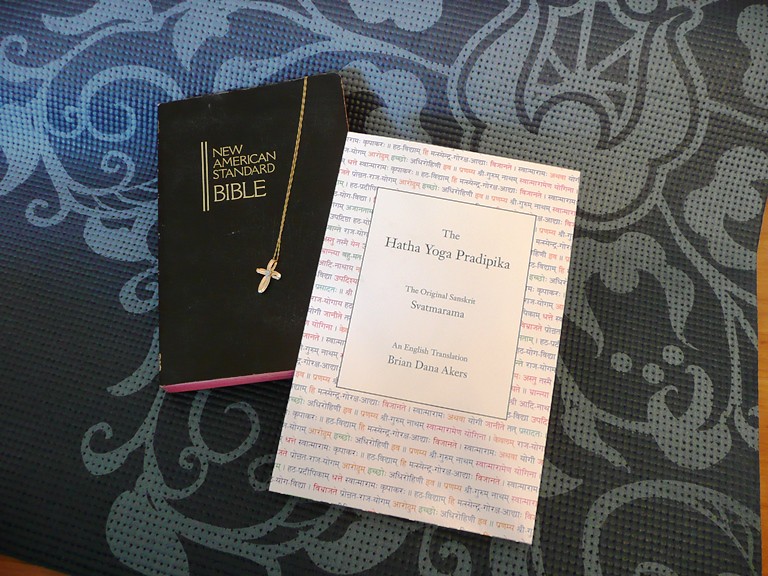
Edit (03.12.25): A photo was posted on Another Stretch For EVERY DAY!
Posted in Yoga/PiYo/Pilates | Tagged: , , , , , , , | 4 Comments »

Practice To Make Yourself Feel Good

Posted by terrepruitt on July 18, 2015

I wrote about compression a few posts back.  In the post I used pictures of Mr. Bones to help explain how sometimes an asana might not work for you in trying to do it the way you might see it pictured in Yoga Journal or on a yoga website.  It could be that your bones actually will connect before you can get that “perfect” pose.  But often what happens is the way you are doing a pose is perfect for you, you don’t have to look like the magazine.  Yoga magazines are just like fashion magazines, they pick the models that will look good doing the poses just like they pick the models that will look good wearing the clothes.  The people in the pictures are not DOING yoga, they are POSING for a PICTURE of a yoga pose.  What they are doing is TOTALLY different from what you are doing.  What you are doing is a practice in order for you to feel better.  So you want to do your asana in a way that will achieve that.

In other words, the idea is not to “get into a pose” the idea is to move into the pose, then BE in that pose.  Sense what your body is like in that pose.  Notice your breath in that pose.  Notice your emotions in that pose.  Notice your mind in that pose.  Could be that you notice pain somewhere, then you are to adjust your body so you are more comfortable.  If your breath is labored, perhaps you need to ease off?  Perhaps not, it depends upon the yoga you are doing . . . but notice your breath.  Some postures bring up certain emotions.  Take note of that.  It is ok to let them happen.  If you want and you feel safe let whatever comes up, come up and out.  But again, you do what you want to do and you do what you feel comfortable doing.  And, notice your mind, your thoughts . . . if you are able to let your mind wander perhaps you need to move deeper into the pose so you are more focused on your breath and body.

A lot depends on the type of yoga you are doing.  A lot depends on what the purpose of the pose is.  But the idea of asana in most types of yoga is to BE in the pose.  Take notice of the pose and all that is happening with you and your body at that moment.  Yoga is just like many things . . . unless you are practicing it for many, many, many hours a day you are better off doing it in your own body’s way then trying to achieve things you see in magazines like Yoga Journal and in the books written by yogis that practice for hours at a time and have been practicing for years.

Again it depends on what type of yoga you are practice, but many types, styles, and teachers realize it is more important to protect the body you have and move into a posture as your body will do the pose, than to try to achieve that “perfect” pose.  If you do the twists, the back bends, the forward bends, the balance poses, and all the other types to the best of your ability you will feel better.  If you do your practice mindfully you will feel better.

What is your most comfortable yoga pose?

Posted in Yoga/PiYo/Pilates | Tagged: , , , , | Leave a Comment »

The Base Of Many Asana

Posted by terrepruitt on July 11, 2015

As you may know, there are thousands of yoga poses.  Some of those may be variations or modifications, but still, there are a lot of yoga poses.  I think of them in four categories; standing, sitting, lying down, and kneeling.  Some people break them into different categories or types: standing poses, forward bends, back bends, twists, balances, and inversions.  Or even standing, twists, sitting/forward bending, supine/prone, inverted, balancing, and back bending.  To me you can do a forward bend while standing or sitting.  Same with a twist.  Balancing can be done standing, sitting, or on knees.  Lying down is generally supine or prone.  Inversions can be done lying down or standing, and the same with back bends.  Within the four categories I named, I think of asana in terms of what are we doing.  Are we balancing, are we stretching, are we working on strength or is this a restful pose.  So sometimes those are my categories.  It just really depends.  Sometimes seated poses might look easy, but they might be more involved than you first realize.  It might appear to be a restful pose when in fact it is a strengthening pose.  One of those poses is Dandasana or Staff pose.

The staff pose is a sitting pose.  It might be considered somewhat restful, but you are using your muscles.  You are activating quite a few.  This pose might not be done often on its own in yoga classes, but it is a base or starting point of many poses.

This asana is simple, yet it might not be easy.  The pose requires you to sit up tall with a straight back.  You want to sit on your sitz bones.  Your weight is evenly distributed over both bones.  Your legs are extended straight out in front of you.  Your legs are together, thighs, knees, ankles and feet, together.  Your thighs are active.  You are actively pressing your legs gently into the floor.  Your knees are facing the sky.  Your feet are flexed with toes pointing up to the sky.  Your spine is lengthening.  You are reaching with the crown of your head to the sky, lengthening the neck, opening the chest, allow shoulders to relax, shoulder blades sliding down into your back pockets.  Your ribs are lifting up, away from your hips.  One way to do this pose is to press into the floor with your hands, arms are straight.

Using your hands is a variation or a modification . . . depends.  Pressing into the floor would give you tension in your arms allowing them to work.  But using your arms might be a modification because your arms might help you keep your spine straight allowing your core muscles to work less.

Another modification would be to sit on a blanket.  That might be more comfortable for your sitz bones.  Another modification would be to sit up against the wall.  This could be a step one might take if they need to build up core strength.

This pose is said to have the following benefits:

–strengthens muscles of chest, shoulders, and back
–tones abdominal organs
–improves digestion
–reduces heartburn and flatulence
–tones the spinal and leg muscles
–lengthens ligaments of the legs
–stretches and activates muscles of legs
–relieves sciatica
–improves posture

As I mentioned this post is the base of many poses.  The lengthening of the spine and legs is the start of many asana.  Some even keep that energy, the energy of the legs moving away from the hips and/or the energy of the head moving away from the hips, throughout the pose.  So this is a great one to master to help with other asana.

Do you practice Dandasana?

Posted in Yoga/PiYo/Pilates | Tagged: , , , , | 2 Comments »

Church Yoga

Posted by terrepruitt on June 4, 2015

There are so many different types of yoga, it is out of my range to know them all or to even have HEARD of them all.  There are “ancient” types of yoga and types that have been around for a very long time, then there are new ones.  There are some that have popped up rather recently.  I believe many ancient types of yoga have been morphed into different types of yoga.  Then once you become aware of a type of yoga it can still be different from studio to studio and teacher to teacher.  I recently became aware of a type of yoga I had never heard of.  I read the description and I thought, “Ok, I’ll give it a try.”  Because I have to teach throughout the week, I have to be attentive to my energy levels.  I have no qualms about attending a class and, if it is more than I want to do at that time, not doing it at the level that is being instructed.  So if it was more strenuous than I wanted I was planning on just doing it gently.  But the description sounded like exactly what I wanted.  So, I went to this class I had never heard of and I am not sure if the class was a little different because it was a holiday or what, but there was a lot of talking.  It was Kriya Yoga.

Kriya Yoga – Low/Moderate

Kriya Yoga highlights the relationship between the breath and the mind.
Breath influences mind and vice versa. Breath control is self-control.
Techniques include preparing the body with stretching and bending
exercises, practicing meditation, and incorporating breath

Dance Exercise, Nia, Nia in the City of San Jose,  Nia at the San Jose Community Centers, Nia classes in the South Bay, Nia Teacher, Nia Class, San Jose Nia, Nia San Jose, Nia workout, Nia, Gentle Yoga, Group Ex City of San Jose, San Jose Group Ex classes, YMCA, Zumba, PiYoThe description of Kriya Yoga that I read on Wiki, had me thinking that it was the type of yoga where participants would be experiencing two of the eight limbs of yoga; asana and pranayama.  But, the class focus or subject seemed more to throw us into experiencing about six of the limbs.  It was memorial day, and I had stopped looking at Facebook before class because I wanted to go to yoga and have a relaxing time of breathing, stretching, and bending.  I was avoiding all the war stories until after class, but I felt jolted by the homily.  It was like yoga and church rolled into one.

When I got home I discovered there are some descriptions online that describe Kriya yoga as the “spiritual yoga”.  That could explain why I felt as if I was in church.

The class is normally an hour, but this class was an hour and a half, so I don’t know if the extra time was used for talking or if the talking is part of the class.  I have not been in regular attendance in classes where talking and thinking about deep subjects are involved.  It was very interesting.  It was not the type of yoga I had been hoping for, I think it was a bit different than the description. I am not sure I will have the opportunity to get back to it because of scheduling conflicts and the location.  But we will see.  As I said, I think the regular class might be different, but I don’t know.  I wouldn’t mind going back to see.  The next time I will be a bit more prepared and not have the idea in my head that I will just be able to relax and focus on the poses.

I am planning on trying more types of yoga!

Have you ever heard of Kriya yoga?  What types of yoga have you heard of?

Posted in Yoga/PiYo/Pilates | Tagged: , , , , , , , , , , , , , , , , | 4 Comments »

I Don’t Like Fish, But I Like This

Posted by terrepruitt on October 30, 2014

I love twists. The folding, bending, twisting poses in yoga. Right now I’m thinking about Ardha Matsyendrasana or Half Lord of the Fishes Pose. This is the one where one leg is folded or bent and the other leg is over it and you’re twisted.  Twists can be challenging, but you can often find a level of execution that you can relax into.  And as with all poses the more you practice it well, the more you can twist as you gain flexibility.  Some twists – depending on the supporting factor – can be good to practice strength and stability.  Twists are good for flexibility and digestion.

I prefer to start this pose sitting on one hip (I’ll use the left hip in the example) with my feet to the (right) side.  Using the clock as we do in Nia, sit in the middle of the clock, with the left knee at 12 O’clock.  Reach with the crown of your head to the sky.  Lengthen the neck – create space between the ears and the shoulders.  Open the chest.  Draw the shoulders back and down.  Let those shoulder blades slide down the back.  Lift the ribs off of the hips.  Gently bring the right knee up and the right foot over the left knee to rest with whole foot on the floor at about 11 O’clock.  Use your left hand to gently hold the right knee as you twist your torso to the right.  Keeping the posture that you set up before you brought your right leg over the left (lengthened spine) allow your right hand gently press into the earth behind you . . . a few inches from your right buttock.  Both hips remain on the floor.  With your posture intact relax into it for a few breaths, then untwist, and bring your feet back to the right side.   Then switch your feet to the other side and proceed on this side.

That was the gentle version.  Stay with this until you are comfortable and confident that you can retain the long straight posture through your entire back and neck before you add the rest of the pose.  The additions could be using the crook of your elbow to hold your knee more snuggly up to your rotated torso.  The supporting hand would land on the floor more towards the center of your back as you increase the depth of the twist.  As you twist further you might find your right foot past the 11 O’clock position, straying towards 10 O’clock.  Find your comfortable place, keeping the whole foot on the ground.

A deeper twist would be to place the left elbow (keeping with the original example) on the outside of your right knee.  Your left hand could even rest on the left knee.  With this the supporting hand would land on the floor perhaps just a smidge more towards the center of your back as you increase the depth of the twist or not.  This is a different type of intensity but it might not take your supporting hand that much further back.

There is even a further step where you can thread your left arm (keeping with the original example) through your right leg under the knee and the right arm behind your back so they can link up.

There is also a way to decrease the intensity and that would be to straighten the left (keeping with the original example) leg.  It would remain active.  As in you would gently press it straight out and down.  Hip, knee, ankle and toes in alignment, with knee and toes to the sky.  The straight leg version can be used with any of the aforementioned “holds” (hand holding knee, crook of elbow, elbow on other side of knee).

This twist really helps with flexibility in the hips, knees, and ankles.  I think of it as one of those “pretzel-y” yoga poses.  I have experienced that it is best demonstrated with my back toward my students so they can bend, twist, turn, and hold the exact same sides.

Do you know this pose?  Do you practice this pose?  Do you like this pose?  How do you feel after you do this pose?

Posted in Yoga/PiYo/Pilates | Tagged: , , , , , , , , , , , | 2 Comments »

Sometimes I Call It The Star Pose

Posted by terrepruitt on September 6, 2014

I like this pose, Utthita Hasta Padasana (Extended Hands and Feet Pose).  It is an easy pose.  It is one of those asanas that can be used in so many places in a yoga routine.  It can be used in the beginning to allow you to “come into your body” and start the process of concentration.  It can be used in between other poses, either to rest or reset, or to allow for an easy transition.  It can be used at the end.  It can be used to help practice awareness and learning sensations in your body.  I often use it as part of the cooldown in my Nia classes.  It is basically something almost everyone can do.  Sometimes it might present an initial challenge for some needing help with balance, but after a bit it becomes easy.  I like it.  It is very versatile.

Generally no matter when or where in the routine this pose is placed in my current yoga classes we do not hop into it.  We step into the wide stance.  The feet are beyond the width of the shoulders.  If we have come from a mountain pose then we continue with our reaching, lengthening, relaxing, and lifting, but if we are stepping into this from another pose then we check our posture.  We want to reach with the crown of the head to the sky, lengthening the neck – creating space between the ears and the shoulders, we allow our shoulders to relax and our shoulder blades to “drip” down our back, we lift the ribs off of the hips, and lift the knee caps by activating our thigh muscles.  The feet – in the wide stance – are parallel to the edges of the mat and each other.  The chest is open.  Arms are stretched out to the side, elbows and hands are at an even height with the shoulders.  We are reaching for the opposite walls.

Standing there you open your chest and create space in the joints.  Reach up to be taller and reach out to be longer.  The head reaching up, the arms reaching out.  Feet are firmly planted, weight is evenly distributed over the entire foot (both feet), toes are spread.  Here is where you sense the strength and stability while opening.

This pose is traditionally done from the mountain pose with hands at chest level, finger tips touching in front of the heart center.  Then when you hop your legs into your wide stance you put your arms out at the same time.  In order to be “gentle” we step into our Utthita Hasta Padasana.

Many yoga poses are challenging.  Many test strength, many test balance, many test flexibility.  The ones, like this one might be very easy so the possibility that they are over looked and not practice in many yoga classes could be very high.  But it is the easy asanas where sometimes we learn the most.  We learn to take a moment to sense the body.  What does it feel like to stand wide, reaching and lengthening?  What is the sensation in my bones?  What is the sensation in my muscles?  Can I open my chest any further?  Can I make my arms longer?  Check into these sensations.  Allow yourself to learn and become familiar so that you can do more challenging poses with the body knowledge you have gained from the easier poses.

Do you do this pose as part of your practice?  Do you do this pose in the yoga class you attend?


Posted in Yoga/PiYo/Pilates | Tagged: , , , , , , , , , , , , , , | Leave a Comment »

Challenging Easy Pose

Posted by terrepruitt on February 25, 2014

I love my students. They are a great source to me; they teach me and they make me laugh. Recently one of my students happen to mention a policy that was told to her – a facility stated she could try the class for 10 minutes without charge, but would have to sign up for the class to stay longer. The comments from those that she was sharing this with was that 10 minutes was not really long enough to get a sense of the class and if they would like it. She said, “I know, if I would have only stayed 10 minutes I would have missed the nap time at the end!” That was the best. She, of course, was kidding . . . sort of. She was talking about Shavasana. A very important part, yet for many, one of the most difficult times in yoga.

She was kidding in the sense that we all know it is not nap time, but not having been familiar with yoga she would have missed seeing that part of the class if she had only been allowed to stay for 10 minutes. Shavasana is a pose of total relaxation. It is where you allow your body to rest and relax from the workout it just participated in. In some classes this is a necessary time for recuperation of the body, but in others it might not be so much about the body. In a Gentle Yoga class it could be more about the mind. In Nia we have BMES – Body, Mind, Emotion, and Spirit. We could say that shavasana is a time for those four things. So after a nice gentle class it could be more a time more for the mind, emotion, and spirit to relax. While the inner dialog should be kept to a minimum while practicing the asanas it is even more important to do so during shavasana. This is the time when the body absorbs all the goodness from the poses it just performed.

I had once thought that you DID shavasana IN the corpse pose, but the name comes from the Sanskrit words Shava meaning “corpse” or dead body and Asana meaning “posture”.*

One of the reasons shavasana is so difficult is because there is not supposed to be any inner dialog going on (as I just mentioned). This is not the time where you begin making your shopping list for your trip to the store after class, or where you decide what you are going to say to your boss/friend/spouse. This is a time of quiet, a time of reflection, a time where you do a “body check”. Check in with each body part or area of your body to see if it needs any attention, see if it needs to be relaxed and focus on allowing it to relax. Sometimes because of this relaxation one might fall asleep. When I first started every time I did shavasana I fell asleep. Now I don’t, I am better at being mindfully relaxed. It is a practice though. This might not be something that comes easy to you, it might be a challenge, but it is something worth practicing.

I’ve heard different ideas on how to hold shavasana in a class. Some say that a guided meditation is the way it should be done. Some say that total silence is the only right way. Some say some music or nature sounds should accompany this pose. In my classes I usually softly lead the participants into a relaxed state. Then I allow them quiet time with this pose — I do have sounds playing during class and I don’t turn that off, but sometimes I turn it down. Then after the time allowed I talk them back to awakening their bodies and moving again.

If this pose and time is not something that you include in your yoga practice, I encourage you to give it a go. Try it. If you fall asleep that is ok. But keep doing it and when you are able to achieve that relaxed state while staying awake you will see how powerful this simple pose is.

Do you practice shavasana? Have you ever fallen asleep during shavasana? How long do you stay in this pose?

*Wiki and Jaisiyaram

Posted in Yoga/PiYo/Pilates | Tagged: , , , , , , , , , , , , , , , , , , | 2 Comments »

Get Down On It

Posted by terrepruitt on February 4, 2014

Did you sing it?  When I began to write this post the first thing I thought of is what I often think of when I sit down to share something on my blog and that is WHICH way do I want to describe it.  As I have said numerous times there are different ways to do things and you can check the web, books, magazines, and other places and you will see different instructions.  So while I was glancing at the different pictures what popped into my head was “GET DOWN ON IT!”  There really is no “it” in this position.  That is just what popped into my head, then as I was typing it . . . I was singing.  Of course, you were singing too as you read it right?  Please stop here and take a few minutes to Get Down On It!

Ok, now that you are back.  Let’s talk about the Garland Pose.  This is an instinctive position for the human body and one that gets abandoned as we age.  As I type, I see myself writing at least three posts about it, not the Garland Pose specifically, but this position.  I am starting with the Garland Pose.

The Garland Pose or Malasana is a yoga asana.  This pose can easily be described as a low, deep, or full squat.  I have posted about squats before, but the squats I was talking about previously were not full squats.  I think of those ones more as “weight training” squats.  Either doing them with weights or on a BOSU and not going all the way down.  The legs are not fully “folded” in that type of squat.

In the Garland Pose the legs are folded to where the back of the calf touches the back of the thigh.

Remember there are different ways to do this, the main goal for ankle and hip flexibility is full foot on the floor, legs folded with knees wide.  So these instructions are going to start with feet flat on the floor.  Place your feet about shoulder width apart (not wider than).  Have your toes pointing just slightly out on the diagonal.  Then lower your buttocks down, keeping your knees wide.

If it is not just a matter of “lowering your buttocks down” as in, this is not easy for you there are things to do to allow you to practice getting into that position.  One way is to fold over, bending at the hips, and place your hands on the ground then lower your tush down.  If that is not a comfortable option you can put your hands on the seat of a chair and lower your butt until it is comfortable.  With each try, go lower.  Eventually you will be using elbows on the chair.  With this method you have to be cautious with the chair.  If you are using it to hold your weight you have to make certain it will not move or tip over on you.  So use a secure chair.

If not the fold over or chair technique, you can use a strap or something secured around a door knob.  Hold onto that as you learn to lower yourself down.  There are many precautions to take when using a door knob so make sure you think about all of them (strap not slipping off, door knob not popping off, door secure – not opening, no one walking in the door you are using — and more, so please be careful if using this technique).  With a secure strap you can work your way down slowly or in increments.

Once down, center your torso in between your knees and thighs.  Your knees are wide.  Place your elbows at your knees hands in Añjali Mudra or prayer position.  Embrace the beauty of posture that is yoga and lengthen your spine.  Lift the crown of your head up, reach the neck longer, lower the shoulders as they pull back, lift the ribs off of the hips, all the while your tail reaching for the earth.  Stay as long as you are comfortable.

Another modification to practice is to put a folded towel or blanket under your heels until you are able to put your heels down.  One of the reasons this position gets abandoned as we get older is our calf muscles get shortened and/or tight.  In some people high heels are the cause of that.

(11/17/21: Click Garland Or Malasana Or Squat for a picture.)

This pose is beautiful for some many reasons.  To name a few; it helps with balance, it opens the hips, it improves flexibility in the ankles, it can transport you back to when you were a child and did not hesitant to squat to see what was on the ground!

When you are done push up to standing.  If that is not an option, I recommend getting up any way that is comfortable for you.  Eventually with practice you will get stronger and find many ways to rise.  Also with practice you might find yourself using the squat to pick things up instead of just bending over.  Remember it is a practice so you don’t have to save all the moves for the mat, incorporate them into your day.

So did you sing?  When practicing this pose how far can you get down?  Are you utilizing either the chair or the door knob technique?

Posted in Nia, Yoga/PiYo/Pilates | Tagged: , , , , , , , , , , , , , , , , , | 10 Comments »

Down Dog

Posted by terrepruitt on June 6, 2009

Even though the Adho Mukha Svanasana or in more familiar language, Downward-Facing Dog is often used as a resting pose or a transitional pose, you are working a lot of your body.  It is a great pose for working your legs, back, shoulders and arms.  More specifically your gastrocnemius (calves), hamstrings, retucs femoris (front of leg), gluteus maximus, latissimus dorsi, serratus anterior (muscles by the ribs), deltoids, and triceps.

As with a lot of yoga asanas the “working” is either a lengthening and stretching or a strengthening or both. This asana also helps strengthen the hands.

Recently I took a yoga class in Los Gatos and I am looking forward to going back because I realized something, I don’t like this pose that much.  But what I have come to accept in my exercise workouts and Nia practice, is that if I don’t like something it is usually because I am not doing it correctly or it is something in which I need to improve.  So the reason I am looking forward to my next class is because I hope to ask the instructor for a body check.  If not in my next class I will ask the instructor in Willow Glen. I want an instructor to assist me in making sure I am doing it correctly.  Then once I feel the correct way to do it, I will work on it.

So, as you can see I am taking this Down Dog thing seriously.  Just because it is thrown in as a way to get to the next move and sometimes treated like a rest, I still want to use it to help strengthen my back, shoulders, and arms.  I want to work at it to make sure I am getting the full benefit of the lengthening of my legs and arms, and the stretching of back.  Do you work your Downward-Facing Dog or just let it lie?

Posted in Yoga/PiYo/Pilates | Tagged: , , , , , , , , , , , , , , , | 4 Comments »