Archive for the ‘Nia’ Category
Posted by terrepruitt on July 3, 2012
I often get e-mails and phone calls from people who say they have injured themselves and they ask if they can do Nia. Well, I am not a doctor and I don’t know the extent of their injuries, but I explain to them one of the core philosophies (if you will) of Nia. You do what YOUR body can do. EveryBODY is different. EveryBODY has something going on in their body and something going on in their life. EveryBODY will be different every day. So we encourage everyBODY to do what they can. Of course, depending upon the injury, people should check with their physician and be cleared for aerobic activity and movement and when they get to class how much they do is up to them.
It is important to remember that each individual is responsible for his/her own body. When someone has had a recent injury it is very important to remember to be their own Conscious Personal Trainer (CPT). It is up to you to move in a way that is healthful. You are the one that knows the extent of the injury and you are the one that has worked with a medical professional to be healed. So here is where you really get to be aware of your body and do only what it can do.
I’ve also posted before about the levels of intensity. In Nia we say that there are three levels of intensity and Nia teachers demonstrate three levels, but really there are many, many, many levels due to the fact that everyBODY is different. My level one (which is deemed the lowest level of intensity) might be someone else’s level two. My level three could be someone else’s level two AND in addition to that, it could change the very next day! EveryBODY has different levels of intensity. I might take BIG steps to the side, whereas the person right behind me might take little steps, and the person next to her medium steps, and the person behind him HUGE steps. We all move in our own way. It is up to each individual participant to do what works for them at that time. If there is an injury involved maybe the level that used to be intensity level one, has now changed to level three intensity. It could take some time for the body to adjust and heal and get back to its original levels of intensity.
Nia believes you do what your body can and by doing what you can you will feel good. And when you feel good you will realize that you can do a lot. So the next time you do it you might do more, then the next time more, then the next time—might be a rough day, you might do less—and Nia rejoices in that. It is important to do what you can at the moment you are doing it.
I always encourage Nia participants in my classes to play with different levels. I also encourage them to try new things, to not always do the same move they are comfortable with. This could be something that one is required to do if they have injured a body part. Any injury sometimes can be a chance to grow in other areas. It doesn’t have to be a stopping point. So I encourage people to keep moving – if they can – so, yes, people can do Nia if they have been injured. As long as they have been cleared to do so by a doctor. If they are fit to move Nia can easily be adapted to help them move in their new state and get them back to dancing with joy.
Posted in Nia | Tagged: Aerobic Activity, Conscious Personal Trainer, CPT, injuries, levels of intensity, Nia, Nia class, Nia participants, Nia students | 4 Comments »
Posted by terrepruitt on June 30, 2012
I teach Nia. I have been teaching Nia for three and a half years. Not as many people who I talk to have heard of Nia as have heard of Zumba so I am constantly being asked the difference between Nia and Zumba. Since I am often asked I am often thinking about them and comparing them. First, they are actually the same in that music is played and participants dance to it. Second, in both the instructor leads the participants through the various dance moves. Third, participants of both claim they are both fun. One difference is Nia is an experience in five sensations, Zumba seems to concentrate on one.
The experience is such a big part of Nia we actually call them the five sensations of Nia. I have posted about them before (FAMSS). They are the sensation of flexibility, of agility, of mobility, of strength, and of stability. In a Nia class your body will move in a way that allows you to sense the energy moving out and away. You will bend and stretch to play with flexibility, either retaining what you have or improving upon it. There are moves in the routines that require the start and the stop. The movement that is agility could be done with our feet, our arms, our hands, our bodies, our heads or a combination of body parts but we sense the start and the stop. With every routine there is a lot of mobility, some routines have more than others, but all of them that I have experienced have a lot. With mobility it is just the same as agility in that it could be a body part that is moving or our whole body. Whatever the case there is a lot of movement from each joint that helps create a healthy joint by allowing the fluid to move to it and within it. Then we also play with strength. We might squeeze our muscles sensing the energy moving in as if the bones are being hugged by the muscles. We might do squats or sit-ups, punches and/or kicks, but there is time where we play with strength. I say Nia is very big on balance because we do many moves that requires us to be stable. Many of our moves are balancing on one leg, could be a kick, could be a stance, but it requires stability. Moving from one move to the next often requires us to call upon our stability. In a Nia routine we experience all of these sensations. I’ve reached the conclusion that Zumba is primarily agility.
In Zumba the moves are always fast. So it is a constant state of start and stop. The only sensation I sense while doing Zumba is agility. Fast start, fast stop . . . . even when there is a stretch where your muscles are yearning for a second to move to their fullest length, it is a fast stretch that does not allow for the muscle to be fully stretched. Doing a full hour of agility is not a bad thing at all. It can be fun and it can produce a lot of sweat. And many of us are programmed to think that sweat equals a good workout. I think that if you are adding Zumba to a stretching program that has some balance practice in it that is great.
I am also a believer that there are a lot of things that compliment Nia too. I actually think that if you like Nia and Zumba and you are able to do both that is a nice combination. You get two different types of cardio. One that is a workout in the sensation of agility and one that can move you through more use of the entire body to get that heart pumping.
I really believe that whatever gets you moving is GREAT. I think that you have to like what you do in order to make it a constant in your life. So Zumba, Nia, Jazzercise, U-Jam, yoga, kickboxing, bootcamp, weight training, whatever works for you is great. Do what you will do! That is the key!
It is that I am always asked about the difference between Zumba and Nia that I am always thinking about it and this was my latest thought after I did a Zumba class. I think I posted before about how I am left wanting to extend and finish my moves in Zumba and it dawned on me that it is the sensation of agility that is predominant in Zumba. Some Zumba classes I have attended do take a song to stretch at the end, but not all of them. So I guess it depends on the instructor. Nia instructors are encouraged to infuse their classes and the routines with their personalities, so I am sure that every Nia class has a few differences too.
Both Nia and Zumba are great cardio workouts. It just depends on what you want to do during your workout and what you want to get out of it. Do what you will do!
So, what is it that you do?
Posted in Nia, Zumba | Tagged: agility, bootcamp, cardio dance, cardio workout, dance exercise, FAMSS, five sensations, flexibility, Jazzercise, kickboxing, Mobility, Nia, Nia Classes, Nia instructor, Nia Moves, Nia participants, Nia routines, Nia Teacher, Nia vs Zumba, stability, strength, U-Jam, Ujam, weight training, Yoga, Zumba, Zumba classes, Zumba instructor, Zumba participants, Zumba routines | 11 Comments »
Posted by terrepruitt on June 26, 2012
I have posted before about the 13 Principles in the Nia White Belt. The fourth principle, FreeDance, has eight stages. I am working my way backwards posting about each stage. This post is about second stage: Being Seduced by the Music – The Art of Listening. In the second stage of Nia FreeDance the exercise we perform is stillness. We keep our bodies still while we listen to the music. We allow ourselves to be seduced by the music and practice the art of listening. When listening to a song that is not familiar or doesn’t have that “get-up-and-dance” beat it is not so difficult, but when the song is one that makes every part of your body want to move, when it is familiar, or one you love it is not easy sitting still. It is not easy to sit with a tall spine that does not gyrate to the beat. But when we do practice the art of listening with only our ears we might hear sounds we had not been aware of before. While we are listening the idea is to name instruments and sounds that you hear. Sometimes you might not know what you are hearing, either you don’t know the name of the instrument or it isn’t really an instrument at all, so you can give them their own names. For instance something might sound like rushing water or trash can lids. I know a Nia teacher whose husband is in a band and she is familiar with a lot of different instruments and the sounds they make. She is very good at naming them when she hears them. Me, if you look at my bars you will see a lot of spaceships. There is a sound that I think of as a spaceship so I use that symbol to signify that sound. I HEAR a spaceship.
This stage might sound a bit like RAW, where we are Relaxed, Alert, and Waiting while we listen to the music, but it is not. Our bodies might be in the same position, of a lengthened spine and a relaxed state but in RAW we are just listening without opinion or too much thought. We have no inner dialogue so there is no naming of sounds. In RAW we are just waiting to receive. With Being Seduced by the Music we are practicing the art of listening and naming what we hear. We are engaged in the music even though we are not moving.
For me this stage of FreeDance might even produce a few pearls. It could be that I don’t know the instrument so I think of what it sounds like which allows us to move “as if we are sloshing in mud”. Or it could be that the sound just makes me think of a certain movement such as “throwing your arms in the air with a burst of sound”. While I might not be purposefully trying to think of pearls with the seduction I just let my mind flow. If there is a dialog then there is, if not, that is fine. I just let the music flow and I listen giving names to this sound and that sound.
Listening to the music without giving it dance or without it allowing to move us in dance allows us a deep relationship with it. We are not imposing our own ideals onto it as we move or we are not interpreting it, we are just letting it in. We are just listening. With that we learn about it. We hear things we might have missed while floating about the space. It is nice to be able to have that connection with the music.
Stage two of FreeDance, Being Seduced by the Music – The Art of Listening is just another toy in our toy box that Nia has given us to play with to become better teachers and better dancers.
Have you ever been sitting still listening to a song you have heard many times before and heard something you hadn’t heard before?
Posted in FreeDance, Nia | Tagged: 13 Principles in the Nia White Belt, Art of Listening, eight stages, Nia, Nia dancers, Nia FreeDance, Nia Music, Nia pearls, Nia RAW, Nia teachers, Nia White Belt, seduced | 2 Comments »
Posted by terrepruitt on June 7, 2012
 Are there any dance exercise classes that you know of where you are encouraged to quack like a duck? Well in all Nia classes we like to have fun, plus Nia understands the benefits of sounding, so there is a move where we quack while we are doing it. Of course, quacking is not limited to being done only when we do this move, but this move is actually called Duck Walk. It is very fitting to quack while doing this move. I know to many quacking seems silly. Sitting and reading about it has to make it sound really silly, but in class with your feet gently slapping the floor, it seems perfectly natural. Making noise is natural and it tends to make working out much more fun. It is also very amazing when moves have their own sound. The Duck Walk, of the Nia 52 Moves is one that has its own sound, “Quack! Quack! Quack!”
All of the 52 Moves are listed with pictures in The Nia Technique Book. I cannot emphasize enough how helpful this book is. If you are interested in movement in the slightest or if you are interested in the body mind connection you would enjoy this book. The Duck Walk is described on page 114 as:
“Standing with your feet slightly apart and no wider than hip width, alternately lift and then lower the toes and balls of each foot, as if you are slapping the ground to splash water in a puddle.”
So your feet can be slightly apart or as far as hip width. Remember “hip width” means hip JOINT width. Thigh bones straight down from your hip joints. Then the toes and ball of foot lift. Then you splash. Splish splash in puddles. As with the Squish Walk I have a different way to do this with different imagery. When I am doing it as stated in the book, I DO think of my toes splashing in the puddles. But when I think of a duck and its walk, I tend to put my toes out. I think of toes out as duck walk. That’s when the move lends to quacking for me.
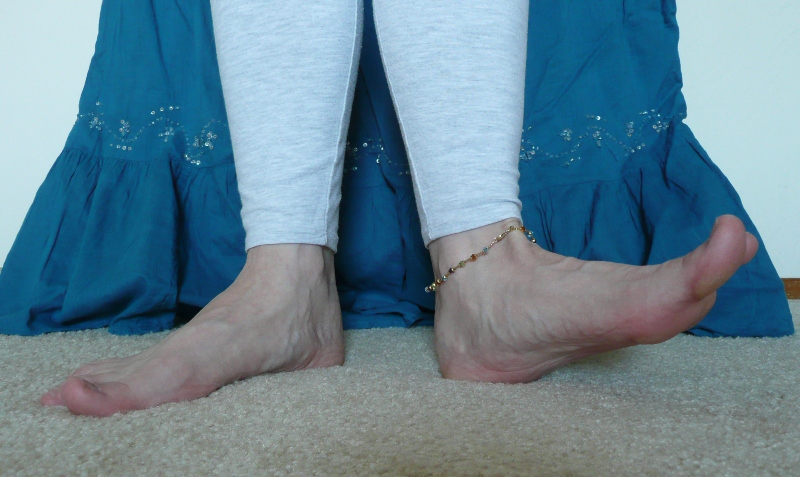 Just as the same as with the Squish Walk The Nia Technique Book does not give instructions to walk while “duck walking”, but we do it all the time in my Nia classes. This duck walk move really allows for ankle movement and helps condition the muscles on the front of the lower legs so I like to use it. High heeled shoes — especially the ones now-a-days — have feet stuck in the opposite direction with hardly any ankle flexion so the Duck Walk is great to get those muscles moving and stretched.
While progressing forward with the duck walk it is not the same as heel lead walk even though you lead with the heel. With the duck walk we don’t roll through the entire foot, we gently splat the foot down. It is a heel lead then splat with the rest of the foot. That is why the imagery of splashing your toes in the puddle works so well, I bet as a child most of us have done that.
Between the quacking and the splashing it is no wonder Nia is so fun. Adults as play! Splish splash quack!
Did you get up out of your chair to try it? C’mon, try it!
Posted in 52 Moves (of Nia), Nia | Tagged: 52 Nia Moves, dance exercise, duck, Duck Walk, hip joints, hip width, Nia, Nia Classes, Nia Moves, quack, Quacks Like a Duck, sounding, Squish Walk, The Nia Technique book | 4 Comments »
Posted by terrepruitt on June 2, 2012
Nia is the same as many things, the more you do it the more accustomed your body becomes to the movement. When you first try swinging a bat or a golf club it seems as if there are so many things to think about. The placement of your feet, the bend in your knees, the sinking of the hips, what your hands are doing, what your elbows are doing, where your chest is facing, to move or not to move your shoulders. Then there is your head, your eyes, and – oh yeah – the ball. So much to remember. Then as you practice you forget that you even were once having to remember all that. You are able to just “let go” a bit and play the game. Dance exercise is the same way for some. There are moves in Nia that we do, the 52 moves. At first the body might be so busy trying to do it correctly it is not allowed to play, but once the moves are learned there is time to play. In a Nia routine a move is often repeated enough so it can be learned and then the play can begin. But there is still a technique, there is still a right way to do it in order to get the benefits from it as was the intention of having the move be a part of Nia.
One of the moves that I sometimes find challenging is the Squish Walk, the way Carlos AyaRosas (FKA Carlos Rosas), told us how to do it. I had thought it was rising on the ball of one foot, then squishing that foot down, then rising on the other ball of the foot, and alternating. The imagery is that of squishing oranges under the heels. I had thought it was one whole foot on the ground before bringing up the other, but that is not how he instructed us.
His instructions were to be on the both balls (of the feet) at the same time. Not all the way up on both feet but one heel HIGH and one lowering and switching like that. The foot that is flat on the ground (whole foot) is not there long because it comes right back up. I found this method much more challenging than the one foot down and the other foot up. The method Carlos had us do tends to work the calves and shins more than the other method.
The Nia Technique Book states one foot is down (whole foot on the ground) before bringing the other foot up. Both methods work the lower legs, improving strength and flexibility. Neither method is actually a walk. We are not progressing forward. Although the squishy movement could be incorporated into a walk.
 With the method in the book, I usually use the image of high heeled shoes. Lift one heel as if you are showing off a new high heeled shoe. The concentration is on the lifted heel. Then switch heels. With the method Carlos taught I think more of oranges. The concentration, to me, is more on the squish.
In the Nia routine we have been doing this past month in my Nia Classes we do something they’ve dubbed the “double squish walk” which is rising at the same time on both balls of the feet. Then the squish is on bringing both heels down at the same time. Double Squish. I just call it up on the balls of your feet, since it doesn’t seem very squishy and it is not like either method.
I invite you to try both methods of the squish walk. Lift one foot onto the ball of the foot, then set it down and lift the other foot. Alternate. And try, lifting up on both balls of the feet, then start to lower one to ground, then alternate. It is as if in one method both feet end up on the ground and with the other method both feet end up on the balls of the feet. So fun, the different ways to do the moves yet, both ways are to help condition the lower legs to help “you move safely with different speeds and intensities”. In other words be sturdy on your feet as you move and dance through life!
Posted in 52 Moves (of Nia), Nia | Tagged: "double squish walk", ball of one foot, Carlos AyaRosas, Carlos Rosas, conditioning benefits, dance, dance exercise, dance practice, dance through life, flexibility, golf club, high heels shoes, improving strength, Nia, Nia Classes, Nia Practice, Nia routine, Nia Technique, Nia's 52 Moves, Squish Walk, squishing oranges, swinging a bat, The Nia Technique book | 4 Comments »
Posted by terrepruitt on May 24, 2012
Just a few posts ago I talked about simple stretches that could possibly bring relief to tight hip flexors and lower back pain. I referred to a yoga pose called the pigeon pose. This pose is where one leg is stretched out to the back and the front of the leg (the front of the thigh, the knee, the shin, and the top of the foot and toes) are on the ground, touching the ground, and the other leg is bent at the knee with foot towards the body, but the shin at a right angle to the body. The hand can hold the foot. The back is long and straight and upright. There are variations. Some are where the leg is bent more and the foot is more pointed toward the opposite hip. In some the back is still long and straight, but the body is lying over the bent leg.
In Nia the variation is called a Side Yawn. The leg is bent so the foot is near the opposite hip, as I mentioned above. The arm on the side of the bent leg is bent while the arm on the side of the outstretched leg is straight with palm on the floor. As the body lowers to the earth over the bent leg the outstretched arm moves on the ground reaching out further. Allow the entire body to sink into a comfortable fold. The lengthened side of the body yawns open.
For the more athletic version there is more weight on the bent leg and instead of just stretching out over the bent leg there are push-ups involved. Pushing away from the earth and sinking slowly back into it. After a few push-ups then allow your body to release to gravity and lay over the bent leg.
This is one of the moves that I mentioned were in the back of The Nia Technique Book. Both the classic version and the athletic version of this move open and release the hips. With the classic as you sink to the floor the side of the body is receiving a long stretch. The athletic version enables strengthen of the arms and core. This move is one where you would do as many repetitions as you would like and then switch to the other side. Or you could do one side then switch and do the other side. The point it to be sure that you do both sides. I would bet, as with most of us, one side is more flexible than the other.
In the Nia routines I do we are often in the pigeon pose or the side yawn pose, but we do not always sink into the yawn. Often we are dancing with our hands on the floor, not necessarily doing straight up and down push-ups, but using our arms to lower us to the earth and push-off again. As with all moves each individual is invited to do what is best for their body at that moment in the Nia class. So some might sink into the yawn. So usually in addition to stretching our hips we are using our core and our arms in our cool down or floorplay.
Do you ever sense your hips are tight and need stretching? Might you think to use this stretch to loosen up?
Posted in Nia, Yoga/PiYo/Pilates | Tagged: Athletic Nia, classic Nia, cool down, flexible, floorplay, Hip flexors, lower back pain, Nia, Nia class, Nia pose, Nia routines, Pigeon pose, side yawn, simples stretches, stretching, The Nia Technique book, tight hips, yawn the body, Yoga, Yoga Pose | 2 Comments »
Posted by terrepruitt on May 17, 2012
I often have mentioned the 52 Nia Moves. I am taking my time posting about them, but they are in the Nia Technique Book. You could always order a copy from Amazon if you are interested. That is how I started my Nia practice. In the book after the section on the 52 Nia Moves there are pages and pages of other moves too. There is the 13 Joint Exercise, explanations of combinations of some of the 52 Nia Moves, Spinal Melts, and T’ai Chi Sways, and many more. They are organized in the Nia Cycles. The moves that are part of the warm up are in the Warm up section the more active moves are in the Get Moving section. Each move has a “Classic” explanation and an “Athletic” explanation. Nia is done in bare feet so there is no to very little impact, but that does not mean there is no intensity. Intensity comes from BIGGER moves. Bigger moves can be more arm movement either faster or further away from the body or both. Bigger moves can be moving deeper into a move. So the explanation of “Athletic” contains bigger or faster (or both) movements. There are over 75 pages of moves. Each with a set of pictures. Both the classic and the athletic has pictures. If you have the slightest interest in Nia or movement in general I would strongly recommend this book.
I felt I had to share that because there really is so much in the book.
That popped into my head as I was sitting here thinking about going to go make dinner. Here is what we are having:
 Terre’s version of the Rantings of an Amateur Chef’s recipe:
Cauliflower Stuffed Portobello Caps
4 large Portobello mushroom caps
most of an entire head of cauliflower
3 green onions
1/2 C cooked and chopped bacon
1/3 C milk
3/4 C shredded cheddar cheese
1/4 C shredded Gouda cheese
salt, pepper, and garlic powder
Cook the bacon.
Scrape out the inside of the cap to remove the stem and gills.
Chop the green onions.
Preheat oven to 350 degrees.
Cut the cauliflower into large pieces. Steam for 6-8 minutes. Place hot cauliflower into the blender and some of the milk. Blend. Add milk as needed to achieve a mashed potato-like consistency. Mix with bacon and onions.
Fill caps with cauliflower mixture. Sprinkle with salt, pepper, and garlic to taste. Sprinkle with shredded chesses. Put a few onions on top. Place on a cookie sheet. Bake for about 15 minutes on the lowest rack in the oven.
The first time I made this I didn’t use the bacon and I will be doing that version a lot more often. It is really good! But I also wanted to try it with the bacon.
So I am going to go cook, then take pictures and post it all at one time!**
 Do look at the Ranting Chef’s blog as he cooks some amazing things. The difference between his recipe and mine is he did not determine from the get go how many mushrooms. His recipe calls for only one half of the cauliflower head, he used bacon bits out of a package (which is uber smart because it helps keep the recipe easy!), his seasoning is pepper and pepper only, and his instructions are to cook it only for 5 minutes.
I don’t like pepper so what I do is just sprinkle each mushroom individually so that my husband, who likes pepper, can have more of that flavor, while I just barely do a turn of the pepper grinder. I also like my mushrooms more cooked when they are stuffed. I have made stuffed small mushrooms and find that I like to cook them a bit before hand.
It’s your turn. Make this recipe and let me know how you like it. Let me know how you adjusted it.
**Ok, so I didn’t like it with the bacon, but my husband did. I like crisp bacon and putting it in with the cauliflower made it just like bits of meat in the mix. I also forgot to mix the onions IN so ended up with them just on top. The bacon bits from a package might make it worth it, but dealing with bacon was not worth it to me.
Don’t The Cauliflower Stuffed Portobello Caps sound yummy?
Posted in "Recipes", 52 Moves (of Nia), Food, Nia | Tagged: 13 Joint Exercise, 52 Nia Moves, Amazon.com, Bacon, Cauliflower Stuffed Portobello Caps, Gouda cheese, Nia, Nia cycles, Nia Practice, Portobello mushrooms, Rantings of an Amateur Chef, Spinal Melts, T'ai Chi Sways, The Nia Technique book | 2 Comments »
Posted by terrepruitt on May 3, 2012
Nia has a different closed stance than some other dances and exercises I know. In Pilates the stance is heels touching and toes apart. I’ve heard it called a Pilates V. The Pilates V is done in more positions than standing. Sometimes there are exercises done while on the reformer where we will place our feet in Pilates V. It is nice to have positions that are specific. It helps a lot. I as a teacher can just say, “Closed stance.” and the Nia students will know what that means. Instead of forming a V as in the Pilates stance we form more of a rectangle. A basic closed stance is simple. It is stable. Nia’s closed stance is the side of the big toes touching and heels apart. It is as if all four corners of a rectangle are in contact with the edge of the foot. This allows for a very stable base. In the basic closed stance the arms hang. The back is straight, we are standing tall, lengthening the spine. Knees are relaxed as well was the feet. Weight is balanced evenly on both feet. Simple closed stance.
 Closed stance is one of the six stances in the Nia 52 Moves. There is Closed Stance, Open Stance, A Stance, Sumo (or Riding) Stance, Bow Stance, and Cat Stance. I believe that in its basic form closed stance is the easiest. But when other elements are added that might not hold true.
We can practice our agility by walking quickly then stopping in closed stance. We might choose to be in closed stance while we allow just our arms to be agile . . . moving around in a starting and stopping fashion. We could just let our closed stance be stable as our arms are mobile. We could do an entire body dance . . . close stance dance. For some this is a challenge, even though our feet are formed into a rectangle and the idea is of a stable base it is still a practice in balance to have your feet secured to the earth while the rest of your body moves around. As I said, what we do with a close stance might not be so simple.
Practicing walking and stopping in closed stance is a good check to make certain you are not landing in “toes in“. The heels shouldn’t be that far apart as if you are doing toes in. Yet the toes should be touching. Coming from other stances to closed is good for conditioning the legs. Moving from Sumo to closed, or from at to closed is something to practice. Again we don’t want our heels to land too far apart making us pigeon toed.
I know of several routines that have us going through the stances. We start out in closed, then go to open stance, then go to A stance, then go to sumo. In some routines we work back through the stances, but in some we do move right into closed from sumo. I can’t think of one where we go from closed to sumo, but I bet there is one and I just can’t put my finger on it. Nia loves to mix up the moves to get the most out of the workout.
Can you sense the stability in the Nia Closed Stance?
Posted in 52 Moves (of Nia), Nia | Tagged: A Stance, Bow Stance, Cat Stance, closed stance, dance exercise, dance positions, Nia, Nia Dance, Nia Moves, Nia participants, Nia Teacher, Nia workout, Nia's 52 Moves, open stance, Pilates, Pilates reformer, Pilates V, Riding Stance, Sumo Stance, workout | 2 Comments »
Posted by terrepruitt on May 1, 2012
 At this point you might have noticed that I only have a post for 9 of the 52 Moves of Nia. I am going to work on that. I have a Nia friend who is posting about the 52 Moves of Nia on her blog and she has inspired me to continue on. I have the list of the moves on my website. I link the blog post from there so people on my site can click to see a description and possibly a picture. With only 9 post I only have 9 links. This is ten and moving forward.
Nia is a unique cardio dance exercise that combines nine movement forms into a fun and energizing workout. Nia has moves we call the 52 Moves. Many of them are common to other dances. I am posting here about Toes In, Out, and Parallel. I know I have seen these moves in other dances if not done together at least done separately.
 To do the move as one move you start with your feet parallel to each other. They can be hip (joint) width apart. Then turn your toes in to face each other. Turn them in as far as you comfortably can. Then swivel your feet out so the toes are pointing in opposite directions. Again, only do it as far as you can — comfortably.
This is the whole move. There is a routine where we are in A Stance and I have the participants dance toes in then toes out. Which I consider a lot of fun. You can play with this move by trying to walk with toes facing in, then with toes facing out.
I like to play with the move by doing one foot toes in and out. Sometimes just letting one foot do a dance all of its own; in, out, in, out, tapping my toe to the ground with each twist of my leg. I also like to do this move with varying stances. My instructions here say to start in open stance, but it can easily be done in A Stance (as I mentioned I do in my Nia class). You’ll notice that different muscles are used when you change the width of your stance.
Moving the feet in this manner allows for all the bones in the leg to rotate which gets the thigh bones moving in the hip socket. Movement is a way to keep the joints health. Movement helps fluid into the joints. I say “juicy joints.” We move to have juicy joints.
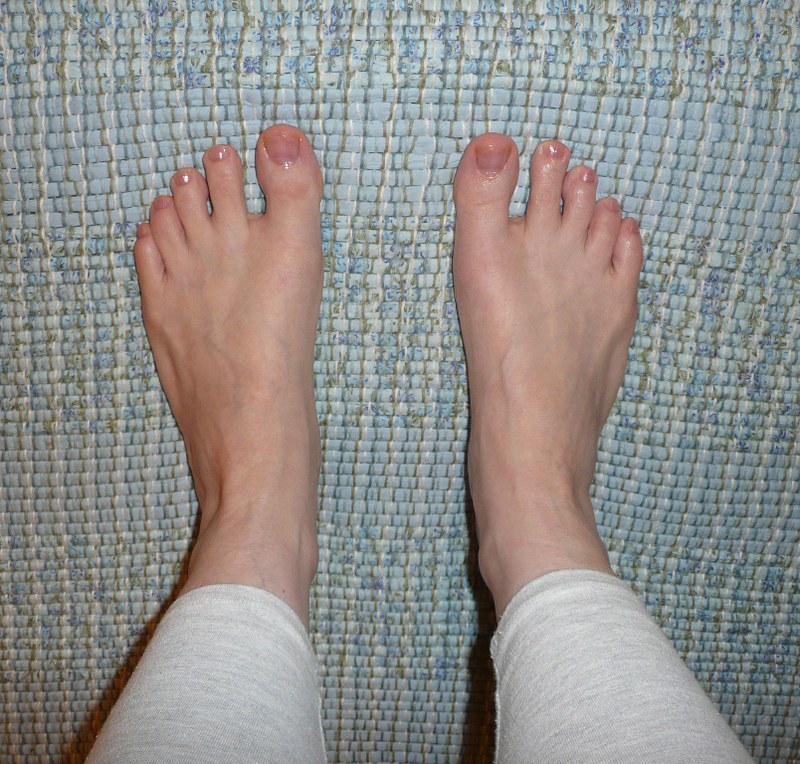 In addition to helping the hip joint this move helps keep the ankles mobile and the knees flexible.
With healthy hip joints, ankle joints, and knee joints the enables walking and moving in general to be done with ease. So even though this is one of the moves we use in our dance exercise routines that does not mean the use of it is limited to that.
You can decide to walk with toes in for a bit during your day, then with toes out. While standing you can stand with toes in, then out, then parallel. It is an easy exercise to play with and incorporate into your day. And it really does help with the health of your joints.
Are you gonna do it? On your trip from your desk to the coffee pot? While you are going about your day with the kids? Which on in your favorite, in or out?
Posted in 52 Moves (of Nia), Nia | Tagged: 52 Moves of Nia, ankle joints, cardio dance exercise, dance exercise, Dance Workout, energizing workout, hip joint, juicy joints, knee joints, Nia, Nia friend, Nia routines, Nine Movement Forms, Toes In, Toes Out, Toes Parallel | 2 Comments »
Posted by terrepruitt on April 28, 2012
When I first discovered Nia I bought The Nia Technique Book to see if I would be able to do it. I don’t mean do it as in do the moves and participate in a class, I mean do it as in “get into it”, as in understand it. It sounded a bit “woo-woo” to me. Listening to your body, voices of the body, energy this, moving energy that. I wasn’t sure I could sync it up with my beliefs. But as I studied it more I realized that it is based on science. It involves human kinetics. Most of the moves, although called the 52 Nia moves are quite common and are seen in many other types of exercises and workouts. The ones that I consider unique are probably part of some other dance I am not familiar with. And the “woo-woo” part, well, I realized that it is woo-woo – at least that is how many people think of certain things like energy, chakras, mind-body, and body-mind practices. I mean look at yoga, when I was young that was one of the “woo-wooest” things around and now people have embraced it. There are so many types of yoga it is difficult to keep track. For some they just ignore the woo-woo while others embrace it because they realize it makes sense. I mean cultures have been using “woo-woo” stuff for centuries. There is meditation, herbs, chanting, drumming — all types of other things that some people think of woo-woo. The woo-woo must not be too far off base though because it seems to work. Recently my posts have been about healing sounds and making sounds, this post is about the vowel sounds related to the chakras and I am sure to some people it sounds a little, or maybe even a lot, “woo-woo”. But I like to imagine that if you are reading this you are somewhat open to new things — even woo-woo things. So you might be willing to try the healing sounds or even the vowel sounds of the chakras.
The vowel sounds related to the chakras are as follows:
CROWN CHAKRA: EEE as in “me”
BROW/THIRD EYE CHAKRA: AAA* as in “say”
THROAT CHAKRA: EYE as in “my”
HEART CHAKRA: AH as in “ma”
SOLAR PLEXUS CHAKRA: OH as in “go”
PELVIC CHAKRA: OOO as in “you”
ROOT CHAKRA: UH as in “cup”
The idea is to say these sounds in a specific note. If you have a keyboard or a phone with an app that has a keyboard or an app that can give you examples of the notes it might help you. Or you might be musical and know what the notes sound like.
EEE is to be made in the B note
AAA is to be made in the A note
EYE is to be made in the G note
AH is to be made in the F note
OH is to be made in the E note
OOO is to be made in the D note
And UH is to be made in the C note
These sounds are to help open and heal the chakras. Or to keep them balanced, all depends on your needs and your practice.
As with everything there is a wealth of information out there on how to “do” the vowels. The commonalities I am seeing is to sit comfortable with a lengthened spine. Be relaxed. Use a normal breath. Repeat each sound seven times.
I have used these sounds in my Nia classes when we are using a chakra as a focus. I am going to take this list and use the vowels sounds just as I did the healing sounds. The focus can be the chakra vowel sounds and we can create an intent from there. Yay! I love thinking of things to use as focuses in my classes. I also think that sitting down to make these sounds as a specific exercise is a good idea. What do you think about chakra vowels? Might you try the exercise?
*Many places note this as “AYE” but to me that is AYE, as in what a pirate says. So I noted it as AAA, like Fonzie would say. 🙂
Posted in Chakras, Nia, Sounding | Tagged: Chakra, chakra energy, chakra vowel sounds, chanting, crown chakra, dance class, dance exercise, Dance Workout, exercise class, Fonzie, Healing Sounds, heart chakra, mind-body workout, Nia, Nia class, Nia Moves, pelvic chakra, root chakra, solar plexus chakra, The Nia Technique book, third eye chakra, throat chakra, unique workout, workout class, Yoga | 9 Comments »

 Terre Pruitt's Blog