Terre Pruitt's Blog

In the realm of health, wellness, fitness, and the like, or whatever inspires me.

  • I teach yoga, Nia, and stretch online!

    ALL CLASSES ARE ON ZOOM AT 10:00 AM PDT

    Tuesday Gentle Yoga 

    Wednesday Nia

    Thursday Stretch

    Please see my website for details!

    I am also available for private Nia / yoga / Personal Training all virtual, of course!

  • Unknown's avatar

  • Enter your email address to subscribe to this blog and receive notifications of new posts by email.

  • My Bloggey Past

  • ******

    Chose a month above to visit archives, or click below to visit a page.

Archive for the ‘Nia’ Category

Nia White Belt P10 – X-Ray Anatomy – 2020

Posted by terrepruitt on September 7, 2020

This is a great principle . . . ok, ok, yes, I know I say that about all of them . . . Debbie does, too.  I laughed at her today when she said something like that.  Again this principle has not changed since I originally took my Nia White Belt back in 2008.  Like I continue to say, the language has changed, the way it is presented, and the knowledge behind it has greatly increased but it is still the basic principle – look at the clues of the body to help you see what is “inside”.
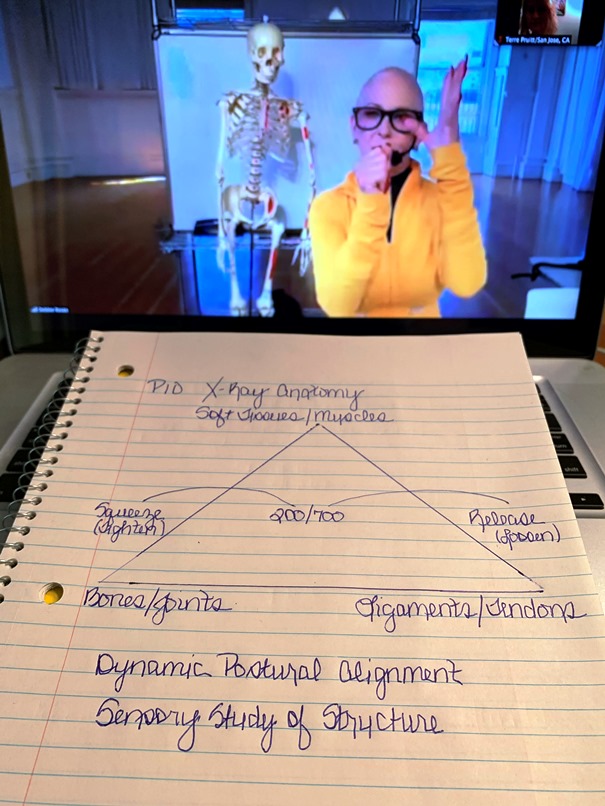
Dance Exercise, Nia, Nia online, San Jose Virtual classes, Nia Teacher, Nia Class, Nia San Jose, Nia workout, Nia, Gentle Yoga, Group Ex classes, Nia Technique, Yin Yoga, stretch classes, online exercise, Zoom classes, virtual yoga, City of San Jose online exercise, live classes via Zoom, Nia White Belt training via ZoomNia White Belt P10 – X-Ray Anatomy.  The triad, as you can see is Bones/Joints, Ligaments/Tendons, and Soft Tissue/Muscles.  These are the things we can “see”.  We make observations then move from there.

If you see one arm able to reach higher than the other or a pant leg shorter than the other, is it a mechanical situation or is it a structural one?  Is there muscle tightness in the shoulder that is preventing the arm to reach high or is one leg actually shorter than the other?  X-Ray Anatomy is just about looking and observing.  With the insight we gain from observing we can decide how to proceed in moving in a class, in teaching a class, and/or just moving through life.  We can then apply our knowledge of movement and anatomy to move in ways to help create ease in the shoulders that will allow the arm to reach its full potential and ease in the legs to allow for their full length.  We can also learn to give our body what it needs to find balance and ease even when it is not equal on both sides.

One way we learn X-Ray Anatomy is by Zorro.  Zorro is just a term Nia uses to describe making note of the flow of energy or the lines in a body.  You can do it by observing people – they can be people on TV or people you see in person.  Just quick strokes on paper (or if you have a device you can use) to note the movement of a body.

As I have said, I have posted about Nia Principle #10 X-Ray Anatomy and Zorro before so no reason to go further in this post.  Please click on over to those posts to learn more.

X-Ray Anatomy is just what we in Nia call observing a body and how it moves and we use Zorro as a tool to see the flow of energy all with the goal of helping ensure that we and our students are moving in the most safe and efficient way available.
Posted in 2020 Nia White Belt Principles, Nia | Tagged: , , , , , , , , , , | Leave a Comment »

Nia White Belt P9 – Upper Extremities – 2020

Posted by terrepruitt on August 31, 2020

Sometimes I laugh when I start to write up my share for the Nia White Belt training. It is so rich there is absolutely no way I can share it all . . . and that is good because it is fun to get more information when you take the training. And with Nia and the Nia 52 Moves there is always more to be had. This week we went over Nia White Belt P9 – Upper Extremities.

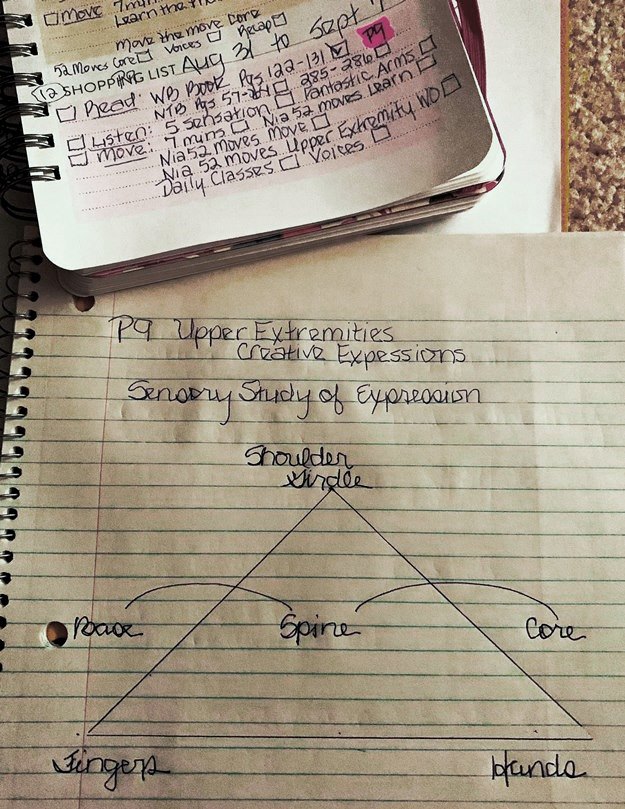
Dance Exercise, Nia, Nia online, San Jose Virtual classes, Nia Teacher, Nia Class, Nia San Jose, Nia workout, Nia, Gentle Yoga, Group Ex classes, Nia Technique, Yin Yoga, stretch classes, online exercise, Zoom classes, virtual yoga, City of San Jose online exercise, live classes via Zoom, Nia White Belt training via ZoomThe picture shows you Principle 9 as Upper Extremities with the tagline of Creative Expressions. And the definition being Sensory Study of Expression. The triad consists of the fingers, hands, and shoulder girdle. Then we have the spine in the middle because it helps and/or is a part of these movements along with the base and the core. We use our fingers and our hands to express ourselves and communicate, yes? Think about it, many of us “talk with” our hands, we reach out with our hands to comfort and be comforted, we can tell someone to come, go, stop, hurry up with our fingers and/or our hands, things like that. They also can be moved in ways that open and close joints and direct energy. Finger and/or hands can be moved to activate muscles. They can be used as the vehicles to help move our arms. Energy flow or lack thereof can affect our base. The spine can provide stability or enable us to move our fingers, hands, and shoulder girdle. The same with the core, it can provide stability or help us with the engagement of our upper extremities.

There is so much that can be said about each of the Nia 52 Moves individually, it is one of the things that is really fun to experience in a training (as I mentioned and will continue to mention).  We review the anatomy (because, remember Nia White Belt is about the BODY) and how the moves move the joints and muscles in the body. I can always revisit any movement and according to my current list of posts I still need to post about a few of the Nia 52 Move that are upper extremities, but for now I will just post the list and links.  I also want to state a reminder that the Nia 52 Moves instructions are done int THE BODY’S WAY.  It could be that your body will not move that way but after practicing the moves your body starts to move that way OR it could be that your body will never move in the exact way the Nia 52 Moves are laid out.  We all have different bodies and sometimes there are injuries or trauma we are dealing with.  And sometimes we are just not made to move that way.  That is why it is very important to keep BOTH THE BODY’S WAY and YOUR BODY’S WAY in mind when practicing Nia (or any movement for that matter).

The Upper Extremities

Arm Moves (3)
35.  Blocks
36.  Punches
37.  Elbow Strikes

Hand Moves (7)
38.  Touching
39.  Fist
40.  Pumps
41.  Strikes
42.  Chop Cut
43.  Webbed Spaces
44.  Palm Directions 

Finger Moves (8)
45. Finger Extensions
46. Finger Flicks
47. Creepy Crawlers
48. Spear Fingers
49. Catching Flies
50. Claw Hand
51. Power Finger Crossover
52. Balance Finger

I invite you to click on the links to see how you can do each move.  Then practice and play and let me know what you think.  Which is your favorite?  Which ones do you do throughout your day (Dancing Through Life)?  Which ones do you do in YOUR workout?

Posted in 2020 Nia White Belt Principles, Nia | Tagged: , , , , | Leave a Comment »

Nia White Belt P8 – Core – 2020

Posted by terrepruitt on August 26, 2020

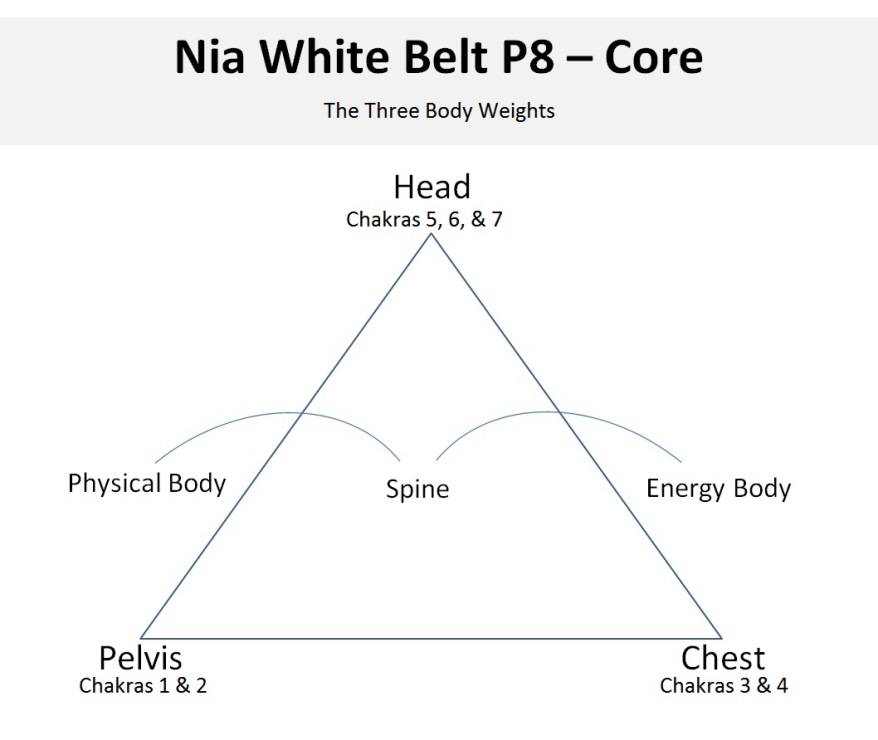
Nia describes the core as three body weights, pelvis, chest, and head. In the training we are currently studying Nia White Belt P8 – Core | Three Body Weights. Again – at least I think I have mentioned it – since Nia is so rich and it is easy to spend a lot of time on one thing, I somewhat feel our two hours are a little rushed, even though Debbie skillfully got through the entire lesson. It would be easy to spend more time. Not only does Nia study the bone structure of the core (the pelvis, chest, and head) but it incorporates the energies associated with each. So the description of the principle is “sensory study of energy centers.”

First we discussed the Nia 52 Moves associated with the core. There are seven.

PELVIS MOVES (2)Dance Exercise, Nia, Nia online, San Jose Virtual classes, Nia Teacher, Nia Class, Nia San Jose, Nia workout, Nia, Gentle Yoga, Group Ex classes, Nia Technique, Yin Yoga, stretch classes, online exercise, Zoom classes, virtual yoga, City of San Jose online exercise, live classes via Zoom
Pelvic Circles
Hip Bumps

CHEST MOVES (2)
Chest Isolations
Shimmy

SPINE MOVES (2)
Undulation
Spinal Roll

HEAD MOVE (1)
Head and Eye Movements

Then we discussed the physical body as is represented by the three points of the triad for Principle 8, pelvis, chest, and head. We reviewed the bones in the pelvis and then moved through the two pelvis move. Since Nia is based on how the body moves we spend a lot of time on how the body is put together. When you understand how the bones move in relation to each other is helps you understand how the body is supposed to move AND, if you pay attention, it can help you understand how your body moves.  For many people, when bones are likened to objects it helps with understanding how they function, say the pelvis is a bowl or a container that is meant to hold and contain and ribs are like a cage made to protect. Remembering that the hip joint is a ball and socket and NOT a hinged joint could lead to a smooth gait when picturing the movement as a rolling movement and not a back and forth. So, in Nia, we examine the structures, learn how they are supposed to move according to the way they were designed, and then we move in different ways to allow us to sense our own body’s way.

We spend a bit of time reviewing the Nia Moves and how they can be adjusted in regards to the planes, the intensity levels, and different body’s needs.

Then she spent time connecting the areas of the spine and body with the energy bodies or the chakras.

CHAKRA 1 | Base or RootAssociation to Core:  Pelvis
It is located at the base of the spine, near the coccyx, in the pelvic area between the perineum and the anus. It’s energy is associated with your legs, coccyx, rectum, and sex organs.

CHAKRA 2 | The Sensual Center (Sacral)Association to Core:  Pelvis
Sacral chakra is located in the lumbar region, just above the sexual organs, and about 2 to 3 inches below the navel.  It is above the root chakra. It’s energy is associated with male and female sexuality, survival, and creativity.

CHAKRA 3 | Solar PlexusAssociation to Core:  Chest
It is located at the mid-thoracic area near your solar plexus. It’s energy is associated with your will, self-confidence, and personal power.

CHAKRA 4 | The HeartAssociation to Core:  Chest
It is located in the center of your chest, at the first, second, and third thoracic vertebrae. It’s energy is associated with love, compassion, joy, and sorrow.

CHAKRA 5 | The ThroatAssociation to Core:  Head
It is located in your throat at the third cervical vertebra. It’s energy is associated with ability to be expressive, to speak up and stand for yourself and for what you believe to be true and real.

CHAKRA 6 | Brow or Third EyeAssociation to Core:  Head
It is located at the first cervical vertebra. It’s energy is associated with your connection to your intuition.

CHAKRA 7 | CrownAssociation to Core:  Head
It is located at the point of your pineal gland. It’s energy is associated with your connection to divine spirit, and soul energy.

She also covered the vowel sounds associated with each chakra, as have I in a previous post.

So along with studying what makes up the physical body, how it is put together, and how it was designed to move, we also studying the energy body.  We move in ways to keep the energy flowing and balanced and we can add sounds to help with that.  Nia is based on Western science as well as ancient beliefs.  Nia White Belt Principle 8 – Core / The Three Body Weights is a very deep principle indeed.

Posted in 2020 Nia White Belt Principles, Nia | Tagged: , , , , , , , , , , , , , , , , , , , , , | Leave a Comment »

Nia White Belt P7 – Planes + Intensity Levels – 2020

Posted by terrepruitt on August 24, 2020

Ahhhh, Nia White Belt Principle 7, here is where we can really get into YOUR BODY’S WAY. The body was made to move in a certain way – THE BODY’S WAY, but for various reasons not all of us can move as perfectly as the body was designed, so we move in our own way, so we call it Your Body’s Way. Nia White Belt P7 – Planes + Intensity Levels allows us to individualize ALL movement – from everyday getting dressed and doing the dishes (Dancing Through Life) to our Nia practice.

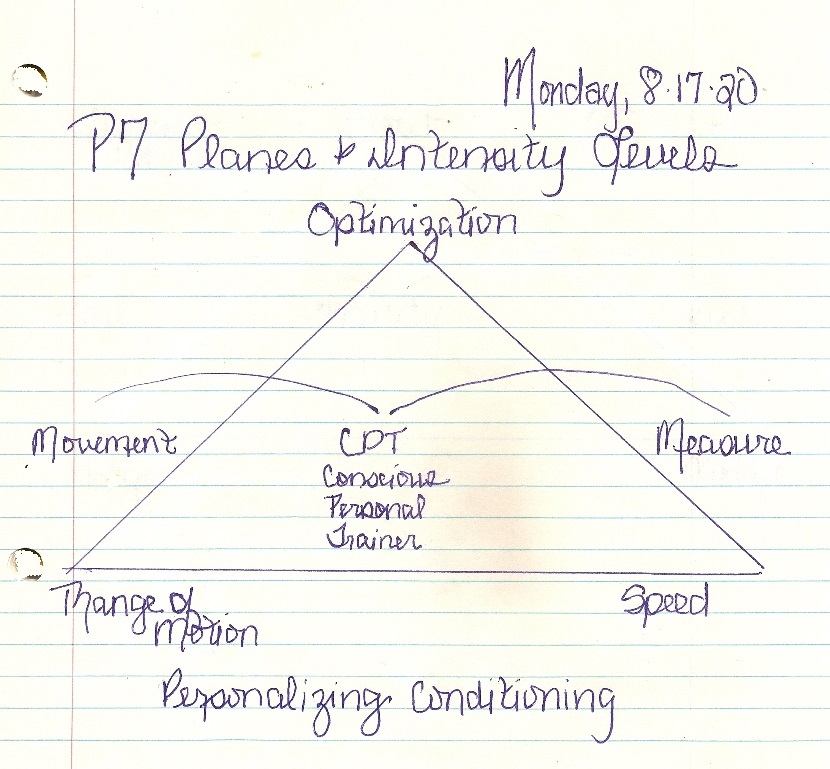
Dance Exercise, Nia, Nia online, San Jose Virtual classes, Nia Teacher, Nia Class, Nia San Jose, Nia workout, Nia, Gentle Yoga, Group Ex classes, Nia Technique, Yin Yoga, stretch classes, online exercise, Zoom classes, virtual yoga, City of San Jose online exercise, live classes via ZoomThere are three triads for this principle. The main triad has Range of Motion, Speed, and Optimization as the three points with CPT in the middle and movement and measure as wings. The CPT is the Conscious Personal Trainer, this is your body telling you what to do, just like you can hire a Certified Personal Trainer (a CPT) to tell you want to do, you can listen to your body which can tell you want you need. You have movement and the measure of it where you are always observing and adjusting according to what you need. Your range of motion and the speed of the movements are done to optimize your sensations and workout.

Triad one is used to illustrate the Nia Planes.  It’s points are High, Middle, and Low, with gravity in the center and sink and rise as wings. Most any movement can be done high, middle, and low. Your whole body can be high, middle, low – standing, sitting, being on the floor. Or you can be on the floor and experience high, middle, low there too. The current Nia White Belt Training book refers to the Hara or body center as a way to measure high, middle, and low.

In Nia there is the smile line. It is up on the ends and down in the middle, like a smile. I think in a routine recently I experienced a FROWN but she called it a smile line, but we were down then went up and down again, like an upside down smile line (frown). You can achieve the smile line by stepping forward – let’s say – and softening at the knees through the step then ending up. Neither the start nor the end need to be in the HIGH plane, but they are higher than the dip of the smile. You can “smile” in an A Stance . . . soft knees and let hips move up on one side, with a little dip in the middle, then up on the other side. So a smile line CAN help you practice both planes and intensity levels.

Intensity levels are additional guides to YOUR BODY’S WAY, this is the third triad with the levels at each corner. In Nia we label the levels, 1, 2, and 3, going from least intense to most. The middle of the triad is YOUR BODY’S WAY with choices and CPT as the wings. You control the intensity of a movement depending upon what you need. It could be that the intensity level is linked with the plane . . . perhaps it is really intense for you to reach really high, but not as intense when you are in the middle and really easy for you to go down or that could be reversed. So intensity is not always tied to planes. Intensity can be applied to in and out It could be that having your arms in and closer to the body is a level 1 intensity, and a little further ways is a level 2, and out far is a level 3. Typically the further away more intense but that also depends on what you are doing. It could be thought of in respect to energy whatever requires less energy would be a level 1 and so on.

With Nia the idea is NOT to always be at a level 3, that is really no way to do a workout or live, in Nia we want to experience ALL the planes and levels. Also, the understanding is there that your high may not be the same every day. Your level 1 can change.  Your level 3 may be your level 2 some days. We like to encourage our students to play with all the planes and levels and we understand that everyBODY’s planes and levels are different and that they can be different every time we dance.

Do your workout vary planes and intensity levels?

Posted in 2020 Nia White Belt Principles, Nia | Tagged: , , , , , , , , , | Leave a Comment »

Nia White Belt P6 – Base – 2020

Posted by terrepruitt on August 10, 2020

Wow. We are already on Principle 6 of the Nia White Belt Principles in the first ever Nia White Belt Training Online. Remember this is somatic training so it is about the body. For people that have not taken any type of anatomy training or exercise training the information might be new, but since Nia is based on the body a lot of it is not new because we pretty much have had the same number of bones in our feet since they have been able to count all the bones in the feet (26 in each foot). Nia is based on science but the way Debbie relates it to your everyday life is what makes it fun and amazing. Nia White Belt P6 Base. It is about the base, our foundation, from our feet to our hip joint.  The triad consists of feet, legs, hip joints.

Dance Exercise, Nia, Nia online, San Jose Virtual classes, Nia Teacher, Nia Class, Nia San Jose, Nia workout, Nia, Gentle Yoga, Group Ex classes, Nia Technique, Yin Yoga, stretch classes, online exercise, Zoom classes, virtual yoga, City of San Jose online exercise, live classes via ZoomI love to remind my students that feet need to be flexible in order to provide the shock absorption we need with each step. Also, in order to help with the entire health of the body they need to be strong, and also allow the energy to flow through. Nia refers to the feet as the Hands that touch the Earth.   Feet like hands relay a lot of information to the body.  In Nia we dance barefoot to not only receive that information through the hundreds of thousands of nerve endings in each foot, but to help with the health of our feet.  Nia has 52 Moves the routines focus on.  Twenty seven of them are associated with the base and each move can help keep feet flexible, strong, and allow energy to flow up to the body.

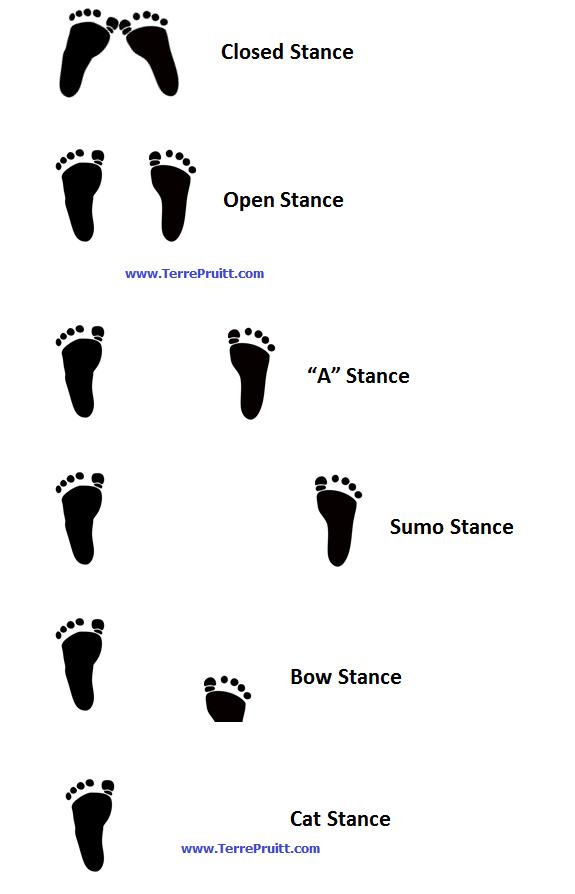
There are four categories associated with the base. The “Feet” category has 8 moves, the “Stances” category has 6 moves, the “Steps” category 9 moves, and the “Kicks” category has 4 moves.  Below is the list of “base” moves and links to my posts about them, except the Cha-Cha-Cha.

Foot Moves (8)
1.  Heel LeadDance Exercise, Nia, Nia online, San Jose Virtual classes, Nia Teacher, Nia Class, Nia San Jose, Nia workout, Nia, Gentle Yoga, Group Ex classes, Nia Technique, Yin Yoga, stretch classes, online exercise, Zoom classes, virtual yoga, City of San Jose online exercise, live classes via Zoom
2.  Whole Foot
3.  Ball of the Foot
4.  Rele
5.  Rock Around the Clock
6.  Squish Walk
7.  Duck Walk
8.  Toes In, Out, Parallel

Stances (6)
9.  Closed Stance
10.  Open Stance
11.  “A” Stance
12.  Riding (Sumo) Stance
13.  Bow Stance
14.  Cat Stance

Steps (9)
15.  Sink and Pivot Table Wipe
16.  Stepping Back onto the Ball of Your Foot
17.  Cross Front
18.  Cross Behind
19.  Traveling in Directions
20.  Lateral Traveling
21.  Cha-Cha-Cha
22.  Slow Clock
23.  Fast Clock

Kicks (4)
24.  Front Kick
25.  Side Kick
26.  Back Kick
27.  Knee Sweep

If you have never been to a Nia class you might be amazed at how many ways you can do each of these moves. There are many ways . . . you could shift your intention, you could shift your energy, you could shift your focus, you could shift your weight . . . . all of these things would allow you to sense the move differently.  And the great thing about them is you don’t even have to be in a dance class to practice them.

Can you spot one you might call a favorite?

Posted in 2020 Nia White Belt Principles, Nia | Tagged: , , , , , , , , , , , , | Leave a Comment »

Nia White Belt P5 – Awareness – 2020

Posted by terrepruitt on August 5, 2020

First of all, to clarify, Nia uses triads in their training and they are continually updating them, they may change the language or possibly rearrange the order, but they have used and are still using triads.  This week our lesson was on Nia White Belt Principle 5.  It has four triads, one for the main principle and three more to help with understanding the principle and being able to have it.  The Nia White Belt Principle 5 is Awareness.  White Belt is all about the body so Nia White Belt P5 – Awareness is about body sensory awareness.

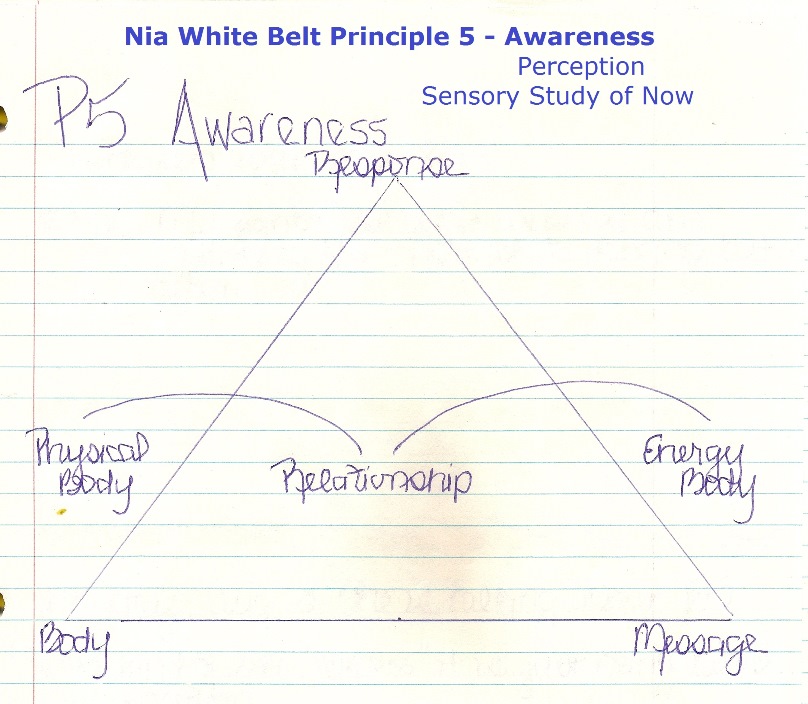
Dance Exercise, Nia, Nia online, San Jose Virtual classes, Nia Teacher, Nia Class, Nia San Jose, Nia workout, Nia, Gentle Yoga, Group Ex classes, Nia Technique, Yin Yoga, stretch classes, online exercise, Zoom classes, virtual yoga, City of San Jose online exercise, live classes via ZoomThe main triad’s three points are: Body, Message, Response.  There is the body and we get messages and there is our response to the messages.  We have a relationship with our physical body and our energy body which are shown on the “wings” of the triad.  Your nose could have a tickle and your body sends you that message.  You have a relationship with that sensation in your body and with the energy/feelings it generates.  And your response could be to scratch your nose.  That is a very simple example.

The idea goes much deeper than that and it has three additional triads.  The first one is about skin, joints, and connective tissue and our perception of pain and pleasure.  The second one is about awareness, stimulation, and self-healing with a temperature gauge for pain and wings of logic and mystery.  And the third is about Dancing Through Life, Living Meditation, and Life as Art with the sacred athlete at the center and body and life as wings.  Dancing Through Life is the “doing” and Living Meditation is the “Non-Doing”.

There is so much that I can say about each triad but I always want to leave a little mystery so that when you get the book or take the training and dive deeper into it yourself you will have somethings still new to you.  I just want to say a few things about some of the points, self-healing in Nia is not telling you that you can heal yourself without medical assistance, it is more to the effect of moving to heal or in a way that allows your body to heal and not cause injury.  If in your dance you step really wide into a sumo stance and you feel pain in your knees, you could “self-heal” by adjusting to a smaller sumo stance.  This is a simple example, but it is about having awareness and moving to stimulate self-healing.

Also, I wanted to get a little more detailed about Dancing Through Life . . . one of my favorite sayings and ideas of Nia.  A part of the idea is to — literally, DANCE THROUGH LIFE.  Again, remember that Nia has a broad definition of “dance”, so this doesn’t mean do the waltz or plies though life, it is more like noticing everything you do is your dance.  Brushing your teeth is your dance, making your dinner is your dance – the DOING of life is your dance,  The non-doing is living meditation.  Stop and notice things.  Then allow Life to be Art.

Remember there is The Nia Technique Book that covers all of this.  As I have been saying the language now in 2020, is a bit different, but the core of the information is the same.  So even though The Nia Technique Book was published in 2004, you would still get a lot out of it.  Also, this training is available to anyone, you don’t have to want to teach Nia, you just have to want to maybe look at things – things that are not new to you – a little differently, from a body centered outlook.  Currently there are many trainings happening (about to happen) online.

What here sparks your interest about Nia White Belt P5 – Awareness?  Are you living in a body that is always in pain?  Do you think of yourself as Dancing Through Life?  Are you living in a body that is always in pain?

Posted in 2020 Nia White Belt Principles, Nia | Tagged: , , , , , , , | 2 Comments »

8 Stages Of Nia White Belt P4 – FreeDance – 2020

Posted by terrepruitt on July 29, 2020

As you know different people learn different ways and as we were only on stage 5 with just 20 minutes left in class on Monday, I was wishing that we had more time to explore the principles. I wanted to be able to be with each stage longer. This is my first time re-taking the Nia White Belt. After class, Debbie stays after to answer additional questions and receive comments and, funny enough, one person said she liked how fast we went through the stages. She felt she got more out of it instead of spending so much time on them. Someone else spoke up and “mirrored” that sentiment. I don’t think it was their first re-take. I would have loved to spend more time with it. For my blog, I thought I would at least separate the introduction of the principle from the stages, since for many people exercising without specific instructions is a new and challenging concept. Being able to move one’s body in their own body’s way in a dance exercise class is not the norm – unless you are in a Nia class. The Nia White Belt Principle #4 is FreeDance and it has eight stages.

With Nia FreeDance participants can dance what their body needs at the time they are in the class, but not everyone knows what to do with that freedom. Not everyone knows what their body needs. So there are eight stages we use in our practice that can help. I am not going to do a language comparison (between when I took it in 2008 and now) I am just going to say the verbiage has changed a bit but the message is the same. Here is the 2020 Nia White Belt Principle #4 8 stages with their tag lines and explanations, as usual there is a lot more, I am just sharing a bit.

Dance Exercise, Nia, Nia online, San Jose Virtual classes, Nia Teacher, Nia Class, Nia San Jose, Nia workout, Nia, Gentle Yoga, Group Ex classes, Nia Technique, Yin Yoga, stretch classes, online exercise, Zoom classes, virtual yoga, City of San Jose online exercise, live classes via Zoom1 – FreeDance ~ Anything goes movement-wise: this really means, just move your body. A lot of people have a strict idea of what “dance” means so unless someone is doing ballet or waltzing across the floor they will say, “that’s not dance”. But in Nia we kick, we punch, we shimmy, we bob our heads . . . . pretty much ANYTHING GOES MOVEMENT-WISE. Granted in a class we will make certain that is it safe.

2 – Being Seduced By The Music ~ The Art of Listening: this is where you can stop moving. You may be surprised at what you hear when you are just listening to the music. And then once you start dancing again you may be moving differently because you actually heard something you hadn’t heard before. Or you may just have a different sense of the music.

3 – Feelings + Emotions ~ Pretend, Fake it, Act “as if”: this is where you pretend. You can pick an emotion . . . and act as if you are XXXX. You can pretend to be mad, angry, happy, sad, tired, bored, flirty . . . whatever and then you dance that. You let your body MOVE that emotion.

4 – Creative Source ~ Real You: here you remember a story and allow yourself to feel that emotion and dance that. You may find that you use less energy when you are actually tapping into a real emotion than when you are acting and the emotion is coming from your head. Dance your story and see where that emotion takes your movements.

5 – Authentic Movement ~ Change!!: this is about the way your body moves. We dance and as we are “forced” to change we find authentic movement. For those that know how to count the bars we change every two bars, but until you know that, just change often . . . let’s just say you should change about 15 times in an average speed 5 minute song.

6 – Witness ~ Neutral Observer: this is where we just notice what our body does. We aren’t supposed to change it we are just noticing what it does.

7 – Accidental Click ~ Music + Movement Integration: this is where we have a “click”, when we really feel our body move to the music and we know that that is how it is supposed to be moving. Something “clicks”. Once you sense that keep doing it.

8 – Body-Centered Choreography ~ Levels 1, 2, 3: this is where you can take that movement tendency or that click and dance through the three levels. The three levels are what we want to demonstrate in a Nia class so that everyBODY can have fun and get the workout their body needs at that time. Level one is less, smaller movements, two is more, and then three is the biggest and something you may not even be able to (or want to) maintain throughout the class. It is nice to visit all the levels so that you can experience the different sensations in the body.  Also, it is important to keep in mind that these levels relate to YOUR body.  My level one might be your level three, that person over there . . . their level three might be my level two . . . . so do YOUR BODY’S levels.

I wrote out the main things that I want to remember (pictured here) and posted here.

There you have a bit about the eight stages of the 2020 Nia White Belt Principle #4 – FreeDance. These can help people with their FreeDance practice.

I could go on and on, but I need to stop here.  I hope this gave you an idea about Nia FreeDance and maybe if gave you some ideas on how you can play and practice with dancing in order to stimulate your BMES.

Posted in 2020 Nia White Belt Principles, FreeDance, Nia | Tagged: , , , , , , , , , , , , , , , , | Leave a Comment »

Nia White Belt P4 – FreeDance – 2020

Posted by terrepruitt on July 27, 2020

I have several posts regarding Nia FreeDance. When I was teaching often there was a period when we had FreeDance Fridays. That was fun. I feel when I am teaching multiple times a week it is really great to have one class be FreeDance. I have posted about the 8 stages of FreeDance. There are a couple of posts about a FreeDance Playshop I produced once and one about the tools for the eight stages of FreeDance that we can use to help us “to stimulate movement creativity”.  We just had our class regarding FreeDance, Nia White Belt Principle #4. I am happy to report, not much has changed. Again, some of the language used has changed and certainly the way it is presented. I want to clarify that the training is always evolving, Nia is always finding new and better ways to deliver the information, but the core information is not changing. That is a great comfort to me and it makes sense. I want the organization I am involved with to grow and improve, but I don’t want it to change the core of what it does. So, 2020 Nia White Belt Principle #4 is FreeDance.

Now in my previous documentation of it, you may see FreeDance written different ways and that is because I understood Carlos (one of the original creators of Nia) to have different ways of writing it. The principle was one way (FreeDance) and then the first stage was another (Free dance). So, if you see differences that is why. And moving forward I will endeavor to keep it FreeDance.

This term sometimes confuses people because they think the class is free. I have experienced this many times. But FreeDance is something that Nia participants do, it is a practice, it is a principle of Nia. It is “stimulating movement creativity”.

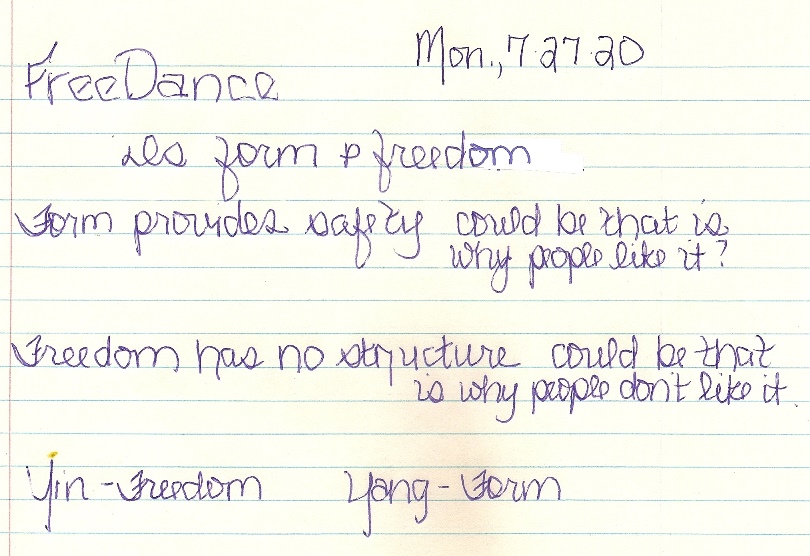
Dance Exercise, Nia, Nia online, San Jose Virtual classes, Nia Teacher, Nia Class, Nia San Jose, Nia workout, Nia, Gentle Yoga, Group Ex classes, Nia Technique, Yin Yoga, stretch classes, online exercise, Zoom classes, virtual yoga, City of San Jose online exercise, live classes via ZoomDebbie said something today that clarified something for me, she was talking about form and freedom, we have a lot of that in Nia. In light of the 2020 Nia White Belt, we have form in the way of choreography and we have freedom in the way of dancing free. Debbie equated form with “structure” and how that makes people feel safe.  Freedom could be compared to “no structure”, which sometimes makes people feel unsafe. The freedom in an exercise class can be intimidating for many people. Being told what to do and how to move the body is the way most people are taught to exercise, so when they come to a Nia class and they are told, “Move your body.” They don’t know what to do. It is just like the story Debbie tells about when she first when to a Dojo. People can be told to focus on moving their arms, but they want to know HOW to move their arms, they want specific movement instruction. We have language to guide people to move in FreeDance, but there is still a lot of freedom in that and for some people that is a huge challenge.

There is a triad for this principle, like with all of the principles, it consists of Move, Explore, and Create. They put the numbers for the 8 stages going counter clock-wise on the triad, but have created a separate graphic with the stages going clockwise. Instead of drawing the triad and creating the graphic I chose to write out the eight stages. We can use the eight stages to helps us move. Here I am just going to list the stages:

1 – FreeDance
2 – Being Seduced By The Music
3 – Feelings + Emotions
4 – Creative Source
5 – Authentic Movement
6 – Witness
7 – Accidental Click
8 – Body-Centered Choreography

The next post will contain the tag lines for each stage and the information I wanted to high-light for myself.

So, Dear Reader, how do you feel about dancing with no instruction?  How do you feel about dancing with little to no instruction in a cardio exercise class?

Posted in 2020 Nia White Belt Principles, FreeDance, Nia | Tagged: , , , , , , , , | Leave a Comment »

Still Zooming – More On Sound

Posted by terrepruitt on July 22, 2020

Well, many of us are still teaching classes via Zoom. In my area indoor exercise is not allowed and even when they thought they were going to allow it they had restrictions on indoor cardio and dance. And Nia is a cardio dance exercise. Because it is full of playfulness, taps into many types of movement forms, energies, and challenges and satisfies the BMES we don’t like to call it just a cardio dance exercise, but when classifying it for indoor activity purposes, that is what it is. So many of us are still doing it online. Some have moved outdoors, but that gets into all types of possible liabilities and issues I am not ready to take on just yet . . . so I continue to try to improve my delivery of the virtual class.

In my last “Zoom” post I wrote about how at the point of class starting my mic and music failed. That was a bummer. Then I had a great week and then it failed again. Some of it, I know is user (me) error, but sometimes I think it is internet or software error. As an example, last week I used a different USB port for my microphone and speaker and in doing so the transmitter was hanging and I think was not plugged in all the way. But then when we were doing our little chat after class, I couldn’t hear one of my students, the other students could, but I couldn’t. I didn’t do anything to fix it, but she exited the meeting then came back on and I could hear her. So it is crazy.

My students continue to be kind and understanding so I continue to try.

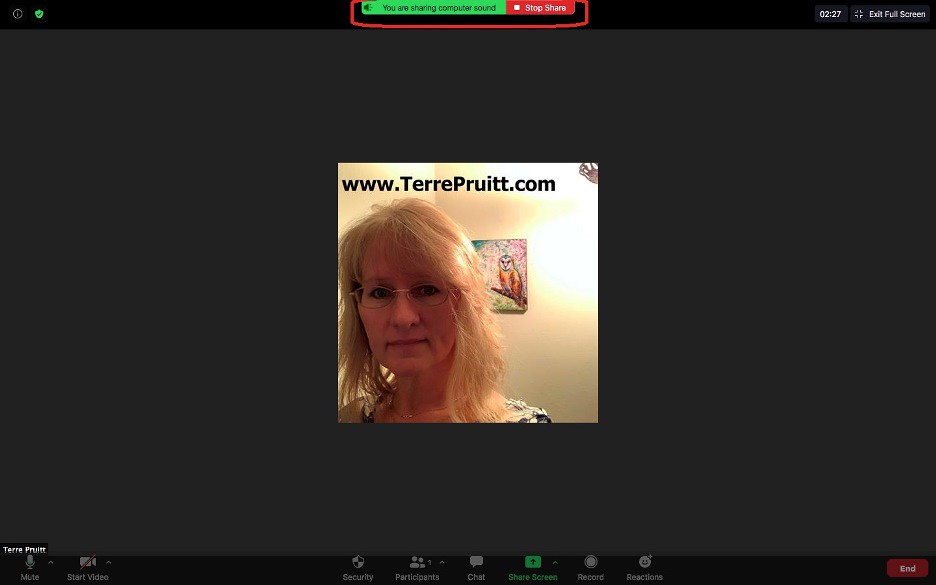
Lately I am using iTunes directly through Zoom. Zoom allows the host to share the screen and in this case the “screen” is just audio. This eliminates the issue of the music cutting out as would happen when I used a speaker and a microphone to pick up both my voice and the music. My fans would create background noise and interfere with music transmission.

Dance Exercise, Nia, Nia online, Zoom meetings, Nia Teacher, Nia Class, Nia San Jose, Nia workout, Nia, Gentle Yoga, Group Ex classes, Nia Technique, Yin Yoga, stretch classes, online exercise, Zoom classes, virtual yoga, City of San Jose online exercise

Here is the advanced screen where you can choose to just share sound.

The Kimafun microphone I got (box shown in my “struggles” post) came with a USB converter that allows me to plug the transmitter into it so it feeds directly into the computer/Zoom and it allows me to have a speaker attached so I hear the music that is being played through Zoom to my students.

I still have to rely on my students telling me if they can hear me and the music, but that will always be the case. I record myself and the music to test it, but it really boils down to what the students hear. So whoever shows up first gets to set the volumes because I adjust according to what they say.

I still feel I need more practice with the microphone. I usually teach without a microphone so I am used to projecting my voice and allowing myself to exhale with all the lovely sounding techniques that Nia encourages, but that gets LOUD with the microphone in my face. The recommendation I saw said to keep it two fingers away from your face and I am using three. Next week I am going to try four. Part of the issue is that it moves around as I dance so the set up changes. I readjust it when I remember. For the most part it is working out, but I will keep in mind that I need to keep trying to improve.

So . . . what do you do when you are teaching a class?  Or, if you don’t teach, what experiences have you had in regards to sounds when in a Zoom class or meeting?

Dance Exercise, Nia, Nia online, Zoom meetings, Nia Teacher, Nia Class, Nia San Jose, Nia workout, Nia, Gentle Yoga, Group Ex classes, Nia Technique, Yin Yoga, stretch classes, online exercise, Zoom classes, virtual yoga, City of San Jose online exercise

This is the basic screen share screen


Dance Exercise, Nia, Nia online, Zoom meetings, Nia Teacher, Nia Class, Nia San Jose, Nia workout, Nia, Gentle Yoga, Group Ex classes, Nia Technique, Yin Yoga, stretch classes, online exercise, Zoom classes, virtual yoga, City of San Jose online exercise

Zoom reminder and “stop” sharing


Posted in Nia, Online Classes, Zoom | Tagged: , , , , , , , , , , | 6 Comments »

Nia White Belt P3 – Music + 8BC System – 2020

Posted by terrepruitt on July 20, 2020

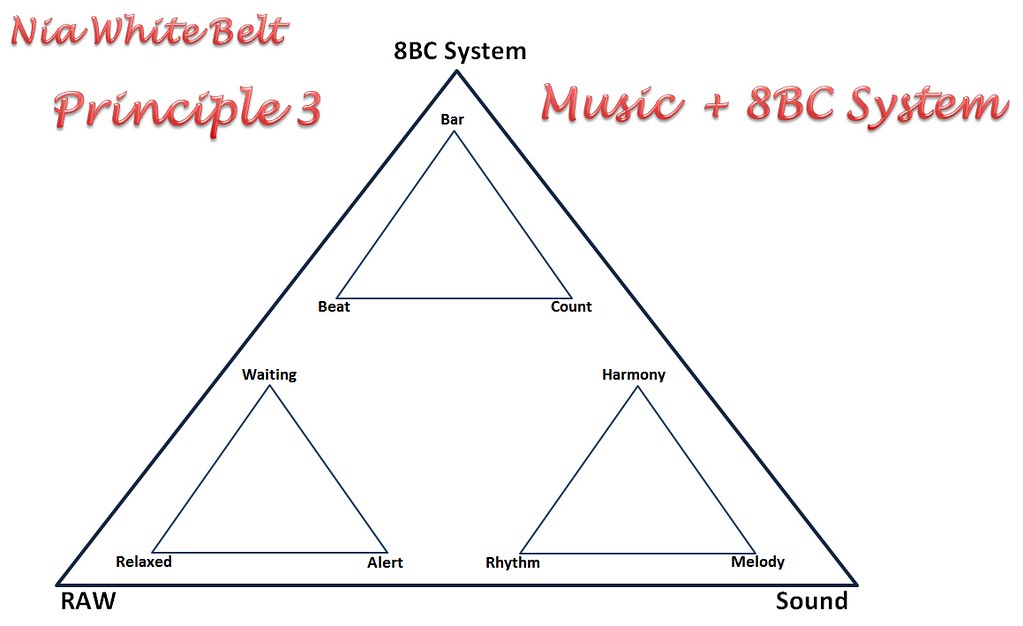
We are on our fifth week of the Nia White Belt Training via Zoom. We have reviewed Principle 3. From my previous posts, when I first took the White Belt, it was treated like two parts. Now, in 2020, while Principle 3 is called Music & 8BC System it is broken down into three parts. While our triads go from bottom left corner, to right, to top, I feel like the book and the training do not follow that order:  Principle 3’s triad is made up of RAW, Sound, and the 8BC System.

Following that triad, we have RAW, which is truly R.A.W. and stands for Relaxed, Alert, and Waiting. This is how we are supposed to listen to our music. Eleven years later and I still get so sleepy I often stop and take a nap. The original instruction was always to sit and most of the time, halfway through a song I am so tired I can’t keep my eyes open, so I think I will start standing in RAW. It really is an amazing way to listen to music. Maybe I just take the “relaxed” part too far. We relax, but we are (supposed to remain) alert, and we wait for the sounds and the silence.

Dance Exercise, Nia, Nia online, Zoom meetings, Nia Teacher, Nia Class, Nia San Jose, Nia workout, Nia, Gentle Yoga, Group Ex classes, Nia Technique, Yin Yoga, stretch classes, online exercise, Zoom classes, virtual yoga, City of San Jose online exercise, Nia Belt Training Online

There are so many ways to do this it can be fun, if you can stay awake! You can listen to the sounds of the song as a whole or you can pick out one instrument or sound and follow it through the whole song . . .that is where the waiting can come in because it might not be a constant throughout the entire song so you are left waiting.  It could be actual silence you are waiting through.  Once you are familiar with the sounds and silences they can become cues when the choreography is added.  You can do this with songs you have never heard or songs you have been listening to your entire life.  Sit in RAW and listen to a song you are familiar with and see if you hear any new-to-you sounds.

On another corner of the triad, we have sound, the anatomy of the music; the rhythm, the melody, and the harmony. This is listened to in RAW. Instead of listening to just one sound/instrument, perhaps you focus your attention on just the harmony and listen to the entire song that way. Or the rhythm or the melody, it is another way to become familiar with the music.  Again, a fun way to listen to music.

And finally we have the 8BC System which is the way we Nia teachers learn our music. We count it to “bar” it and the result is a map that helps us to move to it. Again, eleven years later and I am still learning with this. I love really studying the music and mapping it well because I always hope to “do my own thing” to it, but then, more often than not, I am in awe of the choreography and end up trying to stick to it. So . . . I am still learning to play with Nia music that has choreography.  Perhaps this time through the white belt I will grasp “playing more” with Nia music and become more flexible.  When dancing to music that has not be choreographed by the Nia choreographers I can play just fine, but it is stepping away from the moves that are timed and planned so well that I am still learning.

My previous posts on Nia White Belt Principle 3 Music & the 8BC System are still pertinent so I am not going to go further into it. As I have said over and over, to really understand the richness of the material and training you have to take it for yourself. I have barely scratched the surface on what Debbie went over in class and the triad graphic is incomplete, there is more to each triad. As I have also said about Nia, 98% of this can be applied to your life.

If you approach listening to people in RAW, where you are relaxed but alert and just waiting for them to share with you what they are saying, how fabulous would that be? If you were to stop and listen to the rhythm of life around you and notice the melodies and harmonies that accompany it, what would be able to notice? Now, the 8BC System might be a little more challenging to add to your everyday life, but I bet there is a use for it. If not the ACTUALLY “barring” of life, but the idea of when you hear a certain sound you can attribute a move to it or a sensation.  Perhaps a surge of excitement when a familiar ring tone sounds on your phone.  A move to rise when you hear the doorbell.  A move towards the kitchen when you hear family coming in for a meal.

Can you think of ways you can listen in RAW?  Can you listen to life in the form of rhythm, melody, and harmony? 

Posted in 2020 Nia White Belt Principles, Nia | Tagged: , , , , , , , , , , , , | Leave a Comment »