Archive for the ‘52 Moves (of Nia)’ Category
Posted by terrepruitt on June 27, 2013
Stepping Back Onto The Ball Of Your Foot is certainly not unique to Nia. Many dance modalities incorporate this move. In fact this move is incorporated into every day life. How often are you moving forward only have to stop and move back? You could be in line at the store or anywhere when the person in front of you moves back towards you so you take a step back. While you might not “hang” out on the ball of your foot as we do in Nia you more than likely don’t take a step backwards heel first.  So, yes, Nia has taken moves that might be done in other dance practices, martial arts, and even everyday life and put them in their list of Nia’s 52 Moves. Nia then weaves the moves into the Nia Routine choreography. This move Stepping Back Onto The Ball Of Your Foot is part of our Base Moves. It is done with the feet and legs and they are a part of the base.
This move is described on page 123 of the Nia Technique book written by Debbie Rosas and Carlos Rosas and you can purchase it from Amazon.
As I have said many times there is a proper way to do all moves and while you are practicing them and learning them you do it the proper way. Then as you come across it in a Nia class while doing a Nia routines your body will know the proper way yet be able to adapt to the choreography that you are dancing at the moment.
So to practice this move you can start in Open Stance. Then with one leg step back onto the ball of foot. When stepping back pull the leg straight behind not to either side. Keep the foot parallel to the stationary foot, don’t turn the heel. As is indicated step back onto the ball of the foot. Keep the spine up and the heel high off of the earth. Then shift your weight onto the foot of which you just stepped back on and take the other foot off the ground.  Your torso is upright, pelvis, chest, shoulders, chin, eyes facing forward. Do the same movement with the other foot. You don’t necessarily always have to start in open stance.
After you are comfortable with the stationary start, walk around and stop and step into the move.
This move helps with the mobility and flexibility in the foot. It also helps create or improve stability in the ankle. It helps with balance, especially if you hang out for a measured amount of time on the ball of your foot!
At the moment I can think of one routine in which we step back onto the ball of foot as a large portion of one of the dances. I know we step back all the time, but in this routine I think of one of the songs as “showcasing” this move. The choreography calls for lifting the leg of the foot that is off the ground. Or doing a knee lift. So that is a good example of the variations that Nia choreography uses with its 52 Moves.
Well, what do you think about this move? Can you see how it helps with mobility and flexibility in the foot?
Posted in 52 Moves (of Nia), Nia | Tagged: Amazon, Base Moves, Carlos Rosas, dance modalities, dance practices, Dancing, Debbie Rosas, especially if you hang out for a measured amount of time on the ball of your foot, flexibility, helps with balance, improve stability, knee lift, martial arts, Mobility, Nia, Nia class, Nia Practice, Nia Routine Choreography, Nia routines, Nia Technique Book, Nia's 52 Moves, open stance, Stepping Back Onto The Ball Of Your Foot | Leave a Comment »
Posted by terrepruitt on June 22, 2013
One of Nia’s 52 Moves is the Sink and Pivot Table Wipe. Ha! Sounds funny. I always think of cleaning when I say this move in class, but not many people LIKE to clean so I don’t like to remind them of cleaning while we are in our Joy! There are many other ways to describe the movement, but “table wipe” really gets the point across. It could be a dramatic sweep of the table. Regardless of what spirit might have me say in the midst of the move there is a particular way to do it. As with all of Nia’s 52 Moves there is a specific way to do it. And . . . as I have said . . . often times the specifics are adjusted to work into the song and the moment’s choreography. To me the Sink and Pivot Table Wipe is a combination of an arm movement and a bow stance.
To practice the Sink and Pivot Table Wipe you start in an A Stance. Doing one side at a time, say the left, you would place your left arm out. As you lift up your left foot you turn your body towards the right, your left arm sweeps across the horizon to the right. Your left foot lands gently on the earth on the ball of your foot and your left leg is bent. Your right leg is also bent. The bent legs become the “sink” part of the move. Your arm sweeping is the wiping part of the move. That “table” part is the imaginative part of the move to assist in knowing how the arms sweeps. The arm is straight out and just moves parallel to the ground. Doing the other side, you would you would place your right arm out. As you lift up your right foot you turn your body towards the left, your right arm sweeps out and around to the left. You place your right ball of foot gently on the floor with your right leg bent. Your left leg is also bent. The legs are similar to a bow stance.
 In most instances — the ones I can think of — in the choreography, I usually do a tiny hop so that my front foot ends up with the toes facing the same direction as the foot in the back, the foot that is “ball of foot”. So as I continue to say, the instructions in The Nia Technique book* show the exact perfect way to do a move. Which is the way to learn it, but then once you know the move the choreography dictates the exact way it is done.
The book recommends the word “Whoosh” be said while doing this move. Of course that is just one of many words and sounds that can be made. Sounds are dictated by so many things. The “Whoosh” can be used in the practice of the move, if you would like. When in a Nia class anything goes!
I believe this move is a great stability move because as I said I am normally moving both feet in order to sink, pivot, and wipe the table so I need to “land” stable. Also, I think it is great for the legs because any sink type of move helps condition them. It is also good for coordination because you are moving both the upper body and lower body at the same time, but in a little different manner.
Tee hee . . . . it is really great for a lot of things, depends on what you put into it. The last couple of times I did it in the current Nia routine I am doing I had the class stretching the arm as far as they could reach as they wiped that table. It was a HUGE table and we wanted to wipe it all in one pass!
So what do you imagine you are doing when you do this move?
*The Nia Technique written by Debbie Rosas and Carlos Rosas
Posted in 52 Moves (of Nia), Nia | Tagged: A Stance, Bow Stance, Carlos Rosas, Debbie Rosas, Nia, Nia 52 moves, Nia class, Nia routine, Sink and Pivot Table Wipe, The Nia Technique, The Nia Technique book | Leave a Comment »
Posted by terrepruitt on January 10, 2013
There are six stances in the 52 Moves of Nia. Closed Stance, Open Stance, “A” Stance, Riding (Sumo) Stance, Bow Stance, and the Cat Stance. Each stance has a sound associated with it for practice. There are benefits to doing each stance. All of them help with balance. With the cat stance the balance is on one foot. The cat stance is a stance in which you stand on one leg, using your whole foot. The leg you are standing on is not rigid, but the knee is soft, as if you were going to pounce. The spine is upright, hips are level, not pointing down nor up. The foot that is off the ground is pressing with the side against the standing leg, the foot relaxed, toes hanging towards the earth. Elbows are bent, relaxed. Either both elbows are at the sides or one slightly forward. The arms and hands are engaged. The cat stance is done on alternating legs. These are the specifics of Nia’s Cat Stance.
 There are specific ways to do a stance, the body’s way. But your body’s way is also recognized. So different bodies will do it different ways. Some will do it their own way until the body can adjust to the specifics and some bodies will continue in their own way. For instance some bodies will use the power finger/balance finger hand technique to assist them in standing on one leg. In addition to each body having its own way to do each move sometimes the way the move is done in a routine alters the specifics. The specifics stated above are according to The Nia Technique book, however in the routine Birth, the cat stance in one of the katas consists of hooking the bent leg’s foot around the standing leg. In this particular dance, while we are in the cat stance with our foot hooked around the standing leg, our hands and arms are different from is described in the ideal cat stance stated above. One of our hands “hooks” around our face.
This is often the case. There is a specific way to do each of Nia’s 52 Moves, but each individual has their own body’s way that adjust the specifics AND the specifics are sometimes adjusted according to move in the routine. But it is important to know the specifics and the basics. It is also fun to practice the specifics and the basics.
The basics of the cat stance help with balancing on one leg. This can also be considered a strengthener, the standing leg’s muscles can be strengthened through the practice of supporting all of one’s weight. If this move is being done solely as a practice of the move, then agility can come into play. The practice of walking then stopping and moving quickly into cat stance would allow for the agility. Alternating with a light hop from whole-foot-cat-stance on one leg to the other is an exercise in agility. While this type of movement might also be something we do in a Nia routine it is not always the case. Sometimes we move into cat stance and from there do kicks.
As with all of Nia’s 52 Moves we play with them. All of Nia’s routines consist of playing with movement and music. With the cat stance you have the specific way to do it, then just like a cat you can play as you practice. You can “meow” and use claw hands. The cat stance is a fun way to play with balance and sounding. Practice the specifics then let the animal in you out!
Posted in 52 Moves (of Nia), Nia | Tagged: 52 Moves of Nia, A Stance, Balance Finger, Bow Stance, closed stance, hand technique, Nia katas, Nia Practice, Nia routine Birth, Nia routines, Nia's 52 Moves, Nia's Cat Stance, open stance, power finger, Riding Stance, standing on one leg, Sumo Stance, the body's way, the Cat Stance, The Nia Technique book | 2 Comments »
Posted by terrepruitt on January 8, 2013
There is a stance in Nia called the Riding Stance. It is part of Nia’s 52 Moves. I actually think of it as the Sumo Stance. It is called both. I bet if I actually were to really let my body doing the thinking, my riding stance would be taller than my sumo stance. Stop and think about it. Do you picture a rider with legs straddling a horse and sitting up tall? And a sumo wrestler as legs wider than a horse with his body lower to the ground? A sumo wrestler is still upright and “tall”, but he is closer to the ground. with a wider stance than a horse Ha! I love that. As I am typing and thinking, this is what I come up with. An insight. That is what I love about Nia. Even though there is an ideal there is still the way a body does it. And sometimes a body does it the way the mind thinks about it. My body translates sumo stance as low to the ground. I am going to go to class and use the different terms and see what my student’s bodies do! The Nia Technique states the Riding stance is as if you are riding a horse.
 As I stated, riding a horse – to me is at a higher level than a sumo wrestler. So, I actually do this stance much lower and that is because I THINK of it as a sumo stance. I am going to practice this stance as a RIDING stance and see where my body goes.
The book says: “your knees slightly bent and your feet apart, as if you were riding a horse”. I think I have always had a really wide horse! Whether the horse is wide or not, the feet are parallel.
Again, to be clear, the Riding Stance in the Nia 52 Moves is with the knees slightly bent and the feet apart. The feet are as far apart as if you are riding a horse. As I recently posted the sound to make while doing this stance is “ha!”
I think that it would be fun to say, “Yehaw!”
This stance is a great way to condition the legs. It is fun to play with this stance and try different levels. By levels I mean both the planes and levels of intensity. A level/intensity 1 would be a high plane. Then a level/intensity 2, could be the middle plane. And the level/intensity 3 could be the low plane and maybe more of what I think of as a sumo stance. With all moves in Nia the key is pleasure. So the move is not meant to be painful. If you are sensing pain in any part of the leg adjust your stance. If you sense pain in the knees, check your feet, are your toes facing forward? Are you evenly distributing your weight over your whole foot (feet)? Ankle pain? Are your legs/feet too wide apart? So it is important to not always go as low or as wide as you CAN, but to go as low and as wide as is reasonably comfortable.
I love that as I write I learn. That is one of the reasons I am writing a blog. It is so helpful to put things in writing. It is helpful to stop and examine what you already know, right? Sometimes you see things differently.
Either way . . . . Riding or sumo stance, the stance is with knees bent, feet apart and parallel. Everyone’s stance, every BODY’s stance is different. Got it? Horse riding. Ride ’em cowboy.
I am fortunate enough to have wonderful students that are willing to pose. Here are the “riders” of the group.
Are you ready to ride?
Posted in 52 Moves (of Nia), Nia | Tagged: levels of intensity, Nia, Nia class, Nia students, Nia Teacher, Nia's 52 Moves, Riding Stance, straddling a horse, Sumo Stance, sumo wrestler, The Nia Technique | Leave a Comment »
Posted by terrepruitt on September 6, 2012
 Another one of the 52 Moves of Nia is the “A” Stance. This is the stance where the position of the legs allows the body to look somewhat like the capital letter A. The legs are placed wider than hip distance apart, even wider than shoulder width. The legs are far enough apart and wide enough for them to appear to be as the bottom “legs” on a capital letter A. The feet are parallel, the upper body is relaxed. The Nia Technique Book states the benefits as: “Practicing “A” Stance improves hip flexibility and leg strength, which improves agility and mobility.”
I would like to add that it improves or at least allows the practice of balance. Not balancing on one leg which we do a lot in Nia, but balance between the body and the legs, balance between both legs, and balance between the legs and feet. Also balance of weight between the two feet. This is a stable and balanced stance. The weight is not on one foot more than the other. The weight is not on the front or the balls of the feet more than on the heels. This is a great stance to practice balance in. To allow the body to rest onto the whole foot.
Not only having the feet be parallel but even. If you were to stand at a line would your toes be even, both up to the line? I had noticed with myself for a while now that when I step into an “A” stance my right foot is ALWAYS slightly back from where my left foot is. I have been noticing this since I injured my foot in November of 2010. Just last week as I was teaching my regular Nia Class in Willow Glen, I noticed I stepped into “A” stance and my left foot was the tiniest bit back from the line on which my right foot landed (had there been a line). I thought that was funny. I giggled, but I hadn’t thought of it again until now. I don’t always think about my uneven landings until I have the opportunity to land in a stance where I see my feet several times in a routine. Then during the routine I focus on having my feet land even. There are times, of course in a dance where they don’t need to be or aren’t supposed to be even, but when doing a regular closed, open, A, or sumo stance I think the feet should be even. The “A” stance is a great stance to practice that because you can clearly see your feet and the pose is relaxed enough that there are not other things you might be thinking about. I feel the “A” Stance is a great way to practice balance.
As with all stances one way to practice the “A” stance is to simple stand in one place and move through the stances. Another way to practice is to walk and then stop in the “A” stance. Walking and stopping into an “A” Stance would be a great way to work on landing “even” — as I mentioned before. Walk, then stop, then look at your feet, notice the sensation in your hips, if your feet are even then that is the sensation you want to replicate, if not, then adjust your feet, notice the sensation in your hips and try to replicate it again as you step into “A” Stance.
The “A” Stance is just one of the six stances in the Nia 52 Moves.
What do you sense when standing in the “A” Stance? When you step into the “A” Stance do your feet land “even”?
Posted in 52 Moves (of Nia), Nia | Tagged: 52 Moves of Nia, A Stance, balance of weight, closed stance, Nia 52 moves, Nia class, Nia Dance, Nia in Willow Glen, Nia Practice, Nia Stances, open stance, Riding Stance, Sumo Stance, The Nia Technique book, Willow Glen Nia | Leave a Comment »
Posted by terrepruitt on August 30, 2012
Now, I know that I’ve been doing the knee sweep a lot longer than I have been doing Nia. So it is true that Nia’s 52 moves are not necessarily unique to Nia, but they are part of the core of Nia. You will find a large portion of Nia’s 52 moves in every routine. There are correct ways to do them, but Nia allows for the body’s way and also, I believe Nia allows for the move to be incorporated into the dance. For instance, The Nia Technique book states that the starting position for a knee sweep is the sumo stance. I am sure that I have done a knee sweep from a sumo stance at one time, but the first dance that pops into my head where we do the knee sweep it is not from a sumo position. But the by the book (oh, yeah, that reminds me, “BUY THE BOOK!” 🙂 ), anyway, the by-the-book version of the knee sweep starts from a sumo position, complete with arms in ready position and everything. Then the body rises as you come up on one leg bringing the other leg up with a bent knee. The knee crosses the midline of the body, the opposite hand “pushes” the knee out. The knee swings out so the pelvis is open. Then the leg comes down and the foot lands on the earth. That is the knee sweep of Nia’s 52 moves.
The book does not indicate that when your foot comes down it is in the toes-to-the-front position, but that is how I teach it. I don’t want my students landing on their foot with their knee out to the side. If we are just doing knee sweeps as an exercise, maybe I would have them do that, because they would be aware of the torque in their hip, but probably not.
When I was first doing this move in Nia I was trying to do it as the book shows and as many of the people on the Nia instructional DVDs do and as the instructor does (whether it be Debbie Rosas or Carlos AyaRosas). And that was with the knee out to the side very wide. REALLY opening the pelvis. But when I did that I noticed a “something” – I don’t know what it was, but it was something – in my lower back. So I decided that opening my hip that wide and having my leg out that far was not MY body’s way, so I do not do that. I share with my students that I found the comfortable spot to be about as far as my forearms can reach. I “glue” my elbows to my sides and hold my forearms out to the side. As far as they can go is as far as I allow my knee to go. That is what works for me.
Some of the time that we are doing the knee sweep it is at the end of a “up-two-three-four (knee sweep), back-two-three-four (knee sweep)”. So that would not allow for the sumo position to be the start. Other times we are standing upright. As I said, I am sure I have done it from the sumo position because I bet it is in a routine I am not thinking of. But the ones I am thinking of it is done from a walking or standing position.
The amazing thing about the knee sweep is that it calls for the knee to cross the midline of the body. So that means that if you were doing a left knee sweep (with your left leg) your left knee would enter into the right hemisphere of your body. If you were doing a right knee sweep (with your right leg) your right knee would enter into the right hemisphere of your body. It is a great thing when your limbs cross the midline. It helps stimulate the brain. So there is a reason in many exercise routines and cardio classes that we have you do “cross overs”.
The knee sweep is one of those moves that requires balance. Since at one point you are standing on one leg, you will be able to improve your balance or practice what you have. Also the moving of the leg helps with that stability. Standing on one leg helps with strength and opening the hip helps with mobility and flexibility. The knee sweep of Nia’s 52 moves does a body and brain good!
Are you familiar with this move? Have you done it before in your exercise class? Did you give it a try?
Posted in 52 Moves (of Nia), Nia | Tagged: Cardio classes, cardio dance class, Carlos AyaRosas, cross the midline of the body, dance, Debbie Rosas, exercise routines, flexibility, improve balance, Knee Sweep, Mobility, my body's way, Nia, Nia instructional DVDs, Nia routine, Nia students, Nia's 52 Moves, stability, strength, Sumo Stance, the Nia Technique books | Leave a Comment »
Posted by terrepruitt on August 2, 2012
I learn A LOT when I teach Nia. I learn a lot when I teach anything, but since my focus now is teaching Nia, I say I learn a lot when I teach Nia. One thing I learn or I am reminded of is not everyone has taken a class that has taught them basic steps. It is like when I take a Zumba class and the teach calls out a basic Latin dance and I have no idea what she is talking about. I always laugh to myself and say, “I don’t know what the steps are to that basic Latin dance!” But then I remember my Nia training and my Nia practice and while I try to do whatever dance it is she says we are doing, I remain in Joy and just allow myself to move my body in a way that is dance to me. But not everyone has had Nia training and not everyone practices Nia so it is not as easy for them to just allow their bodies to move and not think so much. One of the tools that Nia uses to help teachers instruct the dance and to just help one dance in general is the clock. I posted about how we look at the clock in a Nia class — ok that is just me because I need the actual reference. I have posted about our step called the “Slow Clock” . This post is about the movement called the Fast Clock. The Fast Clock is one of Nia’s 52 Moves
The Fast Clock is similar to the Slow Clock in that we are stepping on the “hours” of a clock (oh, imagine that!), but with the fast clock we don’t return to center before stepping on another number/hour. So if you stand with your feet together imaging you are in the center of the clock, then step your right foot to 12 o’clock, then back to 6 o’clock (without stopping in the center) that is the fast clock. There are a lot of combinations that can be done when doing a fast clock. You could step to 12 o’clock, then 3 o’clock, then 6 o’clock, then return to center. Then your other foot could step to 12 o’clock, then 9 o’clock, then 6 o’clock, then return to center.
POP QUIZ: Which foot would step to 12 o’clock, then 3 o’clock, then 6 o’clock, then return to center? 🙂
Just the same as the Slow Clock you can actually take a step where you place the weight on the foot that is on the number/hour or you can touch or make it a tap. Sometimes you might even get fancy or really dancy and just do it in the air. But all that fancy stuff is obviously added after you learn the basic Fast Clock. As with many things, Nia does have basic steps and proper ways to execute them, then as we dance we add on to them to make them a more animated part of the dance.
As with many of the moves in Nia the participant is responsible for providing their own desired intensity. You can easily work up a sweat in Nia if you make your movements bigger or louder. We sometimes refer to it as turning up the volume. But again, that is up to you and how you are feeling during that class. A “louder” fast clock could have lengthier steps making the imaginary clock face you are dancing on very large. Or your “bigger” could be going deeper into the steps, bringing your body closer to the earth. Having tools like the face of the clock to assist in knowing where to step, allows the Nia student to focus on their body and what it needs and not be so caught up in whether they are “doing it right”. With the clock it makes it easy to teach and easy to follow!
Ok, now get up and practice your clocks! Which foot goes to 12 o’clock? Which foot goes to 9 o’clock?
Posted in 52 Moves (of Nia), Nia | Tagged: fast clock, Latin Dance, Nia class, Nia Dance, Nia focus, Nia Move, Nia participant, Nia Practice, Nia student, Nia Teacher, Nia training, Nia's 52 Moves, slow clock, Zumba, Zumba class, Zumba dance, Zumba moves, Zumba teachers | Leave a Comment »
Posted by terrepruitt on July 26, 2012
As I mentioned in my last post about using the clock in Nia, we have a move called the Slow Clock. Using an imaginary face of a clock on the ground assists us in knowing where to step. The slow clock can be used to incorporate any “hour” on the clock into the dance. The move starts with the feet in the “center” of the imaginary clock. The “slow” is in reference to always returning the foot to center before allowing the foot to go to another number on the clock. To practice the slow clock move begin with a march in place. If you begin the march with your left foot touching the ground on the one count, then use it first to touch on 12:00, then return it to its original position in the center of the clock. Then place the left foot at 6:00, then return to center. Then use the other foot, touch to 12:00, then center, then 6:00, then center. Hour then center, that is the basis of the slow clock.
As with almost any move it can be done in slightly different manners and still be the same. The slow clock can be done with just a tap or a touch to an hour, with the foot returning to center. Or it can actually be a step, where the weight is put full upon the foot stepping to the hour. To keep it the slow clock the foot would return to center before any other move was made. So it can be a tap, a touch, a step. It can even be a slight shift in the weight. As long as the foot returns to center.
In some Nia routines we do sumos out to 3:00 then return to center, then we sumo to 9:00. Now if you were thinking about that you would know without me saying, “Move your right foot to 3:00, then to center, then your right foot to 9:00.” Remember? I mentioned how efficient it is to use the clock to help instruct with moves instead of saying directions and which foot to move every time. With the instruction of sumo 3:00, you know you are stepping your right foot out to the right so you land in a sumo or riding stance.
With the example above you see that the slow clock can be done with opposite feet. It does not have to be one foot stepping to an hour, then returning to center, and then that same foot stepping to another our. It can be — as example, the right foot to 12:00, center, left foot 6:00, center. Add some rhythm and a little bounce and you have the Charleston! Add some rhythm, a little bend at the knees, and some hips and you have a salsa!
In addition to improving precision and grace, moving with the slow clock does many things depending on how you move with it. For instance dancing the slow clock to a specific rhythm can also improve coordination because the tendency might be to just skip over returning to center. Also, sometimes it can be something to help keep your mind focused because sometimes when the mind wanders your foot can forget it needs to return to center unless it is focused.
So that is the slow clock, another one of the 52 Moves of Nia.
Using the tool of the imaginary clock are you able to move in Slow Clock?
Posted in 52 Moves (of Nia), Nia | Tagged: 52 Moves of Nia, Charleston, dance moves, dance steps, Nia, Nia Dance, Nia routine, salsa rhythm, slow clock | 2 Comments »
Posted by terrepruitt on June 7, 2012
 Are there any dance exercise classes that you know of where you are encouraged to quack like a duck? Well in all Nia classes we like to have fun, plus Nia understands the benefits of sounding, so there is a move where we quack while we are doing it. Of course, quacking is not limited to being done only when we do this move, but this move is actually called Duck Walk. It is very fitting to quack while doing this move. I know to many quacking seems silly. Sitting and reading about it has to make it sound really silly, but in class with your feet gently slapping the floor, it seems perfectly natural. Making noise is natural and it tends to make working out much more fun. It is also very amazing when moves have their own sound. The Duck Walk, of the Nia 52 Moves is one that has its own sound, “Quack! Quack! Quack!”
All of the 52 Moves are listed with pictures in The Nia Technique Book. I cannot emphasize enough how helpful this book is. If you are interested in movement in the slightest or if you are interested in the body mind connection you would enjoy this book. The Duck Walk is described on page 114 as:
“Standing with your feet slightly apart and no wider than hip width, alternately lift and then lower the toes and balls of each foot, as if you are slapping the ground to splash water in a puddle.”
So your feet can be slightly apart or as far as hip width. Remember “hip width” means hip JOINT width. Thigh bones straight down from your hip joints. Then the toes and ball of foot lift. Then you splash. Splish splash in puddles. As with the Squish Walk I have a different way to do this with different imagery. When I am doing it as stated in the book, I DO think of my toes splashing in the puddles. But when I think of a duck and its walk, I tend to put my toes out. I think of toes out as duck walk. That’s when the move lends to quacking for me.
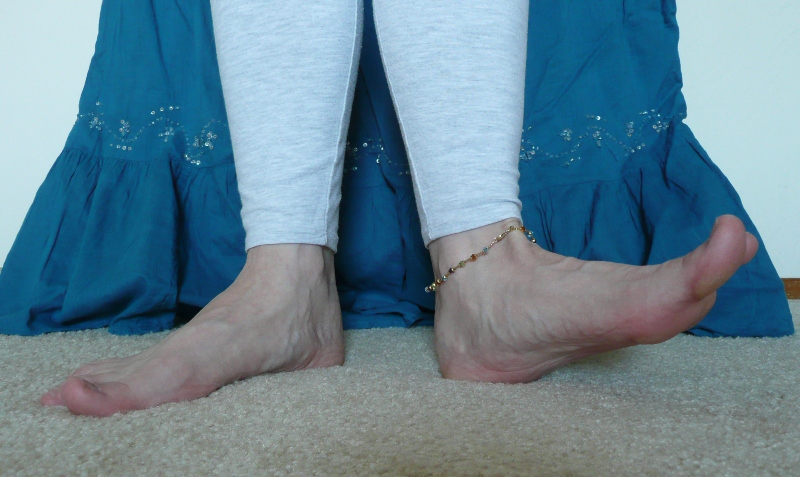 Just as the same as with the Squish Walk The Nia Technique Book does not give instructions to walk while “duck walking”, but we do it all the time in my Nia classes. This duck walk move really allows for ankle movement and helps condition the muscles on the front of the lower legs so I like to use it. High heeled shoes — especially the ones now-a-days — have feet stuck in the opposite direction with hardly any ankle flexion so the Duck Walk is great to get those muscles moving and stretched.
While progressing forward with the duck walk it is not the same as heel lead walk even though you lead with the heel. With the duck walk we don’t roll through the entire foot, we gently splat the foot down. It is a heel lead then splat with the rest of the foot. That is why the imagery of splashing your toes in the puddle works so well, I bet as a child most of us have done that.
Between the quacking and the splashing it is no wonder Nia is so fun. Adults as play! Splish splash quack!
Did you get up out of your chair to try it? C’mon, try it!
Posted in 52 Moves (of Nia), Nia | Tagged: 52 Nia Moves, dance exercise, duck, Duck Walk, hip joints, hip width, Nia, Nia Classes, Nia Moves, quack, Quacks Like a Duck, sounding, Squish Walk, The Nia Technique book | 4 Comments »
Posted by terrepruitt on June 2, 2012
Nia is the same as many things, the more you do it the more accustomed your body becomes to the movement. When you first try swinging a bat or a golf club it seems as if there are so many things to think about. The placement of your feet, the bend in your knees, the sinking of the hips, what your hands are doing, what your elbows are doing, where your chest is facing, to move or not to move your shoulders. Then there is your head, your eyes, and – oh yeah – the ball. So much to remember. Then as you practice you forget that you even were once having to remember all that. You are able to just “let go” a bit and play the game. Dance exercise is the same way for some. There are moves in Nia that we do, the 52 moves. At first the body might be so busy trying to do it correctly it is not allowed to play, but once the moves are learned there is time to play. In a Nia routine a move is often repeated enough so it can be learned and then the play can begin. But there is still a technique, there is still a right way to do it in order to get the benefits from it as was the intention of having the move be a part of Nia.
One of the moves that I sometimes find challenging is the Squish Walk, the way Carlos AyaRosas (FKA Carlos Rosas), told us how to do it. I had thought it was rising on the ball of one foot, then squishing that foot down, then rising on the other ball of the foot, and alternating. The imagery is that of squishing oranges under the heels. I had thought it was one whole foot on the ground before bringing up the other, but that is not how he instructed us.
His instructions were to be on the both balls (of the feet) at the same time. Not all the way up on both feet but one heel HIGH and one lowering and switching like that. The foot that is flat on the ground (whole foot) is not there long because it comes right back up. I found this method much more challenging than the one foot down and the other foot up. The method Carlos had us do tends to work the calves and shins more than the other method.
The Nia Technique Book states one foot is down (whole foot on the ground) before bringing the other foot up. Both methods work the lower legs, improving strength and flexibility. Neither method is actually a walk. We are not progressing forward. Although the squishy movement could be incorporated into a walk.
 With the method in the book, I usually use the image of high heeled shoes. Lift one heel as if you are showing off a new high heeled shoe. The concentration is on the lifted heel. Then switch heels. With the method Carlos taught I think more of oranges. The concentration, to me, is more on the squish.
In the Nia routine we have been doing this past month in my Nia Classes we do something they’ve dubbed the “double squish walk” which is rising at the same time on both balls of the feet. Then the squish is on bringing both heels down at the same time. Double Squish. I just call it up on the balls of your feet, since it doesn’t seem very squishy and it is not like either method.
I invite you to try both methods of the squish walk. Lift one foot onto the ball of the foot, then set it down and lift the other foot. Alternate. And try, lifting up on both balls of the feet, then start to lower one to ground, then alternate. It is as if in one method both feet end up on the ground and with the other method both feet end up on the balls of the feet. So fun, the different ways to do the moves yet, both ways are to help condition the lower legs to help “you move safely with different speeds and intensities”. In other words be sturdy on your feet as you move and dance through life!
Posted in 52 Moves (of Nia), Nia | Tagged: "double squish walk", ball of one foot, Carlos AyaRosas, Carlos Rosas, conditioning benefits, dance, dance exercise, dance practice, dance through life, flexibility, golf club, high heels shoes, improving strength, Nia, Nia Classes, Nia Practice, Nia routine, Nia Technique, Nia's 52 Moves, Squish Walk, squishing oranges, swinging a bat, The Nia Technique book | 4 Comments »

 Terre Pruitt's Blog