You may be familiar with yoga. You know those stretching exercises people do? That is what many people think of as yoga, stretching and bending and making your body a pretzel. Well, the poses, the postures, the asana are a part of yoga. That is really only one part of eight. There are eight limbs of yoga. Another part is pranayama. I mentioned one in my post Breath: Quiet and Safe. In that post I also mentioned why I often compare Nia and yoga. First of all I believe that Nia has incorporated many things from yoga into Nia, so that is one reason why I talk about yoga and Nia. But I also talk about them being similar because Nia is a dance exercise and for many people that is all it is. And since cardio exercise is beneficial I think that is fine, if that is as far as people want to go with it. The same with yoga. Yoga is an exercise. You can just do the moves and, I believe through movement, gain many benefits. However, if you want to get more out of it, there are these other things that you can practice, and one of them is pranayama.
Now, Iyengar says “attempt pranayama only when the yoga asanas have been mastered.” Because that is what Patanjali says in the Yoga Sturas. But for many of us that means we would never do pranayama or if we did it would be years and years AFTER we have been practicing. Now, I am just starting to learn more about pranayama, so if you want to heed the master, by all means, please do. I think, however, that pranayama is beneficial so I don’t want to wait until I have mastered the asana, because, quite honestly I might not “MASTER” them at all.
Now some people might hear pranayama and think that is just to woo-woo. What is that anyway, just a bunch of crossed-legged people breathing? Well, there are specific pranayamas. And there are specific ways to do them. And even specific times. But let me ask you this: have you EVER, EVER, just stopped and held your breath? Perhaps someone said something that made you angry so you stopped and held your breath. Perhaps someone in a store cut in front of you in line so you stopped and held your breath. Or have you ever stopped to took a breath? Perhaps you were just going, going, going and you realized you wanted to slow down so you took a breath? Perhaps you looked outside your window and realized what a beautiful day it was so you took a breath. Now, as I said, pranayama is specific so I am not saying THAT or THOSE breaths were pranayama, but I am saying that if you have ever stopped breathing or stopped and taken a breath for any reason you might be able to see how pranayama could be beneficial.
I mentioned the other post I wrote about pranayama, Ujjayi specifically. Well there is another one that I think of as “easy”. It is Samavrtti. Sama means equal so it is a practice of equality in breathing. But in this type of breath there are FOUR parts. Typically I think of breathing as TWO parts, inhale and exhale. Well, with this the other two are retention. As in holding. Pausing after the inhale then pausing after the exhale. The reason I say this is “easy” with quotation marks is sometimes the retention is stress inducing. Some people don’t like to hold their breath on the inhale and some people don’t like to hold their breath on the exhale. So while the idea is that anyone can do this at anytime, you want to make sure that this is not something that will cause you anxiety.
With this, the idea is to inhale then hold, exhale then hold. Keeping the SAMA in mind, the goal is to inhale, hold, exhale, hold equally. So there are many ways to do it if you are counting as a way of keep track you can inhale 1,2, hold 1,2, exhale 1,2, hold 1,2. If the holding causes anxiety, it is ok to build up to it. Perhaps just holding after the inhale. Or maybe just hold on whichever retention causes less anxiety. Then perhaps graduating to inhale 1,2, hold 1, exhale 1,2, hold 1. There are many combinations to do while you work up to EQUAL parts.
Remember that the breaths should be relaxed and even. So the idea is not to inhale then hold so long that your exhale is a rush of air. It should all be even and relaxed.
Yogacharya B.K.S. Iyengar states in his Light On Pranayama to practice in ratios retain only on the inhalation. Once you achieve his stated ratios THEN move onto the retention after the exhalation. But he begins that instruction stating you will not be able to retain on the exhale. So it could be he means to follow the ratios is you really are unable to hold your exhale. While in general I love to follow the instructions and guidelines of the masters and experts, sometimes if I restrict myself to their instructions I end up not doing it at all. So . . . my recommendation is to try it and do what is comfortable for you. Being mindful and cautious.
Some say the samavritt calms the mind and can help to create steadiness and focus even in the most challenging asanas. And others say it calms the body and focuses the mind.
Do you practice any pranayama? Do you ever take a deep breath?
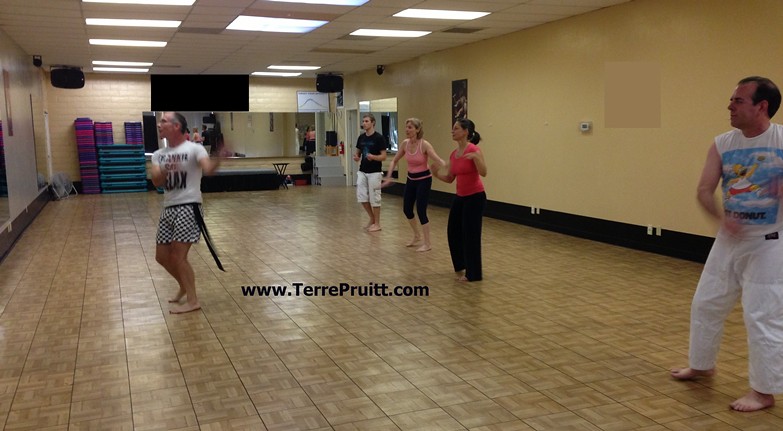
Oh my! I bet you are relieved to hear that I only took a few pictures of the Nia event. I say that because I took so many of the last two events that I couldn’t decide which ones to post, so I posted a lot. In March Jason came to town and taught his Nia routine Frankie Say Nia and a Nia FreeDance Playshop. We had a great time. You can see pictures and videos on my posts What Did Frankie Say?, Dancing, Learning, Posting, Editing, The Nia FreeDance Playshop Was Awesome!, and What Do You Mean Nia FreeDance Tool?. This time Jason was driving through California again so I invited him back to do what he is calling Franking Say Redux. It is so fun. One of the things he said was that we were going to do things we had never done before. I teach Nia so I thought that was a tall order and I shared my skepticism. But I was also eager to see what that might be. Well, a song or two in he had us doing . . . . something I had never done before. And I said, “Alright, here it is!”
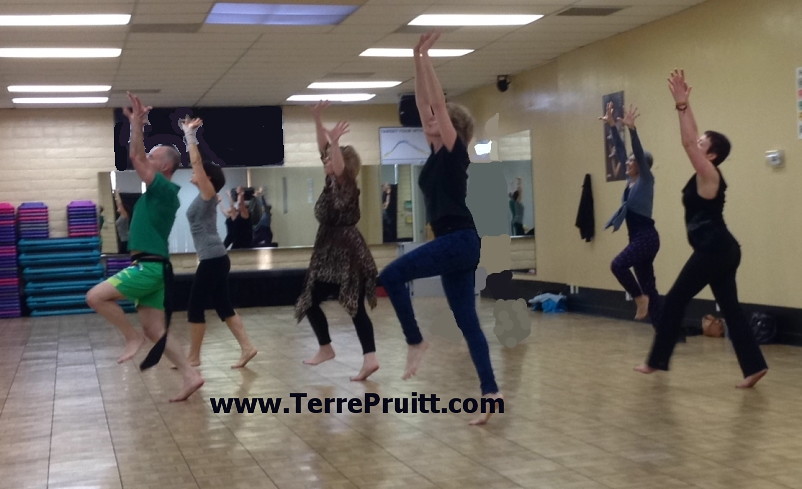
So even though he was here in March and we did the same routine he did it a little different. While he traveled throughout the United States he adjusted it. Plus sometimes part of what a Nia Teacher does while teaching is adjust moves or what we say to encourage different movement. The move was not only new to me but it was so funny I had to laugh while I was doing it. It was a Cat Stance Tail Wag with Jazz Hands. Now, if you know what that is get up and do it. It is hilarious. You don’t even need music to get a giggle out of it. I am sure part of my laughter came from the fact that we were doing other things leading up to or right after the move that doing it was almost a joke because there was just so much going on!
Some of you may need a reminder: a cat stance is balancing on one leg while the other leg is up, a tail wag is when you wag your tail (I like to do it with a release in my spine), and Jazz Hands are your fingers spread wide. Yeah. Ha, ha, ha. Try it!
Loved it. I can’t remember what was before or after, but I know the whole thing was very funny.
We had a small group, but we had a great time. My supportive husband even joined us. Jason is always fun and we always learn something. I think I will just have to keep inviting him back until you come and see for yourself.
Doing something new is such a great way to stimulate the brain and with that the nervous system. Doing something new and having it be physical is a way to stimilate the brain, nervous stystem, and the whole entire body. Jason had us doing all kinds of stimulating things. It was very fun.
Does your exercise class stimulate your brain? Do you do knew things?
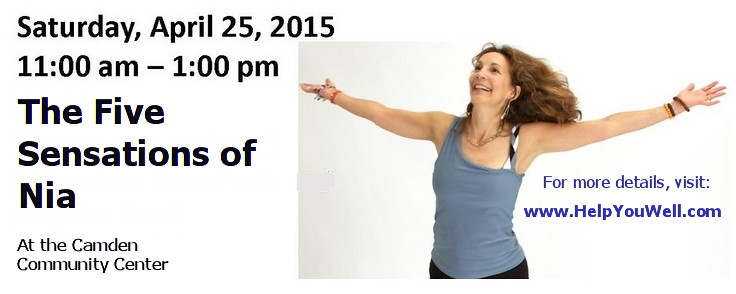
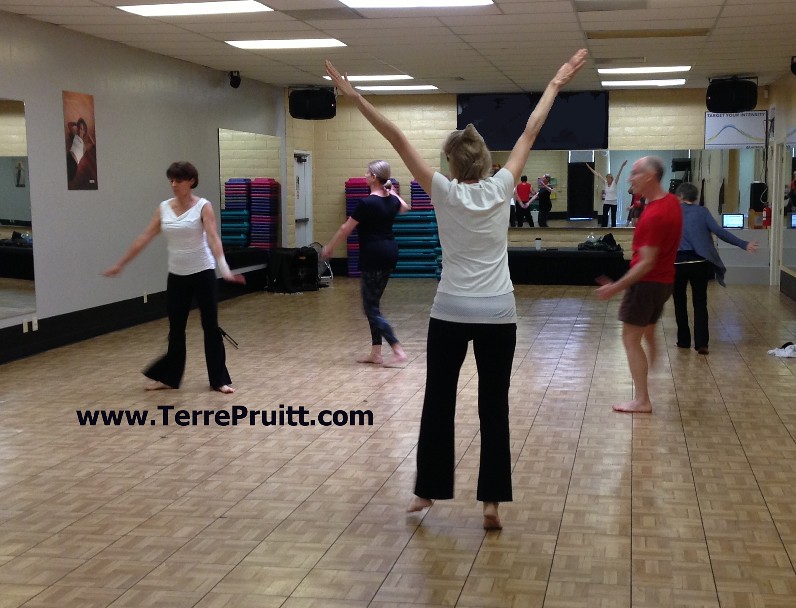
Today we had a workshop to talk about and discover the Nia Five Sensations. Just like a lot of things we do and use in Nia, the five sensations are not unique to Nia, but they are tools we use to enhance our dance exercise. In a Nia class we strive to be in sensation. Being aware of the sensations allows us to choose and dance what we need at the time of the class. We had a small turn out, but the number of attendants is never the measure of success. One of my Nia Students and fellow Nia Blue Belt’s helped me present the workshop. This workshop was held at the request of the Camden Community Center. Our participants shared that they felt they had a better understanding of the sensations and would be able to apply awareness to them either in a Nia class or just in everyday life.
First we started off moving right away. The participants walked in, we said hello then started dancing. We danced to two songs. Then we did a brief introduction of Nia then we shared the five sensations and how we experience them everyday. We shared how they could be helpful to know and be aware of in a Nia class. The 5 sensations are: Flexibility, Agility, Mobility, Strength, and Stability (FAMSS).
Then we moved to each sensation. As we talked we guided the students into the sensations. We shared that flexibility is sensed as energy moving outward. It is the opening your body, the lengthening and yawning. So we stretched and yawned our bodies open. We reached out to lengthen our limbs. We imagined our bones moving away from our center. We practiced sensing the sensation even as our bodies showed no outward movement.
We talked about how agility can be sensed in the quick start and stop of a movement. It is the physical feeling of pulling and pushing. We hopped and jumped. We chopped and slapped. We “played” soccer and tennis. We danced in a “strobe like” fashion. We even stood still and let our gaze bounce around as our eyes moved with agility.
When talking about mobility we said it is sensed as energy in constant motion. It is youthful freedom. (A description from the Nia Technique that I really like.) It is flowing movement, graceful, and easy. We twirled and whirled around the room. We let our bodies ebb and flow. We rolled like the ocean. We moved our arms. We moved our legs. We mobilized our spine. We allowed the energy of constant motion to energize us.
We used the ballet bar and wall to start us off understanding that strength is sensed as energy moving inward. With that first example it gives way to us sensing strength as a resisting, or a quality of weighted energy being moved in ways that allow you to sustain a movement or posture. It is the contraction of muscle. It is the muscle squeezing bone. We contracted and pushed. We squeezed and resisted. Allowing the effort to tire us a bit.
Then we experienced the calm of stability. Stability is sensed as balance and comfort. It is the physical feeling of harmony and peace combined with readiness for action.
After having practiced the sensations we then added them to the stances that are part of the 52 Moves of Nia. We moved through the stances in the 5 sensations. Then we put on the music and danced the stances in sensation. After two songs we reviewed the kicks that are part of the 52 Moves of Nia. We moved through the sensations doing the kicks. Then onto dancing again. We danced doing our kicks in sensation.
We finished off the workshop with two songs focusing on the sensations, but primarily using the Nia choreography and not so much sticking with the kicks and stances. This allowed us to practice dancing in the sensations to whatever moves that come as part of a Nia routine.
It was a great little taste of the Nia 5 Sensations. I can say that because no matter what I am teaching it is ALWAYS the students that make the class GREAT!
Are you aware of any of these sensations in your everyday life?
Recently I was visiting with a friend and she was sharing with me her experience in an exercise class that she had attended a few days earlier. She was sharing that the things they were doing in the class did not qualify as exercise. She was saying that shimmying and doing the hand-around-your-head-move was not exercise. She said she didn’t want to do that type of stuff in an exercise class. I think she forgot who she was talking to. I mean, she was talking to her friend who she was looking at to support her in the fact that neither the shimmy nor the hand-around-your-head-move was exercise. But I think she forgot what I do for a job. I made a comment about how if she didn’t want to use all her muscles, I could see why shimmying would not be something to do. But she said she DID want to use all of her muscles. I did not take the opportunity to elaborate on how the shimmy is a great exercise and uses — not all, but many, muscles. It really was HER moment to share so I just listened. It was obvious she didn’t want to use her muscles THAT WAY. It was not my time to defend my craft or dance as an exercise. It did make me laugh though. It also reminded me why some people don’t like Nia. Some people don’t want to dance as exercise. Some people do not feel that moving to music is exercise. There are many people who think that the only way to get exercise is to do something the same way — to move in the same way, to move in a linear way — over and over again. Some people have very specific ideas about what they want to do as exercise. And that is fine, I am not going to try to get them to a Nia class because they probably wouldn’t be able to participate enough to get a good workout. But I do get my knickers in a twist when people say it is not exercise.
I think it is more accurate to say, “It is not movement that I like or that I consider exercise.” But to say it is not exercise. Not fair. But, again, very much a common way of thinking. I have posted about exercise as dance before. I even mentioned how I liked Dancing with the Stars (even thought I don’t watch it) because I think it helped some people realize that you CAN get a good workout in while dancing. If nothing else, moving around for an hour is great cardio — if you are moving enough to get your heart rate up.
Some dance exercise classes use jumping movements to get the heart rate up. Some — like Nia use big movements, fast movements, low movements, high movements, all over body movements. As, I have said before, it is all there for the participant to use, it is up to each individual to do as much as they want.
Many people don’t care for the shimmying but it really is a great movement that uses upper body muscles. I have seen many of my regular Nia students go from not being able to do it — for whatever reason — to embracing it. I think I have mentioned before that there is one song in one of our routines where I like to keep them at doing the shimmy for a bit. I usually ask, “Are you feeling it?” I just like for people to experience that the shimmy can be an move that can qualify as “an exercise”. Their answer – by the way is usually a laugh with a “OHH yeah!”
Some people move differently once they understand that the shimmy is not shaking what is on the front, but moving from the back. I have a post on that, Shimmy From The Back.
I think there are a lot of dancers at there that would say dance is exercise. However if you don’t like to dance I understand you might not feel that way. But, if you ever want to see what I mean about the shimmy or Nia as a good workout, look for a class near you. There are classes all over the world. There are several in San Jose, California . . . . I know, because I teach ’em.
What do you consider exercise? Have you ever TRIED dance-as-exercise?
At the end of March (2015) there were two Special Nia Events in Campbell, California. They were special for a lot of reasons. One reason being is because a visiting teacher was going to be doing them. It is always special when someone who does not live in the area comes and shares their talents. Another reason is because the Nia Class is a one-of-a-kind-creation. The visiting teacher created the routine and was going to lead us through it. ANOTHER reason, they were special, was that one of the classes was a workshop or a playshop as we like to call them in Nia. And it was also, the creation of the visiting teacher and it was something that I think anyone that dances Nia can benefit from. Another reason they special was they were the first Nia Events that I produced. Produced meaning, when I heard that the Nia Teacher who created the Playshop was coming to my area I contacted him to invite him to do these events. I secured the location, I created marketing material, I promoted the events (as I am sure you have seen, I posted about them often), I worked to get participants to the events, and I worried about how it would all turn out. So, two special Nia Events. I have posted two separate posts (What Did Frankie Say? and Dancing, Learning, Posting, Editing) about the Nia Class that was held on Friday, March 27, 2015. This post is about the Playshop.
The Playshop on Saturday, March 28, 2015 was a playshop regarding Nia FreeDance. In a Nia class, there is normally choreography. Nia Headquarters and the training staff create Nia Routines. There are Nia Routine DVDs that Nia Teachers purchase. We learn the routines and lead our students through them. We have a lot of freedom with our classes. We can follow the routines “exactly” or we can play with them. We can create our own routines from a mix of Nia Routines or we can take the Nia choreography and add it to other music. Or we can create our own routines with other non-Nia music. But with almost every routine there is FreeDance.
FreeDance is where there is not specific choreography. You are not told exactly how to move. Now, I have heard the creators of Nia express very different opinions on FreeDance. I heard one of them say in the past that FreeDance should ALWAYS be guided and the other one say that FreeDance can just be free. So . . . there are different opinions on the matter. I think that in keeping with the Nia White Belt Principle #4, Nia FreeDance does not need to be guided because “Anything Goes . . . movement-wise”. But FreeDance in an exercise class is a challenge to many people. There are many reasons as to why people cannot or will not just move their bodies in their own way in an exercise class.
This playshop was brought here to help people with that. Many of the tools (ideas) Jason shared were covered in the Nia Intensives. So if you have not attended a Nia White Belt Intensive or Nia Blue Belt Intensive, they would be new to you. They are GREAT! And they were the reminder and push I needed to pull them out to use them. The most valuable things he shared with me though were not necessarily the guiding ideas, but more about how the individuals in class can be left to be.
.
When I see people in my class not moving or seeming to struggle with FreeDance, I take responsibility and blame myself for not getting them to move with my suggestions and guidance. But he brought up some very good points that I will now take to class and practice just letting those people be where they are, at that moment, in class.
Although I will still strive for the “When Harry Met Sally Moment” of wanting people to look at us and say, “I’ll have what SHE’S having.” I will also take into consideration that they could very well be doing my suggestion, but it looks different to me than I would do it. Or that they are just not in a place to FreeDance. Could be a case of Natural Time.
I learned a lot. I had a lot of fun. I am excited for Jason to come back again! This video and the video on my website are the same song. As I only stopped participating one time to video. The videos are at different times so they are a little different. Also shown here are a few of the pictures I took during the Playshop. I took more pictures during the hour Frankie Say Nia class than I did during the 3.75 hours of the Nia FreeDance Playshop.
There might be one more blog post about this, but we will see. These are the extent of pictures and videos. Enjoy!
Please share your comments. Please ask if you have any questions!
.
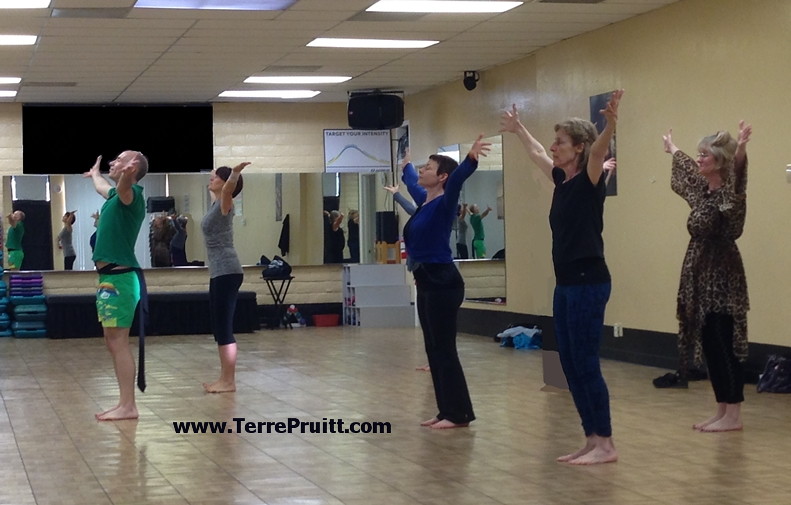
Last night we had a visiting Nia teacher come to Campbell and present a routine that he has created. Jason Alan Griffin is a First Degree Nia Black Belt and he created a routine he calls Frankie Say Nia. He travels around to different places with his dog River and he brings Nia with him. He has routines he has created and playshops. Friday night was the Nia class where he did his 80’s Alternative New Wave music routine. People were invited to dress in 80’s style – bright clothes, animal prints, whatever they think of as 80’s fashion. It is difficult – for me – to think of dressing up at the same times as wearing clothes I can workout and move comfortably in. Jason was wearing shorts that reminded me of Saint Patrick’s Day and I was wearing animal print with my hair up in a silly pony. That was as far as I was able to take my dressing up. I’ll have to check with Jason about the shorts. I forgot to ask him about them today. The dressing up and the clothes were not what makes it fun or 80’s, it was the music.
Jason had us dancing to many familiar tunes. I was happy to hear all of them that I knew. I knew all of them until we arrived at the Floorplay portion of the Nia class and then I was just mystified. I kept thinking I would eventually recognize it, but it was out of my scope of knowledge. And I don’t even remember what it was. I believe there was mention of a bar. It was odd to me. And, later it was indicated that I had a look on my face (odd) matching what I was thinking. As I said, I kept waiting to hear something that would spark some sort of little hint that I had ever heard the song before, but nothing came.
Jason’s playfulness and ability to match movements to music is so evident in his routines. And they are just fun. I can say that we all had a great time because every commented on having one! His choreography and the music made for a great time.
I was very happy that he had some FreeDances in the routine because I was looking forward to gleaning some tools from them as he taught. And I did. Then the next day he took it to the next level with the FreeDance Playshop. That has to be a post all of its own. Perhaps more than one. We will see. I am still processing.
As I have recommended before to you, Dear Readers, if Jason comes to your town you should go to his class. That is, if you like to have a great time while you are getting your dance workout in. You can always check out his schedule on his blog.
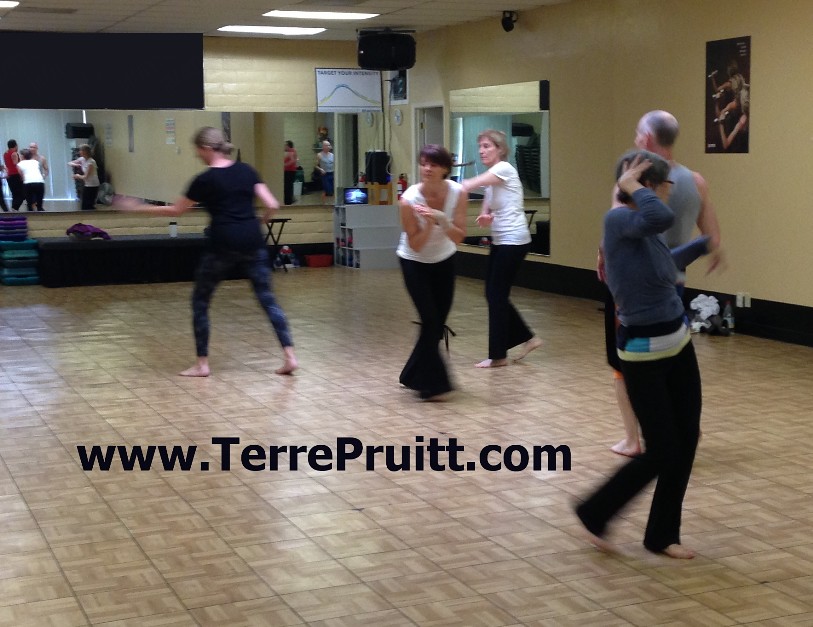
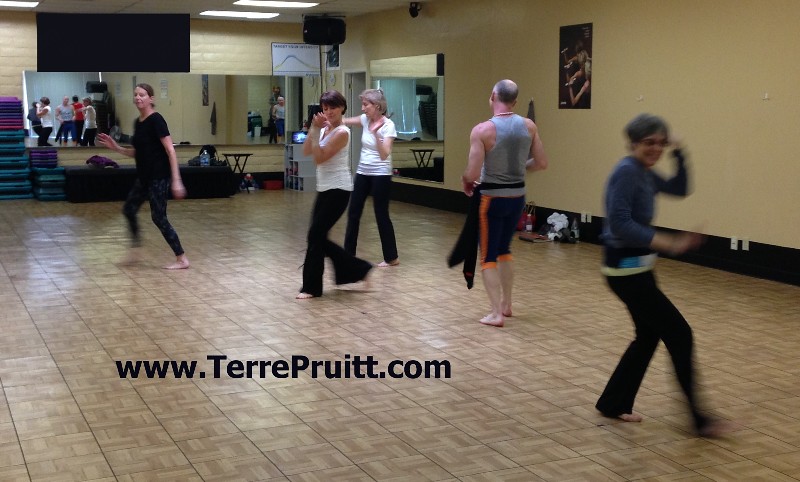
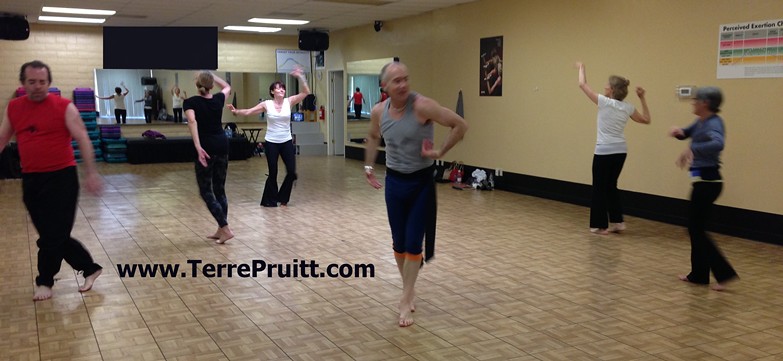
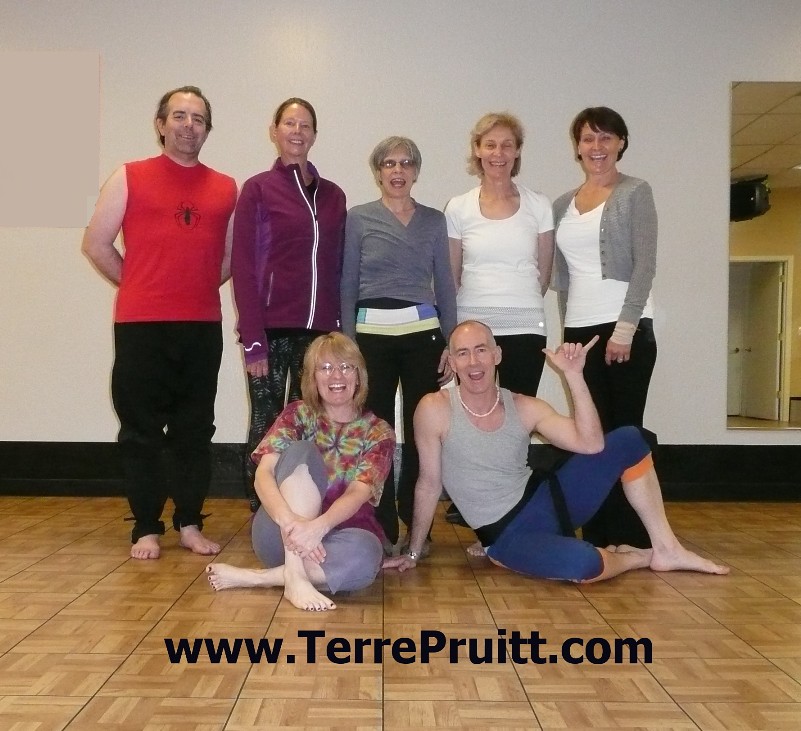
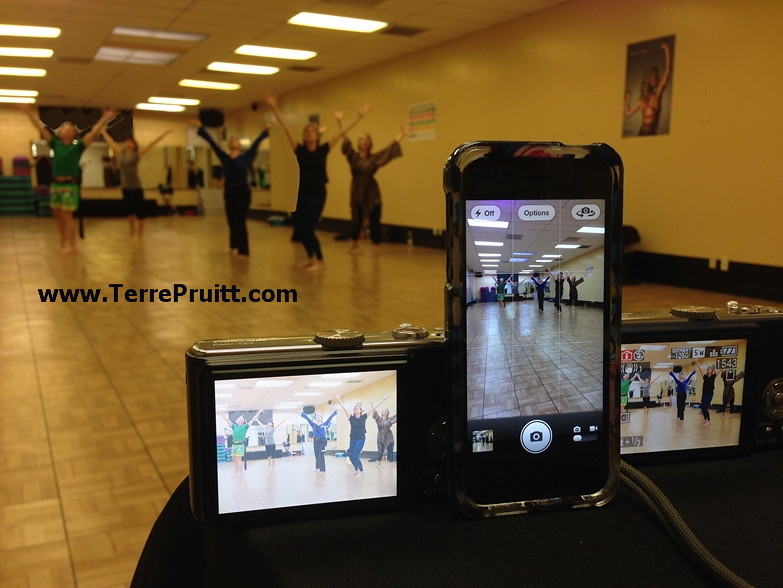
I have included some pictures. As I have said before, it is not easy to get pictures of moving bodies. I had help from my hubby. We had at least three devices taking pictures and videos.
Can you tell from the pictures that we are having a good time?
More often than not in my Nia classes we have a physical focus. A focus and an intent in an exercise class is not easy for some people. So having a focus that is physical seems, for many, to be easier than a focus that is not. I know I have mentioned this before because I know I have talked about focuses before. Today, as always, I asked my class if “they had anything”. Usually someone comes up with a physical thing . . . sore neck, tight hamstrings, aching back, tight shoulders . . . ya know, something physical. Today someone said, “Unstuck.” I had overheard her mention something about being “stuck” while I was getting ready to teach, and I thought that would be a great focus, but I wasn’t sure how to do that. So I said, “Yeah, I heard you mention that, but I am not sure how to do that.” Someone else piped in about being stuck, too. And I laughed and commented that if I knew how to get “unstuck” I wouldn’t ever be stuck. And the “stuck” we were talking about was a feeling of being stuck either in an emotion or a situation or just the feeling of being stuck! So we focused on getting “unstuck”.
The person that originally mentioned feeling stuck was happy to hear that others sometimes felt that way. That is something I learned about feelings they are like questions . . . if one person has it (the feeling or the question) there is at least one other person that does too. There are no stupid feelings. Now, I do believe there are no stupid feelings, but I will admit to being guilty of thinking and sometimes even saying that as a knee-jerk reaction to someone I love saying something I think of as not nice about themselves. If one were to say, “I feel ugly.” “I feel like a bad person.” My automatic reaction is “that’s stupid you aren’t . . . ” But if they FEEL that way that is not stupid. So I am still learning to curb that reaction. But I digress . . . back to getting unstuck.
As I said, I wasn’t sure how to dance “unstuck”. I wasn’t sure how to make that a focus, but then I decided . . . . because I believe . . . that sometimes just thinking about it can help things move along. So my thoughts were that if you were feeling stuck, just acknowledging it and moving with it could be enough to unstick it. Or it could be enough to think of an idea on how to “unstick” it. Or it could just open you up to an idea that is going to come later. Just all types of stuff. We agreed that dancing with the focus of getting unstuck and the intent of being open to that and whatever it meant and however we could achieve that would be our focus and intent for the class.
One person mentioned not getting “too unstuck” which gave me the opportunity to remind people that we are dancing our own interpretation. When I suggest people move as if they are floating in water, everyone moves in their own way. They imagine their own “floating in water”. The same with getting “unstuck”. One can get as “unstuck” as they feel they need to be. The person that mentioned this left early so I didn’t get to delve into what she meant . . . because it could mean so many things.
After class, I actually felt better and a little less stuck. “Unstuck” could relate to letting go or being loose. It is one of those things that if you are feeling anything related and you focus on it with the intent of acknowledging it or relieving it, it can just happen.
For those that are challenged with focusing on things that are not strictly physical “unstuck” works for that because one could have a tight muscle that is “stuck”. Or a joint that might need some loosening because it feels “stuck”. So dancing to “unstick” is really a great focus.
I am always amazed at how my class comes up with such great things to focus on. I am further amazed at how so often what they come up with is something I am feeling the same need for. Getting “unstuck” is great.
Do you ever feel “stuck”? In what way? What do you do to get “unstuck”?
I did not intend to write a blog post on all of the 52 Moves in Nia. My intent was to post a few and entice you into buying The Nia Technique Book. It seems as if I just might get to all of Nia’s 52 Moves on my blog. It so happens that sometimes I am at a loss as to what to post, so I turn to a move on the list of 52 Moves. Or sometimes I am intrigued by one the moves because it is in a routine that I am currently dancing with my students. Or I am intrigued by of the moves that it is in a Nia Routine that I danced with another Nia teacher. OR I am intrigued by of the moves even though it is NOT in a Nia Routine – as in, it is not part of the original choreography, but we do it anyway. That is the fun thing about Nia Routines and the 52 Moves. You can kind of put them in anywhere. And, I will say it again, because I think it is important to state that the moves that Nia includes on their list are not unique to Nia. Nia is not claiming to have created them. Also, it is nice to know that you will experience moves in Nia that you have experienced before. The moves are on the lists and included in Nia Routines because there are benefits to doing them. Some of them are so simple the benefits could be overlooked. Some of them might seem odd to have included on a list of moves done in a dance exercise class. But they have benefits. One move that is simple and might seem random to have in an exercise class is Finger Flicks.
Yeah, you read that right, Finger Flicks. Flicking your fingers. This move can be done so many different ways. Fast, slow, high, low, fingers up, fingers down, with an emotion, without an emotion, with the music, against the music, so many possibilities. The benefits of this move include conditioning the muscles of the forearms and hands. If you really use your thumb to resist the fingers the move contracts the forearm muscles and makes your fingers work! The Nia Technique Book states that this move helps rid the hands of tension.
The how-to is simple enough. I bet you know it already. You form a loose fist with your hand, keeping the thumb on the outside of the fingers. Then push with all four fingers against the thumb. Allow your thumb to resist. Then let your fingers push through. Practice this move with your hand at different levels-as in high above your shoulders, at the same level as your shoulder, below your shoulders. Let your arms hang, hold them out . . . in other words flick your fingers all over. Use one hand, then the other, then both. Just flick, flick, flick, flick. Try doing it how I mentioned, fast, slow, high, low, fingers up, fingers down, with an emotion, without an emotion, with the music, against the music, play with the possibilities.
You can practice this move while dancing around your home. You probably do this move without even thinking about it after washing your hands. You could probably check the mirrors above the sink to verify it.
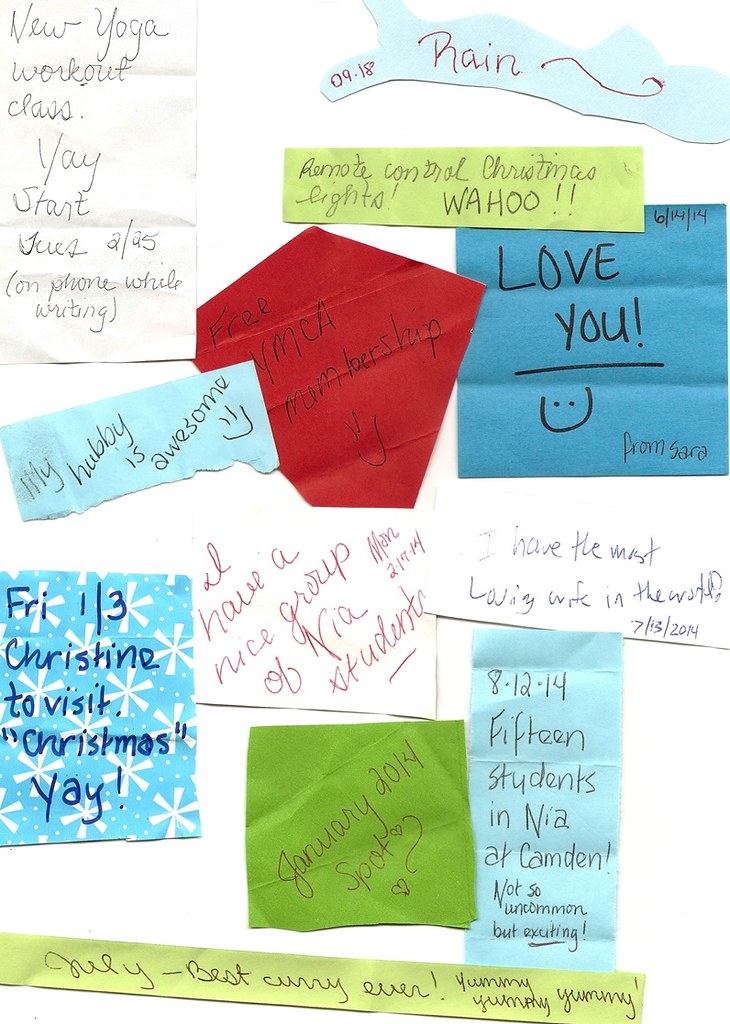
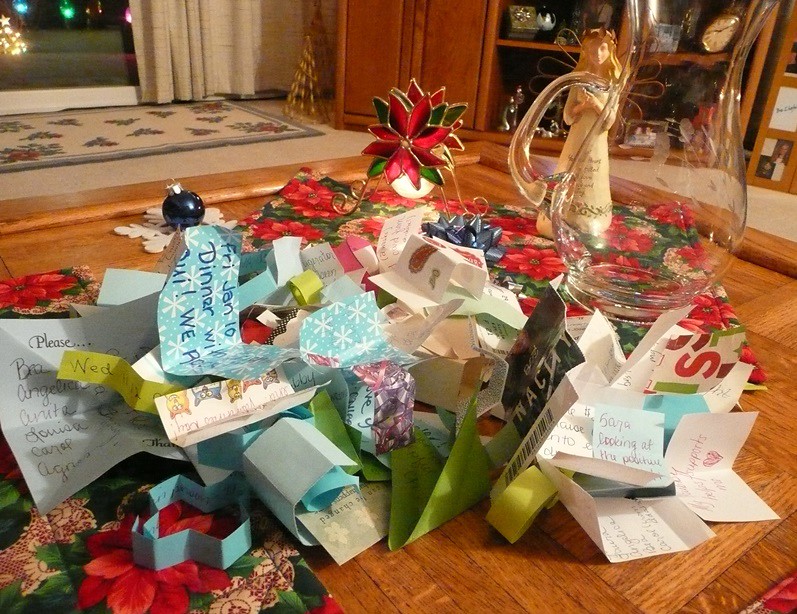
This year we were lucky to have a visitor for our Goodie Jar reading. My niece was visiting and she helped us relive the moments that made us smile. I am a smart enough aunt to know that I have an amazing niece so she was mentioned often in my notes of “Good Things”. Here are some of the highlights from the jar:
~My niece treated us to the Nutcracker Ballet in San Francisco
~Nightingales
~May 29, (2014) was the first “coffee” visit with they Camden Community Center Nia Class
~Wicked
~Colleen came to say goodbye to Spot (06.24.14)
As you can see from the pictures there were a lot more. I’ve had some people ask me what to put in the Good Things Jar. It really is up to you. I am seeing a lot of different versions of “jars” this year so I really think it all depends on you. What do you want your jar to do? The point of my jar is to keep me focused on the GOOD THINGS IN LIFE. There are so many things that can be considered “not good”. It is very easy to get distracted and end up with a negative attitude and to forget all of the blessings that are around us. So, for me, it is a way to keep the blessings in my life at the forefront. That does not mean I can’t be sad or get mad or pout . . . .or whatever . . . it just is a reminder to not stay sad, mad, or pouty. Because that — to me is an insult to the good stuff.
There is another benefit to my Goodie Jar. In addition to making a note and helping me stay focused it really is fun for me to read the good things at the end of the year and to remember. While my family might not enjoy it as much as I do . . . they tolerate it. I even tell stories regarding some of the GOOD THINGS, if they will let me.
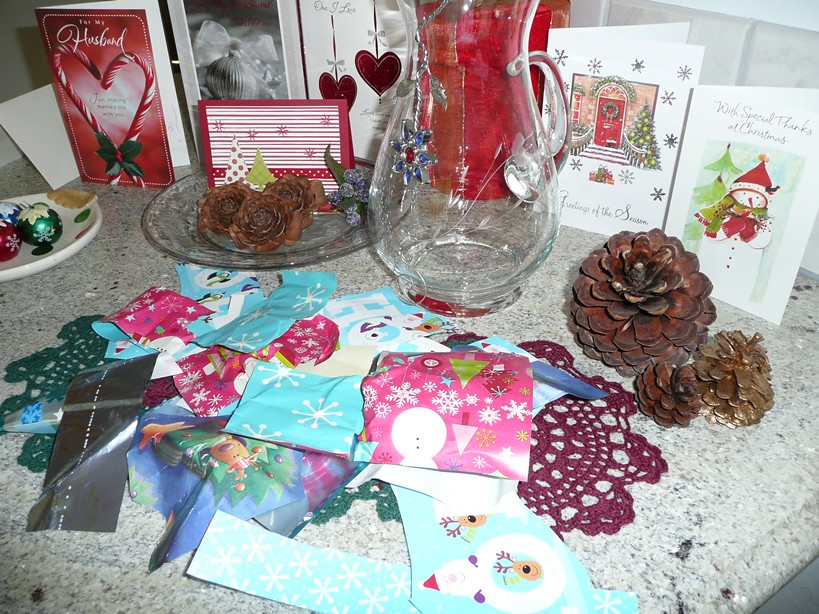
I have mentioned before in posts that I like to use different types of paper. I like to fold them in different shapes and ways. It makes the jar look festive. I noticed last night that the ones my niece grabbed to read were the spiral ones, the ones folded in shapes, or the really festive looking. Yeah, it is fun.
Also pictured here is this post are the pieces of paper we are going to use to fill up the jar in 2015. Yeah, it started off as a one-time thing, but this will be our third year of doing it. I am really loving this tradition. I love the practice throughout the year. I love the decorative jar that sits out all year round reminding me that there has been good things. I love the “ceremony” (to me it is) of reading the good things.
I wish I could remember the origin of this aside from Facebook. I mean, I know WHO I got it from, but I don’t remember where/who SHE got it from. But the Good Things jar was not my idea. Using a beautiful pitcher is my idea and filling it with different types of paper is my idea. Re-using wrapping paper . . . my idea. But the original idea . . . . don’t know. But THANK YOU!
So, what good things have happened to you in 2014? Do you have a Goodie Jar? Are you going to have one for 2015?
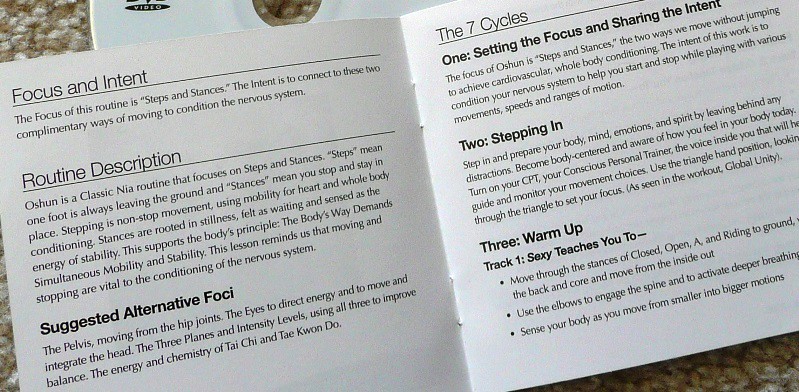
You may be familiar with cycles of a cardio class. Most modalities or classes have a warm-up, a “moving portion”, and a cool down. Not every form of cardio class includes a “flexibility” portion. As I mentioned in my last post, I was in a training recently and they include flexibility in their class structure. That is awesome. Their required class structure is: warm-up, endurance phase (cardio), cool down, then flexibility. I love that they are including flexibility. It is great to see. That is four portions. As you may be aware, Nia has seven. We call our sections of class cycles. The cycles are:
1. Setting your focus and intent
2. Stepping In
3. Warm up
4. Get Moving
5. Cool Down
6. Floorplay
7. Stepping out
Nia’s cycle #4, the “Get Moving” is comparable to the endurance phase or the cardio phase. That is where we really move. We can use big movements and move through the planes to get the heart rate up, so our cardio does not consist of running and jumping. In order to get the heart pumping we move our body up and down, using the muscles. We also move our arms and hands — a lot. Could be we are punching or it could be we are just moving them in a way consistent with the body’s way but that helps get the blood moving.
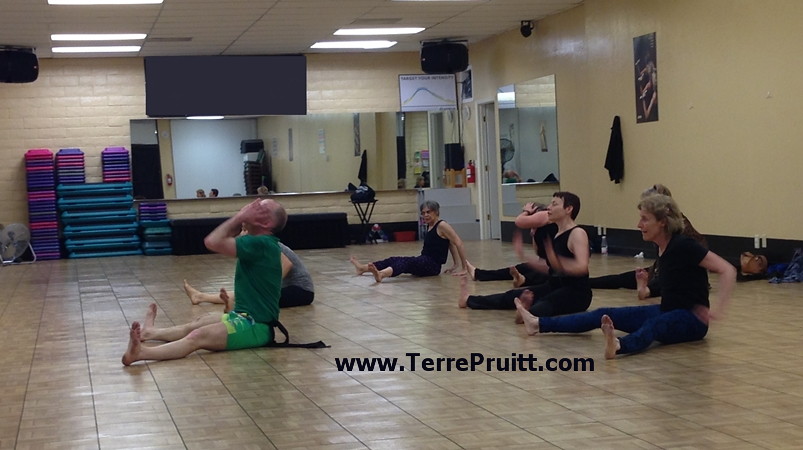
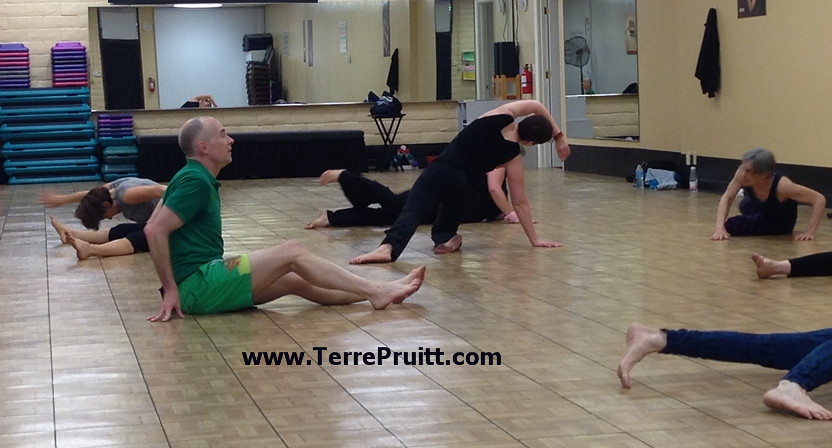
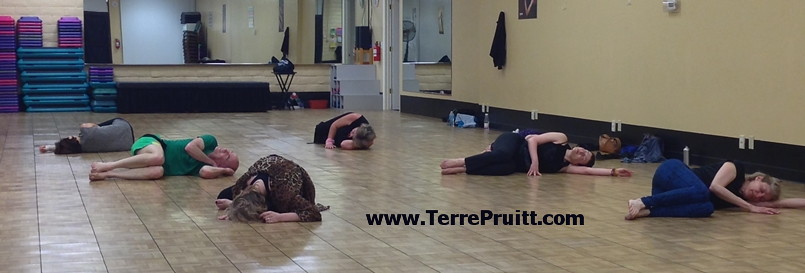
Nia’s cycle #6, Floorplay, is multiple types of movement. It is stretching and/or strengthening. It could be rolling on the floor or even crawling. With floorplay we do exactly that . . . . we play on the floor. There is definitely “flexibility” going on.
I was happy to see the flexibility component added. In fact, it might be so new that it wasn’t even included in the copy of the slides that we received for hand outs.
Flexibility is important. We there is tightness in the muscles sometimes they do not move properly. Where there is tightness in the joints they do not move properly. We our body does not move properly it tries to compensate and often ends up creating more issues. Or the tightness does not allow us to fully straighten so it might feel as if it can’t move at all so then people stop moving. It is somewhat a cycle. Perhaps you would like to read Simple Stretches Could Bring Relief.
Working on flexibility is just as important as working on cardio and resistance training. Flexibility is great to include in your workout routine. It should be scheduled into your workout time. Just like a savasana is done at the end of a yoga routine, stretching should be part of any workout routine you do.
It would be best if you stretched the muscles that you just worked in your workout. Being specific would be good. But in general it seems a safe bet would be to start at the top and work your way down. Stretching each muscles/muscle group. As I mentioned it would be best to stretch what you just worked so if you know how to do that, spend an extra minute or two on those muscles/muscle groups. I know it might feel like you don’t have time for it, but it will actually prove to save you time in the long run.
Do you have stretching as part of your workout? Do you work on your flexibility?


 Terre Pruitt's Blog