Posts Tagged ‘Nia choreography’
Posted by terrepruitt on January 15, 2015
I have said it many, many times, but I am going to say it again. Nia has 52 Moves which we incorporate into the Nia routines. These moves have a specific way to be done. But the way they are done is adjusted, like many things, when you are doing them in a routine. There is or was a debate about one of the moves called the bow stance. The debate is or was about how the weight of the body should be distributed. The reason I am saying “is or was” is because I don’t know if the debate was ever settled. The discussion regarding it — at least one that I had seen — was on Facebook and it was a long discussion. I don’t know what the end result was or what the “official” decree is because to me, I want to teach balance, so if I am JUST doing a bow stance then I would instruct people to have their weight evenly distributed. Usually I am not doing JUST a bow stance. If I am showing people the bow stance it is because it is in the routine and there are other steps prior to or after it and with other moves on either side the weight gets distributed according to the need. So, in other words, we adjust the move to fit the dance and choreography. So that is what my class and I are experiencing right now with the Nia 52 Move called Rock Around the Clock.
If you read my original post about it, the one that explains what it is, the instructions state to start the rock on the heels. But in the routine I am leading my class through currently we start the rock on the toes. Then we roll (or rock) to either the left or the right. We actually go both ways and like many things, the different “sides” or directions are very different in regards to sensation and difficulty level. One side is easier than the other . . . at least that is the consensus with my students. So it is very beneficial to practice “rocking” both ways.
With this post I am doing two things; 1) I am reminding you to practice moves going both directions. Just like we do both sides. If we are doing a move with the left side we do it with the right. We – trainers – often say to keep the body even and it really is to work both sides of the body AND the brain! 2) Share with you a different or additional WAY to practice Rocking Around the Clock.
My original post says something about this being an example of an easy move. It is not necessarily “easy”, what I probably should have said was the Rock Around the Clock was not a high intensity move. So for those that are really starting out learning this move you might even want to sit down and do it. Since feet are in shoes for a large part of the day and those shoes might not allow for a lot of ankle mobility, it could be that your ankles just don’t want to move in the way that is required with this move. So it is a great idea to sit down and allow the ankles to loosen up.
For me, my feet want move opposite of each other. So each foot wants to be on the opposite edge, so training my feet and my brain to be on the same edge it interesting. Sitting in a chair while doing this move allows my feet and brain to understand that this move is “same edge”. Once you get your feet and brain on the same page, then you can stand up. (FYI: Sitting and practicing this move is very different from trying to take pictures of your feet while sitting and practicing this move. But hopefully you will get the idea from the pictures even though they are not very good.)
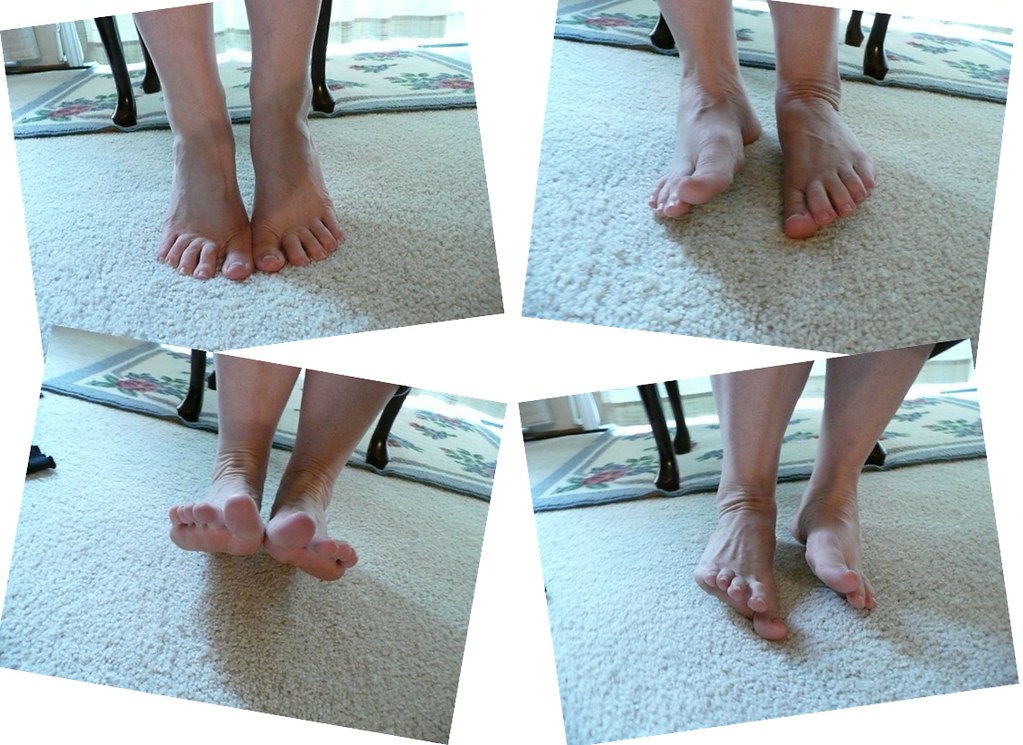
When you are standing you can use something to hold onto like a counter, table, chair, wall, something that is sturdy and can assist you in balancing. Having something to steady you while your feet get used to supporting your weight on the edges is nice. The support also allows you to really exaggerate your foot movements to help get the movement into your muscle memory.
This move helps build strength in the ankles and the feet. This is also a very “mental move”. It is one of those moves you might have to really think about in order to do it correctly. Then, with practice, it will become one of those moves you can do without thinking so much about. And your feet and ankles will benefit greatly.
So have you tried it? Can you do it sitting down? Can you do it standing up? Can you see how it is an interesting move?
Posted in 52 Moves (of Nia), Nia | Tagged: ankle exercise, ankle flexibility, ankle strength, Bow Stance, Facebook, foot exercise, foot strength, Nia choreography, Nia class, Nia Dance, Nia posts, Nia Practice, Nia routines, Nia Technique, Nia's 52 Moves, rock around the clock | 6 Comments »
Posted by terrepruitt on October 11, 2014
In Nia there is something called “the beginner’s mind”. Since learning about it associated with Nia, I have heard about it in association with other things. It might not always be called “beginner’s mind”, but it is the same concept, the same idea. It is the idea of stepping into something – anything, even if is something you are well familiar with – with a mind as if you are a beginner. Step into it as if you are hearing it, doing it, seeing it, or learning it for the first time. Step in as if you are a beginner.
This is a wonderful tool. When you walk into a situation with an empty cup, when it is not full of knowledge on the subject, it is able to be filled with all the information, new stuff is easy to learn, stuff you already “know” can be learned in a new way, and your cup gets filled again.
There are many reasons why you might want to practice the “beginner’s mind”. It could be because you are required – perhaps through your company, your certifying board, or any number of things – to take a particular class. It could be because – even though you know you don’t know everything there is to know . . . the timing of the class has you thinking it will be a waste of time. It could be — as just mentioned — you know you don’t know everything, but the length of the class has you thinking you will only get two hours worth of information out of the twelve hours you are being required to attend.
When I take a Nia class I always step in with a beginner’s mind. I know that no matter what routine is going to be taught it is going to be different. Which is not to say that the teacher will not do it correctly or will not do it the way it was taught on the DVD, but it does allow me to easily accept. I accept the way the teacher is teaching it. It flows so much better if I am just receiving as opposed to trying to inject my knowledge and the way the routine is supposed to be done. I accept that the teacher might not teach it exactly as I teach it. The teacher might use different pearls. The teacher use different cues. She might have found that a slight change in the choreography works better for her students or even something for her. And . . . with the idea that I am doing it as a beginner . . . instead of an expert who knows the routine . . . I can learn something. If I just do as I am being instructed I might sense that the move she does is actually good for a particular audience. Or the pearls that the teacher uses really matches well with the movements. Instead of my inner dialog being the moves or worse something like, “Well, here I say, ‘XXX'” or here we move like XXX, with my beginner’s mind I am listening instead of “talking” over what is happening. All of this could lead to discover of a new movement pattern.
In regards to a training where you are required to be, it could just make it be less dreadful than you thought it would. If you accept the fact that it is a requirement and decide to walk in with a beginner’s mind being told stuff you already know is not such a waster of time. Keeping the beginner’s mind and not telling your entire story to prove what you know gives you time to listen to what others know and learn about them. And — as stated before — possibly hear the same information but in a new way. Allowing yourself to let go and not be the expert is freeing and lets you relax into the learning process.
I was grumpy this past week because I knew I had to spend my Friday night (FRIDAY NIGHT) and all day Saturday in a training. I was afraid that my grumpiness would keep me from learning and be recognized by others. So I asked for help and was reminded of the beginner’s mind. I was able to step into the class not as grumpy. Of course, I did mention the fact to the trainer that it was a long training and the trainer – being an EXPERT trainer and pretty awesome – agreed, gave me the sympathy I wanted and boom! I got over it. 🙂 With my “cup” empty . . . I learned some cool things!
Do you every have the opportunity to practice the “beginner’s mind”? Have you every practice the “beginner’s mind”? How did practicing the “beginner’s mind” work for you?
Posted in Misc | Tagged: begiiner's mind, Expert trainer, movement pattern, Nia, Nia choreography, Nia class, Nia DVD, Nia pearls, Nia routine, Nia student, Nia Teacher, required training, training | 14 Comments »
Posted by terrepruitt on September 16, 2014
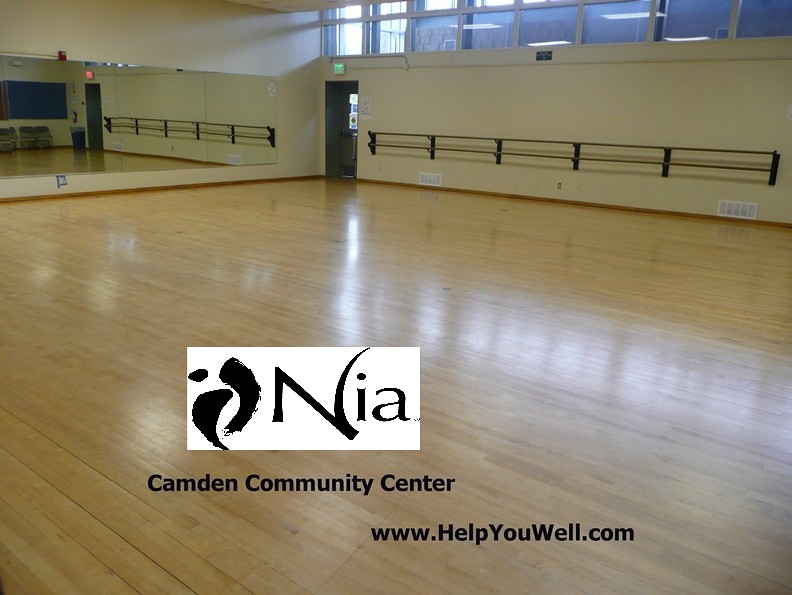 There is a Nia Routine called Miracle. It is fun routine. Like many Nia Routines it has form and freedom. There are two songs in which the foot work is pretty much the same throughout each song (form), but within the sameness you have the freedom to switch it up and add your own style. The choreography gives you the steps, the area where your feet are to be in dancing to the music, but you can decide how to get there and how your foot will be placed into that area. Form and Freedom. There is also something in this routine that Carlos Rosas (NKA, Carlos Aya-Rosas) calls the “Nia Bundle”. It is basically where the entire class gets very close together and dances. This is not easy for people to do. Why? There are at least as many reasons why this challenges people as there are people. But there are many benefits to dancing in a “bundle” and as a group.
One benefit of dancing in a close bundle is to practice our proprioception. In close proximity to other Nia Dancers we want to be aware of where our arms are, where are feet are, where are hands are. Are our limbs close to our body or are they out as far as they can go? Are we going to step on someone’s toes? Are we going to bump into someone? While the goal is not to step on nor bump into anyone, it is understood there might be some contact . . . but not often. For those in my classes that participate in the Nia bundles we do a good job being aware and moving in a close group.
Also dancing so close to each other helps us be aware of each other. Not just the physical presence of the other students, but there is eye contact, there is giggling, there is connection and a sense of community when you are brought really close together. No one is in their own space, we are sharing space. We move as one in space. We move as individuals in a shared space. We learn to dance together.
Another benefit could be that we – as individuals are pressed into moving in different ways. Finding a new way to move our body in dance because we are so close to someone. How can we move our elbows without elbowing someone? How can we dance to the music and express our spirit in such close proximity to others? Ahh . . . yes . . . new-to-your-body-moves just might be discovered.
I always laugh at the thought of someone looking in the dance studio at the community center and seeing all of the space with 12+ of us all clumped together in the middle or in a corner. I imagine them thinking that odd. I imagine them thinking, “WHAT are they doing?” Then we throw our hands up in the air and sing. It is quite fun!
So despite some people’s misgivings about dancing really close in a Nia bundle there are those who join in with gusto and reap the benefits. Does your dance exercise class have a bundle? What would you think if you were to peek in a class and see it? Would you be a bundle dancer?
Posted in Nia | Tagged: benefits of dancing, Carlos Aya Rosas, Carlos Rosas, community center, dance class, dance exercise, Dance Workout, Dancing, foot work, Form and Freedom, fun routine, miracle, Nia Bundle, Nia choreography, Nia dancers, Nia Music, Nia Practice, Nia routine, Nia songs, Proprioception | 2 Comments »
Posted by terrepruitt on September 2, 2014
If you have read more than one post on my blog you know (probably) that I teach a movement class called Nia. Nia is very much about “dancing” and moving to the music. The training required in order to teach is called the Nia White Belt Intensive. The training is over 50 hours long. Believe it or not there is hardly anytime in that 50 hours learning a routine. In fact, I don’t remember learning any part of a routine in my White Belt. But I know people who have taken the training more recently and they said they did review a song. I remember when I first arrived at the training I literally had NO IDEA what it was going to be like. I signed up rather late and if there was any pre-training at that time, I didn’t get it. I had thought I would walk out of the training ready to teach. Ha. Nope. I was given tools to help me be ready to teach. There might be people who are ready to teach when they walk out of the first training . . . but I wasn’t. I wasn’t that familiar with Nia to begin with so the way we were taught to learn a routine was very new to me. As you may know we were taught to map our music by “barring” the music.
I know that Nia is making an effort to make things easier on teachers. Nia Headquarters actually documents the choreography on the bars now. So, I feel that the focus has shifted a bit away from barring the music the way I was taught. I think the way I was taught was very cool. I love the way Nia had at one time had us learning the music. But I also understand the need to learn quickly or to have tools available to allow people to do things faster. That is just the way our society is. Things need to be done fast.
I also understand that we all learn differently. We all have our own ways of doing things. I honestly don’t do EVERY step that I was taught to do. I also mix it up and I don’t always do each routine EXACTLY the same. But pretty much.
For all the routines so far, I do bar the music myself. Sometimes I have trouble with some of the songs so I might rely on the bars from HQ a little more than with other songs. But I bar the music and I document the choreography myself. I “fix” any discrepancies I might see on the DVD. But I do this in steps. First I bar the music. I count the music and I dress my bars. I have found the more detailed I am with the dressing the better it is for me. I put as much detail as I want on there. I don’t just put the sound I hear for the cue for the Nia routine. I put the music on the page. Then I scan the paper into my computer. Now I have barred music. So what I can do with that the barred page — without the Nia choreography on it — is use it for whatever I want. I can add my own choreography. I don’t just have the places marked where I would do or cue the already-created-Nia kata, I have sounds that I am familiar with document. So noting my own choreography to the page is easy.
Then, on my paper I just scanned, I add the Nia choreography. Once I do that then I scan my sheet again. So now I have an electronic image of my complete and final bars. I always know where it is. I admit to taking my sheets of barred music with me either to teach or around the house, then I misplace them. Or I mixed routines up so I have one song in with another routine. Then after a year when I go to do a routine, I am missing a song. I am pretty particular so I will look for it, but sometimes I let go and just look at my electronic copy. I know that eventually I will find the hard copy so I just use the one I know where it is.
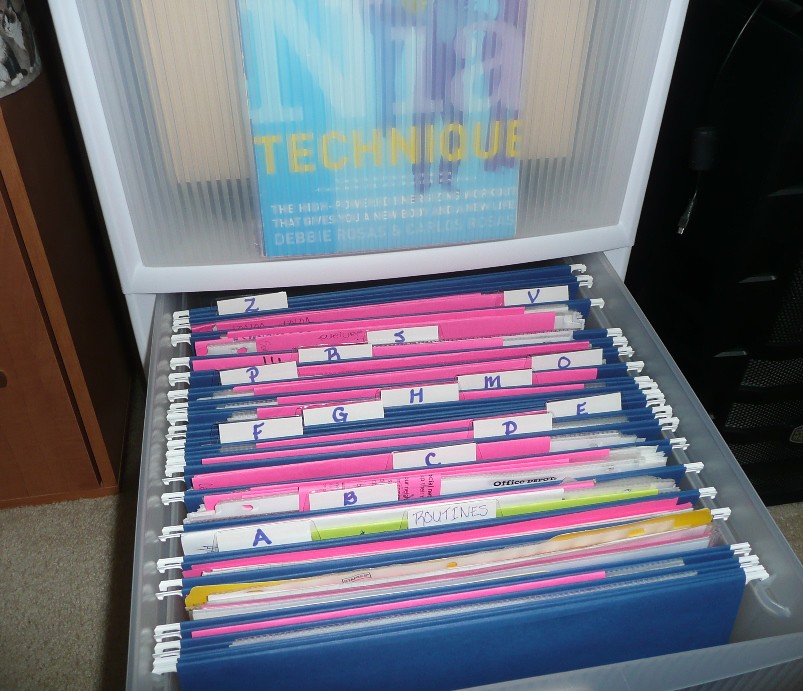
I am so happy though because I finally got a HANGING file system. So much easier to file my routines that way. I used to have them in a pile on a shelf in a cabinet. So in order to get to them I had to take out the entire pile and go through it to find the routine I wanted. Or to put one away . . . that is why I would end up with “lost” songs because I didn’t always want to take the time to take out the stack and deal with it. But now, it is so much easier with them hanging! Yay.
So, if you teach a dance class, how do you document your moves? How do you note your choreography? How do you store your notes?
Posted in Nia | Tagged: barring music, dance class, dance exercise, mapping music, movement class, Nia, Nia choreography, Nia class, Nia Dance, Nia Music, Nia Teacher, Nia training, Nia White Belt Intensive, scanning your bars | Leave a Comment »
Posted by terrepruitt on July 31, 2014
One of Nia’s 52 Moves is Head and Eye Movement. Yes, we intentionally and specifically move our head and our eyes in Nia. A long time ago when I first started teaching I had a student who had come to about three classes and after the third class she said something to affect of since starting Nia she actually moves her head to look around while driving. So my first thought was, “Yay! Nia helps make people better drivers.” If people are not moving their heads and then start doing so after Nia – YAY! – especially while driving. Nia really is about full body health and movement. So we don’t do just a cardio workout that works your heart. We don’t do just a dance exercise that moves your legs. We don’t do just some choreography that involves our hands. We involve the whole body. As you may have surmised from the post on Creepy Crawlers. It is very important for people to move their heads.
I see a lot of people with very stiff necks who in fact do not move their heads. There are a lot of reasons. I know some reasons include stiff muscles. They can’t move their head without pain because their muscles are not used to moving or are holding too much stress. I know some people who can’t move their head because it causes them dizziness. I also know some people who rid themselves of stiff necks and dizziness by moving their head. Moving one’s head will not solve everyone’s issues of stiff necks or dizziness, but I do know some people who were helped by it.
In Nia we move our head a lot. We engage our eyes a lot. But as with all of the 52 Moves of Nia there is a specific way to do it. In just practicing Head and Eye Movements you look all around and move your head to match your gaze. Letting the action of your head follow the intent of your eyes.
Just like with Catching Flies, this move requires looking BEFORE moving. So LOOK and then move the head so you are facing the direction you are looking. As I said look in all directions. Look up, then move your head so you are facing up. Look down, then move your head so your chin is at your chest. Look left, then turn your head left. Look right, then turn your head to the right. Look in a different direction then move your head so you are facing that direction. After looking around nod your head “yes”, shake it “no”, roll the head around both directions. Vary the speed at which you do all of this. Be aware of any sensations that come up. Also, if you are not accustomed to moving your head be careful that you don’t get dizzy or too dizzy.
As I mentioned some people get dizzy from lack of moving their head. It is not because of any condition, it is just lack of practice. So, be cautious when you first practice Nia’s Head and Eye Movement. Now, go, look around, move your head.
How do you feel when you move your head? Do you move your head around? Do you have a stiff neck? Do you get dizzy when you move your head?
Posted in 52 Moves (of Nia), Nia | Tagged: action follows intent, cardio dance, cardio workout, dance exercise, ease neck pain, ease neck tension, Head and Eye Movement, health and movement, Nia, Nia choreography, Nia class, Nia student, Nia Teacher, Nia's 52 Moves, San Jose Group Ex class, teaching Nia, whole body workout Creepy Crawlers | Leave a Comment »
Posted by terrepruitt on May 10, 2014
I imagine I am like all dance exercise teachers, in that when I hear music I enjoy I think about how I can bring it to my Nia class. I think about creating choreography to it. I was thinking the other day about what music would appeal to one of my classes. My train of thought took me on a little journey. First off – before I share my journey – this is not a rant about how modern technology has caused huge chasms between people because while there are some disconnects there are some great connections. This IS a little about how things have changed and how we miss out on somethings but it is more of a ride down a memory rail line then a rant. Many of you that lived through the time period that I am about to mention, have probably heard the “remember when” about when you had to listen to the radio “all” day before you could hear that song (ya know, whichever one you wanted to hear) again. There was no device to turn to that could play it instantly. Unless you held your cassette recorder up to the radio and recorded it, you had to wait for it to be played on the radio. There was also the accidental sharing of music that today’s technology prevents happening.
When I wanted to listen to my music I had to go into the living room and play my records. I usually had to ask if I could. Then I would turn on the stereo with the turntable for the whole house to hear. I am not saying that I played it loud, I am just saying that it was played through speakers so everyone had to suffer through me playing my latest obsession over and over and over. That is why I had to ask permission to play my music. If I was playing it, the people present would have to listen to it. So I am sure my mom got to “know” my music. I shared with her that “latest” tune. The pop music. Now-a-days people have personal devices with which to listen to their music, so it could be that parents never actually hear what their kids are listening to. They don’t get to connect on that level.
Not that parents and kids ever connect on the same level when it comes to music, but sometimes it could happen. I imagine my parents became very familiar with some of my music. I bet they even learned some of the lyrics via pure repetition. I bet that they even grew to like some of it. With these thoughts rolling through my mind, like a leisure train, it made me think that this might be the case with some of my students. I would love to bring music to my Nia classes that reminded them of connections with their children. The connections could even be so tenuous as them not even really liking the song but the sense of familiarity and family would allow their bodies to connect to it. They could move and enjoy the sensation of movement without really thinking about it. They would be able to associate memories to the music.
Ha. These are the thoughts of a Nia Teacher wanting to MOVE her students. But, as I first mentioned, I bet other cardio dance workout teachers think the same way. What do you think? Do you think songs like that could get you moving? Do you think songs with that type of connection could allow you to dance?
Posted in Exercise and Working Out, Nia | Tagged: cardio dance, cardio dance workout, dance choreography, dance exercise, dance teachers, Dance Workout, exercise music, exercise teachesr, memory lane, Nia, Nia choreography, Nia class, Nia Music, Nia students, Nia teachers | Leave a Comment »
Posted by terrepruitt on January 21, 2014
Nia is a cardio dance exercise . . . . yes, it is much more than that, but that is sometimes where we start. The Nia Technique produces DVDs that teachers use to learn the Nia routines that have been choreographed by the Nia Trainers. The teacher-learning-routines process is similar to many exercise formats that are taught in group exercises classes across the board. Most often the music is adored by my students. They don’t like every song, but I would begin to wonder if they did. Nia uses a large variety and I would think it odd if EVERY SINGLE SONG was liked by every student. Every so often though there is a song that someone asks about. They want to know who sings it. They want to know the words. All of Nia routines are available for purchase as an album*, but sometimes it is just a song. Currently I am teaching a Nia routine with one of those songs.
The song is Shine by Joshua. The lyrics are as follows:
People want freedom in life
People want freedom in life
come seek a, come seek a
People want freedom in life
Verse I
(Shine within)
My sun is blossoming my dreams
aloft amidst the winds and the promises they sing
walking in the stream
lovin’ runs often in my veins
become light
so I breathe softly when it rains
crossing over phases of the moon seas change in a whisper
risen from the chambers inner wisdom
painted with the pigments of a vision(ary)
dancing in the plumage of illuminary
I ruminate the way that newness carries me towards my selfness fragrances in praises form a shelter
waves of vibrations pour over relics saturated in wellness precious moments envelope me so my language is angelic
tell it – like a picture spoken in scripture
listen – to the morning born from hope in the mists of enigmas ocean of rhythms sweet ambrosia of beginnings openness is living
Chorus
People want freedom in life
come seek a
way of living, breathing the light
it’s gonna be the
eve before the dawn song before the rhyme
open up and let your love shine
(love shine)
(repeat)
Verse II
Rays of sun trickle down my throat coated with sounds of growing abound
and hope flutters on a melody telling me to develop these heavenly grounds of mine
*Shine* *Shine*
Soul surfing the divine
nurturing intuitions relearning to visualize the moment’s gift it’s open like an infant’s mind
an intimate design a wish up in the sky wisps by “Spread your wings! Come let your spirit fly!” (fly fly)
Ascending inside levity mending the mind states to befriend a sublime face of a love you always knew and present beside waves of benevolence, rise, bathe and through cleansing your eyes you’ll see:
that love was always you!
flow through the mirror to embrace your destiny it’s beckoning so hold it dearly to your breast and feel the blessings the fibers of your being vibrant reasons to let me be me – free
a love shining to eternity, a love shining to eternity, a love shining to eternity, a love shining to eternity, a love shining to eternity, a love shining to eternity, a love shining to eternity, a love me to . . .
Chorus
Let your light shine, let your light shine
Let your dreams shine, let your light shine
Let your heart shine
Let it all shine, shine, shine
Shine now, shine now
(repeat)
Chorus
Heart shine, dreams shine, mind shine
I shine, you shine, we shine… we shine… we shine…
Composed, written, arranged, performed,
produced, and engineered by Joshua Seaman.
Give it a listen at: http://music.relicpro.com/shine/ You can buy it from this site for a dollar, or you can *buy the album that this song is on from: http://www.nianow.com/product/music/r1-cd
I first looked up the words when I heard the part I have in bold. I love that. I hope you enjoy this song. It is a look into some of the music that we dance to in Nia.
What type of music do you like to workout to? Do you have a favorite song that really helps you get your “exercise on”?
Posted in Nia | Tagged: cardio dance, cardio exercise, cardio workout, Joshua Seaman, Nia, Nia cardio, Nia choreography, Nia DVDs, Nia routines, Nia Song, Nia students, Nia teachers, Nia Technique, Nia trainers, R1, Shine | 6 Comments »
Posted by terrepruitt on January 18, 2014
I know – well, I am pretty confident that I have mentioned before in a blog post that I don’t think of myself as teaching people Nia. Even though I say I teach Nia, I usually prefer to say I lead Nia. I wish I could find that post because I would like to check what I said exactly because I am feeling a bit different these days. Or maybe I have it clarified in my mind better. I believe I said that I don’t like to say I teach Nia because I feel that a dance teacher is one that demonstrates the steps and then has the student try to do them while the teacher watches. Then maybe the teacher demonstrates again and the student does it again and then maybe there is some adjusting done by the teacher. Or even in a group dance class setting the move is done over and over until it is somewhat learned and then the next move is added on. Sometimes there is a sequence of moves that is demonstrated then practiced over a few times and then a new sequence added on. That is what I think of as teaching dance. So in THAT way I don’t teach Nia, but I DO teach Nia.
I do not show the move then have the students practice it over and over before we dance it, but sometimes when the song allows we do a preview and practice. It could be that the song has a long introduction in which there is no specific choreography and in that time we demo a move. While I might not tell a participant in particular a way to tweak the move I will look out into my class and see something that could use tweaking so I might say or even do something that I hope will lead to a change. Say, we are doing a move using our toe and I look out and see someone using their heel, I might suggest using the toe like squashing a bug or testing the water (depends on what we are doing). So in essence I hope to teach the students that we are using our toe. I teach the move as we are doing it as opposed to the aforementioned way.
IN addition, I like to share things about Nia while we are dancing. Sometimes I talk about how Nia incorporates the BMES (Body, Mind, Emotion, and Spirit) I might explain Nia’s Five Sensations while we are moving on the floor. Allowing the Nia students to be reminded of them and possibly use them in the floorplay. I often remind the Nia class about Natural Time letting them know they are free to move through the movement/choreography in their body’s own natural way and timing. Sometimes this is actually part of the song and if not people are always encouraged to move in this way.
So, I take it back if I said — as I believe I did — I don’t like to say I teach Nia, because I do teach Nia. But I don’t teach it as if it were a dance, because it is not just a dance. While we do dance, Nia is so much more. Maybe I should say I lead people through Nia Routines and I teach Nia?
Have you ever taken a dance class like I describe – the demo-do-type? Do you see the difference between two?

Posted in Nia | Tagged: BMES, dance class, dance floor, dance teacher, floorplay, Natural Time, Nia, Nia choreography, Nia class, Nia Dance, Nia five sensations, Nia participants, Nia routines, Nia students, Nia teachers | 2 Comments »
Posted by terrepruitt on January 7, 2014
I had a new to Nia person come to class today. She called me yesterday to ask about it and showed up to class today. I like that. Of course, I asked her about it after class. She said she liked it because it made her think. She said that is what she needed. Nia is amazing because it is one of those exercises that DOES make you think. There are differences in a Nia routine. There are times when there is Free Dance, a time where you don’t think. You just let your body move to the music. You let it go and see where it takes you. It is not a trance dance, you are not in a state of trance, but you are letting your body move to the music without thinking. There is no thinking of what others think or how you look, or of a pattern, you just move. There is also the choreographed steps. Some of those steps are described as the actual dance steps there are, say a Jazz Square, a grapevine, a ball change, etc. And when learning them or even when incorporating them into a routine there may be thinking involved. There is also the imagery used in Nia. Where instead of saying reach up we might say pick an apple, instead of just saying walk we might say walk Jazzy, instead of saying get down on the ground we might say melt onto the earth . . . .these things might cause you to have to think for a moment. What are the movements involved in picking an apple? What does “Jazzy” mean? How does a body melt? Sometimes a routine will have us doing a movement that is out of the ordinary. Say against the normal “flow” of movement. And again that is where we have to think. So sometimes, yes, we do think in Nia.
Right now I have just begun teaching a routine, I have only taught it once and it is making me laugh because when I first saw Debbie Rosas do it on the DVD I didn’t understand why she said left hand on one section and right hand on another. To me it looked as if she was alternating. So the first few times I did it, I alternated my hands that I started with. When I was barring the song and I went to write down the arm choreography I stopped to watch it closely. She says left when we start with the left ONLY and right when we ONLY start with the right. There is alternating hands in between, but not alternating starting hands. This is one of those funny moves that makes me think. I love that the other teachers on the DVD didn’t quite get it either. Makes me feel better. Makes me remember that it is a practice and my brain and body will have to think about this move until I have it engrained.
I love that Nia is Body, MIND, Emotions, and Spirit (BMES). I love that new people come in and see all that it is and say they love it. I love it even more when they come back.
I always say that there was a reason Nia was once named Neuromuscular Integrative Action . . . . because that is really what it IS. I don’t know why they abandoned that, but I can imagine. It is a mouthful. And to some perhaps it sounded intimidating. Once people come to class they get to see it for themselves. It really was/is an ingenious name, just a bit much, I guess. As we are thinking we are using our nerves and our muscles.
So, what do you think?
Posted in Nia | Tagged: a ball change, a grapevine, BMES, Body-mind, dance choreography, dance exercise, dance patterns, dance steps, jazz square, Neuromuscular Integrative Action, Nia, Nia choreography, Nia class, Nia Dance, Nia exercices, Nia Free Dance, Nia Music, Nia routine | Leave a Comment »
Posted by terrepruitt on November 14, 2013
Nia is a cardio dance exercise that I teach. It is more than that, but that is one way to describe it. One of the ways it is more than that, is, it is a practice. If you chose to treat it like a practice, as one might treat yoga as a practice, one would become aware of Nia’s 52 Moves. There are 52 moves that get choreographed into the Nia Routines. One of the moves is Traveling in Directions. This is a great move for many reasons.
One reason Traveling in Directions is great is because it is very easy. Another reason it is great is because it is very adaptable and can be used in almost every song and in every routine. The main way to travel in a direction is to simply walk. Using the Heel Lead technique just walk forward, then change the direction you are walking, then change the direction, etc. With the simplest of forms you look where you want to go before you move in that direction. So before your feet actually start going a different direction — LOOK. There is a little bit of thinking involved because we look before we go. Allow your arms to move freely. Step confidently in whichever direction you choose to look. Move your body as a whole.
The Nia Technique book states: “Practicing Traveling in Directions keeps your body agile for moving through space in all directions, able to change direction with ease.”
When we use this move in our routines we have a lot of fun playing with it. The move really is as easy as stated, the fun comes when changing directions quickly. You can be the leader of your own movement or sometimes you are being directed by the teacher. This makes agility one of the Nia sensations we practice with this move. Moving one way then quickly stopping and going another way. Stopping, changing, starting. Varying the speed at times will allow for additional Nia sensations such as strength and stability to come into play.
When Traveling in Directions on your own you become aware of the direction you want to go, then you look, then you go. As I said, there are times when you might be listening to the direction of the teacher, which would still mean you would need to become aware of the direction you want to go, but when being told where to go your body’s reaction is quicker. There is a quick look then a move in that direction. Less thought is involved for you as the participant because someone else thought of the direction you were going to go.
Often when this move is done in a class, quick thinking, quick moving, and quick reacting are additional skills that receive attention because we are dancing with others on the floor so we might have to switch our trajectory quickly to avoid a dance floor collision.
Modifications of the traveling can be done by going backwards or sinking low or even rising high. So many ways to travel in directions. All of them are great opportunities to try out the Nia Sensations, the more you do, the more ways you move your body. If you want you can even skip. Skipping in different directions adds a new dimension to the move.
Sometimes this move is choreographed into the Nia routine with specifics and sometimes is allowed more of a Free Dance. However it is added to the Nia workout it is a wonderful way to dance.
How would you Traveling in Directions to your current favorite song?
Posted in 52 Moves (of Nia), Nia | Tagged: body agile, cardio dance exercise, dance class, dance floor, Free Dance, Heel lead, Nia, Nia choreography, Nia class, Nia participant, Nia routines, Nia sensations, Nia Teacher, Nia workout, Nia's 52 Moves, Practice, stability, strength, The Nia Technique book, Traveling in Directions, Yoga, yoga teacher | 2 Comments »

 Terre Pruitt's Blog