Archive for the ‘Nia’ Category
Posted by terrepruitt on January 22, 2013
One of Nia’s magic toys! Floorplay. This is where we actually get on the floor and play. The most common comment I receive from people about floorplay is, “I don’t like to get down on the floor because I can’t get up.” And sadly that is the most important reason one SHOULD get on the floor is so that they can LEARN to get up. Even though most often with Floorplay we stay ON the floor, there is a time when we do get up. Floorplay is both Nia Class Cycle #6 and the Nia Blue Belt Principle #10. The tagline or second part of the principle is Movement on the Floor.
Floorplay can bring up all kinds of fun stuff. It can bring up memories of infancy. With the scooting, the crawling, the getting up to walk, and the falling. It can bring up memories of childhood. Children often play on the floor. They do somersaults and gymnastic moves. They drive their cars around and roll and play. It is a fact of life that most adults lose their playful connection to the floor. Watch a group of children when they are told in a room to go play. The first thing most of them do is get down on the floor. They go to their knees and start to play. Most adults I know don’t ever think of the floor as a place to be.
Floorplay allows us to reconnect to the earth. It allows us to reconnect to the ground. It allows us to sense gravity and the strength and energy of the earth. There is a pull that we can play with. There is the sense of falling that we can use.
Floorplay is a way to explore. It is a safe place and a safe time to move and sense the body. Sometimes the floor can assist in a particular movement. The gravity can work to enable additional flexibility. It is truly a place of wonder to let go and move. Rolling around, letting limbs fall to the earth, pushing and pulling, stretching and yawning . . . . floorplay is a magical toy in the Nia toy box. It is a powerful time in the Nia workout for body, mind, and spirit.
Floorplay in a Nia class can be a choreographed cycle or a FreeDance. Either way it is an important time to explore both The Body’s Way and Your Body’s Way. It is an opportunity to play with movement and to progress to your ideal. Even when the routine being done in class has choreographed Floorplay participants are free to do their own FreeDance. I often encourage my Nia students to do a “body check” asking their body what desires attention. If they want they are free to do what they need in order to give their body what it needs.
Because most Nia routines include this cycle. It is recommended that Nia participants bring a mat to class in case they are more comfortable moving on a mat. A mat sometimes is exactly what is needed to ensure bone comfort and let the student move more freely on the floor. Most places I teach in San Jose have mats, sometimes there are just a few.
The Nia Blue Belt reminds us that being on the floor is not just about static postures and stretches, it is truly about movement on the floor. That is why this cycle is called Floorplay and with the Blue Belt lens, the way we look at things, we are reminded to play and have fun. We are encouraged to use all of Nia’s 5 Sensations along with gravity and the energy from the earth to connect to the vertical, horizontal, and spiral and to connect with our bodies in a dance on the floor that we call Floorplay.
So when is the last time you got on the floor and rolled around? When is the last time you got on the floor and played? What is stopping you?
Posted in Blue Belt, Nia | Tagged: FAMSS, five sensations, floor, floorplay, freedance, gymnastics, movement on the floor, Nia, Nia Blue Bel Principle #10, Nia Blue Belt, Nia choreography, Nia class, Nia Class Cycle #6, Nia Class in San Jose, Nia magic, Nia participants, Nia routines, Nia San Jose, Nia toys, Nia's 5 Sensations, play, playful connection, San Jose Nia, somersaults, tagline, TBW | 2 Comments »
Posted by terrepruitt on January 17, 2013
I participated in a Nia Blue Belt Intensive in the beginning of November 2012. Nia trainings are accurately named as intensive because they are intense. They are intense because it is 50 plus hours of moving and thinking and learning and listening and exploring, etc. It is a lot. Nia is a great cardio dance workout, but if you want, it is a lot more. The way things are connected is pretty amazing. I am writing posts somewhat off the top of my head as to what my initial thoughts are in regards to the 13 Nia Blue Belt Principles. After I get through all 13, I want to go back and write more as I read about each one and live with each one. I also want to review the 13 Nia White Belt Principles. At this time, I am on Nia Blue Belt Principle #9. The principle is Form & Freedom. The tagline is The Yin and Yang of Nia. As I have stated in my other posts about the principles there is a lot more to them than I am writing about. Nia is deep. This is just off the top.
There are forms in Nia. Some of the forms are:
-The 52 Nia Moves
-The Nia Routines
-The Seven Cycles of a Nia Workout
-All the Principles
-All the Triads
-The music
-The movement forms
-The Nia 5 Sensations
Some of the freedoms are:
-The energy variety
-Personal creativity
-Silence
–FreeDance
–Natural Time
-Adapting the Choreography
-Movement variety
-Mixing routines
-Transubstantiation
We have a lot of things that give us form. We have a lot of things in which we have freedom. There is yin and yang. The form and the freedom can be separate . . . we could just dance a song entirely FreeDance with no form at all. Just everyone dance their own way, no choreographed steps, no guidance, no form. Or we can marry the two. I love that. I love sharing with my Nia class that we are free in our form to do what we want. We can think about what we are doing and the moves we are doing or just let the music dictate to us.
Right now the routine I am doing is full of places to have the form and the freedom. There are many places in the routine where our feet have a specific form. The moves, according to Carlos AyaRosas (FKA Carlos Rosas), are precise. Our feet have a specific place, but our arms are free to move. While our arms are moving when the concentration is on the feet you can sense the form, the structure, the precision. But when the concentration is on the arms . . . .even if you are just letting them dance on their own to the music . . . you sense the freedom. You can sense your spirit. When you’ve had enough practice you can do both, have the form and the freedom.
The form is what many of us are accustomed to having, it is what we were trained to have in an exercise class. The freedom is what helps Nia be unique. With the Nia Blue Belt Principle #9 – Form & Freedom -The Yin and Yang of Nia we get to play and it makes the possibilities endless.
Have you ever played with form and freedom? Why don’t you try it? Put on some music you like to dance to and get your feet moving in a specific pattern. After a few rounds of the pattern just allow your arms to go. Let them move freely. Can you see how that can add up to an amazing workout?
Posted in Blue Belt, Nia | Tagged: 13 Blue Belt Principles, 13 White Belt Principles, 52 Nia Moves, cardio dance workout, Carlos AyaRosas, Carlos Rosas, Form & Freedom, freedance, Natural Time, Nia, Nia 5 Sensations, Nia Blue Belt Intensive, Nia Blue Belt Principle #9, Nia choreography, Nia class, Nia Music, Nia routines, Nia trainings, Seven Cycles of a Nia Workout, The Yin and Yang of Nia, Transubstantiation | Leave a Comment »
Posted by terrepruitt on January 12, 2013
Have you ever listened to a song and had a rush of emotion? Have you ever had a song take you somewhere else? The song could transport you back to a place in time or a location. The song could allow you to to be lost in thought, lost in feeling, lost in emotion. All the world around you fades away and you are in another space. Even if it is not such a strong pull that all the world disappears, have you ever had an emotional response to a song? Have you ever stopped to think what the artists meant by the song? Have you ever dissected a song to really try to figure out what emotion the artist was trying to convey? Have you ever had the emotion you experience during a song seem completly different than what you think the artist is transmitting with the song? Say “Happy Birthday to You” brings you to tears because of a sad birthday memory. It is amazing how music can elicit emotion. It is amazing how music can figuratively transport you to a different time, a different place, a different state of mind. On the other hand have you ever been at a club or a party and just danced or bobbed your head to a song, not thinking about a personal emotional response or what the artist was feeling? This is all part of Principle #8 of the Nia Blue Belt. I say “part of” because as with all of the principles there is a lot more than I am posting about. There is a lot more than I even have thought about. This is just a little part. This principle is The Power Of Silence And Sound. Music, Emotion, Expression.
There is power in the music. The music is both the silence and the sound. There is emotion in the music – in the silence, in the sound. The emotion can be expressed. In Nia, for the purpose of this principle we are saying there are three emotional parts of a song. There is the emotion of the artist. What feeling is the artist trying to get across? The next song you hear, think about it. What do you hear? Then there is the emotional part of YOU. What do YOU feel when you hear the song? As I mentioned sometimes what you feel is different from the emotion the artist was putting out there. Sometimes it can be the same, but not always. Sometimes it can be the same emotion but maybe you feel it more strongly, than the artist was. Then there is the emotion that you express. The emotion of the dance, the emotion of a Nia class.
In a class there is the choreography. The moves have their own emotion. In leading a class, in creating a class, in crafting a class a Nia teacher plays with all three. The artist’s emotion, the personal emotion, and the Nia emotion. Because Nia is a body mind dance exercise (to put it simply) and it is body focused the moves in a class do not always match the motion of the music. Sometimes it is an exercise in itself to move slowly to a fast moving beat. Or even to stop when the music begs for motion. Or to move through a portion of silence. But also, because it is Nia, it is fun to match the choreography to the music exactly. It is fun to take the emotion that the artist is throwing out there and match it. With Principle #8 of the Nia Blue Belt Nia teachers have a great tool in which they can learn and study the music. It can be broken down to allow for all types of movements and emotions to erupt from the dance. We get to play with The Power Of Silence And Sound.
If you want to play with The Power Of Silence And Sound, pick a song. Listen to it to decide the emotion of the artist. Then DANCE that emotion. Then play the song again dancing your own emotion. Then play it again and marry the two, the artist’s emotion and yours. Have fun mixing it up!
Posted in Blue Belt, Nia | Tagged: dance exercise, Emotion, emotional response to a song, emotional rush, Expression, Happy Birthday to You, lost in emotion, Music, Nia choreography, Nia class, Nia emotion, Nia Music, Nia Principle, Nia Teacher, Principle #8 of the Nia Blue Belt, The Power of Silence & Sound, The Power Of Silence And Sound | 5 Comments »
Posted by terrepruitt on January 10, 2013
There are six stances in the 52 Moves of Nia. Closed Stance, Open Stance, “A” Stance, Riding (Sumo) Stance, Bow Stance, and the Cat Stance. Each stance has a sound associated with it for practice. There are benefits to doing each stance. All of them help with balance. With the cat stance the balance is on one foot. The cat stance is a stance in which you stand on one leg, using your whole foot. The leg you are standing on is not rigid, but the knee is soft, as if you were going to pounce. The spine is upright, hips are level, not pointing down nor up. The foot that is off the ground is pressing with the side against the standing leg, the foot relaxed, toes hanging towards the earth. Elbows are bent, relaxed. Either both elbows are at the sides or one slightly forward. The arms and hands are engaged. The cat stance is done on alternating legs. These are the specifics of Nia’s Cat Stance.
 There are specific ways to do a stance, the body’s way. But your body’s way is also recognized. So different bodies will do it different ways. Some will do it their own way until the body can adjust to the specifics and some bodies will continue in their own way. For instance some bodies will use the power finger/balance finger hand technique to assist them in standing on one leg. In addition to each body having its own way to do each move sometimes the way the move is done in a routine alters the specifics. The specifics stated above are according to The Nia Technique book, however in the routine Birth, the cat stance in one of the katas consists of hooking the bent leg’s foot around the standing leg. In this particular dance, while we are in the cat stance with our foot hooked around the standing leg, our hands and arms are different from is described in the ideal cat stance stated above. One of our hands “hooks” around our face.
This is often the case. There is a specific way to do each of Nia’s 52 Moves, but each individual has their own body’s way that adjust the specifics AND the specifics are sometimes adjusted according to move in the routine. But it is important to know the specifics and the basics. It is also fun to practice the specifics and the basics.
The basics of the cat stance help with balancing on one leg. This can also be considered a strengthener, the standing leg’s muscles can be strengthened through the practice of supporting all of one’s weight. If this move is being done solely as a practice of the move, then agility can come into play. The practice of walking then stopping and moving quickly into cat stance would allow for the agility. Alternating with a light hop from whole-foot-cat-stance on one leg to the other is an exercise in agility. While this type of movement might also be something we do in a Nia routine it is not always the case. Sometimes we move into cat stance and from there do kicks.
As with all of Nia’s 52 Moves we play with them. All of Nia’s routines consist of playing with movement and music. With the cat stance you have the specific way to do it, then just like a cat you can play as you practice. You can “meow” and use claw hands. The cat stance is a fun way to play with balance and sounding. Practice the specifics then let the animal in you out!
Posted in 52 Moves (of Nia), Nia | Tagged: 52 Moves of Nia, A Stance, Balance Finger, Bow Stance, closed stance, hand technique, Nia katas, Nia Practice, Nia routine Birth, Nia routines, Nia's 52 Moves, Nia's Cat Stance, open stance, power finger, Riding Stance, standing on one leg, Sumo Stance, the body's way, the Cat Stance, The Nia Technique book | 2 Comments »
Posted by terrepruitt on January 8, 2013
There is a stance in Nia called the Riding Stance. It is part of Nia’s 52 Moves. I actually think of it as the Sumo Stance. It is called both. I bet if I actually were to really let my body doing the thinking, my riding stance would be taller than my sumo stance. Stop and think about it. Do you picture a rider with legs straddling a horse and sitting up tall? And a sumo wrestler as legs wider than a horse with his body lower to the ground? A sumo wrestler is still upright and “tall”, but he is closer to the ground. with a wider stance than a horse Ha! I love that. As I am typing and thinking, this is what I come up with. An insight. That is what I love about Nia. Even though there is an ideal there is still the way a body does it. And sometimes a body does it the way the mind thinks about it. My body translates sumo stance as low to the ground. I am going to go to class and use the different terms and see what my student’s bodies do! The Nia Technique states the Riding stance is as if you are riding a horse.
 As I stated, riding a horse – to me is at a higher level than a sumo wrestler. So, I actually do this stance much lower and that is because I THINK of it as a sumo stance. I am going to practice this stance as a RIDING stance and see where my body goes.
The book says: “your knees slightly bent and your feet apart, as if you were riding a horse”. I think I have always had a really wide horse! Whether the horse is wide or not, the feet are parallel.
Again, to be clear, the Riding Stance in the Nia 52 Moves is with the knees slightly bent and the feet apart. The feet are as far apart as if you are riding a horse. As I recently posted the sound to make while doing this stance is “ha!”
I think that it would be fun to say, “Yehaw!”
This stance is a great way to condition the legs. It is fun to play with this stance and try different levels. By levels I mean both the planes and levels of intensity. A level/intensity 1 would be a high plane. Then a level/intensity 2, could be the middle plane. And the level/intensity 3 could be the low plane and maybe more of what I think of as a sumo stance. With all moves in Nia the key is pleasure. So the move is not meant to be painful. If you are sensing pain in any part of the leg adjust your stance. If you sense pain in the knees, check your feet, are your toes facing forward? Are you evenly distributing your weight over your whole foot (feet)? Ankle pain? Are your legs/feet too wide apart? So it is important to not always go as low or as wide as you CAN, but to go as low and as wide as is reasonably comfortable.
I love that as I write I learn. That is one of the reasons I am writing a blog. It is so helpful to put things in writing. It is helpful to stop and examine what you already know, right? Sometimes you see things differently.
Either way . . . . Riding or sumo stance, the stance is with knees bent, feet apart and parallel. Everyone’s stance, every BODY’s stance is different. Got it? Horse riding. Ride ’em cowboy.
I am fortunate enough to have wonderful students that are willing to pose. Here are the “riders” of the group.
Are you ready to ride?
Posted in 52 Moves (of Nia), Nia | Tagged: levels of intensity, Nia, Nia class, Nia students, Nia Teacher, Nia's 52 Moves, Riding Stance, straddling a horse, Sumo Stance, sumo wrestler, The Nia Technique | Leave a Comment »
Posted by terrepruitt on January 5, 2013
There are a few posts on my blog about sounding in Nia. I even have a separate category for it. See over there to the left under categories, under Nia? Sounding is what we call making noise in a Nia class. Sounding is great for many reasons. Sounding is a release. It can help release tension, emotions, spirit . . . whatever needs “releasing”. Sounding is fun. Sounding can assist in the stabilization of the torso. Sounding can help ground you . . . physically, emotionally, and your spirit. Often times when I am doing Nia both when I am teaching and when I am a student, my spirit just makes a sound. I don’t plan it, I don’t think about it, a noise just comes out. I “woo” a lot. But sometimes other sounds comes out. Sometimes the sound I make makes me laugh because I really don’t think about the sound, something just comes out. I could be thinking of something, for example, maybe the move we are doing reminds me of a swirling skirt, so then the sound could be a “whosh” as in the sound of a skirt, or it could be a giggle of a girl twirling in a skirt. I don’t always think about the sound I just let it out. Sometimes I do think of the sound. Sounding can be purposeful. The noise can have a purpose. I have posted about healing sounds and sounds associated with the chakras. This post is about the sounds that are associated with Nia stances, which are part of Nia’s 52 moves.
The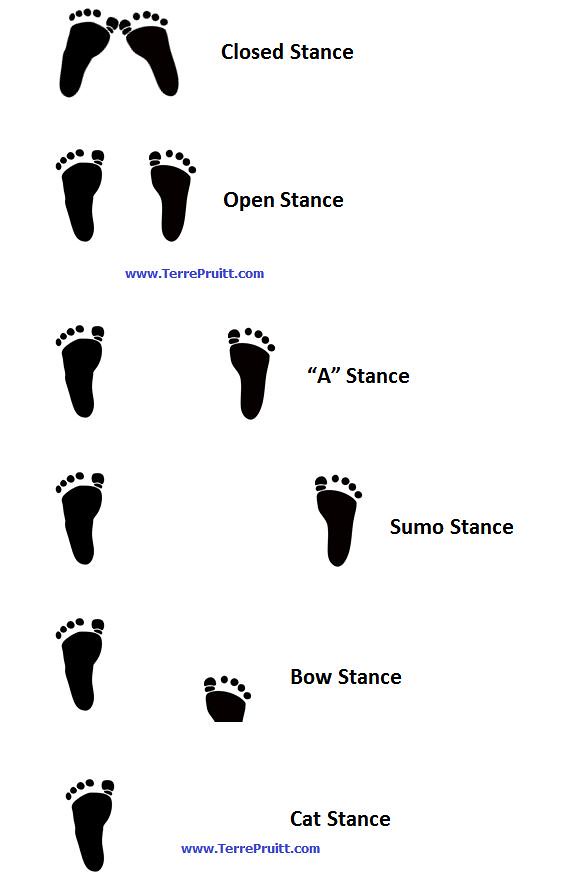 picture in this post is an approximation of how MY feet would be placed in the various stances. Remember that your stances would probably be slightly different. The width would be according to YOUR body and your body’s way. The picture is just to give you an idea and maybe help remind you of the various stances. At this time I have a post associated with four of the six stances.
In Nia’s closed stance the sound is the vowel sound “o”. The sound is made to “create volume in your chest cavity”.
In Nia’s open stance the sound is (to say) “balance” or “ground”. Saying the word “balance” can assist you in your balance. The word “ground” can assist with allowing you to feel grounded and sense balance.
The sound for Nia’s “A” stance is “aaaaahh!”. You say it on an exhale. Letting out all your breath until you are ready to inhale.
Sumo stance or riding stance (feet as wide apart as if you were riding a horse) has an explosive sound. Say “ha!” To me this helps with stabilization.
The bow stance has a sound of “u”. The bow stance is done with either foot in front, not just with the left foot in front as shown in the example.
The cat stance (standing on one foot, with the other foot pressed against the standing leg) has the sound “wooooooo” associated with it. This is done on the exhale. This stance is also done on the other foot and not just the left one as in the example.
So as you are practicing the Nia stances you can use the sounds associated with them for added benefit and fun. It is just fun to make noise. To me it adds to the experience. In my classes I encourage people to make any noise they want. I also like to play with the noises, sounds, and words associated with the move.
Do you attend a dance exercise class or exercise that encourages you to make noise?
Information regarding the sounds made with the Nia stances can be found in The Nia Technique book written by Debbie Rosas and Carlos Rosas (NKA, Carlos AyaRosas). The book can be purchased from Amazon.
Posted in Nia, Sounding | Tagged: A Stance, Amazon, Bow Stance, Carlos AyaRosas, Carlos Rosas, Cat Stance, closed stance, core stabilization, Debbie Rosas, making noise is fun, Nia, Nia class, Nia Sounds, Nia Stances, Nia Teacher, Nia teaching, open stance, Riding Stance, sounding, Sumo Stance, The Nia Technique book | Leave a Comment »
Posted by terrepruitt on December 27, 2012
Principle #7 of the Nia Blue Belt is “Nia Class Format” with the tagline of “Delivering the Promise”. Before starting to write this post I opened my Blue Belt Manual and started reading what it said about principle #7 and for a moment I couldn’t remember learning anything about the principle in the training. In the manual there is six and a half page table comparing a “Body/Mind/Spirit Teaching Style” to a “Traditional Teaching Style”. I found myself thinking, “well, not any longer”. As in the traditional style is really “old school”. A lot of classes now adopt the formula that has ALWAYS been a part of a Nia class. Nia is different from many other workouts. I believe in the almost 30 years that Nia has been around fitness classes have changed a lot and Nia is not the only one that incorporates a more mind-body approach. Although I say that Nia is more a body-mind approach because Nia actually STARTS in the body. So . . . hmmmm? If other classes are now doing what Nia has always done it goes a long way in showing that it is the better way.
Here is an example of the table, this is copied directly from The Nia Technique – Blue Belt Manual, August 2006, V4.0, page 132:
| Class Element: |
Body/Mind/Spirit Teaching Style: |
Traditional Teaching Style: |
| Use of Language |
Uses healing phrases, words, and
visualizations that foster a positive self image. |
Often times makes negative comments in humorous ways
that devalue the human spirit and lessen a positive
self-image of the human being. |
| Individuality |
Stresses the importance of individuality. |
Stresses conformity. |
These are just two examples, as I said there are six and a half pages. And, this table is not saying that every class that is not Nia does the things listed under Traditional Teaching Style. It is just a sample of what some styles are like.
I like the table in the manual. I feel it is a great tool. I can see that sometimes I am using the Traditional Teaching Style (neither of the ones previously mentioned) and that is exactly why I wanted to participate in the Nia Blue Belt Intensive. I wanted to work more on “delivering the (Nia) promise”. I had been taught to exercise via the traditional way so that is what I know or knew. I like the reminder of the Body/Mind/Spirit Teaching Style. I also need the reminder because other people have been taught the other way too so that is what they respond best too. It really is up to me to show them the alternative. It is up to me to deliver Nia with the Nia class formula so that they can see that there is another way to workout.
This principle is about Body, Mind and Emotion, and Spirit. Nia Blue Belt Principle #3 will assist me with this principle. They are all connected.
Two things I want to mention to help clarify, when Nia talks about spirit, it is not in the religious sense, it is comparable to spirit as in “class spirit” or “spirit week”. Ya know, like they do in high schools? It is about the inner “you”, your enthusiasm, what drives you, your “spirit”, not something related to religion.
And the other thing, I believe that Nia is working on re-writing, adjusting, and updating the training material. Nia is always working to remain up-to-date. The trainers were working off of slides that were not even final.
Are you curious enough yet about Nia to find a Nia class in your area? Do you prefer a Body/Mind/Spirit Teaching Style or a Traditional Teaching Style when you take a class?
Posted in Blue Belt, Nia | Tagged: and Spirit", Blue Belt Manual, body, Body/Mind/Spirit Teaching Style, Delivering the Promise, fitness classes, Mind and Emotion, Nia, Nia Blue Belt Intensive, Nia Blue Belt Principle #3, Nia class, Nia Class Format, Nia trainers, old school workout class, Principle #7 of the Nia Blue Belt, Traditional Teaching Style | Leave a Comment »
Posted by terrepruitt on December 18, 2012
The Nia Blue Belt Principle #6 is hilarious. Ok, the principle itself is not hilarious it is just funny – to me – that it identifies something and names it. But that is what some of the principles do for me. The principles identify something that we do in everyday life. Or they connect dance, Nia, teaching to something that is commonly known or done. This is one of the principles that we – you, me, everyone – do all the time. We – you, me, everyone – probably didn’t call it “Split, Ellipt, Blend” with a tagline of “Crafting With Attention”. Basically the principle itself (Split, Ellipt, Blend) refers to attention. As I was writing this post, I typed that the tagline in this case refers to teaching Nia, but then I realized that, while yes, the whole principle is designed to enhance our Nia practice and teaching, – as do many of the Nia principles – it can apply to everyday life. So what is Split, Ellipt, Blend?
Well, as I said it has to do with attention, so in an everyday situation you split off your attention from others and focus on yourself, you focus 100% on another, and you blend it so your attention is on both. So sometimes you might be doing something and completely focused on yourself and what you are doing. You might not even notice other people or other things around you. You are 100% concentrating. Then you hear a loud voice and it is someone, your boss, your spouse, your child, coming towards you. They have something to tell you. So you stop what you are doing and you are 100% focused on them. You are listening. Once you understand the situation and realize that it is not an emergency requiring you to stop what you are doing you go back to what you were doing yet you carry on a conversation with the person talking to you.
 Split into self. Ellipt into others. Blend with.
This is something we do in class as Nia teachers. We might completely concentrate on ourselves. Waiting to receive a pearl. Thinking about the moves. Sensing our body. Then we might focus on the class. Giving all our attention to what they are doing and how they are doing it. Doing a Joy check. Asking for sounds. Then our attention could be on both. We could be receiving information from the class as well as ourselves. The “Crafting With Attention” is us being aware of the split, ellipt, and blend. And how we use it.
A few things I have mentioned before, but will repeat again, “other” does not necessarily have to be another person. You could be splitting, ellipting, and blending with your own body, with the music, with the movements, with many things. And . . . this is just barely a scratch on the surface of the principle. This is just the broad overview and it is what I understood it to be about. There is ALWAYS deeper to go in Nia and the Nia principles. And sometimes the more I do, the more I see it differently. Sometimes, not always. So keep that in mind when I post again about The Nia Blue Belt Principle #6: Split, Ellipt, Blend, Crafting With Attention. (For a list of Nia Blue Belt Principles see Terre’s post The Joy of Being In Relationship With The Nia Blue Belt Principles .
With that quick explanation, can you see how split, ellipt, blend applies to more than just a Nia Teacher teaching a class? With an awareness of it, can you see how you can use it in different ways?
Posted in Blue Belt, Nia | Tagged: attention, Blend, dance, dance class, Ellipt, Nia Blue Belt, Nia class, Nia Dance, Nia pearls, Nia principles, Nia Teacher, SEB, Split, teaching Nia, The Nia Blue Belt Principle #6 | Leave a Comment »
Posted by terrepruitt on December 15, 2012
Nia Blue Belt Principle #5 is The Power of Three. Tagline: Relationship. The Nia Blue Belt manual says, “The Power of Three is the model that we use for awareness of what we bring and what the other brings to the Relationship”. Oh yeah, totally interesting. Remember in our setting “the other” is not always another. It is not always a PERSON. It is whatever you are in relationship with. Just as with the Power of Two, there is Power in Three. The three is “self”, “relationship”, and “the other”. So this really is everyday life stuff. We all have relationships with others.
The principle — to me, in my quick review/regurgitation and in a nutshell and just scratching the surface — helps us see the self, the relationship, and the other. It explains that there are things we bring into a relationship, and there are needs that need to be met, and that there are agreements that self and other reach in order to have a relationship. Makes sense, right? As I said, everyday life stuff. We all have “stuff” we bring to a relationship and we all make agreements to be in the relationship. Most often than not there is no paper or even a discussion on the agreement, they just happen over time. You might have a friend that you call when you would like some cheering up. Your friend always is there to do that for you. You brought a need, your friend brought a “skill” there is an agreement in your relationship.
With Nia the principles most often apply to everyday and every day life, but also to a Nia Class, the Nia Practice, and to the body. So we can apply The Power of Three to a Nia Class. There is all three elements there; self, relationship, and other. There are things that self brings and things other brings and the result in a relationship. Now the interesting part is “the other”. In the case of a Nia Class “the other” could be the student or it could be the space itself (or anything . . . these are just two examples). It might be somewhat obvious that as a Nia Teacher there would be a student and a relationship between the two, and agreements made. But what about the space? I am not saying that a space is like a live creature, but we can still have a relationship. It can be “the other”.
I can be in a space for teaching Nia that is dark and damp and not very inviting. Since it is a space IT cannot change itself. That is what it brings: dark, damp, uninviting, and unchanging. I, on the other hand, can bring a better attitude about the space. I, myself, can be extra excited to be there and allow my excitement to fill the space and making it more inviting. I can bring lights and either a fan or a heater (depending upon the season/weather and reason for damp). The Power of Three is just that — POWER. With another person there can be assistance with the relationship because there can be agreements made and met on both sides, but my relationship with an “object” what I BRING to that relationship is up to me. But there is still Power. Because the three of us, me (self), how the space is used (relationship), the space (other) create the energy and the place that people will be coming into and working out in, I need to bring more to meet agreements in the “relationship”.
Think about that example. Sometimes in order bring Nia to more people Nia teachers don’t get to teach in the ideal settings so we have to bring more. While we have a choice not to teach in a space that is not great, once we decide to do it we have to “bring” more. And for me that is ok sometimes. It is ok to have to bring more when talking about a space, but sometimes it is not ok when talking about a relationship with another. But again, that is where the agreements come in. Each agrees to accept what each brings. Self, relationship, other . . . . The Power of Three; Relationship.
Please remember that this is off the top of my head. I plan on reading and studying and writing more on all the Blue Belt Principles. But can you see how there is Power Of Three? There is self, relationship and other? And that each person (or thing) brings something, then there are agreements in order to form a relationship?
Posted in Blue Belt, Nia | Tagged: better attitude, Nia Blue Belt manual, Nia Blue Belt Principle #5, Nia class, Nia Practice, Nia principles, Nia Teacher Nia student, The Power of Three | 2 Comments »
Posted by terrepruitt on December 13, 2012
 I don’t know the Nia Blue Belt Principles by heart yet. I think I should, but I don’t. I will work on that. I was doing my 30 minutes for the December 30 Minute Movement Challenge, while I was doing it I was wondering if I could get ready to go teach the Nia class tonight, make a salad, straighten up the room, and write a blog all in the 30 minutes I had left before I had to leave. While I realized that was not possible I thought I could at least come up with a topic for my post. I thought about posting the fourth principle of the Nia Blue Belt, but I couldn’t remember what it is. At the end of my 30 minutes for the December 30 Minute Movement Challenge I did the Nia 5 Stages. As I was doing the Nia 5 Stages I thought I could post about them, then I thought not because I would want to spend more time writing about that. I decided to see what the Principle #4 is. When I saw it, I had to laugh out loud. Nia Blue Belt Principle #4 is Developmental Anatomy. The tagline is Reaching Your Ideal. I find this too funny. The reason it is funny is that the Developmental Anatomy used as a tool to assist in reaching your ideal is the Nia 5 Stages.
The Nia 5 Stages are the stages we go through in development. The stages are: Embryonic, Creeping, Crawling, Standing, and Walking. In the womb we are embryonic, we move with comfort through fluid, we are safe, comfortable, and warm. Once born most infants creep. Creeping is not crawling, but it is getting us around, but not very efficiently. At one point there is crawling. We are much more mobile and active. We see a lot more and often we go after it in this stage. Then there is that stage where we “stand”. The standing usually starts out with the help of something or someone. While in life this stage for a child involves a lot of sitting . . . get wobbly and fall on their butt, it does not in the Nia 5 Stages. The standing in the Nia 5 Stages is more of a low to the ground squat. Then there is the stage of walking. The Nia 5 Stages is actually a movement practice. It is based on science. It is a tool to help the body move more efficient. As I previously stated, I would love to do a more in-depth post or even posts on it, I will do that at a later time.
What Nia did for the Nia Blue Belt Principle #4 was allow us to use this movement, the practice of the Nia 5 Stages as a tool to reach our ideals. It is very interesting how Nia uses the body for this. If you have a goal in mind, the idea is to think about it and go to the body to find out where you are in reaching it. Again, to me, another brilliant connection made by Nia. It really makes sense to find out where you are in the stage of reaching your goal so you can work on what you need to work on to complete it. Are you in the embryonic stage of the goal? Maybe just thinking about it? Are you are far as the standing stage? Doing the movement to find out really helps the entire process. There is no triad for this principle as it uses the Nia 5 Stages pictographs. If you are at the point of taking the Nia Blue Belt you would be familiar with the 5 stages and the pictures so they work as the symbols for Nia Blue Belt Principle #4.
So, it was funny to me that I was thinking about posting about principle #4, but couldn’t remember what is was. Then I thought I would post about the Nia 5 Stages. And it turns out they are very much connected.
Do you see how there could be stages of a goal?
Posted in Blue Belt, Nia | Tagged: Crawling, Creeping, December 30 Minute Movement Challenge, Developmental Anatomy, Embryonic, Nia, Nia 5 Stages, Nia Blue Belt Principle #4, Nia class, Reaching Your Ideal, Standing, walking | 2 Comments »

 Terre Pruitt's Blog