I have several posts regarding Nia FreeDance. When I was teaching often there was a period when we had FreeDance Fridays. That was fun. I feel when I am teaching multiple times a week it is really great to have one class be FreeDance. I have posted about the 8 stages of FreeDance. There are a couple of posts about a FreeDance Playshop I produced once and one about the tools for the eight stages of FreeDance that we can use to help us “to stimulate movement creativity”. We just had our class regarding FreeDance, Nia White Belt Principle #4. I am happy to report, not much has changed. Again, some of the language used has changed and certainly the way it is presented. I want to clarify that the training is always evolving, Nia is always finding new and better ways to deliver the information, but the core information is not changing. That is a great comfort to me and it makes sense. I want the organization I am involved with to grow and improve, but I don’t want it to change the core of what it does. So, 2020 Nia White Belt Principle #4 is FreeDance.
Now in my previous documentation of it, you may see FreeDance written different ways and that is because I understood Carlos (one of the original creators of Nia) to have different ways of writing it. The principle was one way (FreeDance) and then the first stage was another (Free dance). So, if you see differences that is why. And moving forward I will endeavor to keep it FreeDance.
This term sometimes confuses people because they think the class is free. I have experienced this many times. But FreeDance is something that Nia participants do, it is a practice, it is a principle of Nia. It is “stimulating movement creativity”.
Debbie said something today that clarified something for me, she was talking about form and freedom, we have a lot of that in Nia. In light of the 2020 Nia White Belt, we have form in the way of choreography and we have freedom in the way of dancing free. Debbie equated form with “structure” and how that makes people feel safe. Freedom could be compared to “no structure”, which sometimes makes people feel unsafe. The freedom in an exercise class can be intimidating for many people. Being told what to do and how to move the body is the way most people are taught to exercise, so when they come to a Nia class and they are told, “Move your body.” They don’t know what to do. It is just like the story Debbie tells about when she first when to a Dojo. People can be told to focus on moving their arms, but they want to know HOW to move their arms, they want specific movement instruction. We have language to guide people to move in FreeDance, but there is still a lot of freedom in that and for some people that is a huge challenge.
There is a triad for this principle, like with all of the principles, it consists of Move, Explore, and Create. They put the numbers for the 8 stages going counter clock-wise on the triad, but have created a separate graphic with the stages going clockwise. Instead of drawing the triad and creating the graphic I chose to write out the eight stages. We can use the eight stages to helps us move. Here I am just going to list the stages:
1 – FreeDance 2 – Being Seduced By The Music 3 – Feelings + Emotions 4 – Creative Source 5 – Authentic Movement 6 – Witness 7 – Accidental Click 8 – Body-Centered Choreography
The next post will contain the tag lines for each stage and the information I wanted to high-light for myself.
So, Dear Reader, how do you feel about dancing with no instruction? How do you feel about dancing with little to no instruction in a cardio exercise class?
Back in December 2008 I took a training for a movement practice called Nia. I had only taken a couple of classes and that was only to see if I liked it enough to teach it. I liked it enough to want to teach it so I signed up for the week long training at the headquarters in Portland, Oregon. I went having no idea what I was getting into and thinking I would walk out with routines learned enough to jump start into teaching. Well, no, that is not what a week training for a Nia Belt is. But it is pretty amazing. Back then the TWO founders were still a part of Nia, whereas now-a-days it is just one of the founders. Turns out Nia is a practice . . . like yoga is a practice. You can do just the physical exercise part of it or you can add it to your life. Adding it to your life is pretty easy since the main idea of Nia – to me – is to notice your body and how it moves.
One thing Nia does is have principles for every “level” (called “Belts”). I listed the principles of the (2008) White Belt in my post Nia Or Nia Technique Is A Specific Practice. Then I wrote a post about each principle individually. With an amazing and unprecedented opportunity to take the training again with one of the Founders online at an astronomically generous discount, I couldn’t say no.
It is the first time a Nia Belt has ever been offered online. Nia is very much about the body and movement so it really does make sense to do it in person – to be in the same space with people learning and doing the same stuff. But . . . Nia is amazing in its ability to adapt and change and do what needs to be done to continue on yet keep its members and participants safe, so we are doing it online. Debbie Rosas (one of the founders) is determined to give it a personal feel and touch so we are on Zoom doing a portion of the training. Then we are assigned to a POD, with over 200 people taking the training I thought the PODs would be big, but there were only five people on my POD list.
Anyway, the principles’ wording has changed a bit so I wanted to post an updated list. With the slight changes I am confident that the principles are still the same. I mean, that is what Nia is based on. It is just that sometimes language can be updated, sometimes to more marketable friendly words. But still stay the same. We will see as I go through the training. I never like to give too much away because it is something you need to experience for yourself, but I do plan to post more about it . . . the information and my experience. That is the reason I started this blog in the first place. I wanted to share Nia with everyone. And now that so many things are having to be online, maybe you can experience it yourself.
As I said I don’t think these have really changed, because if you compare lists they are basically the same but with slightly different wording. Number 11 is what always changes the most. I don’t know how many times it has changed, but I know I kinda didn’t care for some of the versions . . . but again, I think it is all BASICALLY the same. I am looking forward to seeing. This is not only new language to me, it is NEW to everyone . . . Nia just finished crafting it so this is really exciting.
As I said, I hope to be following up this post with more information as it unfolds.
Have you participated in any type of training or lesson online that you were/are enthusiastic about?
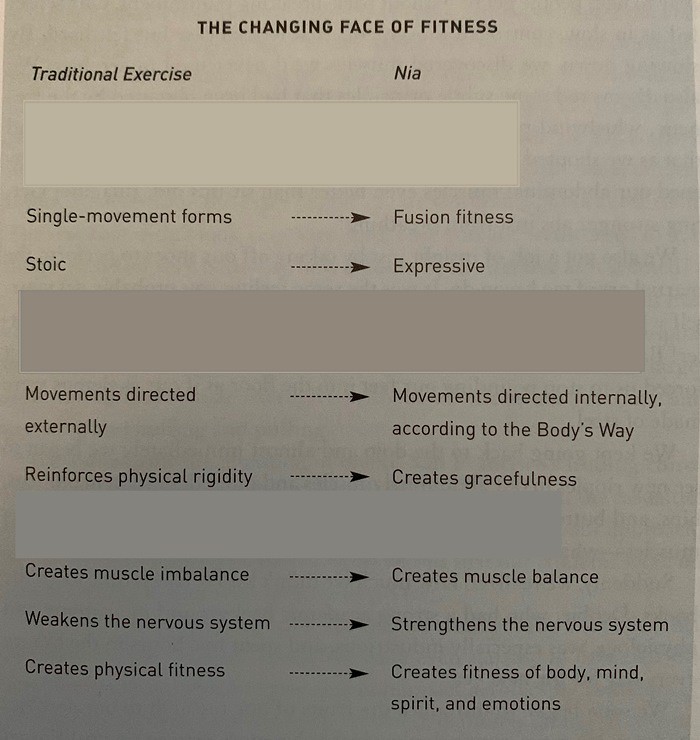
So Nia has a few fundamental ideas, this post is a brief summary of the information that can be found in The Nia Technique book. The book is by Debbie Rosas and Carlos Rosas. It was first published in 2004. This information is on pages 16 through 19.
The Joy of Movement Is the Secret of Fitness. The idea is to not exercise. For many people exercising is not enjoyable. So stop, don’t exercise . . . MOVE. Move in a joyful way, not in a mechanical way that doesn’t bring any pleasure.
Fitness Must Address the Human Being, Not Just the Body. Exercise that is done just to exercise is not fun and will probably be put aside after a little while. But movement that is fun and engages the mind, emotions, and spirit in addition to the body is something that one might stick with for a long time. Your body will benefit from exercise, but if you like the movement you are doing and if it is created to affect more than just the physical you can get more benefit from it. If you walk away from the activity with a clearer head, a happier and/or satisfied disposition, and a lighter spirit it is something you will want to do. Your health will be better overall.
Movement Must Be Conscious, Not Habitual. Haven’t there been studies that prove thinking about what you are doing, focusing on the movement results in greater gains? Being aware of your movement and the sensations of the body makes for a more fulfilling workout. Just hopping on the treadmill and turning on the TV is less satisfying. You also don’t affect the BMES.
Use Your Body the Way It Was Designed to Be Used. Replace the linear exercise with full range of motion movement. Vary the speed and intensity of movements. Move to improve your FAMSS!
Take the Path of Least Resistance. Move the way your body is. Not to say you cannot improve in areas that you want to improve in, but recognize that everyone cannot be a contortionist or run a mile in three minutes.
The chart is from page 19. I redacted some of it so that you would be encouraged to read it for yourself and have the opportunity to get new/additional information. 🙂
Remember that this was written in 2004 and it is really great to see that this type of information and way of thinking is becoming much more common. Yay!
Sometimes we end Nia class with the laughter “exercise”. You know that saying “fake it ’til you make it?” Well, since the brain can’t tell the difference between fake laughter and real laughter it releases the “happy hormones” regardless. There are many additional benefits to laughter:
–it can trigger the release of endorphins (the “happy” hormones mentioned)
–it can help lower your blood pressure
–it can reduce stress hormone levels
–it can give your abdominal muscles a workout
–it can help improve cardiac health
–it can improve your immune system by boosting T-cells
–it can give you a sense of well-being and help you look at the world more positively
–it helps relax the body
–it burns calories
–it may even help relieve pain
What better way to end an exercise class than laughter?
There are a lot of ways to do it, but one way is by laughing and “cooking all four sides”. Debbie Rosas uses that saying when referring to being on or using the “sides” of the body; front, back, left, right or tummy, back, left side, right side.
Sometimes in Nia class since we are already on the floor for the Floorplay cycle of class we will do the “exercise”. It is simple actually. While lying on your back just start to laugh. It doesn’t even have to be “real” laughter. Just start to chuckle or giggle. Or even just begin by saying, “Ha!” One loud HA! Then keep going. Pretty soon your “ha-s” will change into something else – again, it might not yet be real, but someone who has joined in will make a noise that will cause real laughter. Once one person has started, it just goes from there and the next thing you know everyone is really laughing. Even if or when it starts to die down something will happen, someone will think of something funny and start up again, or someone will snort (that is always good for a laugh), or someone will do that long sigh that always happens after a good laugh session and it will start back up again.
After about one minute roll to a side. Stay there and laugh for a minute. Just keep it going even if there are moments when it is not that real-from-the-belly kind of laugh. Then after a minute, roll to the other side. Stay there laughing for about a minute. Keep it going. Then roll to your tummy. Here is where you might start really sensing it in your belly, after three minutes of laughter your abs might already notice and when you roll on the belly and laugh more, they probably will be getting your attention a bit.
This is a really fun way to end the class. It reminds everyone that participates how fun laughing is. It reminds everyone how contagious laughing is. It reminds everyone that no matter what is going on there is a chance for laughter. It also reminds everyone that laughter can be a bit physical.
Of course you don’t have to be in a class to do this exercise. Perhaps there is someone in your home that would like to participate with you. Also you don’t have to do it for a minute on each side.
So what do you think? Is this an exercise you can enjoy?
I’ve been blogging for a long time. At least I think it is a long time. I know there are people out there who have been blogging for even longer, but to me nine years is a long time. In fact this month is my nine year anniversary to the blogging world. I started in March of 2009. Well, since I have been blogging so long and not all of you have been reading my blog that long, I thought I would point out some posts that you might be interested in. Keeping in mind the comments I have received and the conversations I have had with some of you. Also keeping in mind your blogs, here are a few posts that I thought I would point out in case any of you might be interested.
This is one about an amazing product that helps me with my bumps and bruises. Some of you may be interested. The product is Zheng Gu Shui.
Foam Rollers are COOL! is a post about two stretches that you can do with a foam roller. Many of us need to stretch more often and many of us love it when we do. These are super easy ones some of you may like.
I teach Nia, you may have heard :-). One of the things I love about Nia is that a lot of our practices within the practice can be applied to life. Here is a post about Sustain, Increase, Tweak, we do it in Nia while dancing and it can easily be applied to our every day life.
I LOVE to watch birds taking a bath in our bird bath. We used to have blue jays that would come back every year to have their babies near by. One time I got a few photos of a baby taking a bath. Even though he may look big, he is a baby. The young ones usually look larger and fluffier than the adults. Pictures do not capture the joy this bird seemed to be experiencing! This post has is about a Baby Blue Jay Bath.
Hummingbirds’ beaks are not straws they suck through, they actually have really long tongues. You can see that in my Hummingbird Tongues post.
The comments on this one are worth a read, Lyrics Gone Wrong. Too funny!
Some nice shots of a beach trip. Do you wanna see the ocean? Check out my post Santa Cruz, California
Ahh, this one I am posting just to remind myself . . . . I need a color for that! Color Me A Reminder
Ok, sorry, I have shared more than I was planning, because I want you to look at all of them, but ten might be too much. I might just have to do another post somewhere along the way to point out some of my old posts that might be of interest to you. And get them some love.
So, I was so blessed yesterday to have two fellow Nia Teachers attend the class I was teaching. There are three of us that teach a Sunday Nia class at the Northwest YMCA in Cupertino on a rotating basis. We have general “dibbs” on Sundays; Anita likes the first Sunday of the month, I like the second Sunday of the month, and Joan has the fourth Sunday of the month. At one point we had a fourth teacher and she usually took the third Sunday. But now that it is just us three, we each take the third Sunday when we are available. It seems to work out amazingly well that when one (or even two of us) is not available the other two or at least one is. So it works out. Sometimes there is even a fifth Sunday and we make sure one of us is available. Plus we work together when something comes up and we have to switch Sundays. The class is at 12:30 so it is late enough that one can get up and enjoy a nice Sunday morning and not have to rush off to teach. Then we teach and are home in time for a late lunch. 🙂
Well, after class yesterday we were talking about Nia, of course . . . and Anita asked us if we had seen her list of top ten signs you are dancing in a Nia class. I had remembered seeing it, but I didn’t remember them until she started reading them. Then I remembered I saw the list. I had glanced at it, but saved the e-mail to read later. When she brought it up I had asked her if I could share the list on my blog and she kindly agreed. So here ya go:
___
“Anita Christensen’s top ten signs you are dancing in a Nia class:
1. They like to freedance without judgement of themselves or others.
2. They are the nicest people.
3. They are all so grateful for the day she, Debbie*, took off her shoes.
4. They make claws with their fingers and scratch the air….sounding grrr…healing emotional issues related to power, abandonment, fear, and anger.**
5. They shimmy and shake their shoulders to express sassy gestures that play with each other in seductive and joyful ways.**
6. They fully acknowledge and embrace that this is THEIR adult play time!
7. They kick to the front, side, and back with authority settling on a supportive leg.
8. As a collective group they yell out “yes” or “no” for all to hear.
9. They choose, sustain, and tweak their JOY of movement to sense life force energy….
10. They invite you to come and be open to a life affirming experience.
It is true Nia is fun, healing and joyful! Do you have anything to add to my top ten list? How I would enJOY hearing your top ten list! The bay area teachers are THRIVING and we want you to join us.”
*”Debbie” is Debbie Rosas is the founder and co-creator of Nia.
**Referenced from the Language of Nia
___
Anita Christensen is Nia Black Belt and she teaches several classes in the South Bay and the Peninsula. Check out her profile on NiaNow.com.
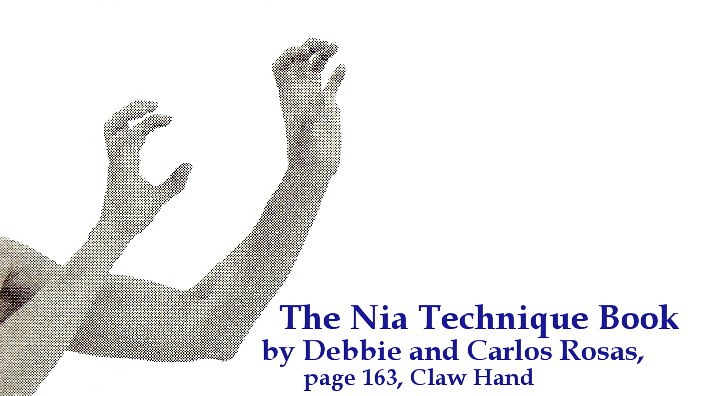
As you may know if you have perused my blog or website, Nia has moves called the 52 Moves of Nia or Nia’s 52 Moves. Moves concentrated and focused on. Generally moves included in all of the routines. Not all the moves are included in all of the routines, but the routines are jam-packed with most of the moves. The moves on the list have physical benefits. Some are fun or silly so they can have mental or spiritual benefits. And in this case I am talking about your spirit or inner child, the part of you that likes to have fun, the part of you that you might not get to display in your regular everyday work life. So not the religious type of spirit but the kind of spirit that you think of when you say or hear “school spirit” or inner child. The fun playful side of you. To me, one of those moves is Claw Hand.
Claw Hand is a great move. It is super easy. It can be done all on its own. You can just stand or sit and do claw hand. You can add it to some foot work. You can add it to some complicated choreography. You can make it soft or hard. You can do it fast or slow. It is very versatile.
You can even make noises when you do it. You can growl like a big cat or a bear. You can meow like a kitty-cat. You can make any noise you want. It is fun stuff.
As I said you can do it standing or sitting and this moves gets done in to all the stances and steps in the Nia Routines. The Nia Technique Book (by Debbie and Carlos Rosas) recommends it be practiced in all the stances and steps. And that is a great idea since we use it with all of them. The routine I am doing now even add it to blocks. We block in with claw hand and we block out with claw hand. Why not?
You can probably figure out what this move is from the description but I tell you what the book says:
“Mimic a claw with your finger and claw the air, as if you were in a cat fight. Keep your wrists relaxed, and sound a cat’s hisses as you do the move. Use both hands.”
The benefits can include strengthening your fingers and hands.
In addition to keeping a relaxed wrist I like to use the claw shape to bring tension into my entire arm. I imagine I am really clawing something. I figure I would need strength to do that so I put my entire arm into it. You can use one had to “claw” and the other hand to feel the muscles in your arm (forearm and upper arm) contract.
The book states that this move can increase your sense of power. When I am doing it with muscles contracted as if I am REALLY clawing something I do have a sense of power. I imagine that is how an animal feels when they wield their claw.
This move allows you to practice bending your fingers too. That helps with the mobility of the joints. I like this move. I like to add sounding to it.
Ok, so stop and try it? What sound do you like to do best with your Claw Hand?
Recently someone asked me about the Nia Belt system. I pointed him to my original post on Nia’s Belt System. The one where I mentioned having seen many articles back then (in 2009) talking about the belt levels as if people had to progress through them in order to participate in Nia. That is not the case. Nia is a dance exercise. It is a workout. You can go to a Nia class just like you can go to a Zumba Fitness Class, a Jazzercize class, a UJAM class, a Hip-Hop class, a yoga class or any other class where you just walk in and do it. You can just walk in and do Nia. No strings (or belts — tee hee!) attached. Just move your body to the music and enjoy the sensation. Get a workout. Get some exercise in. Dance. The belts are for people who want to learn more.
Nia has a “self discovery” program. I don’t want to say self-improvement because some people might think, “I don’t need improving.” and you would be right. The intensives are workshops of about 50 hours that show you how to experience movement in your body, show you how to relate to things. The intensives show you many different things. Each intensive is labeled with a belt color to help distinguish it from the others. I also pointed him to my website which has the belt colors and the focuses of each belt. But I was reminded that the information on my site, from 2012, is not the current information. Nia is always updated herself. She is like the co-creator, Debbie Rosas, she like to be current. Below is the information from 2012. I want to make record of it. Plus I wanted to keep it available in case anyone was interested in remember it and/or comparing it to the newly worded focuses. You can go to my site at Nia Belt Levels and Focuses to see the newly worded focuses and intents for each belt.
In 2012 when I put the information on my site there was a White Belt, a Blue Belt, a Brown Belt, and a Black Belt available to anyone. There is now a 1st Degree Black Belt. There is a Green Belt for people who are teaching and have a Nia Livelihood Membership.
“Each of the four belts mentioned has a separate set of principles. There are 13 principles for each belt, each belt also has a focus.
The focus for a White Belt is physical sensation. (Terre earned her White Belt in December 2008.)
The focus for a Blue Belt is communication, relationship and intimacy. (Terre earned her Blue Belt in November 2012.)
The focus for Brown Belt is sensing and perceiving energy.
The focus for Black Belt is unlimited creativity.
As I said, there is an intensive, Green Belt, that is just for Nia teachers, the focus for a Green Belt is the craft of teaching Nia. This is an optional intensive.” **
When I originally took my White Belt in 2012, the Green Belt was just being created and the original thought was Nia was going to have White Belts that are teaching take it next, before blue. But by the time I had enough money saved up to take my next belt (yes, it took FOUR years) they had relaxed that requirement and now allow people to take the Green Belt when and if they want. I want to take it. However there was a Blue Belt Intensive that was closer and did not require air travel and hotel expenses. So I took the Blue Belt Training prior to the Green Belt Training.
Except for the Green Belt there is no testing as in a martial arts type of setting. And the Green Belt test is written. There IS 50+ hours of movement, lectures, thinking, sensing, learning, agreeing, disagreeing, discovering, connecting dots, ah-has, oh-nos, and ooo-ahs. It is incredible and intense. The training that Nia delivers is excellent.
My posts about the principles of the White Belt and the Blue Belt can help give you a better idea of what we study in the intensives (at least those two), but it is really something one has to experience for oneself.
I hope you click over to my site to see the new verbiage for the focuses and the added intents.
**The belt information was taken from the Nia Now website on November 14, 2012.
Aaaahhhh! I did it again. I do it all the time. I see things on Facebook that I want to look at but I don’t have time or when I see it is it not the right time to look at it so I open it in another window. Then I can watch it, read it, do it (whatever) days later. But then I forget who posted it. This is a Nia video so I know that one of my Nia friends posted it. It took me days to get around to watching it. Then once I did watch it I was soooo disappointed. It is a video of Carlos Rosas (NKA Carlos Aya-Rosas) at a conference talking about the 5 Sensations of Nia. As he is talking I start looking at the time left and I keep thinking, he’s not going to make it. I kept HOPING he would, but I kept thinking, he is not going to make it. He didn’t. He was halfway through (or so it seemed) his talk about Mobility when the video stopped. Sad face. That is why I was disappointed. I was sad because we don’t get to hear all five sensations. But . . . watching the ones he did get through are well worth it. It is just a bummer that we didn’t get information on all five.
I am not sure what year it is, but you will see that they are being referred to as Debbie and Carlos Rosas. Which I always thought that eventually they were referred to as Debbie Rosas and Carlos Rosas. But that is not the point of this post or the video I was just trying to see if I could have an idea of what year it was, but again . . . not that important because the information is tremendous.
The information is very helpful no matter when it was recorded. Carlos first walks you through some things you can sense. He connects them to the 5 Sensations. If you’ve read a few of my posts about Nia you might be familiar with my belief that Nia takes everyday things you are familiar with and probably aware of and connects it to Nia ideas. If you watch this you can get an example of them doing that in the time from 2:45 to 7:00.
After the initial connection to the five sensations, the first sensation Carlos defines is Flexibility. He describes it as energy moving out. So not just stretching, but energy moving out. Then he talks about Agility. He describes that as a quick start stop. He uses the adjective “explode”. This is a very entertaining part of the video. Carlos is a very funny speaker. Then he gets a few minutes into a mobility. He describes that as continuous movement. He talks you through a bit of it, then the video stops.
Even though we only get to see two sensations and a portion of mobility it is still great information. I am not giving you too many details because I want you to watch it. It is so much better from the creator than from me just typing what he is saying.
This was posted by Nia, in addition to watching this video you can go to the Nia Channel on Youtube (click here) and see other videos they have posted. Also, you can go to NiaNow.com and watch recordings of classes. From the home page scroll through the pages and you will find videos of Nia classes. You can dance right along with Debbie and other trainers!
I invite you to watch the video and participate with his exercises to connect you with the sensation of Flexibility, Agility, Mobility, Stability, and Strength (this is the first portion I mentioned). Then stick with it for even more connection to Flexibility and Agility.
I am certain that I have mentioned the fact that Nia changes. Like many things it grows, it morphs, it improves, it changes, yet it remains the same. The basics stay the same. The core of it stays the same, but as time goes on it morphs. Sometimes it is the verbiage and the names of things, but it basically stays the same. It has been a year since I have taken the Nia Blue Belt Intensive. In that intensive we were given a Manual from August 2006 and while we were being trained we were told that a new manual was soon to be released along with some new ways of explaining, talking, and learning things. So part of what I quote here might be a little different from what is being taught now, but the idea and the process is the same. The process is Creating Space.
In an intensive, before every session we gather and create the space. This practice was discovered as something done in martial arts. Debbie Rosas and Carlos Rosas, the creators of Nia, recognized its value and brought it into Nia. It is the responsibility of the participants to create the space. It is the responsibility of trainers to hold the space.
The Blue Belt Manual states: “Creating space is the conscious act of preparing the environment, which includes your body.”
It is an incredibly powerful act that enables an individual and a group to become prepared for receiving. It is — at its core — coming into stillness. In preparation for creating the space we use a prescribed process. There is a schedule that is kept. A bell is rung seven to ten minutes before we are to start creating the space. This allows for people to wrap up any conversations they might be involved in and to do any last minute things that need to be done. Then there is a five minute bell and another one at one minute. Then, the students create a circle in which we sit quietly while we create the space. The things we do is quiet the mind, stop the inner dialog and just let the mind rest and become open to hearing and receiving the teaching that is about to happen. The body is also stilled. The emotions are balanced and not taking over. We are connected to our higher self . . . the manual says, “open, but you are not seeking at the moment”.
A main point is to not allow for distractions of any kind. No physical distractions . . . that is one reason why we sit still. No mental distractions . . .that is one reason why we stop the inner dialog and the thinking. All four bodies, Body-Mind-Emotion-Spirit (BMES), are stilled.
The space we create is “a way to set up an energy environment that supports your practice and learning.” It really is a very helpful and powerful tool to help with the learning process. We continue to sit in the space until the trainer interrupts us by thanking us.
I believe that many things could benefit from the creation of space; a meeting, family dinner time, Nia classes, a yoga practice, any exercise, and many more. I think it is a good idea sometimes to clear your head and body of distractions in order to concentrate fully on the “task” at hand. I know that for me this practice really works well in the intensives.
Is this something that you think you could benefit from? What types of tasks or activities do you think you could create space for?

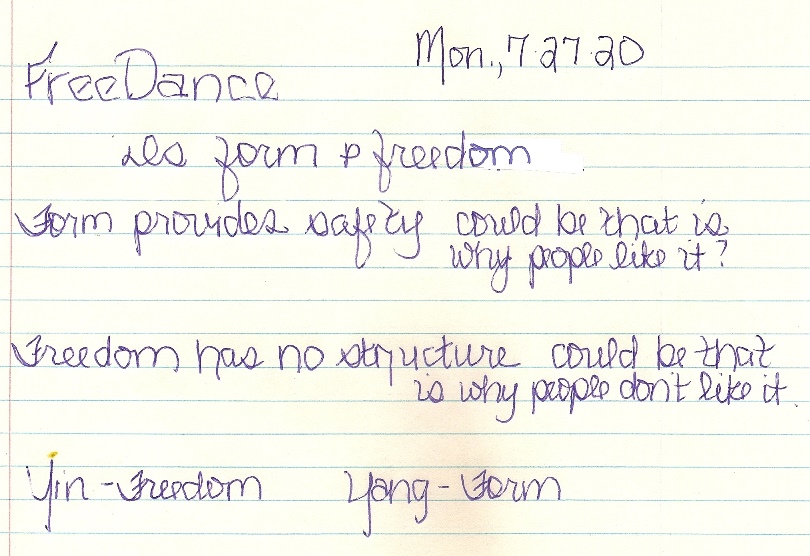 Debbie said something today that clarified something for me, she was talking about form and freedom, we have a lot of that in Nia. In light of the 2020 Nia White Belt, we have form in the way of choreography and we have freedom in the way of dancing free. Debbie equated form with “structure” and how that makes people feel safe. Freedom could be compared to “no structure”, which sometimes makes people feel unsafe. The freedom in an exercise class can be intimidating for many people. Being told what to do and how to move the body is the way most people are taught to exercise, so when they come to a Nia class and they are told, “Move your body.” They don’t know what to do. It is just like the story Debbie tells about when she first when to a Dojo. People can be told to focus on moving their arms, but they want to know HOW to move their arms, they want specific movement instruction. We have language to guide people to move in FreeDance, but there is still a lot of freedom in that and for some people that is a huge challenge.

 Terre Pruitt's Blog