Posts Tagged ‘Nia routines’
Posted by terrepruitt on January 22, 2013
One of Nia’s magic toys! Floorplay. This is where we actually get on the floor and play. The most common comment I receive from people about floorplay is, “I don’t like to get down on the floor because I can’t get up.” And sadly that is the most important reason one SHOULD get on the floor is so that they can LEARN to get up. Even though most often with Floorplay we stay ON the floor, there is a time when we do get up. Floorplay is both Nia Class Cycle #6 and the Nia Blue Belt Principle #10. The tagline or second part of the principle is Movement on the Floor.
Floorplay can bring up all kinds of fun stuff. It can bring up memories of infancy. With the scooting, the crawling, the getting up to walk, and the falling. It can bring up memories of childhood. Children often play on the floor. They do somersaults and gymnastic moves. They drive their cars around and roll and play. It is a fact of life that most adults lose their playful connection to the floor. Watch a group of children when they are told in a room to go play. The first thing most of them do is get down on the floor. They go to their knees and start to play. Most adults I know don’t ever think of the floor as a place to be.
Floorplay allows us to reconnect to the earth. It allows us to reconnect to the ground. It allows us to sense gravity and the strength and energy of the earth. There is a pull that we can play with. There is the sense of falling that we can use.
Floorplay is a way to explore. It is a safe place and a safe time to move and sense the body. Sometimes the floor can assist in a particular movement. The gravity can work to enable additional flexibility. It is truly a place of wonder to let go and move. Rolling around, letting limbs fall to the earth, pushing and pulling, stretching and yawning . . . . floorplay is a magical toy in the Nia toy box. It is a powerful time in the Nia workout for body, mind, and spirit.
Floorplay in a Nia class can be a choreographed cycle or a FreeDance. Either way it is an important time to explore both The Body’s Way and Your Body’s Way. It is an opportunity to play with movement and to progress to your ideal. Even when the routine being done in class has choreographed Floorplay participants are free to do their own FreeDance. I often encourage my Nia students to do a “body check” asking their body what desires attention. If they want they are free to do what they need in order to give their body what it needs.
Because most Nia routines include this cycle. It is recommended that Nia participants bring a mat to class in case they are more comfortable moving on a mat. A mat sometimes is exactly what is needed to ensure bone comfort and let the student move more freely on the floor. Most places I teach in San Jose have mats, sometimes there are just a few.
The Nia Blue Belt reminds us that being on the floor is not just about static postures and stretches, it is truly about movement on the floor. That is why this cycle is called Floorplay and with the Blue Belt lens, the way we look at things, we are reminded to play and have fun. We are encouraged to use all of Nia’s 5 Sensations along with gravity and the energy from the earth to connect to the vertical, horizontal, and spiral and to connect with our bodies in a dance on the floor that we call Floorplay.
So when is the last time you got on the floor and rolled around? When is the last time you got on the floor and played? What is stopping you?
Posted in Blue Belt, Nia | Tagged: FAMSS, five sensations, floor, floorplay, freedance, gymnastics, movement on the floor, Nia, Nia Blue Bel Principle #10, Nia Blue Belt, Nia choreography, Nia class, Nia Class Cycle #6, Nia Class in San Jose, Nia magic, Nia participants, Nia routines, Nia San Jose, Nia toys, Nia's 5 Sensations, play, playful connection, San Jose Nia, somersaults, tagline, TBW | 2 Comments »
Posted by terrepruitt on January 17, 2013
I participated in a Nia Blue Belt Intensive in the beginning of November 2012. Nia trainings are accurately named as intensive because they are intense. They are intense because it is 50 plus hours of moving and thinking and learning and listening and exploring, etc. It is a lot. Nia is a great cardio dance workout, but if you want, it is a lot more. The way things are connected is pretty amazing. I am writing posts somewhat off the top of my head as to what my initial thoughts are in regards to the 13 Nia Blue Belt Principles. After I get through all 13, I want to go back and write more as I read about each one and live with each one. I also want to review the 13 Nia White Belt Principles. At this time, I am on Nia Blue Belt Principle #9. The principle is Form & Freedom. The tagline is The Yin and Yang of Nia. As I have stated in my other posts about the principles there is a lot more to them than I am writing about. Nia is deep. This is just off the top.
There are forms in Nia. Some of the forms are:
-The 52 Nia Moves
-The Nia Routines
-The Seven Cycles of a Nia Workout
-All the Principles
-All the Triads
-The music
-The movement forms
-The Nia 5 Sensations
Some of the freedoms are:
-The energy variety
-Personal creativity
-Silence
–FreeDance
–Natural Time
-Adapting the Choreography
-Movement variety
-Mixing routines
-Transubstantiation
We have a lot of things that give us form. We have a lot of things in which we have freedom. There is yin and yang. The form and the freedom can be separate . . . we could just dance a song entirely FreeDance with no form at all. Just everyone dance their own way, no choreographed steps, no guidance, no form. Or we can marry the two. I love that. I love sharing with my Nia class that we are free in our form to do what we want. We can think about what we are doing and the moves we are doing or just let the music dictate to us.
Right now the routine I am doing is full of places to have the form and the freedom. There are many places in the routine where our feet have a specific form. The moves, according to Carlos AyaRosas (FKA Carlos Rosas), are precise. Our feet have a specific place, but our arms are free to move. While our arms are moving when the concentration is on the feet you can sense the form, the structure, the precision. But when the concentration is on the arms . . . .even if you are just letting them dance on their own to the music . . . you sense the freedom. You can sense your spirit. When you’ve had enough practice you can do both, have the form and the freedom.
The form is what many of us are accustomed to having, it is what we were trained to have in an exercise class. The freedom is what helps Nia be unique. With the Nia Blue Belt Principle #9 – Form & Freedom -The Yin and Yang of Nia we get to play and it makes the possibilities endless.
Have you ever played with form and freedom? Why don’t you try it? Put on some music you like to dance to and get your feet moving in a specific pattern. After a few rounds of the pattern just allow your arms to go. Let them move freely. Can you see how that can add up to an amazing workout?
Posted in Blue Belt, Nia | Tagged: 13 Blue Belt Principles, 13 White Belt Principles, 52 Nia Moves, cardio dance workout, Carlos AyaRosas, Carlos Rosas, Form & Freedom, freedance, Natural Time, Nia, Nia 5 Sensations, Nia Blue Belt Intensive, Nia Blue Belt Principle #9, Nia choreography, Nia class, Nia Music, Nia routines, Nia trainings, Seven Cycles of a Nia Workout, The Yin and Yang of Nia, Transubstantiation | Leave a Comment »
Posted by terrepruitt on January 10, 2013
There are six stances in the 52 Moves of Nia. Closed Stance, Open Stance, “A” Stance, Riding (Sumo) Stance, Bow Stance, and the Cat Stance. Each stance has a sound associated with it for practice. There are benefits to doing each stance. All of them help with balance. With the cat stance the balance is on one foot. The cat stance is a stance in which you stand on one leg, using your whole foot. The leg you are standing on is not rigid, but the knee is soft, as if you were going to pounce. The spine is upright, hips are level, not pointing down nor up. The foot that is off the ground is pressing with the side against the standing leg, the foot relaxed, toes hanging towards the earth. Elbows are bent, relaxed. Either both elbows are at the sides or one slightly forward. The arms and hands are engaged. The cat stance is done on alternating legs. These are the specifics of Nia’s Cat Stance.
 There are specific ways to do a stance, the body’s way. But your body’s way is also recognized. So different bodies will do it different ways. Some will do it their own way until the body can adjust to the specifics and some bodies will continue in their own way. For instance some bodies will use the power finger/balance finger hand technique to assist them in standing on one leg. In addition to each body having its own way to do each move sometimes the way the move is done in a routine alters the specifics. The specifics stated above are according to The Nia Technique book, however in the routine Birth, the cat stance in one of the katas consists of hooking the bent leg’s foot around the standing leg. In this particular dance, while we are in the cat stance with our foot hooked around the standing leg, our hands and arms are different from is described in the ideal cat stance stated above. One of our hands “hooks” around our face.
This is often the case. There is a specific way to do each of Nia’s 52 Moves, but each individual has their own body’s way that adjust the specifics AND the specifics are sometimes adjusted according to move in the routine. But it is important to know the specifics and the basics. It is also fun to practice the specifics and the basics.
The basics of the cat stance help with balancing on one leg. This can also be considered a strengthener, the standing leg’s muscles can be strengthened through the practice of supporting all of one’s weight. If this move is being done solely as a practice of the move, then agility can come into play. The practice of walking then stopping and moving quickly into cat stance would allow for the agility. Alternating with a light hop from whole-foot-cat-stance on one leg to the other is an exercise in agility. While this type of movement might also be something we do in a Nia routine it is not always the case. Sometimes we move into cat stance and from there do kicks.
As with all of Nia’s 52 Moves we play with them. All of Nia’s routines consist of playing with movement and music. With the cat stance you have the specific way to do it, then just like a cat you can play as you practice. You can “meow” and use claw hands. The cat stance is a fun way to play with balance and sounding. Practice the specifics then let the animal in you out!
Posted in 52 Moves (of Nia), Nia | Tagged: 52 Moves of Nia, A Stance, Balance Finger, Bow Stance, closed stance, hand technique, Nia katas, Nia Practice, Nia routine Birth, Nia routines, Nia's 52 Moves, Nia's Cat Stance, open stance, power finger, Riding Stance, standing on one leg, Sumo Stance, the body's way, the Cat Stance, The Nia Technique book | 2 Comments »
Posted by terrepruitt on December 12, 2012
Yay! Here it is day 12! Thank you for being here. I know it is a busy month. I know it is a busy time of the year. Even if Christmas is not YOUR thing there are others who are off doing theirs so you might be busy because of other people taking vacations and time off. So getting that 30 minutes in is a challenge. The reason I called it a challenge is because I know it is a busy time. But it is so worth it. So, again, thank you for participating and being here.
I am teaching Nia this morning. Then with nothing else on my schedule, I am going to do more Nia. I want to review a routine I have been doing for four years and finish learning one that I am in the middle of learning. I am presently teaching two different routines. In my morning classes we are ready to move on. Nia routines are so rich it is easy to keep learning with them. So that will be my 30 minutes.
I will be back to check in.
Posted in December 2012 30 Minute Movement Challenge | Tagged: Christmas, December 30 Minute Movement Challenge, Nia, Nia Classes, Nia routines, Nia schedule, Nia Teacher | 3 Comments »
Posted by terrepruitt on August 21, 2012
 So if you are participating in the little challenge of not getting on the scale for either 21 days or 30 days, today is the 21st day. I assigned 21 days so that is would land on a posting day (I post Tuesdays, Thursdays and Saturdays). I will let you know that due to more “stuff” as I had posted about before, I got off to a late start on my own challenge! So how is it going for you? Has it been a challenge to stay off the scale? Have you noticed that you are not obsessing about the number the scale displays because you are not looking at it? Now the thing with measuring with a measuring tape instead of scale means you need to keep doing what you’re doing. So if you were doing some type of cardio three times a week and adding some strength training in and weighing yourself, looking for that number to change when you stop using the scale it doesn’t mean to stop doing the other stuff. It is just a different way to track progress. And for some it could be a little bit of a reprieve IF they allow the scale to affect their mood. I found it funny that today on FaceBook someone posted about the scale stealing motivation and she reminded people it doesn’t tell the whole story. That is what I am saying too. That is why I thought it would be nice to change it up.
I know that some people don’t even have a scale. Some people don’t even use one. Everyone is different. I just hear a lot about people being upset because they didn’t lose a pound “today” and they’ve been trying so hard. So I think that maybe for those people it is nice to try a different way to track progress.
My schedule is a bit “off” this month as I am spending time dealing with “stuff” and I have picked up a lot of classes that I am subbing for the City of San Jose. I picked up eleven classes which is great but I have not been able to concentrate as much on my resistance training as I would like. My numbers did not change as much as I was hoping to see when I thought of this challenge. What about you? Did you see a change in numbers? Are you stopping at day 21 or going to continue on and see what 30 days will do?
Not only do I have the added class times to do I have a little bit of added prep time for each class and the travel time to and from each class. Since I am subbing in Nia for other classes such as Zumba, Zumba Gold, Pilates, Kick Boxing, and Cardio Toning, I do try to pick Nia routines that will fit. I am not changing Nia to fit the class, because I explained how that turned out in a post earlier this month, but I do try to pick routines that might fit a little better. With a Zumba Gold class I might do a Nia routine that is a bit mellow or doesn’t have a lot of bow stances. And with subbing a Zumba class I might put together a lot of the higher energy “get moving songs”. So all of that cuts into my plan. But I’m going to buckle down a bit because I have some stuff that I needed to get done this month behind me. I am going to keep up with this little challenge myself and see where that tape leads me.
Well? How are you still with me? Are doing the challenge? How is it going? Doing it for 21 days? Doing it for 30 days?
Posted in Misc | Tagged: 21 day challenge, 30 day challenge, body measurements, Bow Stance, cardio, cardio exercise, Cardio Toning, City of San Jose, Facebook, Kick Boxing, measuring tape, Nia routines, Nia San Jose, Pilates, resistance training, San Jose Nia, scale, scale challenge, tape measure, weight, Zumba, Zumba Gold | 2 Comments »
Posted by terrepruitt on July 24, 2012
In Nia we use the clock a lot. We don’t actually USE the clock, but we use the idea of a clock face on the ground. When we are moving and dancing we often times refer to the hours on the face of the clock to indicate where to put our feet or move our body. I had mentioned this in my post about Katas. I find that it works well when I am learning the routines. I note the “o’clocks” on my bars. I find it works well when sharing the moves in my Nia classes. And I find that Nia students appreciate having a reference point. It REALLY helps me when there is an actually clock in the room in my line of site. I know that probably sounds silly because the reason we use a clock to assist in the dance is because it is something familiar and constant, but sometimes it just helps to be able to glance up and be able to say, “Step to one o’clock.” I use the clock a lot.
 Often times our stepping isn’t exactly on an hour. Often times I feel as if it is BETWEEN the hours, say between one and two, but it is still a great reference point. As with many of our moves in Nia it could be that we are stepping on the foot we have placed at a specific hour or it could be that we are pointing or tapping on the hour. Using the hours of the clock as a reference can help prevent confusion when required to state which foot is being used. Since we are moving to music one does not always have time to state, “Cross your left foot to the right diagonal and stop.” And saying, “Left right diagonal” could be confusing, so it is nice to have a set “direction” by using the hours on a clock. So I can say, “Left at 1:00” and that is even more clear than saying either one of the instructions previously stated. It is clear that the left foot is to cross over and land at 1:00.
Also it seems to even work better than just saying the directional left and right. If I were to say, “Put your left foot out” I have not actually indicated WHERE to put your left foot, but when I say, “Left to 9:00” it is clear where the left foot should go when it goes “out”. Another example is a bow, it could be executed with the leg directly behind or crossed back so again the clock adds a greater level of instruction.
Of course, the participants in a dance exercise class are watching the instructor but giving them verbal instructions allows them to do it in their own body’s way instead of just trying to do it the exact way the teacher’s body is doing it. Some people might have a LARGE clock face on the ground on which they are dancing and other’s might have a smaller one. It all depends on where they leg reaches, but at least they know what direction.
In Nia there are even moves that refer to the clock. Within Nia’s 52 moves we have a “slow clock” and a “fast clock“. So as I said we use the clock or at least the idea of a clock a lot in a Nia class.
Makes Nia sounds easy, huh? It is. And it is fun. Find a class near you nianow.com or check out my Nia class schedule on my website (www.HelpYouWell.com).
Posted in Nia | Tagged: clock dance, clock face, dance, dance moves, fast clock, katas, looking at the clock, Nia class, Nia Class Schedule, Nia Dance, Nia katas, Nia participants, Nia routines, Nia students, Nia teachers, Nia's 52 Moves, NiaNow.com, slow clock, www.HelpYouWell.com | 4 Comments »
Posted by terrepruitt on July 9, 2012
In Nia there are 52 Moves that run through the Nia Routines. One move that we do quite often is not on the list of 52 moves. I call it a four-point turn because we take four steps to do it. In one of the routines I recently learned the instructor calls it an Aikido turn. Since Nia borrows moves and ideas from Aikido and associates Aikido with circular, spiral, and spherical motion, it makes sense this turn would be called an Aikido turn. As with many dance exercises the moves can sometimes be done fast or slow depending upon the music. Sometimes in a Nia routine we can do the same move at different speeds. With the four-point – which is four step – or Aikido turn – the best way to accomplish it is by starting with the first step being a “toes out” type of step. Point the foot out, away from the body in the direction you want to turn. Allow the entire thigh to turn out. Whether you are going to do a fast or slow turn, this first step is key in making it all the way around. Another key is to LOOK! Look the direction you want to turn. Also helpful is hands and arms. Allow your hand to follow after the eyes. The order would be eyes/head, hand/arm, foot/leg. While this is one arrangement of the order, sometimes your arms might actually be doing something else and that is fine too. It could be that the hands and arms lead, but whatever the case your eyes can be a part of the turn. Nia is a dance workout so sometimes we might have our arms dancing in another way to the music.
For a beginner learning the turn, I would make the previously mentioned suggestion of the order. Eyes/head, hand/arm, foot/leg. The thigh bone/foot turned out. Then step on that “toes out” foot, weighting it 100%, as you step all your weight on it your body will turn in the direction you want to go. Your free leg can be swung around to what seems like in front of your “toes out” foot, but by the time you step onto it, it will end up being besides the toes out foot because you will put all your weight into your second step and take the weight off the “toes out” foot so for a moment they will be side-by-side. Then you will swing your free leg behind to land about in line with the heel of your weighted foot. You will weight the foot that just was swung, and turn the other foot to parallel . . . making that the fourth point or step.
Maybe left and right indications will work better for you: The order: Turn your head/eyes to the left , allow your hand/arm to follow. Move your LEFT FOOT to “toes out” turning your left thigh bone to the left. Then step on your LEFT FOOT in a “toes out” position, put your weight on it 100%. As you are stepping all your weight on your LEFT FOOT, allow your body to turn to the left, in the direction you want to go. Swing your RIGHT LEG (free leg) around to what seems like in front of your LEFT FOOT. Step onto your RIGHT FOOT, toes pointing to the back of the room (or what started off as the back of the room), take the weight off the LEFT FOOT (“toes out” foot). Swing your LEFT FOOT (free leg) behind to land about in line with the heel of your RIGHT FOOT (weighted foot). You will stand on the LEFT FOOT, and turn the RIGHT FOOT to parallel . . . making that the fourth point or step.
Right to left works the same but start with your right foot.
To me, it is actually easier to do it fast than slow. But either way the hips get great rotation in the sockets. I was taught that we do not slide on our feet or spin on our feet. We dance barefoot so it is very different than if you have dance shoes on. There is not a nice layer of material that allows for easy sliding and spinning. We pick up our feet so as not to get blisters and to better condition the feet and the legs. So when we turn we are not spinning on the balls of our feet. That is one reason why I call it a four-point turn because we are hitting “points” in our dance. Points, steps, either way it is not a spin on the foot. This is another reason why it is important to start the turn with the toes already turned out because we also always want to be gentle on our knees. Also in Nia we are always reminded to remember our own body’s way. It is more important to protect and love our knees than it is to make it all they way around when doing a turn!
This is a pretty common dance move in dance exercise classes, but it is not always easy and can present a challenge. I believe it becomes particularly challenging when the person doing it wants to keep their eyes on the instructor. The best way to do it is to allow the eyes to move with the turn.
This is also a very fun move because you never know what we are going to do at either end (after the 4th step). Now that you got the turn down come to a Nia class and see what could be waiting at the end! You got the turn down, right?
Posted in Nia | Tagged: Aikido, dance exercise class, dance exercises, Nia, Nia 52 moves, Nia class, Nia Dance, Nia instructor, Nia Music, Nia routines, Toes Out, turned out toes | Leave a Comment »
Posted by terrepruitt on June 30, 2012
I teach Nia. I have been teaching Nia for three and a half years. Not as many people who I talk to have heard of Nia as have heard of Zumba so I am constantly being asked the difference between Nia and Zumba. Since I am often asked I am often thinking about them and comparing them. First, they are actually the same in that music is played and participants dance to it. Second, in both the instructor leads the participants through the various dance moves. Third, participants of both claim they are both fun. One difference is Nia is an experience in five sensations, Zumba seems to concentrate on one.
The experience is such a big part of Nia we actually call them the five sensations of Nia. I have posted about them before (FAMSS). They are the sensation of flexibility, of agility, of mobility, of strength, and of stability. In a Nia class your body will move in a way that allows you to sense the energy moving out and away. You will bend and stretch to play with flexibility, either retaining what you have or improving upon it. There are moves in the routines that require the start and the stop. The movement that is agility could be done with our feet, our arms, our hands, our bodies, our heads or a combination of body parts but we sense the start and the stop. With every routine there is a lot of mobility, some routines have more than others, but all of them that I have experienced have a lot. With mobility it is just the same as agility in that it could be a body part that is moving or our whole body. Whatever the case there is a lot of movement from each joint that helps create a healthy joint by allowing the fluid to move to it and within it. Then we also play with strength. We might squeeze our muscles sensing the energy moving in as if the bones are being hugged by the muscles. We might do squats or sit-ups, punches and/or kicks, but there is time where we play with strength. I say Nia is very big on balance because we do many moves that requires us to be stable. Many of our moves are balancing on one leg, could be a kick, could be a stance, but it requires stability. Moving from one move to the next often requires us to call upon our stability. In a Nia routine we experience all of these sensations. I’ve reached the conclusion that Zumba is primarily agility.
In Zumba the moves are always fast. So it is a constant state of start and stop. The only sensation I sense while doing Zumba is agility. Fast start, fast stop . . . . even when there is a stretch where your muscles are yearning for a second to move to their fullest length, it is a fast stretch that does not allow for the muscle to be fully stretched. Doing a full hour of agility is not a bad thing at all. It can be fun and it can produce a lot of sweat. And many of us are programmed to think that sweat equals a good workout. I think that if you are adding Zumba to a stretching program that has some balance practice in it that is great.
I am also a believer that there are a lot of things that compliment Nia too. I actually think that if you like Nia and Zumba and you are able to do both that is a nice combination. You get two different types of cardio. One that is a workout in the sensation of agility and one that can move you through more use of the entire body to get that heart pumping.
I really believe that whatever gets you moving is GREAT. I think that you have to like what you do in order to make it a constant in your life. So Zumba, Nia, Jazzercise, U-Jam, yoga, kickboxing, bootcamp, weight training, whatever works for you is great. Do what you will do! That is the key!
It is that I am always asked about the difference between Zumba and Nia that I am always thinking about it and this was my latest thought after I did a Zumba class. I think I posted before about how I am left wanting to extend and finish my moves in Zumba and it dawned on me that it is the sensation of agility that is predominant in Zumba. Some Zumba classes I have attended do take a song to stretch at the end, but not all of them. So I guess it depends on the instructor. Nia instructors are encouraged to infuse their classes and the routines with their personalities, so I am sure that every Nia class has a few differences too.
Both Nia and Zumba are great cardio workouts. It just depends on what you want to do during your workout and what you want to get out of it. Do what you will do!
So, what is it that you do?
Posted in Nia, Zumba | Tagged: agility, bootcamp, cardio dance, cardio workout, dance exercise, FAMSS, five sensations, flexibility, Jazzercise, kickboxing, Mobility, Nia, Nia Classes, Nia instructor, Nia Moves, Nia participants, Nia routines, Nia Teacher, Nia vs Zumba, stability, strength, U-Jam, Ujam, weight training, Yoga, Zumba, Zumba classes, Zumba instructor, Zumba participants, Zumba routines | 11 Comments »
Posted by terrepruitt on May 24, 2012
Just a few posts ago I talked about simple stretches that could possibly bring relief to tight hip flexors and lower back pain. I referred to a yoga pose called the pigeon pose. This pose is where one leg is stretched out to the back and the front of the leg (the front of the thigh, the knee, the shin, and the top of the foot and toes) are on the ground, touching the ground, and the other leg is bent at the knee with foot towards the body, but the shin at a right angle to the body. The hand can hold the foot. The back is long and straight and upright. There are variations. Some are where the leg is bent more and the foot is more pointed toward the opposite hip. In some the back is still long and straight, but the body is lying over the bent leg.
In Nia the variation is called a Side Yawn. The leg is bent so the foot is near the opposite hip, as I mentioned above. The arm on the side of the bent leg is bent while the arm on the side of the outstretched leg is straight with palm on the floor. As the body lowers to the earth over the bent leg the outstretched arm moves on the ground reaching out further. Allow the entire body to sink into a comfortable fold. The lengthened side of the body yawns open.
For the more athletic version there is more weight on the bent leg and instead of just stretching out over the bent leg there are push-ups involved. Pushing away from the earth and sinking slowly back into it. After a few push-ups then allow your body to release to gravity and lay over the bent leg.
This is one of the moves that I mentioned were in the back of The Nia Technique Book. Both the classic version and the athletic version of this move open and release the hips. With the classic as you sink to the floor the side of the body is receiving a long stretch. The athletic version enables strengthen of the arms and core. This move is one where you would do as many repetitions as you would like and then switch to the other side. Or you could do one side then switch and do the other side. The point it to be sure that you do both sides. I would bet, as with most of us, one side is more flexible than the other.
In the Nia routines I do we are often in the pigeon pose or the side yawn pose, but we do not always sink into the yawn. Often we are dancing with our hands on the floor, not necessarily doing straight up and down push-ups, but using our arms to lower us to the earth and push-off again. As with all moves each individual is invited to do what is best for their body at that moment in the Nia class. So some might sink into the yawn. So usually in addition to stretching our hips we are using our core and our arms in our cool down or floorplay.
Do you ever sense your hips are tight and need stretching? Might you think to use this stretch to loosen up?
Posted in Nia, Yoga/PiYo/Pilates | Tagged: Athletic Nia, classic Nia, cool down, flexible, floorplay, Hip flexors, lower back pain, Nia, Nia class, Nia pose, Nia routines, Pigeon pose, side yawn, simples stretches, stretching, The Nia Technique book, tight hips, yawn the body, Yoga, Yoga Pose | 2 Comments »
Posted by terrepruitt on May 1, 2012
 At this point you might have noticed that I only have a post for 9 of the 52 Moves of Nia. I am going to work on that. I have a Nia friend who is posting about the 52 Moves of Nia on her blog and she has inspired me to continue on. I have the list of the moves on my website. I link the blog post from there so people on my site can click to see a description and possibly a picture. With only 9 post I only have 9 links. This is ten and moving forward.
Nia is a unique cardio dance exercise that combines nine movement forms into a fun and energizing workout. Nia has moves we call the 52 Moves. Many of them are common to other dances. I am posting here about Toes In, Out, and Parallel. I know I have seen these moves in other dances if not done together at least done separately.
 To do the move as one move you start with your feet parallel to each other. They can be hip (joint) width apart. Then turn your toes in to face each other. Turn them in as far as you comfortably can. Then swivel your feet out so the toes are pointing in opposite directions. Again, only do it as far as you can — comfortably.
This is the whole move. There is a routine where we are in A Stance and I have the participants dance toes in then toes out. Which I consider a lot of fun. You can play with this move by trying to walk with toes facing in, then with toes facing out.
I like to play with the move by doing one foot toes in and out. Sometimes just letting one foot do a dance all of its own; in, out, in, out, tapping my toe to the ground with each twist of my leg. I also like to do this move with varying stances. My instructions here say to start in open stance, but it can easily be done in A Stance (as I mentioned I do in my Nia class). You’ll notice that different muscles are used when you change the width of your stance.
Moving the feet in this manner allows for all the bones in the leg to rotate which gets the thigh bones moving in the hip socket. Movement is a way to keep the joints health. Movement helps fluid into the joints. I say “juicy joints.” We move to have juicy joints.
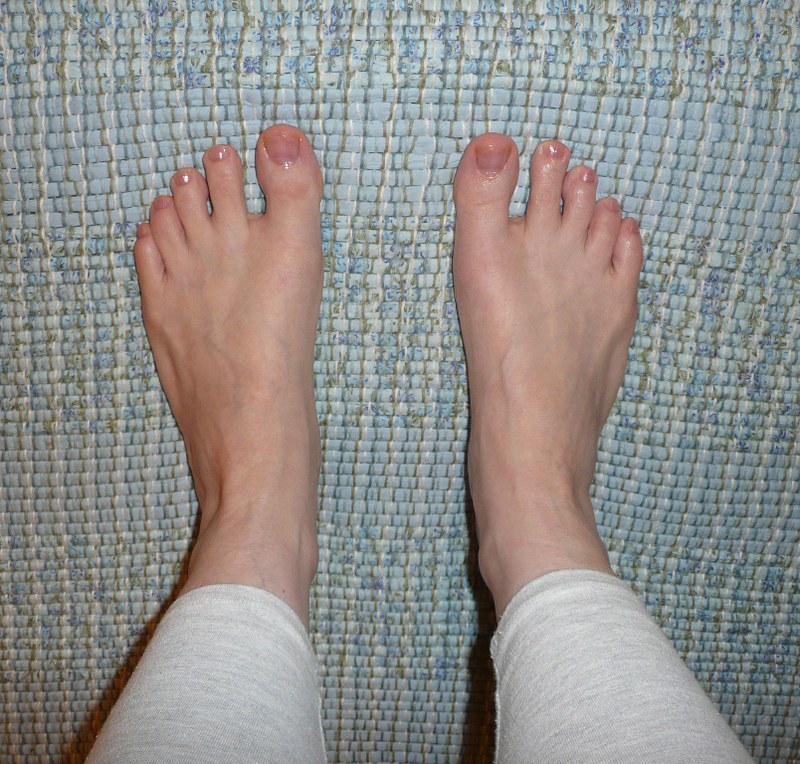 In addition to helping the hip joint this move helps keep the ankles mobile and the knees flexible.
With healthy hip joints, ankle joints, and knee joints the enables walking and moving in general to be done with ease. So even though this is one of the moves we use in our dance exercise routines that does not mean the use of it is limited to that.
You can decide to walk with toes in for a bit during your day, then with toes out. While standing you can stand with toes in, then out, then parallel. It is an easy exercise to play with and incorporate into your day. And it really does help with the health of your joints.
Are you gonna do it? On your trip from your desk to the coffee pot? While you are going about your day with the kids? Which on in your favorite, in or out?
Posted in 52 Moves (of Nia), Nia | Tagged: 52 Moves of Nia, ankle joints, cardio dance exercise, dance exercise, Dance Workout, energizing workout, hip joint, juicy joints, knee joints, Nia, Nia friend, Nia routines, Nine Movement Forms, Toes In, Toes Out, Toes Parallel | 2 Comments »

 Terre Pruitt's Blog