Posts Tagged ‘The Nia Technique book’
Posted by terrepruitt on January 10, 2013
There are six stances in the 52 Moves of Nia. Closed Stance, Open Stance, “A” Stance, Riding (Sumo) Stance, Bow Stance, and the Cat Stance. Each stance has a sound associated with it for practice. There are benefits to doing each stance. All of them help with balance. With the cat stance the balance is on one foot. The cat stance is a stance in which you stand on one leg, using your whole foot. The leg you are standing on is not rigid, but the knee is soft, as if you were going to pounce. The spine is upright, hips are level, not pointing down nor up. The foot that is off the ground is pressing with the side against the standing leg, the foot relaxed, toes hanging towards the earth. Elbows are bent, relaxed. Either both elbows are at the sides or one slightly forward. The arms and hands are engaged. The cat stance is done on alternating legs. These are the specifics of Nia’s Cat Stance.
 There are specific ways to do a stance, the body’s way. But your body’s way is also recognized. So different bodies will do it different ways. Some will do it their own way until the body can adjust to the specifics and some bodies will continue in their own way. For instance some bodies will use the power finger/balance finger hand technique to assist them in standing on one leg. In addition to each body having its own way to do each move sometimes the way the move is done in a routine alters the specifics. The specifics stated above are according to The Nia Technique book, however in the routine Birth, the cat stance in one of the katas consists of hooking the bent leg’s foot around the standing leg. In this particular dance, while we are in the cat stance with our foot hooked around the standing leg, our hands and arms are different from is described in the ideal cat stance stated above. One of our hands “hooks” around our face.
This is often the case. There is a specific way to do each of Nia’s 52 Moves, but each individual has their own body’s way that adjust the specifics AND the specifics are sometimes adjusted according to move in the routine. But it is important to know the specifics and the basics. It is also fun to practice the specifics and the basics.
The basics of the cat stance help with balancing on one leg. This can also be considered a strengthener, the standing leg’s muscles can be strengthened through the practice of supporting all of one’s weight. If this move is being done solely as a practice of the move, then agility can come into play. The practice of walking then stopping and moving quickly into cat stance would allow for the agility. Alternating with a light hop from whole-foot-cat-stance on one leg to the other is an exercise in agility. While this type of movement might also be something we do in a Nia routine it is not always the case. Sometimes we move into cat stance and from there do kicks.
As with all of Nia’s 52 Moves we play with them. All of Nia’s routines consist of playing with movement and music. With the cat stance you have the specific way to do it, then just like a cat you can play as you practice. You can “meow” and use claw hands. The cat stance is a fun way to play with balance and sounding. Practice the specifics then let the animal in you out!
Posted in 52 Moves (of Nia), Nia | Tagged: 52 Moves of Nia, A Stance, Balance Finger, Bow Stance, closed stance, hand technique, Nia katas, Nia Practice, Nia routine Birth, Nia routines, Nia's 52 Moves, Nia's Cat Stance, open stance, power finger, Riding Stance, standing on one leg, Sumo Stance, the body's way, the Cat Stance, The Nia Technique book | 2 Comments »
Posted by terrepruitt on January 5, 2013
There are a few posts on my blog about sounding in Nia. I even have a separate category for it. See over there to the left under categories, under Nia? Sounding is what we call making noise in a Nia class. Sounding is great for many reasons. Sounding is a release. It can help release tension, emotions, spirit . . . whatever needs “releasing”. Sounding is fun. Sounding can assist in the stabilization of the torso. Sounding can help ground you . . . physically, emotionally, and your spirit. Often times when I am doing Nia both when I am teaching and when I am a student, my spirit just makes a sound. I don’t plan it, I don’t think about it, a noise just comes out. I “woo” a lot. But sometimes other sounds comes out. Sometimes the sound I make makes me laugh because I really don’t think about the sound, something just comes out. I could be thinking of something, for example, maybe the move we are doing reminds me of a swirling skirt, so then the sound could be a “whosh” as in the sound of a skirt, or it could be a giggle of a girl twirling in a skirt. I don’t always think about the sound I just let it out. Sometimes I do think of the sound. Sounding can be purposeful. The noise can have a purpose. I have posted about healing sounds and sounds associated with the chakras. This post is about the sounds that are associated with Nia stances, which are part of Nia’s 52 moves.
The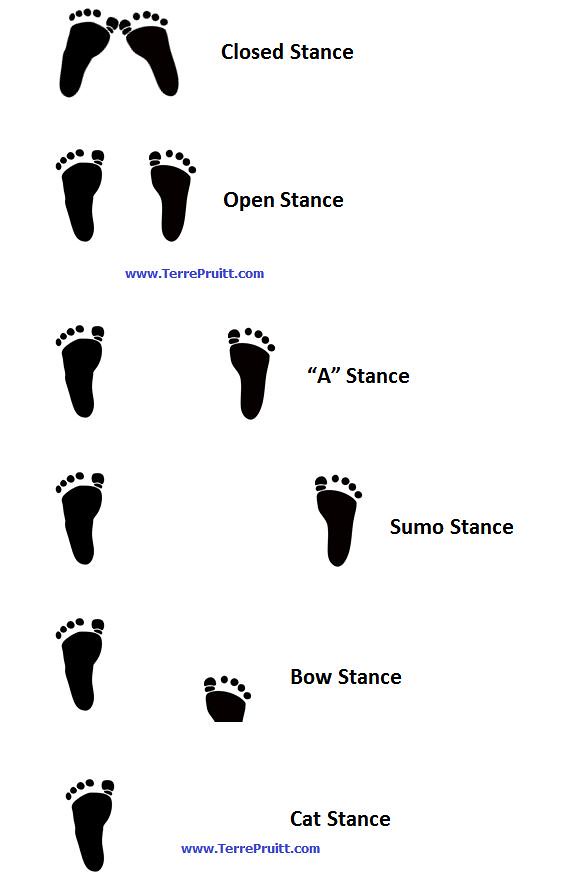 picture in this post is an approximation of how MY feet would be placed in the various stances. Remember that your stances would probably be slightly different. The width would be according to YOUR body and your body’s way. The picture is just to give you an idea and maybe help remind you of the various stances. At this time I have a post associated with four of the six stances.
In Nia’s closed stance the sound is the vowel sound “o”. The sound is made to “create volume in your chest cavity”.
In Nia’s open stance the sound is (to say) “balance” or “ground”. Saying the word “balance” can assist you in your balance. The word “ground” can assist with allowing you to feel grounded and sense balance.
The sound for Nia’s “A” stance is “aaaaahh!”. You say it on an exhale. Letting out all your breath until you are ready to inhale.
Sumo stance or riding stance (feet as wide apart as if you were riding a horse) has an explosive sound. Say “ha!” To me this helps with stabilization.
The bow stance has a sound of “u”. The bow stance is done with either foot in front, not just with the left foot in front as shown in the example.
The cat stance (standing on one foot, with the other foot pressed against the standing leg) has the sound “wooooooo” associated with it. This is done on the exhale. This stance is also done on the other foot and not just the left one as in the example.
So as you are practicing the Nia stances you can use the sounds associated with them for added benefit and fun. It is just fun to make noise. To me it adds to the experience. In my classes I encourage people to make any noise they want. I also like to play with the noises, sounds, and words associated with the move.
Do you attend a dance exercise class or exercise that encourages you to make noise?
Information regarding the sounds made with the Nia stances can be found in The Nia Technique book written by Debbie Rosas and Carlos Rosas (NKA, Carlos AyaRosas). The book can be purchased from Amazon.
Posted in Nia, Sounding | Tagged: A Stance, Amazon, Bow Stance, Carlos AyaRosas, Carlos Rosas, Cat Stance, closed stance, core stabilization, Debbie Rosas, making noise is fun, Nia, Nia class, Nia Sounds, Nia Stances, Nia Teacher, Nia teaching, open stance, Riding Stance, sounding, Sumo Stance, The Nia Technique book | Leave a Comment »
Posted by terrepruitt on September 6, 2012
 Another one of the 52 Moves of Nia is the “A” Stance. This is the stance where the position of the legs allows the body to look somewhat like the capital letter A. The legs are placed wider than hip distance apart, even wider than shoulder width. The legs are far enough apart and wide enough for them to appear to be as the bottom “legs” on a capital letter A. The feet are parallel, the upper body is relaxed. The Nia Technique Book states the benefits as: “Practicing “A” Stance improves hip flexibility and leg strength, which improves agility and mobility.”
I would like to add that it improves or at least allows the practice of balance. Not balancing on one leg which we do a lot in Nia, but balance between the body and the legs, balance between both legs, and balance between the legs and feet. Also balance of weight between the two feet. This is a stable and balanced stance. The weight is not on one foot more than the other. The weight is not on the front or the balls of the feet more than on the heels. This is a great stance to practice balance in. To allow the body to rest onto the whole foot.
Not only having the feet be parallel but even. If you were to stand at a line would your toes be even, both up to the line? I had noticed with myself for a while now that when I step into an “A” stance my right foot is ALWAYS slightly back from where my left foot is. I have been noticing this since I injured my foot in November of 2010. Just last week as I was teaching my regular Nia Class in Willow Glen, I noticed I stepped into “A” stance and my left foot was the tiniest bit back from the line on which my right foot landed (had there been a line). I thought that was funny. I giggled, but I hadn’t thought of it again until now. I don’t always think about my uneven landings until I have the opportunity to land in a stance where I see my feet several times in a routine. Then during the routine I focus on having my feet land even. There are times, of course in a dance where they don’t need to be or aren’t supposed to be even, but when doing a regular closed, open, A, or sumo stance I think the feet should be even. The “A” stance is a great stance to practice that because you can clearly see your feet and the pose is relaxed enough that there are not other things you might be thinking about. I feel the “A” Stance is a great way to practice balance.
As with all stances one way to practice the “A” stance is to simple stand in one place and move through the stances. Another way to practice is to walk and then stop in the “A” stance. Walking and stopping into an “A” Stance would be a great way to work on landing “even” — as I mentioned before. Walk, then stop, then look at your feet, notice the sensation in your hips, if your feet are even then that is the sensation you want to replicate, if not, then adjust your feet, notice the sensation in your hips and try to replicate it again as you step into “A” Stance.
The “A” Stance is just one of the six stances in the Nia 52 Moves.
What do you sense when standing in the “A” Stance? When you step into the “A” Stance do your feet land “even”?
Posted in 52 Moves (of Nia), Nia | Tagged: 52 Moves of Nia, A Stance, balance of weight, closed stance, Nia 52 moves, Nia class, Nia Dance, Nia in Willow Glen, Nia Practice, Nia Stances, open stance, Riding Stance, Sumo Stance, The Nia Technique book, Willow Glen Nia | Leave a Comment »
Posted by terrepruitt on June 7, 2012
 Are there any dance exercise classes that you know of where you are encouraged to quack like a duck? Well in all Nia classes we like to have fun, plus Nia understands the benefits of sounding, so there is a move where we quack while we are doing it. Of course, quacking is not limited to being done only when we do this move, but this move is actually called Duck Walk. It is very fitting to quack while doing this move. I know to many quacking seems silly. Sitting and reading about it has to make it sound really silly, but in class with your feet gently slapping the floor, it seems perfectly natural. Making noise is natural and it tends to make working out much more fun. It is also very amazing when moves have their own sound. The Duck Walk, of the Nia 52 Moves is one that has its own sound, “Quack! Quack! Quack!”
All of the 52 Moves are listed with pictures in The Nia Technique Book. I cannot emphasize enough how helpful this book is. If you are interested in movement in the slightest or if you are interested in the body mind connection you would enjoy this book. The Duck Walk is described on page 114 as:
“Standing with your feet slightly apart and no wider than hip width, alternately lift and then lower the toes and balls of each foot, as if you are slapping the ground to splash water in a puddle.”
So your feet can be slightly apart or as far as hip width. Remember “hip width” means hip JOINT width. Thigh bones straight down from your hip joints. Then the toes and ball of foot lift. Then you splash. Splish splash in puddles. As with the Squish Walk I have a different way to do this with different imagery. When I am doing it as stated in the book, I DO think of my toes splashing in the puddles. But when I think of a duck and its walk, I tend to put my toes out. I think of toes out as duck walk. That’s when the move lends to quacking for me.
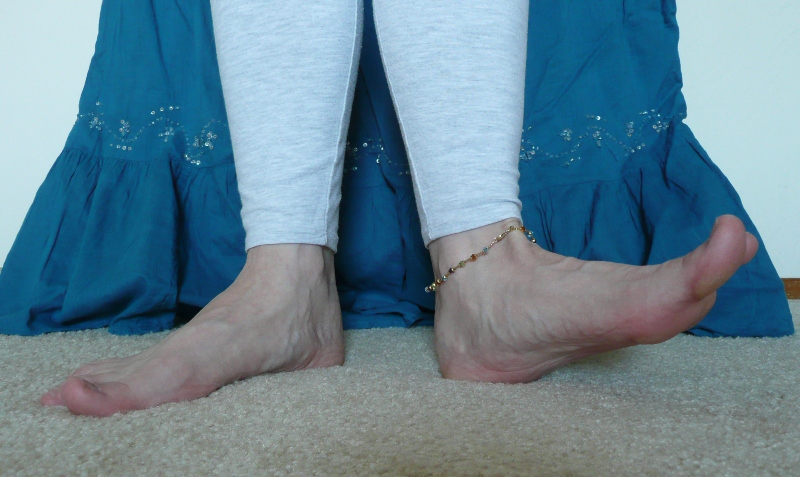 Just as the same as with the Squish Walk The Nia Technique Book does not give instructions to walk while “duck walking”, but we do it all the time in my Nia classes. This duck walk move really allows for ankle movement and helps condition the muscles on the front of the lower legs so I like to use it. High heeled shoes — especially the ones now-a-days — have feet stuck in the opposite direction with hardly any ankle flexion so the Duck Walk is great to get those muscles moving and stretched.
While progressing forward with the duck walk it is not the same as heel lead walk even though you lead with the heel. With the duck walk we don’t roll through the entire foot, we gently splat the foot down. It is a heel lead then splat with the rest of the foot. That is why the imagery of splashing your toes in the puddle works so well, I bet as a child most of us have done that.
Between the quacking and the splashing it is no wonder Nia is so fun. Adults as play! Splish splash quack!
Did you get up out of your chair to try it? C’mon, try it!
Posted in 52 Moves (of Nia), Nia | Tagged: 52 Nia Moves, dance exercise, duck, Duck Walk, hip joints, hip width, Nia, Nia Classes, Nia Moves, quack, Quacks Like a Duck, sounding, Squish Walk, The Nia Technique book | 4 Comments »
Posted by terrepruitt on June 2, 2012
Nia is the same as many things, the more you do it the more accustomed your body becomes to the movement. When you first try swinging a bat or a golf club it seems as if there are so many things to think about. The placement of your feet, the bend in your knees, the sinking of the hips, what your hands are doing, what your elbows are doing, where your chest is facing, to move or not to move your shoulders. Then there is your head, your eyes, and – oh yeah – the ball. So much to remember. Then as you practice you forget that you even were once having to remember all that. You are able to just “let go” a bit and play the game. Dance exercise is the same way for some. There are moves in Nia that we do, the 52 moves. At first the body might be so busy trying to do it correctly it is not allowed to play, but once the moves are learned there is time to play. In a Nia routine a move is often repeated enough so it can be learned and then the play can begin. But there is still a technique, there is still a right way to do it in order to get the benefits from it as was the intention of having the move be a part of Nia.
One of the moves that I sometimes find challenging is the Squish Walk, the way Carlos AyaRosas (FKA Carlos Rosas), told us how to do it. I had thought it was rising on the ball of one foot, then squishing that foot down, then rising on the other ball of the foot, and alternating. The imagery is that of squishing oranges under the heels. I had thought it was one whole foot on the ground before bringing up the other, but that is not how he instructed us.
His instructions were to be on the both balls (of the feet) at the same time. Not all the way up on both feet but one heel HIGH and one lowering and switching like that. The foot that is flat on the ground (whole foot) is not there long because it comes right back up. I found this method much more challenging than the one foot down and the other foot up. The method Carlos had us do tends to work the calves and shins more than the other method.
The Nia Technique Book states one foot is down (whole foot on the ground) before bringing the other foot up. Both methods work the lower legs, improving strength and flexibility. Neither method is actually a walk. We are not progressing forward. Although the squishy movement could be incorporated into a walk.
 With the method in the book, I usually use the image of high heeled shoes. Lift one heel as if you are showing off a new high heeled shoe. The concentration is on the lifted heel. Then switch heels. With the method Carlos taught I think more of oranges. The concentration, to me, is more on the squish.
In the Nia routine we have been doing this past month in my Nia Classes we do something they’ve dubbed the “double squish walk” which is rising at the same time on both balls of the feet. Then the squish is on bringing both heels down at the same time. Double Squish. I just call it up on the balls of your feet, since it doesn’t seem very squishy and it is not like either method.
I invite you to try both methods of the squish walk. Lift one foot onto the ball of the foot, then set it down and lift the other foot. Alternate. And try, lifting up on both balls of the feet, then start to lower one to ground, then alternate. It is as if in one method both feet end up on the ground and with the other method both feet end up on the balls of the feet. So fun, the different ways to do the moves yet, both ways are to help condition the lower legs to help “you move safely with different speeds and intensities”. In other words be sturdy on your feet as you move and dance through life!
Posted in 52 Moves (of Nia), Nia | Tagged: "double squish walk", ball of one foot, Carlos AyaRosas, Carlos Rosas, conditioning benefits, dance, dance exercise, dance practice, dance through life, flexibility, golf club, high heels shoes, improving strength, Nia, Nia Classes, Nia Practice, Nia routine, Nia Technique, Nia's 52 Moves, Squish Walk, squishing oranges, swinging a bat, The Nia Technique book | 4 Comments »
Posted by terrepruitt on May 24, 2012
Just a few posts ago I talked about simple stretches that could possibly bring relief to tight hip flexors and lower back pain. I referred to a yoga pose called the pigeon pose. This pose is where one leg is stretched out to the back and the front of the leg (the front of the thigh, the knee, the shin, and the top of the foot and toes) are on the ground, touching the ground, and the other leg is bent at the knee with foot towards the body, but the shin at a right angle to the body. The hand can hold the foot. The back is long and straight and upright. There are variations. Some are where the leg is bent more and the foot is more pointed toward the opposite hip. In some the back is still long and straight, but the body is lying over the bent leg.
In Nia the variation is called a Side Yawn. The leg is bent so the foot is near the opposite hip, as I mentioned above. The arm on the side of the bent leg is bent while the arm on the side of the outstretched leg is straight with palm on the floor. As the body lowers to the earth over the bent leg the outstretched arm moves on the ground reaching out further. Allow the entire body to sink into a comfortable fold. The lengthened side of the body yawns open.
For the more athletic version there is more weight on the bent leg and instead of just stretching out over the bent leg there are push-ups involved. Pushing away from the earth and sinking slowly back into it. After a few push-ups then allow your body to release to gravity and lay over the bent leg.
This is one of the moves that I mentioned were in the back of The Nia Technique Book. Both the classic version and the athletic version of this move open and release the hips. With the classic as you sink to the floor the side of the body is receiving a long stretch. The athletic version enables strengthen of the arms and core. This move is one where you would do as many repetitions as you would like and then switch to the other side. Or you could do one side then switch and do the other side. The point it to be sure that you do both sides. I would bet, as with most of us, one side is more flexible than the other.
In the Nia routines I do we are often in the pigeon pose or the side yawn pose, but we do not always sink into the yawn. Often we are dancing with our hands on the floor, not necessarily doing straight up and down push-ups, but using our arms to lower us to the earth and push-off again. As with all moves each individual is invited to do what is best for their body at that moment in the Nia class. So some might sink into the yawn. So usually in addition to stretching our hips we are using our core and our arms in our cool down or floorplay.
Do you ever sense your hips are tight and need stretching? Might you think to use this stretch to loosen up?
Posted in Nia, Yoga/PiYo/Pilates | Tagged: Athletic Nia, classic Nia, cool down, flexible, floorplay, Hip flexors, lower back pain, Nia, Nia class, Nia pose, Nia routines, Pigeon pose, side yawn, simples stretches, stretching, The Nia Technique book, tight hips, yawn the body, Yoga, Yoga Pose | 2 Comments »
Posted by terrepruitt on May 17, 2012
I often have mentioned the 52 Nia Moves. I am taking my time posting about them, but they are in the Nia Technique Book. You could always order a copy from Amazon if you are interested. That is how I started my Nia practice. In the book after the section on the 52 Nia Moves there are pages and pages of other moves too. There is the 13 Joint Exercise, explanations of combinations of some of the 52 Nia Moves, Spinal Melts, and T’ai Chi Sways, and many more. They are organized in the Nia Cycles. The moves that are part of the warm up are in the Warm up section the more active moves are in the Get Moving section. Each move has a “Classic” explanation and an “Athletic” explanation. Nia is done in bare feet so there is no to very little impact, but that does not mean there is no intensity. Intensity comes from BIGGER moves. Bigger moves can be more arm movement either faster or further away from the body or both. Bigger moves can be moving deeper into a move. So the explanation of “Athletic” contains bigger or faster (or both) movements. There are over 75 pages of moves. Each with a set of pictures. Both the classic and the athletic has pictures. If you have the slightest interest in Nia or movement in general I would strongly recommend this book.
I felt I had to share that because there really is so much in the book.
That popped into my head as I was sitting here thinking about going to go make dinner. Here is what we are having:
 Terre’s version of the Rantings of an Amateur Chef’s recipe:
Cauliflower Stuffed Portobello Caps
4 large Portobello mushroom caps
most of an entire head of cauliflower
3 green onions
1/2 C cooked and chopped bacon
1/3 C milk
3/4 C shredded cheddar cheese
1/4 C shredded Gouda cheese
salt, pepper, and garlic powder
Cook the bacon.
Scrape out the inside of the cap to remove the stem and gills.
Chop the green onions.
Preheat oven to 350 degrees.
Cut the cauliflower into large pieces. Steam for 6-8 minutes. Place hot cauliflower into the blender and some of the milk. Blend. Add milk as needed to achieve a mashed potato-like consistency. Mix with bacon and onions.
Fill caps with cauliflower mixture. Sprinkle with salt, pepper, and garlic to taste. Sprinkle with shredded chesses. Put a few onions on top. Place on a cookie sheet. Bake for about 15 minutes on the lowest rack in the oven.
The first time I made this I didn’t use the bacon and I will be doing that version a lot more often. It is really good! But I also wanted to try it with the bacon.
So I am going to go cook, then take pictures and post it all at one time!**
 Do look at the Ranting Chef’s blog as he cooks some amazing things. The difference between his recipe and mine is he did not determine from the get go how many mushrooms. His recipe calls for only one half of the cauliflower head, he used bacon bits out of a package (which is uber smart because it helps keep the recipe easy!), his seasoning is pepper and pepper only, and his instructions are to cook it only for 5 minutes.
I don’t like pepper so what I do is just sprinkle each mushroom individually so that my husband, who likes pepper, can have more of that flavor, while I just barely do a turn of the pepper grinder. I also like my mushrooms more cooked when they are stuffed. I have made stuffed small mushrooms and find that I like to cook them a bit before hand.
It’s your turn. Make this recipe and let me know how you like it. Let me know how you adjusted it.
**Ok, so I didn’t like it with the bacon, but my husband did. I like crisp bacon and putting it in with the cauliflower made it just like bits of meat in the mix. I also forgot to mix the onions IN so ended up with them just on top. The bacon bits from a package might make it worth it, but dealing with bacon was not worth it to me.
Don’t The Cauliflower Stuffed Portobello Caps sound yummy?
Posted in "Recipes", 52 Moves (of Nia), Food, Nia | Tagged: 13 Joint Exercise, 52 Nia Moves, Amazon.com, Bacon, Cauliflower Stuffed Portobello Caps, Gouda cheese, Nia, Nia cycles, Nia Practice, Portobello mushrooms, Rantings of an Amateur Chef, Spinal Melts, T'ai Chi Sways, The Nia Technique book | 2 Comments »
Posted by terrepruitt on April 28, 2012
When I first discovered Nia I bought The Nia Technique Book to see if I would be able to do it. I don’t mean do it as in do the moves and participate in a class, I mean do it as in “get into it”, as in understand it. It sounded a bit “woo-woo” to me. Listening to your body, voices of the body, energy this, moving energy that. I wasn’t sure I could sync it up with my beliefs. But as I studied it more I realized that it is based on science. It involves human kinetics. Most of the moves, although called the 52 Nia moves are quite common and are seen in many other types of exercises and workouts. The ones that I consider unique are probably part of some other dance I am not familiar with. And the “woo-woo” part, well, I realized that it is woo-woo – at least that is how many people think of certain things like energy, chakras, mind-body, and body-mind practices. I mean look at yoga, when I was young that was one of the “woo-wooest” things around and now people have embraced it. There are so many types of yoga it is difficult to keep track. For some they just ignore the woo-woo while others embrace it because they realize it makes sense. I mean cultures have been using “woo-woo” stuff for centuries. There is meditation, herbs, chanting, drumming — all types of other things that some people think of woo-woo. The woo-woo must not be too far off base though because it seems to work. Recently my posts have been about healing sounds and making sounds, this post is about the vowel sounds related to the chakras and I am sure to some people it sounds a little, or maybe even a lot, “woo-woo”. But I like to imagine that if you are reading this you are somewhat open to new things — even woo-woo things. So you might be willing to try the healing sounds or even the vowel sounds of the chakras.
The vowel sounds related to the chakras are as follows:
CROWN CHAKRA: EEE as in “me”
BROW/THIRD EYE CHAKRA: AAA* as in “say”
THROAT CHAKRA: EYE as in “my”
HEART CHAKRA: AH as in “ma”
SOLAR PLEXUS CHAKRA: OH as in “go”
PELVIC CHAKRA: OOO as in “you”
ROOT CHAKRA: UH as in “cup”
The idea is to say these sounds in a specific note. If you have a keyboard or a phone with an app that has a keyboard or an app that can give you examples of the notes it might help you. Or you might be musical and know what the notes sound like.
EEE is to be made in the B note
AAA is to be made in the A note
EYE is to be made in the G note
AH is to be made in the F note
OH is to be made in the E note
OOO is to be made in the D note
And UH is to be made in the C note
These sounds are to help open and heal the chakras. Or to keep them balanced, all depends on your needs and your practice.
As with everything there is a wealth of information out there on how to “do” the vowels. The commonalities I am seeing is to sit comfortable with a lengthened spine. Be relaxed. Use a normal breath. Repeat each sound seven times.
I have used these sounds in my Nia classes when we are using a chakra as a focus. I am going to take this list and use the vowels sounds just as I did the healing sounds. The focus can be the chakra vowel sounds and we can create an intent from there. Yay! I love thinking of things to use as focuses in my classes. I also think that sitting down to make these sounds as a specific exercise is a good idea. What do you think about chakra vowels? Might you try the exercise?
*Many places note this as “AYE” but to me that is AYE, as in what a pirate says. So I noted it as AAA, like Fonzie would say. 🙂
Posted in Chakras, Nia, Sounding | Tagged: Chakra, chakra energy, chakra vowel sounds, chanting, crown chakra, dance class, dance exercise, Dance Workout, exercise class, Fonzie, Healing Sounds, heart chakra, mind-body workout, Nia, Nia class, Nia Moves, pelvic chakra, root chakra, solar plexus chakra, The Nia Technique book, third eye chakra, throat chakra, unique workout, workout class, Yoga | 9 Comments »
Posted by terrepruitt on October 9, 2010
 In my last post about the Nia workout I referenced an index I created for the Nia Technique Book. I want to point out that some of the section titles you see might be different than some of the information you hear now coming from Nia. The Nia Technique Book was published in 2004. The creators of Nia – Debbie Rosas and Carlos Rosas wrote the book to explain how Nia came about and to share its principles and moves. As you read the book you will see how Nia was not just thought up over night — actually it wasn’t thought up at all — it was born and it was grown and continues to grow and change. That is my point here, the names you might see of sections or principles in the index and in the book, might be different now because Nia is always moving, changing, and growing.
The basics remain the same. The core principles themselves have not changed but, they might have morphed a bit. In my post about Principle #11, I have said some of this before. I try not to repeat myself in entirety but often times it is ok to repeat some things. I like to repeat that Nia has been around for 26 years, the main ideas of moving to increase health, moving as the body was designed, and many more are still the same, but at the same time Nia has changed.
As I was typing up the index for the Nia Technique Book I noticed that, aside from Principle #11, Principle #9, #12, and #13 had different names then when I learned them and as we move forward the names change. But that is just a natural way of things. Things need to adapt a bit in order to survive. The core of it does not have to change, but it might need to be tweaked a bit. Even as the things have changed the book is still great information. Things have not changed enough for the book to be obsolete or have to be rewritten. The book is still an excellent starting point if you are just beginning and an excellent tool if you’ve been doing Nia for years.
Another thing I like to remind people is that I am a Nia Teacher and Nia Student. I post information on my website and blog about Nia. I might voice my opinion or my understanding about Nia, but the concept and the idea of Nia originated with Debbie Rosas and Carlos Rosas. I am just helping to promote Nia. It is a workout, an exercise, a dance that makes one feel energized and happy. It is something I love to share. Come to one of my Nia classes or find one near you!
Posted in Nia | Tagged: Carlos Rosas, concept of Nia, dance exercise, Dance Workout, Debbie Rosas, exercise dance, how Nia originated, Nia, Nia book, Nia class, Nia Dance, Nia exercise, Nia Principle #11, Nia Principle #12, Nia Principle #13, Nia Principle #9, Nia principles, Nia student, Nia Teacher, Nia Technique, Nia workout, The Nia Technique book | 7 Comments »
Posted by terrepruitt on May 13, 2010
 This information is taken directly from The Nia Technique Book. Usually I use my own words from my own experiences and from what others have shared with me, I thought this time I would share with you a portion directly from the book. I am hoping that this information and the information that I have shared will interest you enough so that you will purchase the book for yourself.
—Classic Nia is for everyone—from neophyte to dancer to athlete.
—Classic Nia is a learning experience, with an emphasis on gaining new knowledge about your body and the best ways to move.
—In Classic Nia, it is reasonable and acceptable not to expect perfection in your movements.
—Classic Nia is noncompetitive, meaning you grow and change in your own time and in your own way.
—Classic Nia teaches you to play, have fun and express yourself.
—In Classic Nia teaches you to play, to have fun, and express yourself.
—In Classic Nia, you focus at least as much on your Body’s Way as you do on the Body’s Way.
This is information taken from pages 168 and 169 of the Nia Technique Book written by Debbie Rosas (presently Debbie Rosas Stewart) and Carlos Rosas (presently Carlos AyaRosas).
Please let me know if you have any questions. I love both questions and comments.
Posted in Nia | Tagged: Carlos AyaRosas, Carlos Rosas, classic athlete, classic dancer, Debbie Rosas, Debbie Rosas Stewart, Nia dancer, Nia movements, Nia teachers, Nia workout, The Nia Technique book | 2 Comments »

 Terre Pruitt's Blog