Posts Tagged ‘Nia Practice’
Posted by terrepruitt on October 29, 2015
Back in 2010, I posted a bit about X-Ray Anatomy, principle #10 of the Nia White Belt. It is what Nia Teachers, Yoga Teachers, Personal Trainers, and people in the profession of helping people move do to see how a body is moving. We all do it, but Nia calls it X-Ray Anatomy. We look at the posture of the body or the placement of the clothes to see the alignment of the bones or to see the movement of the muscle. If we look at someone’s waist band and one side is higher than the other we can then look closer to see, if they were in a hurry when they pulled on their pants, hiking one side higher, or if their hips are actually askew. We can look at shoulders, checking to see if one is tilted down. We might check to see if a muscle is really tight causing an imbalance. We look, then we go about guiding the person to adjustment, guiding them into ease. Now . . . that is what we do for our students and/or clients. But we wouldn’t do that to someone we just see on the street. Even if we take a pad of paper to the park or to the mall or use our DVDs to practice with “Zorro”.
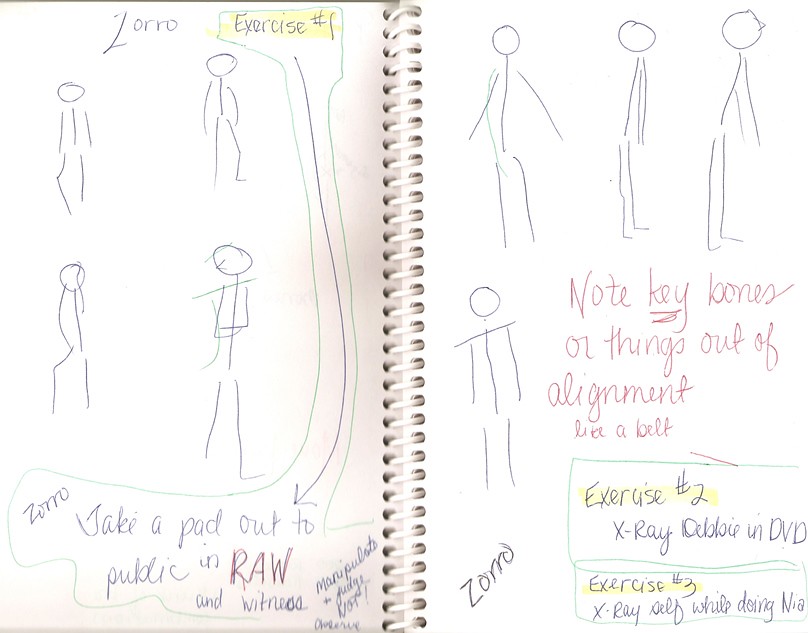
In the Nia White Belt Intensive I took, one of the tools that the co-founder of Nia, Carlos Aya-Rosas, gave us was “Zorro”. Where you look at someone and with just a few strokes of the pen/pencil you draw their structure. It is supposed to be quick, not a lot of details, just the things you are x-raying. Just key bones or things (like a belt, pant legs, collars, etc.) to allow you to see posture and/or alignment.
Here are my “Zorros” from my White Belt in 2008. We had split up into two groups and we faced each other. Each group had a turn at making shapes and posturing and then “Zorroing”.
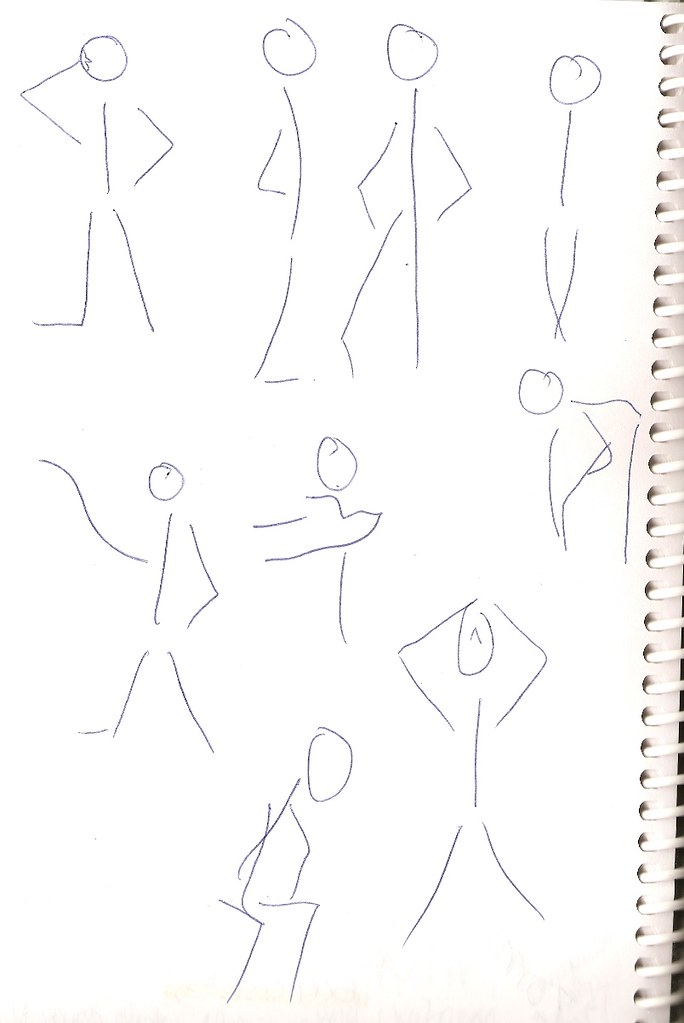 When I wrote my post back in 2010, I had said in a comment I was going to go out and do some X-Ray Anatomy Zorroing, but I hadn’t. When I came across the comment again, I decided to do it. Here is the result of me doing Zorro on a random video of people walking and of one of the Nia Routine DVDs.
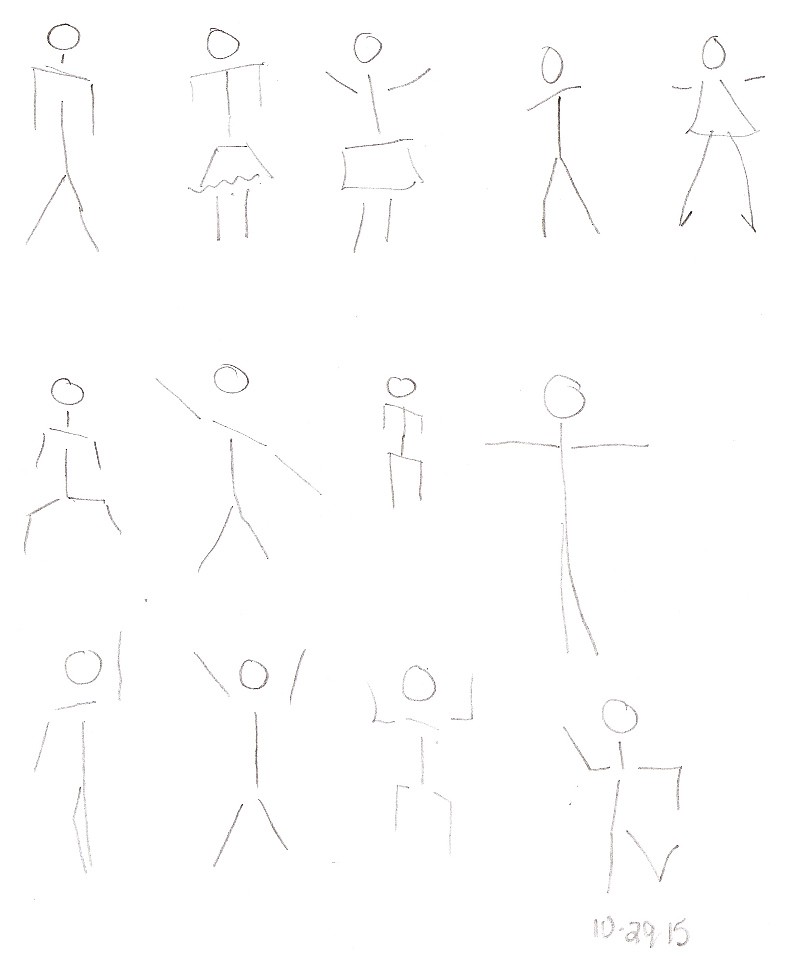
This type of practice can help us see things quickly that might need adjustment while we are dancing. Then we can cue some guidance to help people move in a safe way. As an example, an easy thing to see is thigh bones, while we cannot actually SEE the thigh bone, if we look at the toe and it is pointed off in one direction we can conclude that the thigh bone is rotated . . . depending on what we are doing, that might not be the safest thing for the knee and hip. So we can keep an eye on toes and practice X-Ray Anatomy.
I have confidence in thinking that you get the idea of this. You can see how you can quickly look at someone and have an idea of the placement of the bones. You can glance at someones clothes and use them to determine their alignment. Is the clothing method 100% accurate? No, people’s clothes might be sitting off for a number of reasons, as I mentioned in the beginning of this post, perhaps someone just pulled their pants on crocked, but this is an idea. But using the clothes is a quick way to perhaps get an idea of what the body is doing. Sometimes a closer inspection or more attention is needed, but for just practicing clothes are great to help with Zorroing.
Can you see how “Zorroing” can help with X-Ray Anatomy? So might you us your X-Ray Anatomy the next time you are out?
Posted in Nia | Tagged: alignment of bones, Carlos Aya Rosas, Nia DVDs, Nia Practice, Nia teachers, Nia White Belt Intensive, personal trainers, principle #10 of the Nia White Belt, X-Ray Anatomy, yoga posture, Yoga Practice, yoga teachers, Zorro | 2 Comments »
Posted by terrepruitt on April 11, 2015
This week my friend and Nia student, Dr. Tanya Baldwin, invited me to her Foot Fitness Workshop she was holding today. I shy away from stuff that has me working on my feet. I tend to think I have to “save” my feet for my classes. But, it occurred to me that thinking like that might be backwards. I started thinking it would be a good idea to see what type of exercises and care I could do for my feet. I think that Nia and yoga are great ways to exercise the feet. Since both are done barefoot they allow for an individual to practice using the feet the way there were designed to be used. Nia is done barefoot so that we can bend and flex and move our feet to help them with strength and balance. But this workshop was solely (ha, ha, ha!) for the feet. It was an amazing workshop. I would HIGHLY recommend it to anyone with feet.
It was very informative and FASCINATING. First it wasn’t so surprising that each of us had different issues with our feet. So along that same line it wasn’t surprising that the different exercises presented different challenges for each of us. What was surprises was how somewhat tiring it was. Some of the exercises were as much BRAIN exercises as foot/muscles exercises. Somewhat like what some of the things we do in Nia are – brain stuff! With a couple of them the movement we were supposed to do with our foot was opposite of what we normally do. For example pointing and flexing the foot. Now when you point your toes you “point” your foot. And when you flex your foot, your toes flex, too. In one exercise we were pointing our toes then flexing our foot yet keeping our toes pointed. It was hilarious. Because at first the foot just doesn’t do it . . . but then it will, but you have to really think about it. Or for some, even HOLD your toes in the point.
There were other exercises that really require thought. Which is always great because that means that you are changing up patterns – both movement patterns and brain patterns. So it is a win-win.
We started out with a self-assessment so we could see where we were at the start then sense how we felt at the end. This included holding a pen (or not) and writing (or not) with our toes. Then we did eleven “manual releases” without any props. So just using our hands and the floor. Some of these were not enjoyable for me. My foot that I injured a few years back is very “stuck”. So it did not enjoy some of the movements we did.
Then we had a soft spiky ball that lit up. YUP! That was really part of the fun. Dr. Baldwin mentioned that at first she didn’t care for the lighting up part, but then she realized it could serve as a tool to help you see if you are putting enough pressure on the ball. With this spiky ball, after another self-assessment, we rolled our foot over it and performed an exercise or two.
Then, our next set of exercises was with a towel. YUP, a towel, a hand towel. So this was great because maybe you don’t want to purchase a soft spiky ball, but most people have hand towels. We did a variety of grabbing and moving the towels with our toes. This portion included some other exercises (doming, inchworm, tapping, and strumming toes) without the towel.
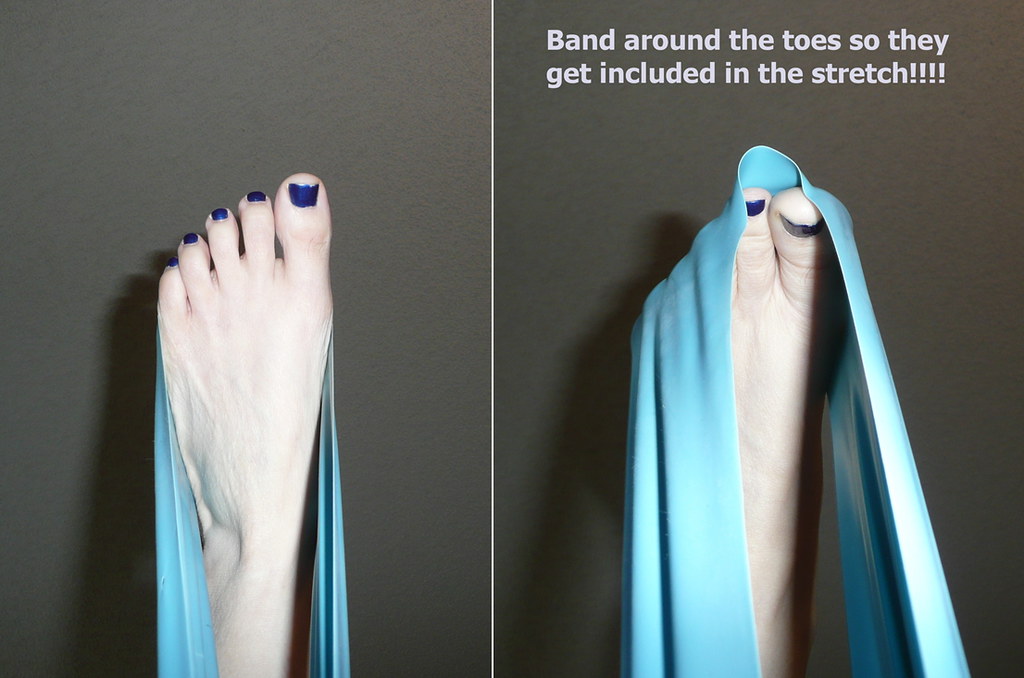 Then we used a Theraband. We did several exercises and stretches with the band. This is the section where we did the pointed toes and flexed foot. This section is the one that had me thinking a lot. It was as if I had to keep my body from doing what it normally did. It had to “forget” all that it has in its muscle memory. The best tip from this section was when using the band to stretch the feet include the toes in the band. I guess I think of the bands as stretching legs so I put the band over the arch of my foot. Well, if the band is over the foot AND the toes, the toes can get involved in the stretching. Ha! Brilliant!
Then there was a section titled “Toe Corrector”. Um . . . I don’t think my toes enjoyed being “corrected”. We used a rubber band around our big toes and did various movements including walking, which was funny to me because — let’s just say I could use more practice walking.
The next section was Reflexology which sounds really nice, but it was the one that had us groaning the most. This was done with a smaller than usual tennis ball. We stood and rolled the ball under the various portions of our feet. It is like that stretch or massage you know is good for you, but kinda doesn’t FEEL like it is good for you at the moment.
Then there was one last quick thing to help feet. Kneeling with your toes curled. By this time my right foot was tired so it didn’t care for the desired pose, where you are sitting on your heels. But I was ok with the modifications where you take the weight off the toes by stretching forward and leaning on your arms.
This was a great workshop. My feet are actually feeling pretty good. Although I have to teach almost every day next week so I think I will soak them tonight just to help them recover further.
Easy(ish) things to do to help the feet. Do you pamper your feet? Do you specifically exercise your feet?
Posted in Misc | Tagged: barefoot dance, Dr. Tanya Baldwin, exercise your feet, foot exercises, Foot Fitness, Nia, Nia Classes, Nia Practice, Reflexology, soft spiky ball, Toe Corrector, Yoga | 2 Comments »
Posted by terrepruitt on March 14, 2015
There are a lot of different aspects of yoga. Just like there are a lot of different aspects of Nia. As I have said before you can do Nia without getting involved in all of the principles and aspects of it. You can treat it like a workout and not take it any further. The same goes for yoga. That is why I always compare the two. You can go to a yoga class and go through the poses without giving any of the other aspects a second thought. I believe that both Nia and yoga can be more beneficial, more satisfying when you do think about the other parts of it . . . but we all have different goals and different ideas. One of the “aspects” of yoga or limbs of yoga – is pranayama. There are different pranayamas. A common one – Ujjayi is typically done while doing the yoga poses, and it might be helpful in reducing or stopping snoring.
So, pranayama is the practice of controlling one’s prana (life force) through breath or the practice of controlling one’s breath. There are many forms of this type of practice and many ways in which to perform them. But as I said, a common one is ujjayi breathing. It is what many recommend be done while doing the asanas. Some call it the Victory Breath, the Warming Breath, the Ocean Breath, Snake-breathing, throat breathing, or even the Darth Vadar Breath. It is done through the nose, both the inhale and the exhale. Some of the names stem from the fact that when you do it you may sound like the ocean, a snake, or Darth Vadar.
This breath “exercise” is done by closing the glottis partially on the exhale. This post is not to get into the mechanic of how to do ujjayi breathing. But a quick way to give you an IDEA of how to do it, is to think Felix Unger. Remember him? Remember that annoying noise he used to make? Well, that is a lot more sound than you want, but that gives you an idea of what needs to be going on in your throat / nasal area.
I am excited by the prospect that this type of breathing could help stop snoring or even more importantly sleep apnea. The idea behind this thought process is that the muscles need toning. People snore because stuff in there gets to relaxed and it makes noise as the person breathes. So, it kind of makes sense that if it can be toned or trained then it could help stop the snoring or the life threatening sleep apnea.
Yoga Therapy.com says: “In fact, this snoring is the sound that occurs when air passes through stenosed nasopharynx, caused by vibration in the air flow of compliant structures of the pharynx (tongue, soft palate, etc.). The main reason that causes vibration of the said formations is impairment of muscle tone of the pharynx and soft palate, structural anomalies and functional abnormalities of the pharynx and soft palate.” Like I said the stuff in there makes noise.
Again, as I said, this makes sense to me . . . as in, why not try it, it can’t really hurt, but if it did help . . . Oh man, for some it would be a life saver. I think it is worth a try. Just another reason to practice pranayama.
Do you think a breathing practice is worth trying if it would stop snoring and/or sleep apnea? Do you know anyone that snores? Do you know anyone with sleep apnea?
Posted in Yoga/PiYo/Pilates | Tagged: asanas, Eight limbs of yoga, Felix Unger, Nia, Nia Practice, Nia principles, personal goals, prana, pranayama, sleep apnea, snorer, snores, snoring, soft palate, ujjayi, Yoga, Yoga exercises, yoga poses, yoga pracitce, yoga therapy | 2 Comments »
Posted by terrepruitt on February 19, 2015
Do you ever just dance? You might be one to turn on the music and start dancing. Perhaps you have a favorite song you like to dance to? Or you might be one who breaks into dance spontaneously. You could be in the house and a song comes on and you don’t even really think about it, next think you know you are moving to the music. Perhaps you are one that is so gusty or you just don’t care so you dance in the aisle at the grocery store. Music moves us. It is easy to dance to a song we like. Sometimes we “can’t help it”. We just burst into a dance. But dancing without choreography in a dance exercise class? No one telling you exactly how to move? Just move to the music? Without having consumed any alcohol? It is a concept not easily grasped by many. It is a concept that we practice often in a Nia class. We call it Nia FreeDance.
As I mentioned dancing without choreography in an exercise class is a new concept to many. Moving without having a structured plan doesn’t sound like exercise to many people. Some people are very resistant to Nia FreeDance because of this reason. Some people cannot understand how you can “get a good workout” without having a structured plan, without moving the same way over and over again. The way we have been programmed to exercise includes repetition and structure. It includes traveling in a straight line from point a to point b, it includes being told how to move. So just moving without any idea of what comes after the present movement is vastly alien to some.
Yet, I have people who actually let go and try it. Those who push beyond their own skepticism and doubt come up to me and say, “Wow! I am sweating.” Those who let the music move their bodies without thinking about it have said, “Who would have thought that I would have gotten such a great workout?” Some realize, “I might be sore tomorrow.” They MIGHT be sore the next day because they moved their bodies in ways that their bodies are not accustom to moving.
Nia FreeDance is there to help stimulate movement creativity. So if you do it with full abandon you might end up with muscles that talk to you the next day. Your body will have moved in new and different ways. So Nia FreeDance is not the dancing you would do at a club or a dance lesson. It is just free movement. Yes, some of those cool club moves or patterns you learned in dance class sneak in because we dance what we know. We think about it and move in that way. But there really is more to FreeDancing. It might have a pattern for a moment, it might have structure for a moment, but it moves away and comes back. It is free.
 To assist with FreeDance and to deepen the practice there are eight stages that can be a guide, because as I said, it is not necessarily an easy thing to do.
Stage 1: FreeDance
Catch Phrase: Anything Goes, Movement-Wise
Stage 2: Being Seduced by the Music
Catch Phrase: Art of Listening
Stage 3: Feelings and Emotions
Catch Phrase: Pretend, Fake It, Act As If
Stage 4: The Creative Source
Catch Phrase: The Real You
Stage 5: Authentic Movement
Catch Phrase: Change!!
Stage 6: Witness
Catch Phrase: Interfere…Judge…Not! Observe
Stage 7: Choreography
Catch Phrase: The Accidental Click
Stage 8: Nia Class
Catch Phrase: Levels 1, 2, 3
The catch phrases have changed slightly since I participated in the Nia White Belt Intensive in 2008, but it is all basically the same. The catch phrases give you a clue as to what the stage is for. All the stages help you to FreeDance. You can dance each stage separately or combine them in any fashion.  The idea is just to give you something to help get you moving and then give you something to keep you moving. Moving in new and different ways. The new and different active body, mind, emotions, and spirit. FreeDance is one of the key things that makes Nia unique. If you click on the stages above you will go to the post that I have posted for each stage.
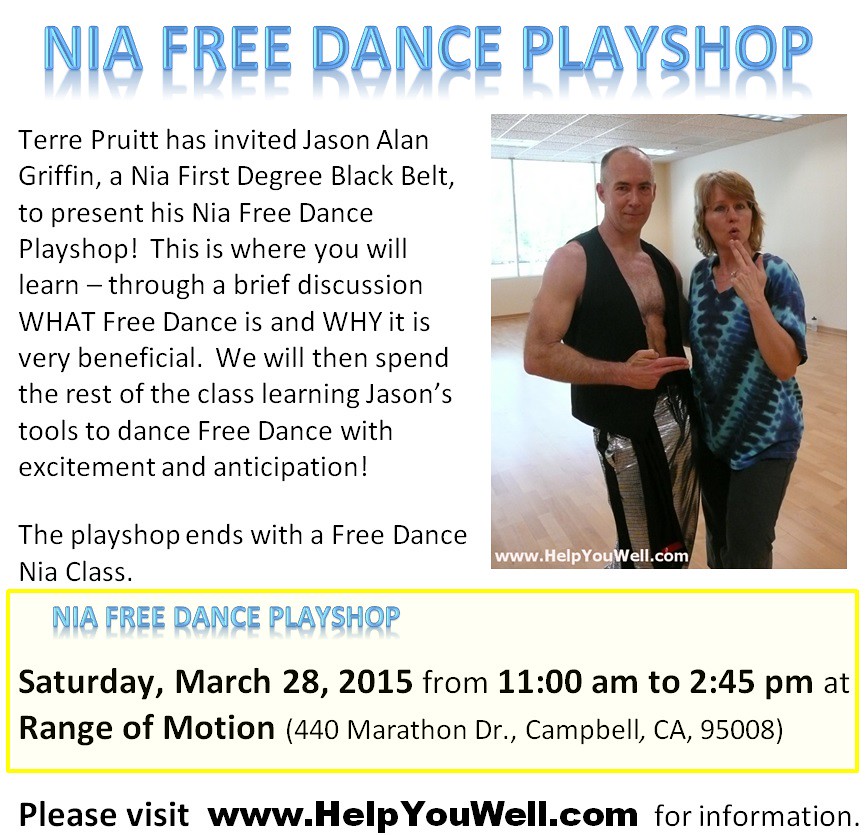
I am very excited about the Special Nia Class and Nia Free Dance Playshop that I am producing next month. So I have been thinking a lot about FreeDance and how great it is. This post is a result of my excitement and my attempt at getting people excited and curious about FreeDance. Reading about it is one thing, but getting up and actually DOING it is another. These are the stages used to deepen your practice, but they are not what we will be covering in the Playshop. As the flyer states, we will be learning Jason’s tools for FreeDance! I hope you will join us!
Are you a dancer? Do you break into dance? What is the current hit that you can’t help but dance to?
Posted in FreeDance, Nia | Tagged: Authentic Movement, City of San Jose, dance class sneak, dance exercise class, dance spontaneously, dance without alcohol, Dancing Free, eight stages of Nia FreeDance, FreeDancing, Group Ex, group exercise, just dance, movement creativity, Nia choreography, Nia class, Nia Free Dance Playshop, Nia FreeDance, Nia patterns, Nia Practice, Nia Technique, Nia White Belt Intensive, programmed exercise, Special Nia Class, structured exercise, The Accidental Click | 2 Comments »
Posted by terrepruitt on January 17, 2015
Perception. Such an odd thing. I remember when I was 15 years old and working in an office with some young women. They were probably in their 20s so really still young. I remember all the stories they would tell me and how they would carry on like 20-somethings do. Then one day a child walked in and the woman I knew to be a young person who enjoyed to go out and have a good time became a mom. It was the weirdest thing. I am not saying this woman was a party animal, but it was just odd to see this woman go from working woman to working mom. Since she didn’t really talk about her kid all that much it was easy to forget that she was a mom. I am not saying she didn’t talk about her kid because she didn’t love her child or because she didn’t care. She talked to me more about things that a 15 year old is involved in or going through; relationships, school, and being young . . . . not kids. The group conversations in the office tended to be around other things since not everyone had kids. Also, there was seeing a tough boss lady with her spouse. Seeing the loving side of a meany. Seeing different sides. I didn’t know the woman as a mother, so it was odd to see her acting like one. I didn’t know the gruff boss lady as a wife so it was odd to see her act like one. Friends also might have different perceptions than family members because they’ve seen different things and experienced different things. Also new friends and old friends. Sometimes people modify their behaviors, mature, or just change so people who are just meeting someone for the first time might not have any idea of how it used to be. So the perception of the person is different for the new person than for the person that has been around. What you know to be true from your experience, can be different from what someone else knows because they have had different experiences.
 So amazing how that is. It is amazing how everyone’s perception can be different. Our perception has a lot to do with ourselves. Someone who has been cheated on by a significant other might take “I’m working late,” completely different from someone who has never had that mistrust thrust upon them.
This is all just talking about people. What about “things”? Like viewing clouds or art. Two people look up in the sky, one person sees a dinosaur and the other a horse. And even if both people were to look up and see a horse it would probably still be different types of horses. As I was contemplating the “people” aspect it occurred to me that recently I had been thinking about perception in regards to Nia. I always say it is a practice like yoga, and for those people who think of yoga as a religion, I am wondering now if they think I mean that Nia is a religion. A recent conversation made me think so. Even though I was hoping I was explaining it well when I say that you can take some of the ideals and principles of Nia out into the world just like you do with yoga. I guess that could sound like a religion – especially if you think of yoga as a religion. Yoga being a religion is also a funny thing, because some people say it is and some people say it isn’t. I was hoping to get a regular Nia class going at a yoga studio a long time ago and I said something about “some people believe it is a religion” to the owner of the studio, she got very upset saying that was not true. Well, it is VERY true some people DO think it is a religion. I never got a class there.
I think of Nia as an exercise program with a holistic twist. Just like yoga. But yoga can be taken to the point of being a religion, but not everyone that does yoga considers it a religion. I actually don’t know anyone that teaches Nia who considers it a religion. But the more I think about it, the more I can see how some people could think of it that way. Perhaps comparable somehow to the people who have been cheated on. If they think of everything as being in competition with their own religion maybe anything outside of it that you practice would be considered a religion to them. I don’t know . . . that is one of the things I have been thinking about when thinking about how people see things. Perception is weird. The ol’ “glass half full, glass half empty” thing.
Do you ever experience the differences in perception? With people you know that your friends know? With co-workers? With family? How do you experience it?
Posted in Misc | Tagged: exercise program, glass half full glass half empty, holistic exercise, Nia, Nia class, Nia Practice, Perception, religion, Yoga, Yoga Practice | 2 Comments »
Posted by terrepruitt on January 15, 2015
I have said it many, many times, but I am going to say it again. Nia has 52 Moves which we incorporate into the Nia routines. These moves have a specific way to be done. But the way they are done is adjusted, like many things, when you are doing them in a routine. There is or was a debate about one of the moves called the bow stance. The debate is or was about how the weight of the body should be distributed. The reason I am saying “is or was” is because I don’t know if the debate was ever settled. The discussion regarding it — at least one that I had seen — was on Facebook and it was a long discussion. I don’t know what the end result was or what the “official” decree is because to me, I want to teach balance, so if I am JUST doing a bow stance then I would instruct people to have their weight evenly distributed. Usually I am not doing JUST a bow stance. If I am showing people the bow stance it is because it is in the routine and there are other steps prior to or after it and with other moves on either side the weight gets distributed according to the need. So, in other words, we adjust the move to fit the dance and choreography. So that is what my class and I are experiencing right now with the Nia 52 Move called Rock Around the Clock.
If you read my original post about it, the one that explains what it is, the instructions state to start the rock on the heels. But in the routine I am leading my class through currently we start the rock on the toes. Then we roll (or rock) to either the left or the right. We actually go both ways and like many things, the different “sides” or directions are very different in regards to sensation and difficulty level. One side is easier than the other . . . at least that is the consensus with my students. So it is very beneficial to practice “rocking” both ways.
With this post I am doing two things; 1) I am reminding you to practice moves going both directions. Just like we do both sides. If we are doing a move with the left side we do it with the right. We – trainers – often say to keep the body even and it really is to work both sides of the body AND the brain! 2) Share with you a different or additional WAY to practice Rocking Around the Clock.
My original post says something about this being an example of an easy move. It is not necessarily “easy”, what I probably should have said was the Rock Around the Clock was not a high intensity move. So for those that are really starting out learning this move you might even want to sit down and do it. Since feet are in shoes for a large part of the day and those shoes might not allow for a lot of ankle mobility, it could be that your ankles just don’t want to move in the way that is required with this move. So it is a great idea to sit down and allow the ankles to loosen up.
For me, my feet want move opposite of each other. So each foot wants to be on the opposite edge, so training my feet and my brain to be on the same edge it interesting. Sitting in a chair while doing this move allows my feet and brain to understand that this move is “same edge”. Once you get your feet and brain on the same page, then you can stand up. (FYI: Sitting and practicing this move is very different from trying to take pictures of your feet while sitting and practicing this move. But hopefully you will get the idea from the pictures even though they are not very good.)
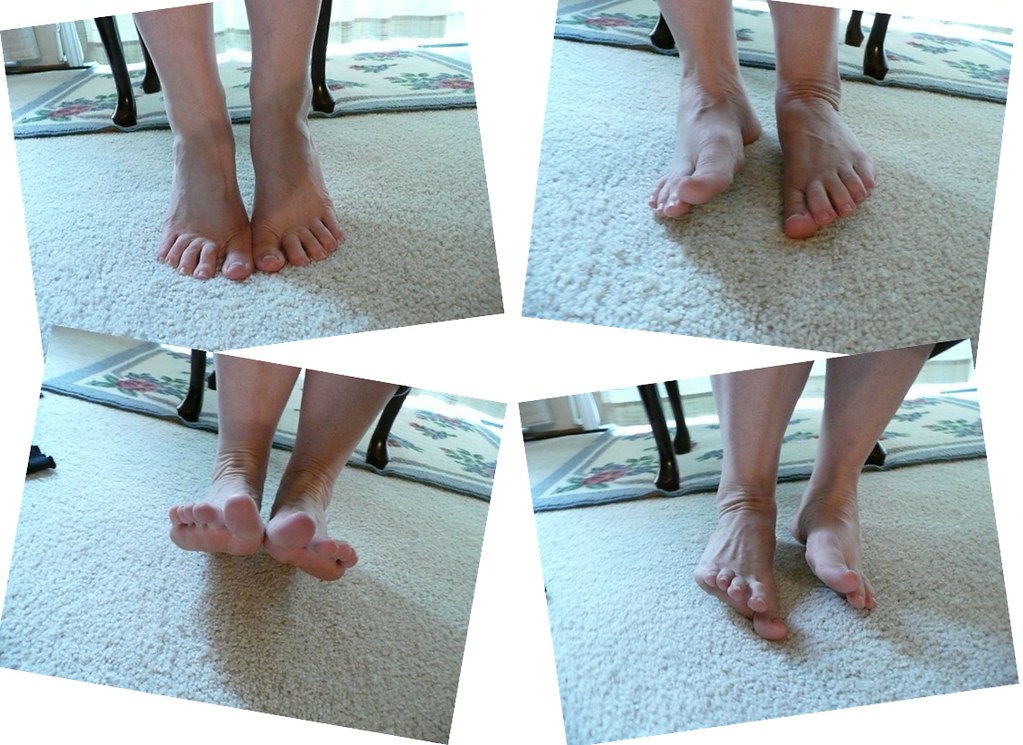
When you are standing you can use something to hold onto like a counter, table, chair, wall, something that is sturdy and can assist you in balancing. Having something to steady you while your feet get used to supporting your weight on the edges is nice. The support also allows you to really exaggerate your foot movements to help get the movement into your muscle memory.
This move helps build strength in the ankles and the feet. This is also a very “mental move”. It is one of those moves you might have to really think about in order to do it correctly. Then, with practice, it will become one of those moves you can do without thinking so much about. And your feet and ankles will benefit greatly.
So have you tried it? Can you do it sitting down? Can you do it standing up? Can you see how it is an interesting move?
Posted in 52 Moves (of Nia), Nia | Tagged: ankle exercise, ankle flexibility, ankle strength, Bow Stance, Facebook, foot exercise, foot strength, Nia choreography, Nia class, Nia Dance, Nia posts, Nia Practice, Nia routines, Nia Technique, Nia's 52 Moves, rock around the clock | 6 Comments »
Posted by terrepruitt on October 30, 2014
I love twists. The folding, bending, twisting poses in yoga. Right now I’m thinking about Ardha Matsyendrasana or Half Lord of the Fishes Pose. This is the one where one leg is folded or bent and the other leg is over it and you’re twisted. Twists can be challenging, but you can often find a level of execution that you can relax into. And as with all poses the more you practice it well, the more you can twist as you gain flexibility. Some twists – depending on the supporting factor – can be good to practice strength and stability. Twists are good for flexibility and digestion.
I prefer to start this pose sitting on one hip (I’ll use the left hip in the example) with my feet to the (right) side. Using the clock as we do in Nia, sit in the middle of the clock, with the left knee at 12 O’clock. Reach with the crown of your head to the sky. Lengthen the neck – create space between the ears and the shoulders. Open the chest. Draw the shoulders back and down. Let those shoulder blades slide down the back. Lift the ribs off of the hips. Gently bring the right knee up and the right foot over the left knee to rest with whole foot on the floor at about 11 O’clock. Use your left hand to gently hold the right knee as you twist your torso to the right. Keeping the posture that you set up before you brought your right leg over the left (lengthened spine) allow your right hand gently press into the earth behind you . . . a few inches from your right buttock. Both hips remain on the floor. With your posture intact relax into it for a few breaths, then untwist, and bring your feet back to the right side. Then switch your feet to the other side and proceed on this side.
That was the gentle version. Stay with this until you are comfortable and confident that you can retain the long straight posture through your entire back and neck before you add the rest of the pose. The additions could be using the crook of your elbow to hold your knee more snuggly up to your rotated torso. The supporting hand would land on the floor more towards the center of your back as you increase the depth of the twist. As you twist further you might find your right foot past the 11 O’clock position, straying towards 10 O’clock. Find your comfortable place, keeping the whole foot on the ground.
A deeper twist would be to place the left elbow (keeping with the original example) on the outside of your right knee. Your left hand could even rest on the left knee. With this the supporting hand would land on the floor perhaps just a smidge more towards the center of your back as you increase the depth of the twist or not. This is a different type of intensity but it might not take your supporting hand that much further back.
There is even a further step where you can thread your left arm (keeping with the original example) through your right leg under the knee and the right arm behind your back so they can link up.
There is also a way to decrease the intensity and that would be to straighten the left (keeping with the original example) leg. It would remain active. As in you would gently press it straight out and down. Hip, knee, ankle and toes in alignment, with knee and toes to the sky. The straight leg version can be used with any of the aforementioned “holds” (hand holding knee, crook of elbow, elbow on other side of knee).
This twist really helps with flexibility in the hips, knees, and ankles. I think of it as one of those “pretzel-y” yoga poses. I have experienced that it is best demonstrated with my back toward my students so they can bend, twist, turn, and hold the exact same sides.
Do you know this pose? Do you practice this pose? Do you like this pose? How do you feel after you do this pose?
Posted in Yoga/PiYo/Pilates | Tagged: Ardha Matsyendrasas, asana, flexibility, Half Lord of the Fishes Pose, Nia, Nia Practice, stability, strength, twists, Yoga, yoga poses, Yoga Practice | 2 Comments »
Posted by terrepruitt on October 7, 2014
I often tell my students at the end of class that making them get up is the worst part of my job. I have posted blog posts about savasana. The restful period of time at the end of a yoga class where you take time to relax letting the body and mind absorb the benefits to be had from the asanas that were just practiced. Let the body remember the stability and strength. Give the body time to become accustom the space that was created. Allow the mind to reflect on the stillness. Well, in Nia we often end the routine in Floorplay. Floorplay is either playing with gravity to experience the muscles or stretching or . . . it can be a combination of both. There are a lot of ways to play on the floor. There are a lot of ways to end the class. Our Nia training DVDs have floorplay and ending movements, but they are not choreographed. So there is a lot of freedom in the last songs. Nia teachers can either duplicate what the trainer does on the DVD or they can create their own movements to the songs and end the class in their own way. I know I sometimes do what I sense the class needs so sometimes I lead the class through movements and sometimes I instruct them to do their own free dance. Often times we end by lying on the floor in a restful pose. Just like in my yoga classes I don’t like to have to make my students get up.
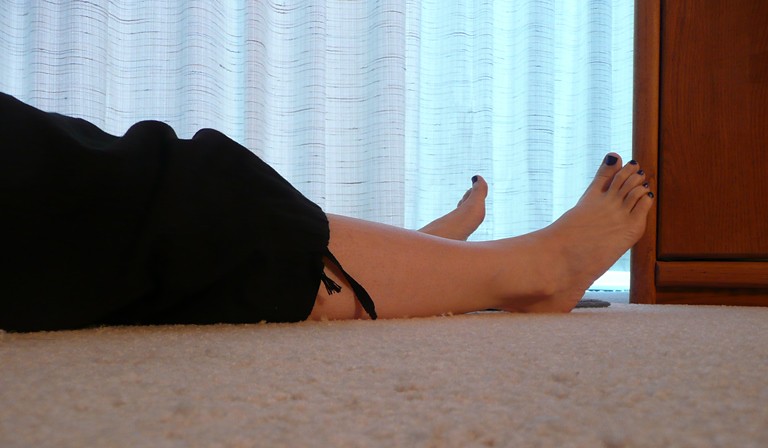 In the studio I rent, I think that I should rent an extra 30 minutes so we can just lie there. Sometimes I sense the class could easily just stay there for an extra 30 minutes beyond the one hour Nia class. In the classes I teach for the San Jose Park and Recs Department, I sense they could do that too, but we need to end on time. Sometimes there is a class right after us so our restful period is interrupted. But when it is not, it is a challenge to know when to interrupt the peace.
Recently I taught a class and I really didn’t want to tell them to get up. The clock in the room was not working so I snuck up to check my phone and as I was returning to the circle I saw such peace and relaxation I didn’t want to bother them. I toyed with the idea of just letting them stay an extra 5 or 10 minutes. But without having planned that in advance, I didn’t want someone lying there past the hour and not knowing it. Many people workout on their breaks so they need to get back to work. Or they just need to get on with their day. So as much as I don’t like interrupting their peace and as much as I would like to just let them relax, I need to keep to our schedule. But it really is the worst part of my job when I feel they would love to just stay.
But, on the other hand, it really is a great part of my job when I can be in the presence of those that can just relax and let go. After dancing and getting all sweaty it is so nice that they can just take a deep breath and melt into the earth and relax. I get a huge sense of peace when I am in the presence of their stillness . . . . that is why it is so hard to disturb them.
Do you take moments out of your day to just relax and experience peace?
Posted in Nia, Yoga/PiYo/Pilates | Tagged: asanas, body weight exercises, Body-mind, dance exercise, gravity exercises, Nia class, Nia DVDs, Nia flooplay, Nia Free Dance, Nia Practice, Nia routine, Nia routines, Nia songs, Nia students, Nia training, Nia workout, restful period, San Jose City Nia classes, San Jose Park and Recs Department, savasana, shavasana, Yoga class, Yoga Practice | Leave a Comment »
Posted by terrepruitt on September 16, 2014
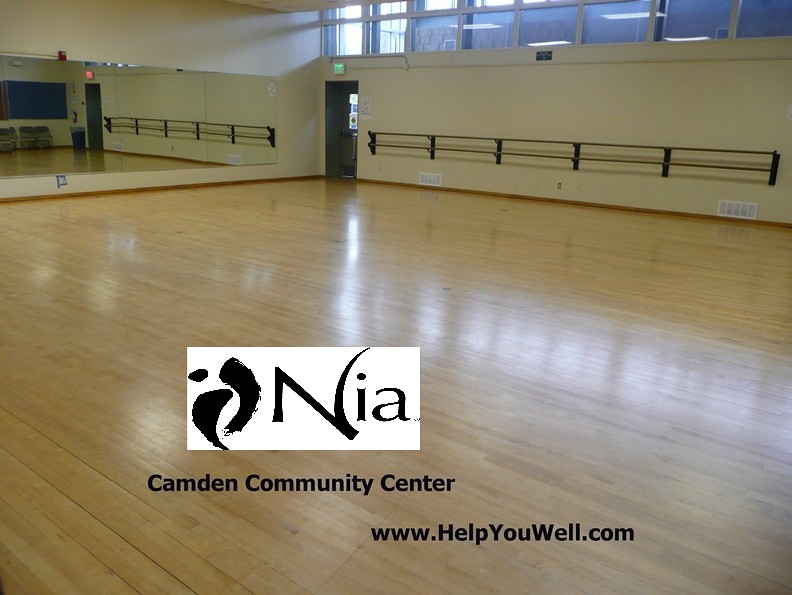 There is a Nia Routine called Miracle. It is fun routine. Like many Nia Routines it has form and freedom. There are two songs in which the foot work is pretty much the same throughout each song (form), but within the sameness you have the freedom to switch it up and add your own style. The choreography gives you the steps, the area where your feet are to be in dancing to the music, but you can decide how to get there and how your foot will be placed into that area. Form and Freedom. There is also something in this routine that Carlos Rosas (NKA, Carlos Aya-Rosas) calls the “Nia Bundle”. It is basically where the entire class gets very close together and dances. This is not easy for people to do. Why? There are at least as many reasons why this challenges people as there are people. But there are many benefits to dancing in a “bundle” and as a group.
One benefit of dancing in a close bundle is to practice our proprioception. In close proximity to other Nia Dancers we want to be aware of where our arms are, where are feet are, where are hands are. Are our limbs close to our body or are they out as far as they can go? Are we going to step on someone’s toes? Are we going to bump into someone? While the goal is not to step on nor bump into anyone, it is understood there might be some contact . . . but not often. For those in my classes that participate in the Nia bundles we do a good job being aware and moving in a close group.
Also dancing so close to each other helps us be aware of each other. Not just the physical presence of the other students, but there is eye contact, there is giggling, there is connection and a sense of community when you are brought really close together. No one is in their own space, we are sharing space. We move as one in space. We move as individuals in a shared space. We learn to dance together.
Another benefit could be that we – as individuals are pressed into moving in different ways. Finding a new way to move our body in dance because we are so close to someone. How can we move our elbows without elbowing someone? How can we dance to the music and express our spirit in such close proximity to others? Ahh . . . yes . . . new-to-your-body-moves just might be discovered.
I always laugh at the thought of someone looking in the dance studio at the community center and seeing all of the space with 12+ of us all clumped together in the middle or in a corner. I imagine them thinking that odd. I imagine them thinking, “WHAT are they doing?” Then we throw our hands up in the air and sing. It is quite fun!
So despite some people’s misgivings about dancing really close in a Nia bundle there are those who join in with gusto and reap the benefits. Does your dance exercise class have a bundle? What would you think if you were to peek in a class and see it? Would you be a bundle dancer?
Posted in Nia | Tagged: benefits of dancing, Carlos Aya Rosas, Carlos Rosas, community center, dance class, dance exercise, Dance Workout, Dancing, foot work, Form and Freedom, fun routine, miracle, Nia Bundle, Nia choreography, Nia dancers, Nia Music, Nia Practice, Nia routine, Nia songs, Proprioception | 2 Comments »
Posted by terrepruitt on June 14, 2014
 Everyone is so different. We all have different ways of doing a lot of things. Sometimes we can see things the same way in order to function. We can get along or just go along with ideas and customs to just have peace. Or we can do it for a loved one. But it seems like when it comes to death and our beliefs around it there is sometimes a huge separation. You can be going along in life completely meshing up with everyone around you and then someone dies and BAM! You suddenly don’t agree on anything. The way we all handle death is so different. I understand the five stages of grief*, “popularly known by the acronym DABDA”, (although, I have never heard it called that). I am not saying that I understand each stage in the sense that I have experienced them, I am saying I understand that someone has identified these as stages people grieving might go through. But what people do during these stages and after is still very individualized. Everyone deals with grief differently, I understand that, although I do not agree with how everyone deals with it as you might have guessed if you read Grief Is a Very Personal Thing, where I say people grieve differently and as long as they aren’t mean or causing harm I don’t like to label their behavior unacceptable. This post is not so much about behavior, I don’t think. I know that many people want their loved ones near or they want to be able to visit their loved ones, but I am not one of those people. I think of my loved ones as being gone . . . so having their remains near by is just odd to me.
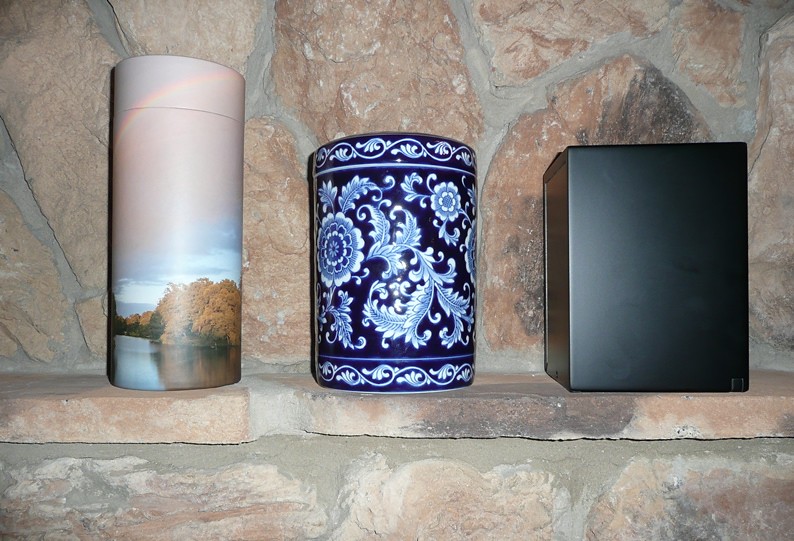
Today I was trying to concentrate on learning a Nia routine and it is one that has the Nia participant turning to face all four walls. So that means I turn to each four walls in the room. I found myself facing the ashes of loved ones at two of the walls. The first and second wall, so by the time I got to the third and fourth wall I was lost in other thoughts. I had been avoiding the room upon my travels through the house. Normally I walk into this room to get to the back rooms because it is the softer path, but I had been avoiding it. But this is the best, the largest room to practice in so I was doing my Nia practice in it. But it just happens to have three of my relatives in it. I don’t care for that.
As I type all three of them are at my back. I bet I would not be as conscious of it had I not seen a post on Facebook from a friend who is pretty confident she did not receive the correct ashes of her pet. She posted a picture of the paw print of what she received compared to the pet she had. She has similarly sized pets still so she compared paws. The mold she received was at LEAST four times larger. And she went onto say that she has about three cups of ash. She said she thought her pet would be about one. AHHHHHHHHHHHHHHHHH!
It got me thinking. AHHHHHHHHHHHHHHHHHHH! How many cups of people are in this house. WHAT???????????? Sigh. Breathe. Breathe. Breathe. Breathe.
Whew. People are so different. Many people have loved one’s ashes. In fact, they sell beautiful urns to contain these ashes. We’ve (probably) all seen those horrendous comedy TV shows where someone has accidentally spilled the ashes all over. Breathe.
I just don’t know what to think about that. I am working on letting people do what they need to do. But, I personally don’t need to do it. I think that tomorrow I will workout in another room — and probably from here on out. I — don’t care to have THAT kind of reminder of my loved ones around. To each their own. And let everyone be . . .
Donna, thanks for always making me laugh, even if it is particularly in horror.
Thoughts? What are your thoughts about this? Are you an ashes and urn type of person? Please feel free to share your feelings. I’ve shared mine.
*The five stages of grief (according to Wiki):
- Denial — As the reality of loss is hard to face, one of the first reactions to follow the loss is Denial.
- Anger — “Why me? It’s not fair!”; “How can this happen to me?”; ‘”Who is to blame?”; “Why would God let this happen?”
- Bargaining — “I’ll do anything for a few more years.”; “I will give my life savings if…”
- Depression — “I’m so sad, why bother with anything?”; “I’m going to die soon so what’s the point?”; “I miss my loved one, why go on?”
- Acceptance — “It’s going to be okay.”; “I can’t fight it, I may as well prepare for it.”
Posted in Diane Bacho | Tagged: ashes, DABA, DABDA, death, Facebook, five stages of grief, four wall dance, how many cups of ashes is a person, how many cups of ashes is a pet, Nia, Nia Classes, Nia participant, Nia Practice, Nia routine, paw print, pet ashes, urns | 4 Comments »

 Terre Pruitt's Blog