This class was held in San Ramon on April 30, 2014!
As you probably know I teach a dance exercise called Nia. It is a cardio workout. If you have read any of my information on Nia you will also be aware that many of the people who practice Nia consider it to be more than JUST a cardio dance exercise. But . . . on the surface that is what I call it, in brief, to let people know what it is. If they are interested then we can discuss some of the other facets of it. Like many exercise disciplines there are star teachers or celebrities. I’ve talked about that before. There is always some people who were there from the beginning and so they have the most experience and often times get categorized into star or celebrity “status”. Yesterday we had a long-time Nia Practitioner and Teacher do a 007 Nia class.
Jason Alan Griffin is one of the first First Degree Black Belts. Nia has created an additional training intensive, they have added a “degree” to the black belt. It is so new that not a lot of information is out regarding that, and I didn’t even think to ask Jason about it. I am Facebook friends with Jason and yesterday was the first time we met in person. Jason likes to travel, so he drives around with his dog River bringing Nia to cities around the United States. He created a routine he called Bond Girls, but recently re-named it to Goldfinger and that is what he is delivering on his current trip. He was in the East Bay last year (I believe) but he packs his travel schedule so tight he doesn’t stay long and so I missed the classes he had. Maybe he was in the North Bay too. I don’t remember. I couldn’t make it. So this trip I was very excited to get to take his class, meet him, and his dog.
Jason is one of those dog daddies that takes his pet parenting seriously and he posts a lot about his dog. So through his Facebook and blog I feel I know both of them a bit so I was happy to finally get to meet him.
Not to use the current happenings in my life as an excuse, but I found myself leaving for the class much later than I intended and also the directions I looked up gave me a different travel time than the day before. I ended up being late for class. And while I felt very bad about that . . . I decided to forgive myself which enabled me to jump right in to his already-started-class. It was so fun.
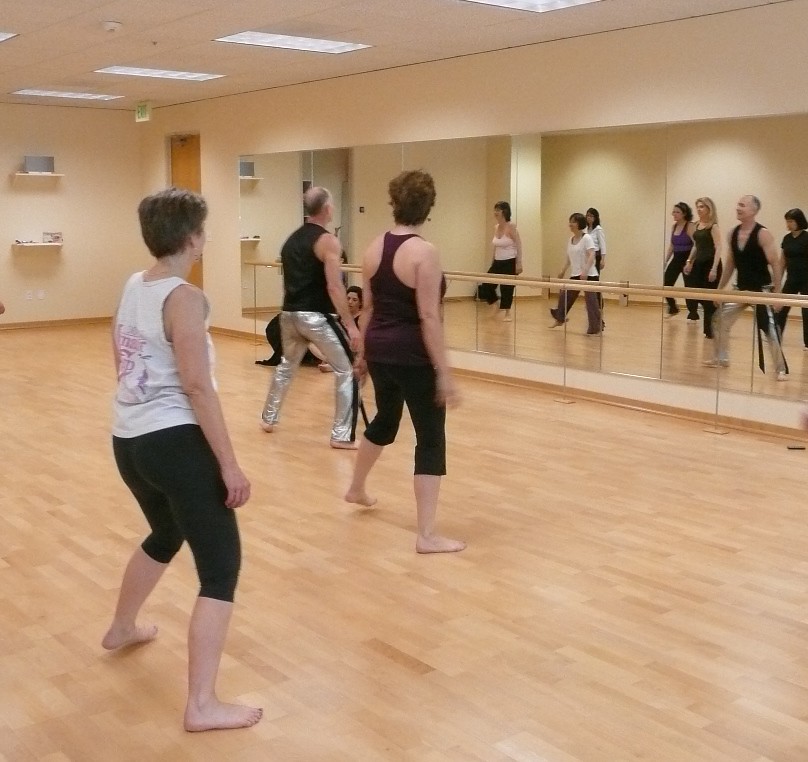
While the invitation to dress up in something shimmery was there, I completely forgot, but Jason did not disappoint. He had on some shiny silver pants. He led us through many of the 52 Nia moves while we focused on pelvis, chest, head. We used our spear fingers in true James Bond fashion. We danced in our own body’s way and laughed and sang while doing so.
Every time I take a Nia class I realize I am not a Nia student often enough. I love being able to laugh at myself because I don’t get the moves on the first (or how many ever it takes) go around. I love being able to just follow as someone else’s lead. I love being able to learn new pearls and moves. It is so fun. I am so glad that I was able to join the East Bay Nia community while they hosted Jason’s class. It was super fun. I want Jason to come to San Jose to deliver his FreeDance Playshop. 🙂
I hope you jump at the chance to dance with Jason when he is in a city near you. He is really fun to dance with. And if you are lucky, River will sneeze on you!
Thanks, Jason and River. I look forward to your next visit!
Jason leading the class in his silver pants!
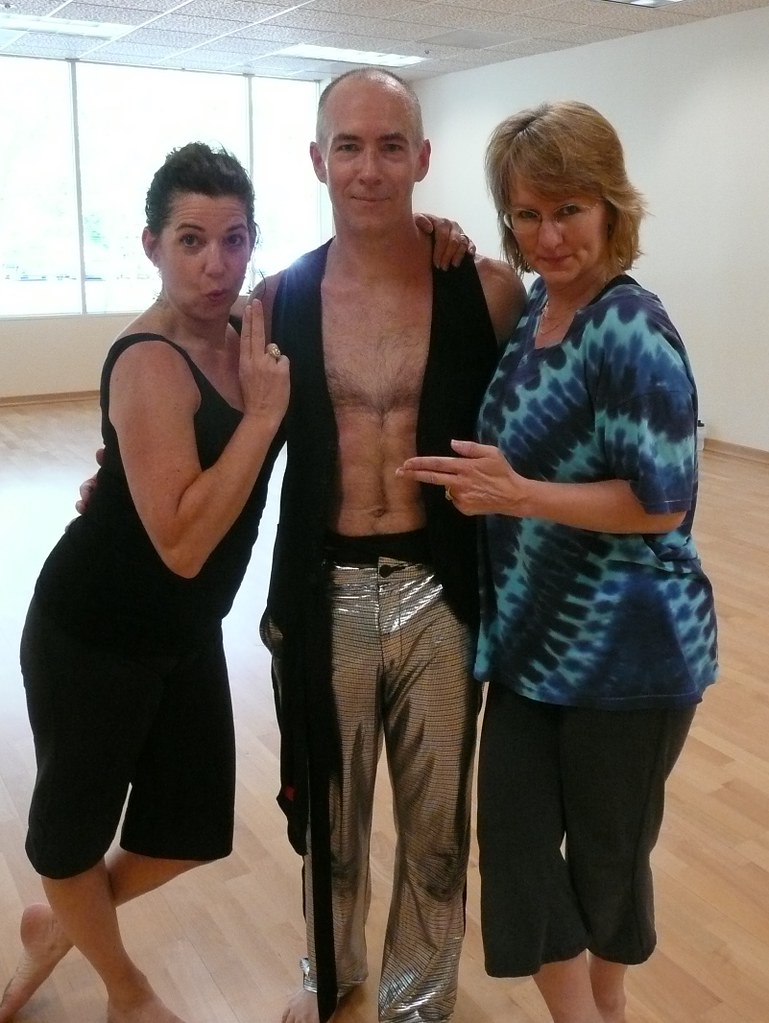
Janet and I doing our Bond Girl impressions – with spear finger
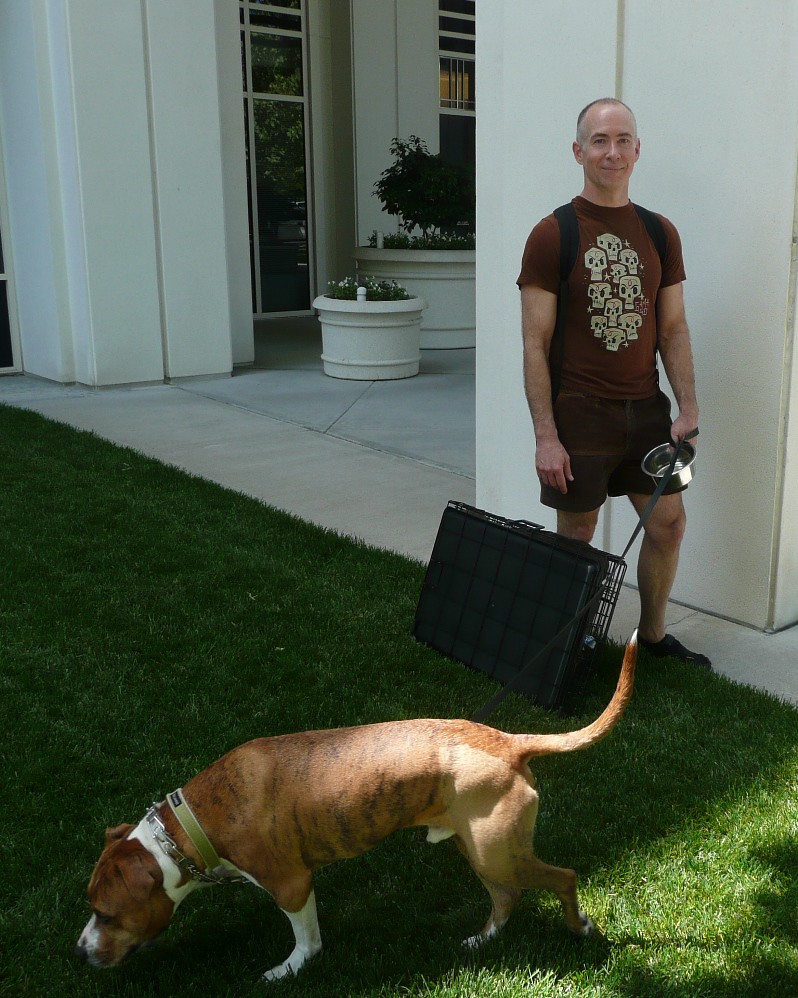
Jason and River. River was more interested in the grass than posing!
You might have read my post about Sounding in Nia. That is what we call it when we make noise in a Nia class — sounding. You might have read my post about Reasons for Sounding in a Nia Class. Even if you did not read that post, I bet you are aware of some of the reasons to make noise in an exercise class. One of the biggest ones is to ensure breathing. If you are making noise you are breathing. Knowing the students are breathing is a HUGE relief to an instructor. Some of the other reasons sounding is good are it can help stabilize your core, it can act as an emotional, spiritual, or physical release, and it can be really fun. Sounding can be noises/words such as HA, HI, HEE, HOO, WAH, WAHOO, etc. Sounding can also be singing. With “Nia Music” sometimes singing is just sounds.
I always invite the Nia participants to sing. Often times I tell them it is really easy because there are no words. I have often wondered how the singer sings. I have often pondered how it is done. Then Nia put out this video*. It is an interview with Carl Tietze whose song Am I The One, is on the Sanjana Album. Sanjana is the first Nia routine I learned. In the interview Carl talks about how he invited a vocalist, Jen Folkner, to listen to the song. He said he put the headphones on her and most of what we hear on the song is from her first time hearing the music.
She is sounding. Granted, she is doing is beautifully. I don’t want to put the pressure on and say this is what we do or need to do in a Nia class. No, not at all. I am just saying that it is fine to MAKE NOISE. I did laugh when I heard this interview because I kind of imagined that songs that have no real words but are just a singer making noise was done like this. I imagined the musicians just saying, “Go!” and the singer just letting her/his voice come out.
I was recently very amazed and in awe of a woman who had never been to a Nia class before – in fact, before class she asked me what it was. So she didn’t even know what type of exercise/workout it was. And yet, while she was moving to moves she had never done, she was singing. The song was one of those songs without words, but she was just making noise in a “singing voice”. It was great! I was very impressed.
Making sounds or singing in a group workout class is not something that comes easy to everyone. Sounding while learning moves doesn’t come easy to people who normally make noise, so it was especially fun to have her in class. Plus she had that much more fun and received the benefits of sounding.
I hope this interview helps give you a glimpse into making sounds. I hope you are able to experience the benefits of making noise while do your cardio dance. You know it is fun.
Do you sing while you dance in your fitness dance class? Don’t you love the way singing and dancing makes you feel?
*Click here to go to Nia’s website to sign up for the monthly newsletter!
Oh my! You might have read my post about me getting to teach a Nia class in Santa Cruz. Santa Cruz, for those of you that might not be familiar, is a beach town in California. It is not very far from me, but I still don’t get over there often. The place where Nia is held over there is lovely. My student and I usually make a day of it when we go over the hill. The last time we went we stopped and had breakfast at a place serving daily toast. That started my fascination with what I call “Fancy Toast” – click here for the post on Fancy Toast. I have tried it with pears and I like it much better with persimmons, which is funny because that was a substitution on the part of the restaurant owner. But the persimmons have to be REALLY, REALLY, REALLY ripe. At the point where they are almost mushy and a little slippery to cut up. Since I eat the Fancy Toast all the time — because I just happened to have had a few persimmons — I thought I would look into the nutritional value of persimmons.
The ones that I have been using are the flat-ish kind. I hear they are the Asian persimmons. According to a document from the California Department of Public Health a medium (168g) persimmon has 118 calories, only 3 of which are from fat. With the following percentages of the government daily values:
Total Fat: 0g 0%
Saturated Fat: 0g 0%
Trans Fat: 0g
Cholesterol: 0mg 0%
Sodium: 2mg 0%
Total Carbohydrate: 31g 10%
Dietary Fiber: 6g 24%
Sugars: 21g
Protein: 1g
Vitamin A 55% / Vitamin C 21% / Calcium 1% / Iron 1%
Persimmons have a lot of sugar and relatively no protein. But a nice amount of fiber and a good amount of Vitamin C, but even better amount of Vitamin A.
Remember, also, that colorful fruit has carotenoids which provide the orange color in the fruits. And the carotenoids act as antioxidants in your body, meaning they attack harmful free radicals that damage tissues throughout your body.
Most of the recipes I saw called for persimmon puree which is a combination of cooking and blending. So I like the idea of putting them on my toast, I cut up the raw fruit and pile it on top, making it “fancy” or putting them raw into a salad. I actually have not tried them in a salad because I have used them all on my toast!
There are two varieties, the Hachiya and the Fuyu. The Hachiya is the taller of the two, with the Fuyu being more flat. The Hachiya is used more for baking whereas the Fuyu is the one that people eat raw. The document I mentioned states “The Fuyu was developed by breeding out the tannic acid from the Hachiya, making it more appealing to taste and easier to eat whole and raw.”
Have you tried making and eating the Fancy Toast? What else do people do with persimmons? Do you have a persimmon recipe?
I am beginning to bet you don’t believe me when I say I was not going to post a recipe and I do. I WAS going to post a picture of the first toast I made on my Facebook page, but then when I sat down and started eating it I changed my mind. Then my hubby made yummy noises the entire time he was eating it and it confirmed my “need” to post it on my blog and tell the whole story. In my last post I talked about my fabulous day in Santa Cruz after teaching a Nia class. I mentioned two restaurants. The one we love, Rebecca’s, is closed. I was very sad because it has really yummy food and is a very nice place to eat. But, I also recognized this as an opportunity to try a new place. Having other things to do I didn’t do any research, but my student did. Yay! She suggested River Cafe. It was on the way to where we were going. So we went there. They have a menu item called “The Daily Toast”. When we were there it was supposed to be Humboldt Fog*, Pears, walnuts, and the woman behind the counter said they would drizzle honey over it. Sounds good, huh?
I ordered that. A few moments later a woman came to our table and said she could not find the pears, but she said she had persimmons or jams. She suggested the jam, but I declined and requested the persimmons. I had some on my counter I didn’t know what to do with. I thought this would be a great way to experiment. Well, even though the persimmons weren’t ripe, they forgot the walnuts and the honey (as you can see in the first photo), it was still VERY good. So good that I wanted to try making it the next day.
We didn’t have any salty cheese so I decided not to. But then the NEXT day I decided who cares. I wanted to try it anyway. I asked my hubby if he wanted cheese toast. He said yes. Then I asked if he wanted regular cheese toast or an experiment. I have mentioned before he is pretty good about eating whatever, but he does have some food “dislikes” so when my experiment includes some of them I like to ask first.
Anyway, this turned out very yummy. It is easy to make but comes out – in my opinion – kinda fancy. I have noted the recipe as I made it, but, I think the idea of the River Cafe is better in regards to the cheese. A nice soft salty, flavorful cheese seems best, but I used what I had.
_________
Fancy Toast
2 pieces sliced sour dough
2 pieces wheat bread
slices of marbles Colby Jack (enough to cover all four pieces of bread)
one ripe persimmon
2 tsp of shredded parmesan cheese
a handful or two of chopped walnuts
honey (enough to drizzle over the toast)
Toast the bread, not all the way (at least with my toaster oven. I have to leave it a little “undone” so it will be perfect after the cheese melts). Top the bread with the sliced cheese. Melt the cheese on the toast. While the bread is toasting and the cheese is melting peel and slice the persimmon. After the cheese has melted, place the persimmons on the toast, sprinkle the parmesan over the persimmons. Allow to warm a bit in the toaster oven/oven. Then sprinkle the walnuts on the toast. and drizzle the honey over the top.
Serve with a fork and knife!
____________ I was thinking that this would be an easy type of toast to serve for brunch. Toasting the bread in the oven on a cookie sheet. I also thought it would be a nice toast to serve at a tea. Yum. I used the parmesan as the “salty” and it turned out pretty good. I was surprised my husband liked it so much. He is not fond of bread, especially toast. Not like me. He also doesn’t care for walnuts. So it is a testament to its yumminess that he loved it.
I loved it so much I had it again the next day! (I forgot the parmesan.)
Well? What do you think? Sound yummy?
*Humboldt Fog is a specific type of cheese: Cheesemaker Mary Keehn of Humboldt County, CA invented this cheese, so named for the Pacific mists, in the early 80’s. (According to Wiki).
Ooooo! Only TWO months left to fill up the Goodie Jar. It is never to late to note the good things so if you haven’t started yet, why not start NOW!?!?! I have a few good things to put into my jar today.
I had a fabulous conversation with a potential Nia student. I talk to a lot of potential participants, some actually do end up attending one of my Nia classes and some do not, but I have always had wonderful conversations. While I would love to have everyone I talk to come to one of my Nia classes and I would love to meet them, I still feel fortunate to have been able to talk to them on the phone. I love sharing about Nia and listening to their stories. So many are inspirational.
Also, I received a wonderful e-mail. The subject alone made me so happy. (“Nia rocks my world!”) How could it not? The rest of the e-mail made my face hurt (from SMILING)!!!!!!! I loved it so much, I printed it out and it is going in the goodie jar!
And, as some of you may know, our cat has Inflammatory Bowel Disease (IBD) which is a chronic condition. Basically it means that the intestines are not working properly so the body does not absorb the required nutrients. When the body does not absorb what it needs it does not function the way it should. And when the intestines are not healthy there are other issues. So it is a matter of controlling symptoms and getting the body to a comfortable and a close-to-normal state as possible. It has been about three months since we started treating this and today is a good day. I think – as with many things – there will be days where she doesn’t feel as good as others. I think that is just the way it will be. But today we are half-way through our fifth day without vomit. When I wrote my post Spot Update we were almost up to a three day vomit-free period, but that was as long as we got. Now we are on our fifth day. That is really huge. Even if she throws up now we still made it almost FIVE DAYS! I am sure she is as happy about it as I am! To me four and half days vomit free is a darn good thing. See there really is no rule as to what you can put in your jar. THIS is a good thing for me. THIS makes me happy.
When I read about it on December 31, 2013, I will be happy.
What are you putting in your goodie jar? Any good things happen yesterday on Halloween?
I have been teaching Nia for over four and half years. I have students that are Nia teachers. I have students who have taken the training but are not teachers. The Nia Intensives are open to people who do not intend to teach. So I have people in my classes who have experienced the training, but this is the first time that I have people who are taking the Nia White Belt Training because I introduced them to Nia. Well, one for certain, she did not know about it until she had taken my class and the other one I think didn’t know about it until she came to one of my Nia classes. Now this is not me saying I am so great that I have inspired two individuals to take the intensive, this is me saying, “Yay!” to the power of Nia. It is fun cardio dance exercise class . . . but if you want to take the intensive it is a lot more.
I am so excited. I have not had a chance to talk to my student much. She just returned and we have yet to meet so I can get the scoop, but she did express awe. She is in my Tuesday morning class. The Tuesday before she left for her training she was so kind she said that she was bringing a laptop and she would be able to send me some e-mails and we could communicate the week she was in the training. I told her no we would not. I told her that she is going to be so full she will not be able to e-mail. For me, while I was in the intensive, any time that I was not actually IN the training, I was either trying to absorb it and remember and think about all that I had just heard or I was do a little bit of socializing. The training is intense. I have mentioned before. It is not so physically intense that you feel as if you are at military boot camp, but it is physical. There is a lot of moving. I did send her an e-mail during the week and she said she was too tired to respond. I laughed. It is a lot.
Usually there is a Nia class at 7:00 in the morning or so. And when I was in the training we were not required to go to them all, but why not? So the day starts with movement at 7:00 am. Then there is lectures and movement and all of it together. And – something else I’ve said before – not everything you hear is a new concept or a new idea, but the way it is presented or tied into Nia and/or movement makes it seem new in the sense that your brain and your body want to examine it. Learning can be exhausting. Intensives are about 50 hours. The day usually ends about 7:00 pm after an evening Nia class. I know I said most of this just this past November when I took my blue belt. But I am just so excited to have two students becoming Nia White Belts I wanted to share. I want to shout it out!
The brief moments I did get to speak to my student she expressed exactly what one expects after a training. She was happy and grateful and just full of new things. She was amazed to see how much anatomy is part of the Nia training. One of the co-founders wanted to be a doctor so she is very interesting in anatomy. Plus knowing how the body is designed helps know how to create choreography that will allow the body to have a wonderful sensation while moving. Nia is amazing.
I really just wanted to share my joy that one of my students took the next step in the amazing journey that is Nia. She was very kind and as a thank you for introducing her to Nia, she brought me these lovely gladioli.
Many people hold their breath while working out. Or even just concentrating. I was recently learning something and concentrating really hard and my husband said, “Are you holding your breath?” I burst out laughing because I was in fact holding my breath. I didn’t even realize it until he asked. I thought it was funny that I was holding my breath and I thought it was extra funny because I remind people to breathe all the time. Exercising and concentrating are two things that make people hold their breath so if they are concentrating while exercising it makes sense that it happens. Also people tend to hold their breath when lifting something heavy. This type of maneuver or effect is called the valsalva maneuver or valsalva effect. While some people who do heavy lifting claim it is good to do the valsalva maneuver and that it helps with the lifting others say it is not good and it does not help. For me and my students breathing is ALWAYS in order. How you breathe depends on what you are doing. If you are lifting weights or doing exercises your breathing is different from when you are doing a cardio workout, such as Nia.
Breathing allows oxygen get to the muscles. The muscles need that. For me, I find that when I breathe I can move better. That was actually the point of my husband asking me if I were breathing. He could tell by the way I was moving that I was not breathing. He was across the room and he could tell. Even though the movement I was doing was very small by holding my breath my movements did not flow and were very sporadic.
One of my husband’s favorite sayings is “If you do not breathe correctly, you do not move correctly.” He got that from a campy film called Remo Williams: The Adventure Begins from 1985, but, I’ll be darned if it is not 100% accurate!
One way trainers and instructors ensure breathing is to have the client/student talk. When you are talking you are breathing. In Nia we sing, laugh, shout, and in general make all types of noises. In Nia we call it sounding. By engaging in sounding we are ensuring we are breathing. It is necessary for the body, but it is also fun for the spirit.
A sound made my a sharp exhalation helps both with stabilization of the core, but to me it seems to do a better job of engaging the core muscles than just holding my breath. This method could be utilized during lifting or an agility move. Sometimes when doing an exercise that is challenging it can help to pant with either your tongue out as an animal would or with semi-pursed lips. Also when a muscles seems fatigued it often helps to take that extra deep breath. No matter how you breathe remember it really is important to do so. And even though it might sound silly that we “forget” to breathe, it is a common occurrence. So practice remembering to breathe. Breathing is a good thing!
Do you ever find yourself holding your breath? When?
In my post about Nia Routines in February of 2010, I stated I would explain more about what we receive on a Nia Routine Teacher DVD. A comment with questions on a recent post (Nia Routines I’ve Learned), reminded me that I needed to do that. Over three years later, I am explaining what we get. I also wanted to share what is in the Nia Training/Continued Education package as a whole. We get a LOT. It is more than just music and routine. The amount of time and effort and all that goes into our training DVD/package is awesome. I know that even though I see the results and I think it is a lot, there is probably so much more that goes on in the background I would be even more impressed. Since we get so much I am finding as I type this that it is a longer explanation than I like to have in one post. So this will be part one of what is in a Nia Routine Teacher Training package. When a Nia Teacher receives a “Nia Routine” there is a CD and a DVD. We used to receive a pamphlet within the package, but now we have to print those out ourselves if we want a hard copy. But basically a training routine package is CD, DVD, and pamphlet.
The CD and DVD are in a cardboard holder, one side has the list of songs with the 8BC and the time shown. The other side has the Focus and Intent that the routine was created with. The back of the holder states the name of the routine and the creator, along with a paragraph about Nia Technique’s thoughts on routines.
The CD is a typical music CD. It has music on it. But as a Nia Teacher or student you know there is nothing really typical about Nia routine music. 🙂 The songs play one after the other with no pause unless the song itself has a pause before the music begins or after the song ends. Or I guess the engineer putting the CD together could put a pause in.
The DVD consists of five sections: the Focus, Move the Move, Learn the Move, Energize the Move, and the Music. The “Focus” portion of the DVD is the creator (or one of them) talking about the focus and the intent of the routine. Often times they explain a bit about how the focus relates to the choreography. For example if the focus is “Steps and Stances” it might be mentioned that there are a lot of opportunities in the routine to experience all six stances.
“Move the Move” is the routine filmed almost as if you were taking a class. Sometimes they change the camera angle, but it is still basically as if you are taking a class.* The music is playing and the teacher is teaching. *There is one routine I have in which it was filmed with the class FACING the camera the entire time. I do not care for that at all. I like it when the camera is BEHIND the teacher with the mirror in the shot and it is as if I am standing behind the teacher taking a Nia class. I don’t know if there are other routines in addition to Birth that is filmed with the teachers and the class facing the camera, but I will inquire before I purchase additional routines.
Often times in addition to the teacher demonstrating different LEVELS of a move, they will demonstrate a lot of different moves that CAN be done while doing the routine. I always have to remind myself that just because they are showing us multiple ways to do the move or multiple ways in general to move to the music it does not mean I need to put them all into the routine when I am leading it. They are just showing examples as to what can be done. I find it very funny that a lot of the times Carlos was not even doing what he explained the choreography to be. To me, he often just let his spirit go and he danced to the music that he clearly loved. In his spirit dance he was able to show a lot of different things that could be done to the music.
As you can see this post is a bit long in itself. I have only touched upon two of the sections included on the training DVD. So stayed tuned for part two where I give a brief summary of the sections: Learn the Move, Energize the Move, and the Music.
Do you like to take lead follow exercise workout classes where the teacher is facing you? Or would you rather have the teacher’s back to you?
Since my current Nia class schedule has me teaching at dinner time on Tuesdays and Thursdays, I have been using the “Time Bake” setting on my oven. When talking about using this feature with some of my Nia students one student commented that her oven is really old and must not have that feature. I confirmed with my mom that our oven had that feature and my husband’s childhood home oven has that feature too. Both of those ovens are almost 50 years old. So it could just be that the “Time Bake” feature is not something my student needed to use so was unaware of it. Does your oven have a “Time Bake” setting? I often use mine to cook dinner (meat), but I could understand if someone is going to be gone all day long they might not want to leave meat in the oven all day. I am not gone that long so I don’t worry about leaving meat in the oven for it to start cooking while I am gone. Also the oven isn’t on that long before I’m back to check on it. The oven’s time bake feature is perfect for vegetables or potatoes, ya know, something you would feel comfortable not being refrigerated all day if that is what your schedule requires. Time bake might be something you have on your oven and have not thought of using. It really comes in handy.
On the days I have a late Nia class we end up eating dinner really late. I would rather eat late with my hubby than eat early without him. It really helps me get dinner on the table faster when I have it cooking while I am gone. Depending on what I am cooking there might be some partial cooking before I leave. Lately I have been roasting eggplant and I roast it a bit on both sides before I leave. Then put onions and cheese on it and leave it in the oven. I have it start baking before I get home then when I arrive home it is done.
As you know if you’ve read a post or two of mine, I love having leftovers. I try to plan it so that on my late nights I will have a left over protein (pork, chicken, steak) so I only have to cook a veggie. Also, if you’ve read a post or two of mine you know I love to roast my veggies, so there you go; Time Bake is perfect. I can prepare my veggies for roasting and leave them in the oven and it turns on and roasts them while I am gone. When I get home I can heat the meat quickly and have fresh hot veggies. LOVE IT!
But there are other things that “Time Bake” has helped me cook. Pizza, chicken, casseroles, you name it. It is a great feature on my oven. It helps me cook and get dinner on the table.
What about you? Does your oven have Time Bake? Do you use the Time Bake feature on your oven?
This is Nia Blue Belt Principle #12, Observe, Listen, Guide, Co-Creating Movement. This is something that we can do as part of the practice of Nia. This is something we can do in a live Nia class or even while doing a Nia DVD. Observe the teacher, listen-observe ourselves, then guide our own bodies to match what the teacher is doing. So watch and follow. Then really pay attention to what it is you are doing. Sometimes we might think we are doing the same thing but we are not. Then guide yourself to match what the teacher is doing. It does not have to be rushed. The moves do not have to match right away.
All of it is done with X-Ray Anatomy which is principle #10 of the Nia White Belt. X-Ray Anatomy does not mean we have X-ray vision, but it does mean that we see the way the body moves. We look at the body and observe the movement of the bones. As we dance and observe the teacher we see the placement of the bones. We see the vertical and the horizontal. We see the different planes.
Then, with X-Ray Anatomy, we listen to our own bodies. We acknowledge where our bones are. We notice the alignment. We pay attention to the structure. We monitor our vertical and horizontal. We discover how our bodies do the move. We witness it. We can stay here until we are ready to guide ourselves to match the teacher. If we are playing with the principle in a live class it is recommended to speak with the teacher beforehand so that they understand that we might not move onto the move they are doing until we are ready. It is also a good idea to stand in the back of the class so as not to distract the other students. Most people will move on to the next move, following the teacher, within one or two repetitions, but with practicing, play with, and the dancing of Nia Blue Belt Principle #12, Observe, Listen, Guide an entire sequence of moves could possibly be “missed” while in the “listening” stage.
Then when you are ready — no rush — you move onto matching the teacher. Have your bones and your angles match hers/his. Have your alignment match, your vertical and horizontal match.
This also works as a teacher observing the student. We can observe the student. We can watch the way they are doing a move. Then we listen to our body. We pay attention to how we are doing it. Then without rushing we can model our student’s move. It is a way of Co-Creating Movement. The practice of this principle also entails Nia Blue Belt Principle #6, because there is going to be some Split, Ellipt, Blend with this. But the order would be more of an Ellipt, Split, Blend. We would be ellipting onto the teacher or student to observe. Then splitting into self to listen. Then blending in the guide portion.
This is another interesting aspect of the practice of Nia. This is another way that Nia is unique. We Co-Create Movement to dance with our students. With music as our main guide we have all these principles to play with.
Can you see how the practice of Observe, Listen, Guide is a way to Co-Create Movement in a class?




 Terre Pruitt's Blog