Posts Tagged ‘Yoga’
Posted by terrepruitt on November 23, 2013
 Bummer. I was so determined to remember every check in to the end of the year and, alas, I got distracted. Yesterday I forgot to post a Good Things Jar check in. It was supposed to be Goodie Jar – Check In #39. Sigh. I do hope you are still filling your Goodie Jar. I will only forgive myself because I was off doing things that actually are notable for the Good Things Jar! I was so excited to be subbing a Nia class in Santa Cruz and I ended up having such a beautiful day, that I just plumb forgot. We had a great focus in class, but I lost my blog focus when I arrived home. The plan is usually something like Nia, breakfast, chocolate, beach, home. This time we weren’t exactly sure of our plan. Turned out to be a fabulous day. As I said, one for the Goodie Jar.
I feel less wasteful when I have someone with me driving “over the hill”. If you live in the San Francisco Bay Area we often call going to the beach “driving over the hill”. It is about a 40 mile drive and–depending on the traffic–can take anywhere from 45 minutes to 90 minutes. If there is a lot of traffic or an accident it can take hours and hours. When I go, I feel as if I should have at least one other person with me. So when I get asked to teach a Nia class over there I like to take someone with me. I have one student who usually is game. She has a favorite chocolate shop over there so when she is “over the hill” she likes to drop by. This last trip I was lucky enough to have TWO students join me.
The wonderful studio where I sub is in the Tannery and there used to be a great little cafe next door. My student and I would dance then go get breakfast, then hit up the chocolate shop, then drive to the beach. We have never actually walked on the sand . . . I don’t need to do that, I just need to be at the ocean. Sadly the cafe is closed — although the sign says temporarily, we missed it. So this trip we went to another place to eat, still got to the chocolate shop then went to the ocean.
A ll week long it had been raining, both on our side of the hill and over the hill, but on Friday it was as pictured. It was awesome. We were blessed. The place we visited is called Natural Bridges. It is no longer has a “natural bridge”, but the beach is still wonderful.
Also, in regards to the focus, as you might be familiar with, in Nia classes we have a focus and an intent. Well, I had been concentrating on learning a new routine, creating a gentle yoga class, and working out my schedule I hadn’t even settled on what we were going to dance, much less a focus. I often ask my students what they might think or feel they need to focus on. So I turned to my student and said, “Oh snap! I haven’t even thought about a focus. What do you got? Do you have anything?” She said, “I feel I need some healing. I feel kinda uuughhh.” And I said, “Thanks. We can do that.” I turned to one of the other students and gave her a questioning look because she was pressing on her ribs. She said, “This is my first class back after having been in a bicycle accident.” Ah-ha! Healing was perfect as a focus.
It always amazes me and warms my spirit that it happens that one focus needed or desired by one person turns out to be the perfect focus for so many. So often we are able to apply it to what is going on and find an intent that compliments it.
After class one the other student that came with me said that she enjoyed that focus. I shared with her the way it came about and she was surprised because she had thought the woman who was touching her ribs had suggested it. So she too was amazed that it was a focus that was appropriate for all. But that is just how it always seems to happen. It is so great. It is —-ahhhhhh!
We shared a great focus although I was so focused on the Joy from class and my morning in Santa Cruz that I forgot about my Goodie Jar post. But I think you will agree it was worth it.
So, do you think I had a good reason to forget? Are you still filling your Good Thing Jar?
Posted in Good Things in the Goodie Jar, Misc, Nia | Tagged: beach, gentle yoga, good things jar, Goodie Jar, Natural Bridges, Nia, Nia class, Nia focus, Nia intent, Nia routine, Nia San Francisco Bay Area, Nia Santa Cruz, Nia sub, Nia Teacher, over the hill, Santa Cruz, Santa Cruz beach, Tannery, teach Nia, Yoga | 2 Comments »
Posted by terrepruitt on November 14, 2013
Nia is a cardio dance exercise that I teach. It is more than that, but that is one way to describe it. One of the ways it is more than that, is, it is a practice. If you chose to treat it like a practice, as one might treat yoga as a practice, one would become aware of Nia’s 52 Moves. There are 52 moves that get choreographed into the Nia Routines. One of the moves is Traveling in Directions. This is a great move for many reasons.
One reason Traveling in Directions is great is because it is very easy. Another reason it is great is because it is very adaptable and can be used in almost every song and in every routine. The main way to travel in a direction is to simply walk. Using the Heel Lead technique just walk forward, then change the direction you are walking, then change the direction, etc. With the simplest of forms you look where you want to go before you move in that direction. So before your feet actually start going a different direction — LOOK. There is a little bit of thinking involved because we look before we go. Allow your arms to move freely. Step confidently in whichever direction you choose to look. Move your body as a whole.
The Nia Technique book states: “Practicing Traveling in Directions keeps your body agile for moving through space in all directions, able to change direction with ease.”
When we use this move in our routines we have a lot of fun playing with it. The move really is as easy as stated, the fun comes when changing directions quickly. You can be the leader of your own movement or sometimes you are being directed by the teacher. This makes agility one of the Nia sensations we practice with this move. Moving one way then quickly stopping and going another way. Stopping, changing, starting. Varying the speed at times will allow for additional Nia sensations such as strength and stability to come into play.
When Traveling in Directions on your own you become aware of the direction you want to go, then you look, then you go. As I said, there are times when you might be listening to the direction of the teacher, which would still mean you would need to become aware of the direction you want to go, but when being told where to go your body’s reaction is quicker. There is a quick look then a move in that direction. Less thought is involved for you as the participant because someone else thought of the direction you were going to go.
Often when this move is done in a class, quick thinking, quick moving, and quick reacting are additional skills that receive attention because we are dancing with others on the floor so we might have to switch our trajectory quickly to avoid a dance floor collision.
Modifications of the traveling can be done by going backwards or sinking low or even rising high. So many ways to travel in directions. All of them are great opportunities to try out the Nia Sensations, the more you do, the more ways you move your body. If you want you can even skip. Skipping in different directions adds a new dimension to the move.
Sometimes this move is choreographed into the Nia routine with specifics and sometimes is allowed more of a Free Dance. However it is added to the Nia workout it is a wonderful way to dance.
How would you Traveling in Directions to your current favorite song?
Posted in 52 Moves (of Nia), Nia | Tagged: body agile, cardio dance exercise, dance class, dance floor, Free Dance, Heel lead, Nia, Nia choreography, Nia class, Nia participant, Nia routines, Nia sensations, Nia Teacher, Nia workout, Nia's 52 Moves, Practice, stability, strength, The Nia Technique book, Traveling in Directions, Yoga, yoga teacher | 2 Comments »
Posted by terrepruitt on November 5, 2013
Nia is a cardio dance workout. Come to a class, dance, sweat, get a workout. Nia is also a practice, like yoga is a practice. Just like yoga you can go to a class, participate, and get a good workout in and go home. Or you can take some of the ideas and principles with you into your daily life. If you chose, you can decide to apply some of the body mind “stuff” to your daily life. All up to you. Now the reason I explain all that is because – keeping in mind that Nia is a practice (for those that want to take it that far) – there are a lot of things to, well, practice. And Nia HQ is great about creating and supplying continue education for its members. Also, it is great about writing articles to help people learn more about the practice of Nia. One such article that was recently posted is Move Beyond Your Comfort Zone.
It talks about how each individual has different comfort zones so that “moving beyond” would be something different to each individual. It reminds us that moving beyond the place where we feel comfortable is “the best thing to keep the body and brain strong”. It shares a story and gives examples of comfort zones. I do hope you click the link above and pop over to NiaNow to read it.
Here I am going to share other ways that Nia helps us do “the best thing to keep the body and brain strong” by helping us out of our comfort zone. One way is dancing to music we don’t like. I know . . . I can hear a lot of people say, “But WHY?” Well, that is part of moving out of our comfort zone. There seems to be some beats that just call to everyone. That one song that is popular on the radio that gets everyone’s foot tapping and head bobbing. Those songs are easy to dance to. The universal dance song. But the songs that come on that you might find yourself reaching for that tuning knob are great songs to step out of the comfort zone to dance to. They are the ones that your regular, normal, COMFORTABLE dance moves just might not fit with. The song that might have you using different muscles than you are used to. The song that might have you moving in an entirely different way . . . . away and out of your comfort zone. That is one reason why that Nia routine might have one of THOSE songs in it.
Then there is the song you just love. The second it begins to play in class you are so ready to just sink into it, then your teacher says to move in a way that is in COMPLETE contradiction to the tone of the song. “WHAT? You want me to do a strong block to this sweet, sweet melody?” Moving in a way that seems opposite from what the music is “telling” you can be WAY out of some people’s comfort zones. It is a great way to keep the body and brain strong.
Playing with emotions and acting “as if” can be beyond some comfort zones. Allowing yourself to just let go and dance without caring what you look like or if your “form” is perfect can be a big step away from some people’s comfort zones. In one of my posts recently, I wrote about “messing up” . . . . . that can be MILES away from some people’s comfort zones. Sounding can really be a big stretch for some individuals. Not everyone is used to making noises while they workout.
These are just a few examples of what we do in Nia classes to help us step out of our comfort zones. As stated, the reason is to work the brain as well as the body. Moving out of our comfort zone helps mix it up. Keeps the body and brain moving in different ways. So the next time you feel resistance, let go and know you are doing something good for your body and brain.
Are you ready to step out of your comfort zone?
Posted in Nia | Tagged: cardio dance workout, cardio workout, comfort zone, Mind-body practice, mind-body workout, Move Beyond Your Comfort Zone, Nia, Nia class, Nia HQ, Nia Practice, Nia principles, Nia routine, sounding, Yoga, Yoga class, Yoga Practice | 6 Comments »
Posted by terrepruitt on September 24, 2013
I have stated in previous posts that we do moves in Nia that are not exclusive to Nia. Since Nia is three different arts; Martial Arts, Dances Arts, and Healing Arts, with three different movement forms in each art there is a large possibility that you have experienced the move before if you have participated in any of the movement forms. The nine basic Nia movement forms are T’ai chi, Tae Kwon Do, Aikido, Jazz Dance, Modern Dance, Duncan Dance, Feldenkrais, the Alexander Technique, and Yoga. Even if you have not practiced any of the movement forms you still might have found yourself doing the cha-cha, a jazz square, a side kick, or sitting cross legged. Nia does however have moves that are a part of Nia, say the core movements. We call them the 52 Moves of Nia or Nia’s 52 Moves. Two of the 52 moves are crosses. There is the Cross Front and the Cross Behind. The action of the cross is done with the feet.
The Cross Front is where you step across your body to the other side. Some what like taking a diagonal step forward. To practice this you can stand in an open stance and use one leg to step in a forward and diagonal direction. The ideal of the Cross Front is with a heel lead. Practice is done with arms and hands swinging freely.
The Nia Technique book states that benefits from this move is the strengthen of your inner thigh muscles.
This is a great practice in stability. Especially since often when we are doing the cross front it is combined with another move. We do not normally cross front continually from a standing still open position. So the cross front often takes on a personality of its own. Knowing how to do it in it simplest form allows for the energy and playfulness that it is normally supplied while dancing to come out. This is often a move used to play with agility because in the dance we are moving and there is a start and a stop as we cross front.
The Cross Behind, like all moves, even the one mentioned above, has its proper way to be done. To practice the cross behind start in an open stance then step with one foot back/behind on the diagonal so the moving foot comes behind and to the side of the stationary foot. The moving foot lands on “ball of foot“. The end result is the ankles look like an “x” is being made. With this further practice can be done to allow for you to sink into a lower position . . . just a little bend in the knees. But you keep the foot that crossed behind on the ball of foot. Further practice has you rising on BOTH feet onto the ball of your foot. This move helps with mobility and stability in the legs.
Again, that is the way to do it in practice. While moving, practicing, and playing with all the moves. There are routines that call for the movement to be done exactly like stated. We have our ankles crossed in the X and we are on ball of foot. That is a true cross behind. But in dancing it is often adjusted into looking a little different.
It could be that the ankles do not land that close together as we start to sense the music and dance it in our own bodies way. Could be we land on whole foot. There are many ways to dance and find this move adjusted. But as with many things, it is important to learn the base, the correct way to do it and then play from there.
So as you can tell we do a lot of moves in Nia that are familiar. I would not be surprised at all if you have done these on the dance floor at a club or a wedding reception. Maybe not exactly as we do in Nia when executing them with precision to allow us the flexibility, agility, mobility, strength, and stability available, but in a way that would make doing it in a Nia class familiar.
So where have you done the Cross Front? And the Cross Behind? Are you a grocery store dancer?
Posted in 52 Moves (of Nia), Nia | Tagged: Aikido, Ball of foot, core moves, Duncan Dance, Feldenkrais, Jazz Dance, modern dance, Nia, Nia class, Nia routine, Tae kwon do, Tai Chi, the Alexander Technique, Yoga | Leave a Comment »
Posted by terrepruitt on September 14, 2013
In Nia we have the five sensations that we dance and move with. I always feel that one of them is a personal favorite of one of the co-founders of The Nia Technique. I think that Debbie Rosas really loves stability. I imagine she loves them all because she does a superb job of ensuring they are all included in a each Nia Routine, but sometimes I just get this feeling that practicing balance is her favorite. It could be because sometimes stability, being balanced, requires flexibility and/or agility and/or mobility and/or strength. So you can practice and play with all of the five sensations when practicing balance. In yoga there is at least three of the five sensations we experience in Nia. In yoga there is flexibility and/or strength and/or stability/balance. In the Gentle Yoga class I am teaching I really like to put a huge emphasis on balance. I think balance is very important and yoga is a great way to practice it. There are many poses in yoga that are balance poses. Not all of them are standing poses.
One pose I really like to use for enhancing balance is the Gate pose. This pose is a kneeling pose, somewhat.
In the gentle yoga class we start on our knees. Up off our calves, as in we are not sitting on our legs. Then we lean forward and over to one side, say the left. We lean forward to the left placing both our hands on the ground in front of the left knee. Then we swing our right leg out so it is pointed out to the side. The heel of the right foot is aligned with the left knee or slightly in front. The right foot is flat on the ground and the toes are pointed away from the body. We then lift up so we are kneeling on our left leg with our right leg posed out to the right of our body. Then the left arm comes up reaching straight over the head. Palm towards the right. The right hand is palm up resting on the right thigh. If stability and balance is achieved then those that are comfortable lean over to the right, allowing the right hand to rest lower on the leg, at the shin, not the knee. If comfortable we turn the head to gaze past our left arm. All the while the crown of the head is moving away from our body and the tail is moving in the opposite direction. We are lengthening our spine. The shoulders are being drawn back and down. Even though one arm is up we still keep the space between the ear and the shoulder open and large. The same with the side we are leaning towards.
(11/08/21: Click Gate, Locust – Pictures May Help for a picture.)
Whether you are staying up right or leaning over to the side, keep your body from leaning forward. Stay in the pose for a few breaths. After you perform this pose on one side, do the other.
Parighasana, the Gate pose, is a nice way to pursue balance. The foot that is out can be adjusted to a parallel (to the body) position if that allows it to be more comfortable or stable. Or the foot can be lifted leaving just the heel on the ground. The depth of the side bend is always a point that can be adjusted for the individual’s needs at the moment.
I love all the poses in yoga that allow for balance practice. I think this is a great post with which to practice balance.
Are you familiar with the Gate pose? Do you like this pose?
Posted in Yoga/PiYo/Pilates | Tagged: balance, co-founders of Nia, dance, Debbie Rosas, enhanced balance, FAMSS, Gate pose, gentle yoga, Nia, Nia Dance, Nia routines, Nia's Five Sensations, Parighasana, stability, The Nia Technique, Yoga, Yoga class | 2 Comments »
Posted by terrepruitt on August 27, 2013
There are a lot of things I like about yoga, one thing that I really like is that many of the asanas or poses are executed with a lengthening of the spine. In many poses the idea is to reach with the top of your head, or the crown of your head, in the opposite direction of your tailbone. Often the cue is to reach with the crown of your head to the sky while reaching with your tailbone into the earth. I feel as if the reaching and stretching in the opposite directions really help the body be taller.
While standing, sitting, bending the motion or action is to reach. Reach in opposite directions. Create space in between each vertebra. While consciously stretching the backbone, you are pulling your shoulders back and down. Create a long neck by reaching. Push the shoulders away from the ears. The ribs lift upwards, and off and away from the hips.
One motion or thought to help straighten and lengthen is to extend your sternum skyward. This somewhat juts the chest out and the shoulder automatically go back and down. With this as an image there might be some adjusting that needs to take place, but it can help move you in the right direction. With the lengthening of the spine comes the separating of the ribs. Allowing space in between each rib can sometimes help increase lung capacity. If your lungs have more room to move in they might expand further. This all lending to bigger, deeper breaths.
In the Gentle Yoga class I am currently teaching I am continually reminding the students to lengthen their spine. I, myself, have a habit of scrunching. I think I have mentioned this before. I both scrunch my shoulders up to my ears and round my back. I liken my posture to that of a spoon. So it is very easy for me to fall into that even while I am leading a class because I begin to shift my concentration. So the reminder is for all of us. A reminder is nice because then you can check to make certain you are doing all the things involved in lengthening the spine. Although sometimes I feel a bit repetitive, I think it is worth it. In addition to myself I usually see at least one participant make an adjustment.
In Nia while we might not always be lengthening and reaching with our spine throughout an entire routine there is often at least a moment. If not in one of the dances itself in the cool down or the floorplay. I often include imaging space in between each vertebra as we sit or bend over in a stretch. The Nia routing might not include yoga poses by the idea of it is included. Part of the yoga inclusion “is the conscious alignment of bones and joints”* While lengthening the spine we are lining up the bones and the joints. Our posture is intact.
I really enjoy the growing taller sensation that yoga can offer through a variety of asanas where we are reaching and lengthening. To me it makes for a taller me.
Do you sense you are taller after doing yoga? Do you sense your spine is more straight after yoga? Do you do a pose that really has you feeling you are taller after?
*The Nia Technique, page 276. A yoga focus.
Posted in Nia, Yoga/PiYo/Pilates | Tagged: asanas, crown of the head, gentle yoga, lengthening of the spine, Nia, Nia class, Nia Dance, Nia floorplay, Nia routine, Nia Teacher, Yoga, yoga poses, yoga posture | 14 Comments »
Posted by terrepruitt on August 24, 2013

I have mentioned before that I have fantastic Nia students. Well, I also have fabulous students in my gentle yoga class. When I posted about green beans being the only beans I like, except garbanzo beans in a couple of recipes, one of my students commented asking if I liked hummus. Turns out she just made some with sweet potato. I asked if she wanted to guest post or give me the recipe so that I could post it. Just as I say about recipes she used the original recipe as a guide and made it her own. She gave me kinda what she did (pictured). In addition to bringing me the recipe she actually brought me some hummus. In a little baggie! So cute. So sweet of her. It was a perfect addition to our dinner that night because I hadn’t really planned a well-rounded meal since I spent a good portion of the day at the vet’s office with my cat. You know that all medications have side effects and one of hers had a big one so we are now on a different plan on how to handle her issue in order to deal with the issue that came up as a side effect. I had my very first Thursday morning Nia class that will be Thursdays at 8:30 am the same day. So being at the vet for hours then coming home and having to get some stuff done before having to leave for Gentle Yoga didn’t leave me time to think about dinner in detail. So having the sweet potato hummus to serve with a raw bell pepper helped a lot. And it was delicious. I modified it only by roasting the sweet potatoes and adding more water.
 Hummus With Sweet Potato:
Ingredients (pictured)
1 cup peeled and chopped up roasted sweet potato* (I measured it AFTER I roasted it)
1 can garbanzo beans, rinsed and drained
1/4 cup fresh squeezed lemon juice
1/3 cup Tahini
7 garlic cloves, roasted (or raw)**
1 tbsp olive oil
1/2 tsp cumin
1 tsp salt
1/4 cup water (not pictured)
Peel and chop a sweet potato. Roast it in the oven (at about 450° F with garlic salt and olive oil). Until it is cooked to your liking.***
Put all ingredients in the blender or food processor and pulse until smooth.**** You can start with less water than 1/4 cup and add as you see fit.*****
________________________________
Recipe notes
*I measured the sweet potato AFTER I roasted it
**I used roasted garlic
***I roasted the sweet potato less than I would have if I were eating it
****I don’t have a food processor, I used my blender and I had to scrape and pulse quite a lot. I did not drizzle with oil or sprinkle with paprika.
*****I will use the “bean water” next time. (I forgot that I needed water at all otherwise I would have saved the bean water to use.)
________________________________
 As you can see there are two different colored spreads in the picture. I think we might have used different colored sweet potatoes because I can’t imagine a sprinkle of paprika or her + of cumin would change the color that much. Can you?
Either way they both were delicious. Hers was more sweet. Again not sure if it is because of different potatoes or not. Could be the roasting.
Either way . . . this recipe is just a guide. A place to start. Something to look at to say, “Ok, someone has put sweet potato in a hummus and they thought it was good, now what can I do to make it my own?”
Right? So . . . . go make it and report back! 🙂
Posted in "Recipes", Food | Tagged: cat medications, cumin, Garbanzo beans, gentle yoga students, hummus, Nia, Nia class, Nia students, olive oil, paprika, roasted garlic, sick cat, side effects of medication, sweet potato, tahini, Yoga | 10 Comments »
Posted by terrepruitt on July 16, 2013
A post or two ago I wrote about how breathing is good. I mentioned that it is very common to hold your breathe while exercising and/or concentrating. I shared that I was reminded of that recently by my husband (and Remo Williams). I briefly shared a few situations in which people might breath differently. Of course, I had to mention Nia Sounding. In my post What IS PiYo?, I mentioned yoga breathing and Pilates breathing. Generally they are a bit different.
Simply put yoga breathing is done through the nose. Both the inhale and the exhale. Depending on what type of yoga you are doing, you may move as you inhale and exhale in a flow. It is almost as if the breath can work as your metronome. Or the flow is done where on certain moves you just inhale or exhale, timing your breath to your moves instead of your moves to your breath. You can just breath normally and move through the poses as you want with no regard to the pace of your breath, but you still move with your breath. As with most exercising the exhale is on the effort whether you are doing poses in a flow or at your own pace unrelated to your breathing pace. While breath and breathing is related to movement in yoga, it does not always set the pace. In addition to the breath entering and exiting through the nose the breath affects the belly. On the inhale it is the belly that expands. On the exhale the belly compresses. This is called diaphragmatic breathing.
To put Pilates breathing simply, it is done through both the nose and the mouth. Inhaling through the nose and exhaling through the mouth. And even though ALL breathing utilizes the diaphragm Pilates breathing expands the thoracic/chest area. When I was first learning Pilates I was taught it was called “Back breathing”. This name helped me to concentrate on the change in shape of my upper body and not pull the breath down into my belly. As with yoga, breathing is a large part of Pilates and breath relates to movement, but the area of the body with which the breathing is done is different.
Both yoga and Pilates breathing are done fully and completely. So whether the air is flowing into the lower part of lungs and you are allowing your belly to expand or whether the air is going into all of the “corners” and your chest is expanding it is a full breath. I like to practice allowing all the air that my lungs can hold to enter, to the point where I know there is no more space, then exhaling completely, until I know there is no more air left in my lungs. This expelling completely is done with either type of breathing practice.
So in general that is the difference between yoga breathing and Pilates breathing. As you practice either yoga or Pilates there are many details that you will learn and experience but that is it in a nutshell.
As I said, I like to practice full and complete breathing. In addition I like to practice BOTH types of breathing. I think they each have different benefits. I think it is very important — no matter which type of breathing you are doing — to make the breaths FULL and COMPLETE – as much in as you can as much out as you can.
If you were to report on your breathing you are doing right now, which type would you say it more closely resembles?
Posted in Yoga/PiYo/Pilates | Tagged: back breathing, belly breathing, breathe while exercising, diaphragmatic breathing, holding your breath, Nia, Nia sounding, Pilates, Pilates breathing, Remo Williams, thoracic breathing, Yoga, yoga breathing, Yoga/PiYo/Pilates | Leave a Comment »
Posted by terrepruitt on July 9, 2013
I am very shocked and somewhat embarrassed that I have had this blog for over four years and I have never written a post explaining PiYo™. PiYo is a combination of Pilates (Pi) and Yoga (Yo), brought to us by Chalene Johnson. Chalene is the creator of Turbo Jam®, Turbo Kick®, TurboFire®, Hip Hop Hustle®, and ChaLEAN Extreme®. These programs are put out by either Beachbody or her company, Powder Blue Productions. With PiYo the idea is to combine the two mind/body practices in order to appeal to a large audience. Pilates and yoga are somewhat similar to begin with, both have a component of connecting the mind and the body in conscious movement. Both have ideals on breathing and breath. Both are a way to improve flexibility, stability, strength, and balance. Depending on which type of yoga practice there could be agility and mobility involved as in Pilates. Now this might sound familiar if you know about Nia. In Nia we have the five sensations flexibility, agility, mobility, strength, and stability (FAMSS) which we play with in our dance. In PiYo the same sensations can be experienced. The manual states: “PiYo is considered a ‘Western’ approach to the practices of mind/body fitness.”
 I believe that many people think yoga has been “Westernized”. Since there are so many types of yoga there might not always be a spirituality in the yoga class or chanting, meditating, or even the Sanskrit terminology. That is true with a PiYo class. It is more about the physical with an awareness.
PiYo combines yoga breathing and Pilates breathing. In general a yoga pose is done with yoga breathing and a Pilates exercise is done with Pilates breathing. Of course, students are encouraged to breath in a way that is comfortable to them and that works with their individual body, the aforementioned is just a general guide.
The PiYo class follows the tried and true module of a typical exercise class. There is a section for warming up, a section for general strength and balance, a section with more of a focus specific area of the body (say a core, upper body, or lower body), then a cool down and relaxation section. While yoga poses could meet all the requirement of each section and Pilates exercises could also, it is often the case that each section will have a majority of one or the other. Although, you might be like me and think that there is such a huge cross over it is difficult with some moves to claim it is only a yoga move or only a Pilates move. While I am certain the move did originate from one or the other practice specifically it seems as though currently there is a huge cross over. That is one reason why I think Pilates and yoga marry ups so well. They can be considered very similar.
So throughout the class there will be yoga poses and Pilates exercises. It is up to the instructor and the make-up of the class as to whether the yoga poses will be held for a measured amount of time or done in a flow. No matter which is chosen it will be a sequences of poses. Whereas the Pilates exercises are done in repetition. Generally sequences of repetitions.
A PiYo class is allowed the freedom of design. As mentioned there is a class format, but then the way it is carried out is dependent on the instructor and students. The consistence of a PiYo class is that it is for the body and the mind using both yoga poses and Pilates moves.
Do you practice yoga? Do you practice Pilates?
Posted in Yoga/PiYo/Pilates | Tagged: agility, balance, Beachbody, ChaLEAN Extreme, Chalene Johnson, chanting, conscious movement, exercise programs, flexibility, Hip Hop Hustle, meditating, mind/body fitness, mind/body practices, Mobility, Nia, Nia class, Nia Dance, Nia five sensations, Pilates, PiYo class, PiYo manual, Powder Blue, Sanskrit terminology, spirituality, stability, strength, Turbo Jam, TurboFire, TurboKick, types of yoga, Western approach, Yoga, Yoga class, Yoga Pose, Yoga/PiYo/Pilates | 2 Comments »
Posted by terrepruitt on June 29, 2013
 Nia was designed to be done in bare feet. I believe that yoga is also supposed to be practiced in bare feet. But there are many reasons as to why people want to have something on their feet. Many reasons why people don’t like “naked feet“. Some people don’t like to be barefoot in public places (and with that there could be many reasons). Some people need support of shoes for their comfort and health. Some people like to have traction built into their footwear. Since Nia is designed to be done in bare feet we do not spin on our feet we lift them up so having a little bit of traction does not interfere with our movement, whereas in a Zumba class where you are often twisting on your feet you do not want traction. What someone has come up with for yoga are toe less socks with traction on the bottom. I had a friend give me some as a gift. She was so sweet and said, “I know you do Nia barefoot, but I thought you might like these.”
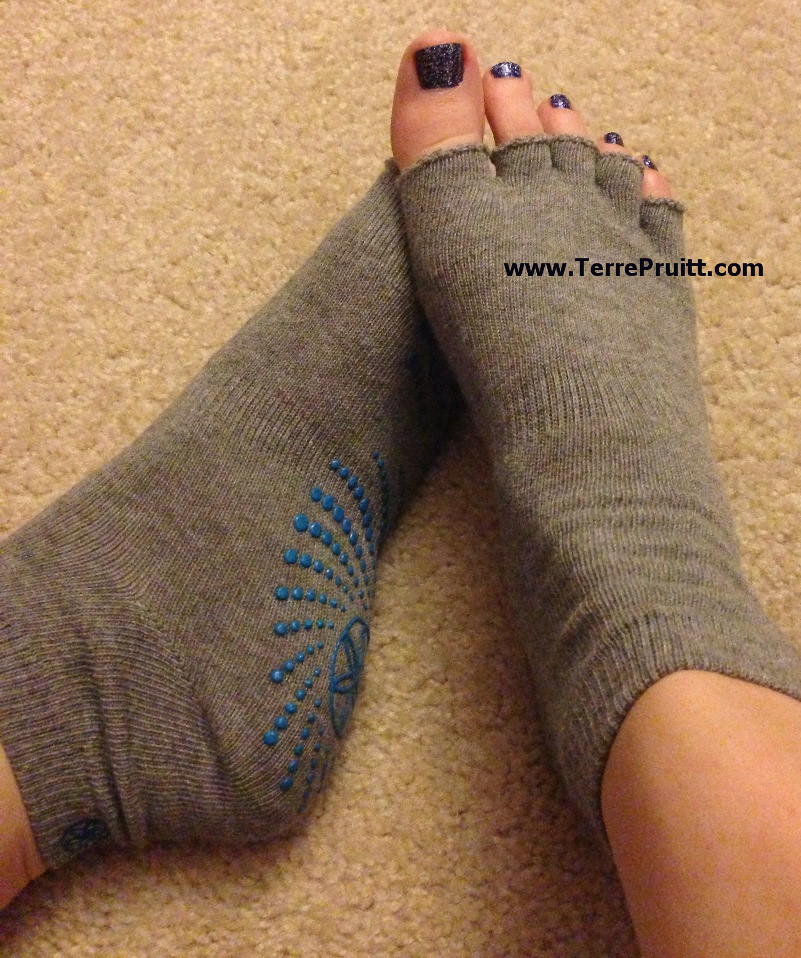 While I love to do Nia barefoot there are some floors where the toe less socks come in handy. Some floors that I dance on or have danced on have a texture to them that is not very comfortable on the feet. Some floors are really dirty (without access to a dry mop or broom) and so the layer of fabric between the foot and the floor helps to keep the grit from digging into my feet and being uncomfortable. The fact that the toes are exposed give me a bit of a barefoot sensation. Allowing the toes to come in contact with the floor and keeping those nerves activated. The energy flowing from the earth and to the earth via the exposed toes.
For yoga these are great because the textured bottom of the sock allows for traction if sliding is an issue for you. The texture also assists in keeping you from spinning on the foot when doing Nia. Ha! I just realized it might help stop that altogether. It is possible to spin, twist, slide on your bare feet although you might end up with blisters. But with the traction on the bottom of the sock it stops you in your tracks. You are unable to spin, twist, or slide.
Maybe the yoga socks could act as “training wheels” for some. If at first exercising barefoot seems odd, maybe the socks can help ease you into it. Perhaps the socks could also assist in training people not to spin, twist, or slide, so when they do decide to go barefoot for their Nia workout they will already have the know-how of lifting the feet.
Whatever the person’s reason for not going barefoot, toe less yoga socks might be a great solution. I do want to say, just so you know, when in my Nia classes as long as the facility allows shoes (some yoga/dance studios do not allow shoes), everyone is encouraged to be comfortable so when wearing shoes allow people to be comfortable then they are invited to do so.
Do you ever exercise barefoot?
Posted in Nia | Tagged: bare feet, barefeet, dance class, dance studio, naked feet, Nia, Nia class, Nia Practice, toe less yoga socks, training wheels, Yoga, Yoga Practice, yoga socks, yoga studio, Zumba, Zumba class | Leave a Comment »

 Terre Pruitt's Blog