Posts Tagged ‘BMES’
Posted by terrepruitt on September 27, 2014
I teach a cardio dance exercise called Nia. But it is more than that. At one point in its history Nia was NIA and stood for Neuromuscular Integrative Action. I have mentioned this before. I have also mentioned that I am not sure why the name has gone through many changes. I personally think that Nia has changed its name trying to find a wide audience. Trying to become more popular. It is sometimes the way with things that there has to be a catchy name or something in order to get people’s attention. Sometimes the name that best describes something is not catchy or marketable enough to attract people. Neuromuscular Integrative Action is really a great name. It describes Nia very well. But I don’t think it is very catching. It is difficult for some to remember, perhaps, and it might not come easy to understand to many people. But it really is a perfect name for Nia.
The Merriam-Webster online dictionary states:
Full Definition of NEUROMUSCULAR:
of or relating to nerves and muscles; especially : jointly involving or affecting nervous and muscular elements
A Google search shows the following:
integrative:
serving or intending to unify separate things.
[In] • Medicine — combining allopathic and complementary therapies.
So the actions during the workout will have to do with nerves and muscles. The movements, in addition to moving the entire body, also bring together the Body, Mind, Emotions, and Spirit (BMES). So it truly is Neuromuscular Integrative Action. But that truly is a mouthful. Even though it is a great, descriptive name, I think it might have been decided it was too difficult. I don’t know. I am just speculating.
I mentioned in my post about Knee Sweeps how it is beneficial to the brain for our limbs to cross over the midline of the body. I want to write a little more on that . . . . imagine you have a string that starts at the top of your forehead and it fall down the middle of your forehead, down the middle of your nose, in between your breast down the middle of your chest, over your belly button, continuing down in between your legs. That is the MIDLINE of your body. So when your cross your left hand/arm or foot/leg over to the right side of that line you are crossing the midline. And vice-versa. This type of action is good for your brain. This type of action is good for your nervous system. It is action relating to nerves and muscles. You use your muscles in action and this stimulates your nervous system.
I often remind my class how we are “working” the brain when we cross the midline of the body, when it really is so much more than that. Because, as you know, each side of the body is controlled by opposite sides of the brain so when you cross the midline both sides of the brain are forced into working. Both sides must communicate with each other. This communication with the nerve-cell pathways linking both sides, but strengthening them.
Many exercise classes do this. That is because it is important (I believe I have said this before.) Even yoga does it in some of its asanas. So the crossing does not have to happen in a cardio class or during a cardio exercise. Crossing the midline in stretches also helps “stretch” the brain. So even if you don’t participate in Nia, you can do things to help your brain. But I just wanted to share again – I know I’ve mentioned some of this a few times – how Nia is a lot more than a dance exercise, it really is neuromuscular integrative action.
So, with the reminder that it is good for your brain and nervous system, are you gonna cross that line?
Posted in Nia | Tagged: BMES, Body Mind Emotions Spirit, cardio, cardio class, cardio dance exercise, cross the midline, dance, dance exercise class, exercise, exercise the brain, exercise the nervous system, exercises, Knee Sweeps, marketable, midline, Neuromuscular Integrative Action, Nia, Nia class | 2 Comments »
Posted by terrepruitt on April 1, 2014
HOLY MOLY!!!! Sigh. Ok, I feel that since I started it, I need to continue with it. Right? I mean, it is not my intention to make my blog all about death, but since I asked for love and support, I think it is only fair that I give you all an update. I sat with my mother in her hospital room for roughly seven days. During that time she was presented with an option that would have been extremely painful and risky. The surgeon gave three scenarios that could occur and two of them pretty much ended with immediate death, so she opted to skip the procedure and just spend her last days with a tube down her throat, unable to speak and unable to cry. She entertained visitors. Not many because it was exhausting to her. She also was asked to pick the day on which she would have the tube removed. The thoughts were that her trachea is so encroached with cancer and would be so traumatized by the tube that when they pulled it out she would not have much time before she died.
Regarding the procedure mentioned — for those that are curious — it was a stent. A stent was to be placed in the trachea. The idea was that it would hold open the collapsing trachea so that she could breathe. But, it would only be for a few days. The stent is not a permanent or even semi-permanent solution. It is also metal and rigid, it would not have flexed and moved. It would have been very uncomfortable/painful, because the trachea moves.
She did not want to go. She had a lot left she wanted to do. Knowing she couldn’t do ALL that she wanted to do before she died, she thought she could at least do SOMETHINGS. So she decided to have the tube removed on Monday. She made that decision on a Wednesday. It is MY belief that if she knew all that she would have to go through between Wednesday, March 26th, and Monday, March 31st she would not have picked that day. But she wanted to at least get her Easter cards written out. She also wanted to advise me of who gets what in the stack of Christmas gifts she already bought. She also wanted to spend as much time with her family as she could — who wouldn’t, right? But in order to do so she suffered a lot. The medical professionals taking care of her were always there to administer the drugs she needed so she wouldn’t be in pain, but those drugs made her groggy and unable to think clearly so sometimes I think she held off a bit. Plus the procedures that need to be done to allow someone to breath through a tube are not comfortable. So anyway . . .
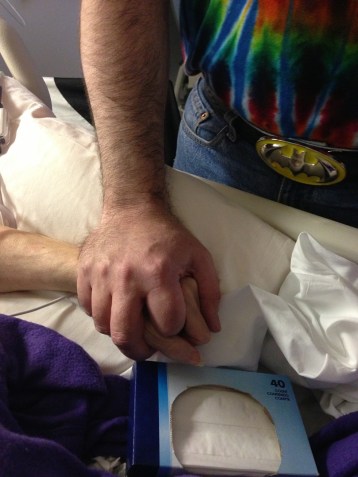 We got to visit for several days. As I have said several times, she was unable to talk with the tube in her throat. She also was unable to cry because the contractions that happen when one cries caused too much pain. Normally I would not tell someone not to cry because crying is such a great release. I believe crying is good for the BMES – ha, yes, that is a Nia acronym. It helps clear the tear ducts and allows for a physical release. Crying helps clear the mind also. It is an emotional release as well as a spirit helper so to me, it is a good thing. So if you want to cry, cry — except while you are driving or you have tube down your throat and it hurts too much.
I was there until Friday night. I got home around midnight on Friday. I came home to do some laundry, teach a yoga class, do some paper work, and pick up my husband. We went back up Saturday night. We visited all day Sunday and waited around for 1:00 pm on Monday. We all were under the impression that at 1:00 pm it would happen. But we all forgot that “hospital time” is not exact. They do things — even scheduled things — around other things. So our 1:00 pm scheduled extubation turned into 2:28 pm. I trusted the medical staff (although it turned out not to be who we were told it would be) would see that she was not in pain, but we still didn’t know if there would be any gasping and gagging and who knows. I was confident that it would not be a long time after. I saw the MRI of the trachea/esophagus area. Nurses and doctors helped convince me that it would be quick. Well it was not. We are going into our 29th hour. While my mom is so medicated she doesn’t know what is going on and she feels no pain . . . this is NOT what she would have wanted. Lingering on. In fact every visitor that came to visit her while I was there, her answer to their comment of “I’m praying for you.” was “Pray that I don’t linger.” Again, I am at a loss.
Yes, we all have ideas as to why she has not died . . . . she is not ready . . . . she is doing it in her own time (something we call Natural Time in Nia) . . . ALL TYPES of ideas . . . but really we don’t know. All that I know is that this is really hard on my dad. This is not a case where she might revive and be ok. This is not a hopeful, “Oh, I’ll sit by your bedside until you are awake.” This is a grueling death watch. Judge me anyway you want, I left last night. I didn’t want to see her as I know she would not want to be. I didn’t want to hear the “death rattle”. Ugh! Since it is hard on my dad, if it drags on until the weekend I will go back up.
Well, this post is way longer than I like to have my post, but I really wanted to let you know what the status is. Also . . . I guess it helps to write it out. One more thing . . . I believe that I would not have been able to handle this if it weren’t for all of you. So many people have “come out of the wood work” to share and support and deliver sparkles. So thank you all for sharing and caring and giving. I have not been told I am loved or said, “I love you” this much in as many days before in my life.
Please keep up with those thoughts, prayers, stories, sparkles, and all that jazz. It REALLY helps!
Posted in Diane Bacho | Tagged: BMES, breathing tube, cancer, death, esophagus, extubation, hanging on, lingering, love and support, Natural Time, Nia, stent, trachea | 24 Comments »
Posted by terrepruitt on February 25, 2014
I love my students. They are a great source to me; they teach me and they make me laugh. Recently one of my students happen to mention a policy that was told to her – a facility stated she could try the class for 10 minutes without charge, but would have to sign up for the class to stay longer. The comments from those that she was sharing this with was that 10 minutes was not really long enough to get a sense of the class and if they would like it. She said, “I know, if I would have only stayed 10 minutes I would have missed the nap time at the end!” That was the best. She, of course, was kidding . . . sort of. She was talking about Shavasana. A very important part, yet for many, one of the most difficult times in yoga.
She was kidding in the sense that we all know it is not nap time, but not having been familiar with yoga she would have missed seeing that part of the class if she had only been allowed to stay for 10 minutes. Shavasana is a pose of total relaxation. It is where you allow your body to rest and relax from the workout it just participated in. In some classes this is a necessary time for recuperation of the body, but in others it might not be so much about the body. In a Gentle Yoga class it could be more about the mind. In Nia we have BMES – Body, Mind, Emotion, and Spirit. We could say that shavasana is a time for those four things. So after a nice gentle class it could be more a time more for the mind, emotion, and spirit to relax. While the inner dialog should be kept to a minimum while practicing the asanas it is even more important to do so during shavasana. This is the time when the body absorbs all the goodness from the poses it just performed.
I had once thought that you DID shavasana IN the corpse pose, but the name comes from the Sanskrit words Shava meaning “corpse” or dead body and Asana meaning “posture”.*
One of the reasons shavasana is so difficult is because there is not supposed to be any inner dialog going on (as I just mentioned). This is not the time where you begin making your shopping list for your trip to the store after class, or where you decide what you are going to say to your boss/friend/spouse. This is a time of quiet, a time of reflection, a time where you do a “body check”. Check in with each body part or area of your body to see if it needs any attention, see if it needs to be relaxed and focus on allowing it to relax. Sometimes because of this relaxation one might fall asleep. When I first started every time I did shavasana I fell asleep. Now I don’t, I am better at being mindfully relaxed. It is a practice though. This might not be something that comes easy to you, it might be a challenge, but it is something worth practicing.
I’ve heard different ideas on how to hold shavasana in a class. Some say that a guided meditation is the way it should be done. Some say that total silence is the only right way. Some say some music or nature sounds should accompany this pose. In my classes I usually softly lead the participants into a relaxed state. Then I allow them quiet time with this pose — I do have sounds playing during class and I don’t turn that off, but sometimes I turn it down. Then after the time allowed I talk them back to awakening their bodies and moving again.
If this pose and time is not something that you include in your yoga practice, I encourage you to give it a go. Try it. If you fall asleep that is ok. But keep doing it and when you are able to achieve that relaxed state while staying awake you will see how powerful this simple pose is.
Do you practice shavasana? Have you ever fallen asleep during shavasana? How long do you stay in this pose?
*Wiki and Jaisiyaram
Posted in Yoga/PiYo/Pilates | Tagged: asana, BMES, body check, corpse pose, inner dialog, Jaisiyaram, naptime, nature sounds, Nia, Nia Classes, Nia Practice, relaxation pose, sanskrit, savasana, shavasana, Yoga, yoga poses, Yoga Practice, yoga students | 2 Comments »
Posted by terrepruitt on February 8, 2014
One of my Blue Belt Sisters (a woman I attended the Nia Blue Belt Intensive with) posted a link on Facebook to an article about 5 reasons to do a full squat. I love when I see information like that . . . information about why it is good to do “something”, something we do in Nia. I love that. I love when people confirm and promote Nia movement. As you know, if you have read some of my Nia posts, Nia is not new. Nia has been around for 30 years. Nia incorporates moves and ideals from different modalities so most of it is not new. HOW they incorporate it is often unique, but we use a lot of movements used in other exercise and workout programs. Which is a great thing. Not that just because something is done commonly makes it good, but since Nia is based on how the body was designed to move it makes sense that we do movements done in other practices and vice versa. So I was excited to see an article talk about something we do in Nia. Nia knows the benefits of squats.
I posted about the Garland Pose and I posted about what Nia 5 Stages calls “standing“. Here I am going to touch upon some benefits of doing full squats. A few of mine are different than the 5 mentioned, so check that out too. First, the article reminds us that children squat to reach for things on the ground and will get into that position when playing on the ground. Many things that children do we understand to be beneficial yet we no longer do them as adults. In addition to the many physical benefits of a full squat, it can possibly help us remember that child-like position of play. A Nia workout includes “exercising” the BMES (Body, Mind, Emotion, and Spirit) and many people claim that the play we do in Nia is great for their spirit. Squat like a kid!
Small children have all that yummy flexibility. Their bodies have not yet sat in chairs for years or worn shoes that either keep their ankles from moving in a full range of motion or even keep their foot in one position, possibly even shortening their calf muscles. So they can easily squat with both feet fully on the ground, and their legs folded, and their chest to their thighs with their bum low to the ground. So a squat allows for all of that. Mobility and flexibility in the ankles. Flexibility in the knee. And balance. Being able to squat with flat feet and stay stable is proof of good balance. Think of all those muscles you use to stay tush down and upright . . . (if you need help “thinking”, do it now and just sense all of that).
If you are doing the “Garland” type squat with the wide knees you are really opening the hips and groin area. It is important to have flexibility and mobility in the hips because those things help make walking more comfortable. A body is able to stand more upright when the hip flexors aren’t tight. So squatting can help the body allow for good posture. The squat also helps with stretching the back of the legs. Squats target the hamstrings and the glutes.
And if you push up to standing you are using your glutes, so standing up from a squat is a good bum strengthener/toner. Sometimes we move into a deep squat position in Nia as part of a Nia routine. We do squats as part of the Nia 5 Stages and we push up into a walk. So as I said Nia knows the benefits of squatting. What about you?
Are you a squatter? Do you find yourself squatting during the day? Is the squat something your body needs practice doing?
Posted in Nia | Tagged: BMES, child play, Facebook, flexibility, Garland Pose, good posture, Mobility, Nia, Nia 30 year anniversary, Nia 5 Stages, Nia Benefits, Nia Blue Belt, Nia Blue Belt Intensive, Nia exercise, Nia Movement, Nia posts, Nia Practice, Nia sister, Nia workout, squat, workout programs, Yoga Pose | Leave a Comment »
Posted by terrepruitt on January 25, 2014
Nia is a body/mind type of practice. Or mind/body . . . however you want to say it. I tend to say body/mind because the first step is to get into the body. But it is different from a lot of other exercises. It is much more like yoga and Pilates then say . . . weight lifting or running. I recently taught a class where a woman told me afterwards that she really loves it because she is very athletic, she runs, she plays other sports, but she wanted something that was more freeing and more connected so she decided try Nia and now she is hooked. She still does all of the other stuff and continues to love it, she is just rounding out her workouts and exercise with Nia as a body/mind addition. Nia is really great to add to any type of workout regime you have.
Since Nia focuses on allowing the participant to participate at their own level it can easily fit into your workout schedule. I have had many people who love more traditional sports tell me that Nia is a great addition for them. They all love that body/mind connection and the way it allows them to feel like a kid. They love the play of it.
I have had people come up to me before class and say, “I can’t dance are you sure I can do this?” The answer in The Nia Technique is “if you can walk you can do Nia.” And that is true. In a Nia class you might even fine tune your walking a bit. We might train you to do that Heel Lead that often gets lost in a high heeled or runner’s gait. Get that flex and extend back in the ankle. But really anyone can do Nia.
I would bet that you have noticed the increase in the popularity of yoga . . . well, it is that mind/body connection that draws people to it. Many people are understanding that even a regularly scheduled exerciser benefits from having that mind/body connection. With Nia there is also the Emotions and Spirit. The whole enchilada. BMES. Body, Mind, Emotions, and Spirit.
I’ve posted about Spirit before. It is one of the things that many people really enjoy about Nia. It can be compared to the “feeling like a kid” again. The play in the exercise or workout. The “Wooohooo!”
So the intention of this post is just to remind people – because I am sure I have said it before – that Nia is for everyBODY. To remind you that people who like the more traditional exercise and workouts, the more athletic type of stuff, as in running and weight lifting, find they really like to add in Nia to the mix. It actually helps them in their other type of workouts. They claim — the ones that talk to me — they are more focused when they do run and/or lift weights. So if you are one of those people who prefer the more traditional exercise, maybe break out of that for a Nia class and see how it works for you.
Check out my schedule on my website Nia Class Schedule or if San Jose is too far for you look at the Nia Classes on the main website.
Do you ever find yourself wanting to try something different for a workout? Do you want to add something new to your exercise regime?
Posted in Nia | Tagged: and Spirit", athletic, BMES, body, body-mind practice, emotions, Heel lead, Lifting Weights, mind, Mind-body practice, mind/body connection, Nia, Nia class, Nia Classes, Nia exercise, Nia San Jose, Nia schedule, Nia workout, NiaNow.com, Pilates, running, San Jose Nia, The Nia Technique, weight lifting, workout regime, www.HelpYouWell.com, Yoga | 2 Comments »
Posted by terrepruitt on January 18, 2014
I know – well, I am pretty confident that I have mentioned before in a blog post that I don’t think of myself as teaching people Nia. Even though I say I teach Nia, I usually prefer to say I lead Nia. I wish I could find that post because I would like to check what I said exactly because I am feeling a bit different these days. Or maybe I have it clarified in my mind better. I believe I said that I don’t like to say I teach Nia because I feel that a dance teacher is one that demonstrates the steps and then has the student try to do them while the teacher watches. Then maybe the teacher demonstrates again and the student does it again and then maybe there is some adjusting done by the teacher. Or even in a group dance class setting the move is done over and over until it is somewhat learned and then the next move is added on. Sometimes there is a sequence of moves that is demonstrated then practiced over a few times and then a new sequence added on. That is what I think of as teaching dance. So in THAT way I don’t teach Nia, but I DO teach Nia.
I do not show the move then have the students practice it over and over before we dance it, but sometimes when the song allows we do a preview and practice. It could be that the song has a long introduction in which there is no specific choreography and in that time we demo a move. While I might not tell a participant in particular a way to tweak the move I will look out into my class and see something that could use tweaking so I might say or even do something that I hope will lead to a change. Say, we are doing a move using our toe and I look out and see someone using their heel, I might suggest using the toe like squashing a bug or testing the water (depends on what we are doing). So in essence I hope to teach the students that we are using our toe. I teach the move as we are doing it as opposed to the aforementioned way.
IN addition, I like to share things about Nia while we are dancing. Sometimes I talk about how Nia incorporates the BMES (Body, Mind, Emotion, and Spirit) I might explain Nia’s Five Sensations while we are moving on the floor. Allowing the Nia students to be reminded of them and possibly use them in the floorplay. I often remind the Nia class about Natural Time letting them know they are free to move through the movement/choreography in their body’s own natural way and timing. Sometimes this is actually part of the song and if not people are always encouraged to move in this way.
So, I take it back if I said — as I believe I did — I don’t like to say I teach Nia, because I do teach Nia. But I don’t teach it as if it were a dance, because it is not just a dance. While we do dance, Nia is so much more. Maybe I should say I lead people through Nia Routines and I teach Nia?
Have you ever taken a dance class like I describe – the demo-do-type? Do you see the difference between two?

Posted in Nia | Tagged: BMES, dance class, dance floor, dance teacher, floorplay, Natural Time, Nia, Nia choreography, Nia class, Nia Dance, Nia five sensations, Nia participants, Nia routines, Nia students, Nia teachers | 2 Comments »
Posted by terrepruitt on January 7, 2014
I had a new to Nia person come to class today. She called me yesterday to ask about it and showed up to class today. I like that. Of course, I asked her about it after class. She said she liked it because it made her think. She said that is what she needed. Nia is amazing because it is one of those exercises that DOES make you think. There are differences in a Nia routine. There are times when there is Free Dance, a time where you don’t think. You just let your body move to the music. You let it go and see where it takes you. It is not a trance dance, you are not in a state of trance, but you are letting your body move to the music without thinking. There is no thinking of what others think or how you look, or of a pattern, you just move. There is also the choreographed steps. Some of those steps are described as the actual dance steps there are, say a Jazz Square, a grapevine, a ball change, etc. And when learning them or even when incorporating them into a routine there may be thinking involved. There is also the imagery used in Nia. Where instead of saying reach up we might say pick an apple, instead of just saying walk we might say walk Jazzy, instead of saying get down on the ground we might say melt onto the earth . . . .these things might cause you to have to think for a moment. What are the movements involved in picking an apple? What does “Jazzy” mean? How does a body melt? Sometimes a routine will have us doing a movement that is out of the ordinary. Say against the normal “flow” of movement. And again that is where we have to think. So sometimes, yes, we do think in Nia.
Right now I have just begun teaching a routine, I have only taught it once and it is making me laugh because when I first saw Debbie Rosas do it on the DVD I didn’t understand why she said left hand on one section and right hand on another. To me it looked as if she was alternating. So the first few times I did it, I alternated my hands that I started with. When I was barring the song and I went to write down the arm choreography I stopped to watch it closely. She says left when we start with the left ONLY and right when we ONLY start with the right. There is alternating hands in between, but not alternating starting hands. This is one of those funny moves that makes me think. I love that the other teachers on the DVD didn’t quite get it either. Makes me feel better. Makes me remember that it is a practice and my brain and body will have to think about this move until I have it engrained.
I love that Nia is Body, MIND, Emotions, and Spirit (BMES). I love that new people come in and see all that it is and say they love it. I love it even more when they come back.
I always say that there was a reason Nia was once named Neuromuscular Integrative Action . . . . because that is really what it IS. I don’t know why they abandoned that, but I can imagine. It is a mouthful. And to some perhaps it sounded intimidating. Once people come to class they get to see it for themselves. It really was/is an ingenious name, just a bit much, I guess. As we are thinking we are using our nerves and our muscles.
So, what do you think?
Posted in Nia | Tagged: a ball change, a grapevine, BMES, Body-mind, dance choreography, dance exercise, dance patterns, dance steps, jazz square, Neuromuscular Integrative Action, Nia, Nia choreography, Nia class, Nia Dance, Nia exercices, Nia Free Dance, Nia Music, Nia routine | Leave a Comment »
Posted by terrepruitt on December 7, 2013
So, as a group exercise instructor one usually has a few jobs or venues to teach at. I have Nia classes at a studio where I rent the space, at a community center for the City of San Jose, and soon at some local YMCAs. In order to teach for the City of San Jose I had to go through the hiring process. Same with the YMCA. Today I spent a good portion of the day at a YMCA orientation. While a lot of the information they cover is common sense and a lot of it is information I have received at almost every job I have worked at some of it was unique to the YMCA. Such as the history of the YMCA. I admit I learned a lot. I knew what Y.M.C.A stood for (Young Men’s Christian Association), but that is about it. It helped that the trainer was clearly very enthusiastic about the history of the Y. As always when I learn something I think is interesting I like to share with you. Plus, when I document it via my blog, I have the information where I can always find it! So here are some facts I thought were cool about the history of the YMCA.
—-The YMCA was founded in 1844 in London, England
—-In 1859 a sea captain led the formation of the YMCA in Boston
—-In 1856 German immigrants participated in the first-known English as a Second Language class
—-Andy Rooney, Dan Rather, Malcolm X, Dr. Martin Luther King, Jr., Jack Kerouac, and Andrew Young (U.S. Ambassador), have all stayed at the YMCA
—-In 1869 the first YMCA buildings constructed with gyms were opened
—-In 1875 in San Francisco, to serve the Chinese population, YMCAs serving Asians were established
—-In 1879 Thomas Wakeman founded a YMCA for U.S. Native Americans
—-In 1917 a Japanese YMCA was founded
—-In 1891 James Naismith, a physical education teacher at the International YMCA Training School, invented basketball
—-In the 1890s William Morgan, a YMCA instructor thought basketball was too strenuous for businessmen so he invented volleyball
—-By 1950 YMCAs operated 20 colleges in cities across the country
—-During World War II, the YMCA staff organized clubs and activities for children in the Japanese Interment camps — all in secret
—-In 1950 Joe Sobek, a YMCA volunteer, invented raquetball
—-In 1967 racial discrimination was banned in all YMCAs
—-In the mid 1970’s the Youth Basketball Association (YBA) was created by the YMCA and the NBA Players Association. The YBA promotes skills and teamwork over winning at any cost
—-In 2008 the YMCA and the Department of Defense and the YMCA partnered to fund memberships and child care services for families facing the hardship of military deployment
—-In 1891 a triangle was used a the logo, the equal sides representing “man’s essential unity, body, mind and
spirit, each being a necessary and eternal part of man, he being neither one alone . . . ”
I especially loved the last one as Nia has many triads and is greatly focus on Body, Mind, and Spirit. We add Emotion so we have BMES, but it is very much the same thing. Anyway . . . these are some of the main things I thought were interesting. Since the YMCA has been around so long it really has a long history.
Which YMCA history fact(s) is new to you? Which ones did you know? What do you know about the Y that I have shared?
Posted in Misc | Tagged: Basketball, BMES, City of San Jose, group exercise class, group exercise instructor, local YMCAs, Nia, Nia Classes, Nia Teacher, Nia trainer, Nia triad, raquetball, vollyball, YMCA, YMCA history, Young Men's Christian Association | Leave a Comment »
Posted by terrepruitt on November 30, 2013
I am certain that I have mentioned the fact that Nia changes. Like many things it grows, it morphs, it improves, it changes, yet it remains the same. The basics stay the same. The core of it stays the same, but as time goes on it morphs. Sometimes it is the verbiage and the names of things, but it basically stays the same. It has been a year since I have taken the Nia Blue Belt Intensive. In that intensive we were given a Manual from August 2006 and while we were being trained we were told that a new manual was soon to be released along with some new ways of explaining, talking, and learning things. So part of what I quote here might be a little different from what is being taught now, but the idea and the process is the same. The process is Creating Space.
In an intensive, before every session we gather and create the space. This practice was discovered as something done in martial arts. Debbie Rosas and Carlos Rosas, the creators of Nia, recognized its value and brought it into Nia. It is the responsibility of the participants to create the space. It is the responsibility of trainers to hold the space.
The Blue Belt Manual states: “Creating space is the conscious act of preparing the environment, which includes your body.”
It is an incredibly powerful act that enables an individual and a group to become prepared for receiving. It is — at its core — coming into stillness. In preparation for creating the space we use a prescribed process. There is a schedule that is kept. A bell is rung seven to ten minutes before we are to start creating the space. This allows for people to wrap up any conversations they might be involved in and to do any last minute things that need to be done. Then there is a five minute bell and another one at one minute. Then, the students create a circle in which we sit quietly while we create the space. The things we do is quiet the mind, stop the inner dialog and just let the mind rest and become open to hearing and receiving the teaching that is about to happen. The body is also stilled. The emotions are balanced and not taking over. We are connected to our higher self . . . the manual says, “open, but you are not seeking at the moment”.
A main point is to not allow for distractions of any kind. No physical distractions . . . that is one reason why we sit still. No mental distractions . . .that is one reason why we stop the inner dialog and the thinking. All four bodies, Body-Mind-Emotion-Spirit (BMES), are stilled.
The space we create is “a way to set up an energy environment that supports your practice and learning.” It really is a very helpful and powerful tool to help with the learning process. We continue to sit in the space until the trainer interrupts us by thanking us.
I believe that many things could benefit from the creation of space; a meeting, family dinner time, Nia classes, a yoga practice, any exercise, and many more. I think it is a good idea sometimes to clear your head and body of distractions in order to concentrate fully on the “task” at hand. I know that for me this practice really works well in the intensives.
Is this something that you think you could benefit from? What types of tasks or activities do you think you could create space for?
Posted in Nia | Tagged: BMES, Body-Mind-Emotion-Spirit, Carlos Rosas, creating space, Debbie Rosas, inner dialog, martial arts, Nia, Nia Blue Belt, Nia class, Nia creators, Nia Intensives, Nia manual, Nia participants, Nia Practice, Nia sessions, Nia students, Nia trainers | 2 Comments »
Posted by terrepruitt on September 26, 2013
Today after Nia Class a Nia White Belt and I were talking. We were talking Nia over coffee and a friend from her past happened by. So she joined us. She was coming from Jazzercise and so, of course the conversation turned to us sharing some information about Nia with her. She sounded as if she was willing to try it but also as if she was never going to move away from Jazzercise. I love that she is moving. I think it is important that people exercise and one of the ,best ways to ensure that is to find something you like or better yet — love. I appreciate that there is so much out there for people to participate in. Of course, I would love for you to come to my Nia class. I would love for you to love Nia. I think it is great because it addresses the BMES, but not everyone likes that in their exercise. In the course of our conversation she said she tried Zumba, but it didn’t work for her that well. She had already mentioned that she takes it easy on her knee so I felt justified in recommending the correct type of shoe. I often hear people don’t like Zumba because it hurts their knees and it often has to do with the shoes they are wearing. In Nia we dance bare foot. We do not twist on our foot or scoot, we pick our feet up off the ground. When doing a dance exercise or a fitness class, like Zumba the need for shoes is apparent. In Zumba there is a lot of twisting, shuffling, and sliding. You need the right shoe for that.
 Exercise sneakers, tennis shoes, cross trainers, and running shoes are not the correct shoe for doing Zumba or any type of dance that requires shoes for that matter. An exercise sneaker or tennis shoe has what you want in regards to cushion, construction and support. A cross trainer has even more support in the shoe because with cross training you are moving forward, backward, side to side, and even up and down. So the shoe itself is made to support your foot and keep it secured in the shoe. And running shoes are great for the cushion. They cushion your step and help absorb the shock of your foot landing on the earth. So these types of shoes are great, the “upper”, because they are built for impact and moving in different directions, but it is the sole you do not want to dance on. These shoes are made for traction. They are made to stop you from twisting and sliding. When you are playing tennis, doing cross training, or running you don’t want to be slipping, sliding, and twisting around. So the soles are made to keep that from happen. I mean, have you seen some of those soles? They look like tire treads. Great for outdoors.
 Now a dance shoe, say a jazz shoe or a ballet slipper is perfect for dance. Without all of the cushion and support that is an athletic shoe they are usually light and easy to lift and move in. The bottom of the shoe has material that allows you to slide and glide, spin, turn, and twirl on the dance floor. Perfect for moving to the music and getting your groove on. And THAT is the kind of sole you want. Something you can twist in. Something you can slide in. Something that won’t stop you foot dead as you dance across the floor. But then again, those shoes have the SOLES you want, but not the support. Since you are doing cross training type of motion (forward, backward, side to side, and even up and down) you want that type of support. And it would be nice to have some cushion too, huh?
Well, do your knees a favor and do not do Zumba in tennis shoes, cross trainers, and running shoes. And do your feet a favor and do not do Zumba in a jazz shoe or a ballet slipper. What you need is a dance sneaker. Someone, somewhere – I don’t know the origin of them – decided to combine the two. Brilliant. Someone added the support, cushion, and comfort of an athletic shoe to a sole that can slide and glide. Whew! This is genius. This will help save your knees and other joints!
I know Zumba has a brand of shoe that has a great dance sole, I don’t know about the cushion and support of the shoe. I bought Capezios because they don’t have a sole over the arch so they allow for the foot to really move.
Since you are investing in your health and wellness by going to a dance exercise class, please take it a one step further and splurge for those dance sneakers. They don’t have to cost more than $50.00, and you will be saving yourself so much more in the long run. You will be allowing your body to move with greater comfort on the dance floor.
What do you think? Do you think a shoe that allows you to slide a bit is better for dancing? Doesn’t it make sense to have a dance sneaker?
Posted in Zumba | Tagged: athletic shoe, BMES, Capezio Dances shoes, correct type of dance shoe, cross trainers, dance exercise, dance fitness, dance shoes, dance soles, exercise class, exercise sneakers, fitness class, Jazzercise, Jazzercise class, Nia, Nia class, Nia Dance, Nia exercise, Nia White Belt, running shoes, tennis, tennis shoes, What type of shoe to wear for Zumba, Zumba, Zumba class, Zumba shoes | 4 Comments »

 Terre Pruitt's Blog