There is a Nia Routine called Miracle. It is fun routine. Like many Nia Routines it has form and freedom. There are two songs in which the foot work is pretty much the same throughout each song (form), but within the sameness you have the freedom to switch it up and add your own style. The choreography gives you the steps, the area where your feet are to be in dancing to the music, but you can decide how to get there and how your foot will be placed into that area. Form and Freedom. There is also something in this routine that Carlos Rosas (NKA, Carlos Aya-Rosas) calls the “Nia Bundle”. It is basically where the entire class gets very close together and dances. This is not easy for people to do. Why? There are at least as many reasons why this challenges people as there are people. But there are many benefits to dancing in a “bundle” and as a group.
One benefit of dancing in a close bundle is to practice our proprioception. In close proximity to other Nia Dancers we want to be aware of where our arms are, where are feet are, where are hands are. Are our limbs close to our body or are they out as far as they can go? Are we going to step on someone’s toes? Are we going to bump into someone? While the goal is not to step on nor bump into anyone, it is understood there might be some contact . . . but not often. For those in my classes that participate in the Nia bundles we do a good job being aware and moving in a close group.
Also dancing so close to each other helps us be aware of each other. Not just the physical presence of the other students, but there is eye contact, there is giggling, there is connection and a sense of community when you are brought really close together. No one is in their own space, we are sharing space. We move as one in space. We move as individuals in a shared space. We learn to dance together.
Another benefit could be that we – as individuals are pressed into moving in different ways. Finding a new way to move our body in dance because we are so close to someone. How can we move our elbows without elbowing someone? How can we dance to the music and express our spirit in such close proximity to others? Ahh . . . yes . . . new-to-your-body-moves just might be discovered.
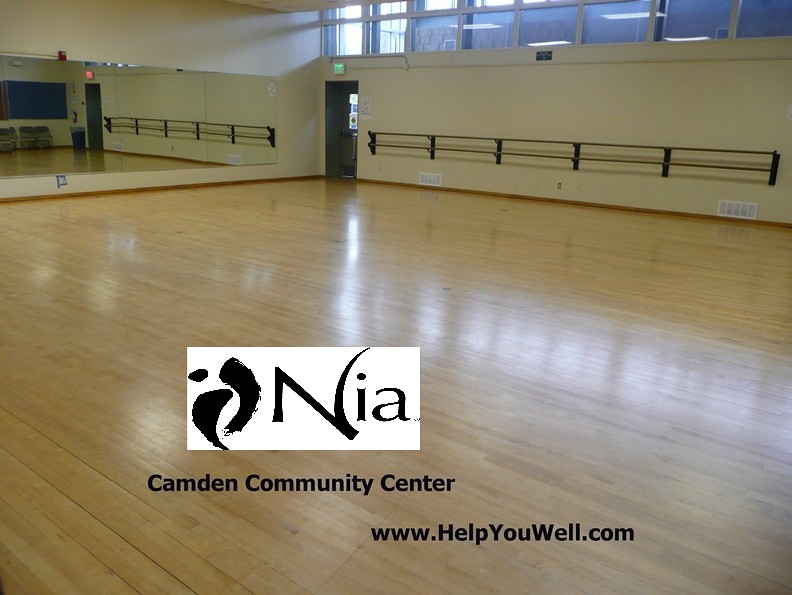
I always laugh at the thought of someone looking in the dance studio at the community center and seeing all of the space with 12+ of us all clumped together in the middle or in a corner. I imagine them thinking that odd. I imagine them thinking, “WHAT are they doing?” Then we throw our hands up in the air and sing. It is quite fun!
So despite some people’s misgivings about dancing really close in a Nia bundle there are those who join in with gusto and reap the benefits. Does your dance exercise class have a bundle? What would you think if you were to peek in a class and see it? Would you be a bundle dancer?
If you have read more than one post on my blog you know (probably) that I teach a movement class called Nia. Nia is very much about “dancing” and moving to the music. The training required in order to teach is called the Nia White Belt Intensive. The training is over 50 hours long. Believe it or not there is hardly anytime in that 50 hours learning a routine. In fact, I don’t remember learning any part of a routine in my White Belt. But I know people who have taken the training more recently and they said they did review a song. I remember when I first arrived at the training I literally had NO IDEA what it was going to be like. I signed up rather late and if there was any pre-training at that time, I didn’t get it. I had thought I would walk out of the training ready to teach. Ha. Nope. I was given tools to help me be ready to teach. There might be people who are ready to teach when they walk out of the first training . . . but I wasn’t. I wasn’t that familiar with Nia to begin with so the way we were taught to learn a routine was very new to me. As you may know we were taught to map our music by “barring” the music.
I know that Nia is making an effort to make things easier on teachers. Nia Headquarters actually documents the choreography on the bars now. So, I feel that the focus has shifted a bit away from barring the music the way I was taught. I think the way I was taught was very cool. I love the way Nia had at one time had us learning the music. But I also understand the need to learn quickly or to have tools available to allow people to do things faster. That is just the way our society is. Things need to be done fast.
I also understand that we all learn differently. We all have our own ways of doing things. I honestly don’t do EVERY step that I was taught to do. I also mix it up and I don’t always do each routine EXACTLY the same. But pretty much.
For all the routines so far, I do bar the music myself. Sometimes I have trouble with some of the songs so I might rely on the bars from HQ a little more than with other songs. But I bar the music and I document the choreography myself. I “fix” any discrepancies I might see on the DVD. But I do this in steps. First I bar the music. I count the music and I dress my bars. I have found the more detailed I am with the dressing the better it is for me. I put as much detail as I want on there. I don’t just put the sound I hear for the cue for the Nia routine. I put the music on the page. Then I scan the paper into my computer. Now I have barred music. So what I can do with that the barred page — without the Nia choreography on it — is use it for whatever I want. I can add my own choreography. I don’t just have the places marked where I would do or cue the already-created-Nia kata, I have sounds that I am familiar with document. So noting my own choreography to the page is easy.
Then, on my paper I just scanned, I add the Nia choreography. Once I do that then I scan my sheet again. So now I have an electronic image of my complete and final bars. I always know where it is. I admit to taking my sheets of barred music with me either to teach or around the house, then I misplace them. Or I mixed routines up so I have one song in with another routine. Then after a year when I go to do a routine, I am missing a song. I am pretty particular so I will look for it, but sometimes I let go and just look at my electronic copy. I know that eventually I will find the hard copy so I just use the one I know where it is.
I am so happy though because I finally got a HANGING file system. So much easier to file my routines that way. I used to have them in a pile on a shelf in a cabinet. So in order to get to them I had to take out the entire pile and go through it to find the routine I wanted. Or to put one away . . . that is why I would end up with “lost” songs because I didn’t always want to take the time to take out the stack and deal with it. But now, it is so much easier with them hanging! Yay.
So, if you teach a dance class, how do you document your moves? How do you note your choreography? How do you store your notes?
There is a move I do often at the end of my Nia Classes. I learned it as the Ragdoll Pose in yoga. Some say it is just a variation on the Uttanasana or the Forward Fold. Since it is a standing pose where you bend over I can see that. But the Forward Fold is a very active pose. You are using other muscles, you are actively lengthening your spine. Whereas in my classes, the move we do as the Ragdoll pose is just a hang. The idea is to hang, ya know, like a rag doll.
After all the movement we do in a cardio dance exercise class where moving your entire body is the key, it is nice to just hang around for a bit. This pose made my list of favorite yoga poses but is not one of my sixteen favorites. Kinda surprised me.
With the Ragdoll, as I said the idea is to hang like a rag doll folded over at the hips. Your body goes limp. Your arms can hang. Your shoulders and hang. Everything just hangs. Legs can be straight or bent at the knee. It is a relaxation pose so doing it to your optimum comfort is advised. Let the weight of your head help lengthen and stretch your back and spine. So you are not actively lengthening or straightening, it all comes from the weight of the head. Even if you are resting you forearms on your thighs you are hanging.
One way that people do this pose is with the arms hanging overhead, but bent at the elbows. The forearms are folded together allowing the hands to hold the opposite elbow. This variation is just like the bent knees and/or the arms — or even hands — on the thighs, it is up to the individual at the time of the pose.
Bending over or doing an inverted pose is good for the systems in your body. Such as the circulatory system, turning upside down helps blood flow which helps the respiratory system. The lymphatic system is assisted by inversions which stimulates the body’s immune system.
It seems as if the body enjoys the break from the normal pull of gravity and it likes to be upside down every once in a while. Calms the nerves, heightens the sense, and brings a little peace. Only when done reasonably comfortable. Poses should not be held if they cause pain or dizziness. So when you are in any pose especially and inversion stay only as long as it is comfortable.
To me, the Ragdoll is one of those comfortable poses. Usually just fold over and hanging. But I do remember at least once when my neck was not aligned properly so the full on hang did not feel good, but bending my knees and resting on my thighs was the ticket. Always remember that you do a pose for the moment you are in at the moment you are doing it. So yesterday all the way down might have been the way, but maybe today it is not. Do what your body wants in the moment.
Enjoy the weight of the head and the arms. Let it stretch your spine and bring space into your back. Hang as a rag doll would.
Do you like the Ragdoll pose? Do you like inversions? Which ones are your favorite?
I know – well, I am pretty confident that I have mentioned before in a blog post that I don’t think of myself as teaching people Nia. Even though I say I teach Nia, I usually prefer to say I lead Nia. I wish I could find that post because I would like to check what I said exactly because I am feeling a bit different these days. Or maybe I have it clarified in my mind better. I believe I said that I don’t like to say I teach Nia because I feel that a dance teacher is one that demonstrates the steps and then has the student try to do them while the teacher watches. Then maybe the teacher demonstrates again and the student does it again and then maybe there is some adjusting done by the teacher. Or even in a group dance class setting the move is done over and over until it is somewhat learned and then the next move is added on. Sometimes there is a sequence of moves that is demonstrated then practiced over a few times and then a new sequence added on. That is what I think of as teaching dance. So in THAT way I don’t teach Nia, but I DO teach Nia.
I do not show the move then have the students practice it over and over before we dance it, but sometimes when the song allows we do a preview and practice. It could be that the song has a long introduction in which there is no specific choreography and in that time we demo a move. While I might not tell a participant in particular a way to tweak the move I will look out into my class and see something that could use tweaking so I might say or even do something that I hope will lead to a change. Say, we are doing a move using our toe and I look out and see someone using their heel, I might suggest using the toe like squashing a bug or testing the water (depends on what we are doing). So in essence I hope to teach the students that we are using our toe. I teach the move as we are doing it as opposed to the aforementioned way.
IN addition, I like to share things about Nia while we are dancing. Sometimes I talk about how Nia incorporates the BMES (Body, Mind, Emotion, and Spirit) I might explain Nia’s Five Sensations while we are moving on the floor. Allowing the Nia students to be reminded of them and possibly use them in the floorplay. I often remind the Nia class about Natural Time letting them know they are free to move through the movement/choreography in their body’s own natural way and timing. Sometimes this is actually part of the song and if not people are always encouraged to move in this way.
So, I take it back if I said — as I believe I did — I don’t like to say I teach Nia, because I do teach Nia. But I don’t teach it as if it were a dance, because it is not just a dance. While we do dance, Nia is so much more. Maybe I should say I lead people through Nia Routines and I teach Nia?
Have you ever taken a dance class like I describe – the demo-do-type? Do you see the difference between two?
You might have read my post about Sounding in Nia. That is what we call it when we make noise in a Nia class — sounding. You might have read my post about Reasons for Sounding in a Nia Class. Even if you did not read that post, I bet you are aware of some of the reasons to make noise in an exercise class. One of the biggest ones is to ensure breathing. If you are making noise you are breathing. Knowing the students are breathing is a HUGE relief to an instructor. Some of the other reasons sounding is good are it can help stabilize your core, it can act as an emotional, spiritual, or physical release, and it can be really fun. Sounding can be noises/words such as HA, HI, HEE, HOO, WAH, WAHOO, etc. Sounding can also be singing. With “Nia Music” sometimes singing is just sounds.
I always invite the Nia participants to sing. Often times I tell them it is really easy because there are no words. I have often wondered how the singer sings. I have often pondered how it is done. Then Nia put out this video*. It is an interview with Carl Tietze whose song Am I The One, is on the Sanjana Album. Sanjana is the first Nia routine I learned. In the interview Carl talks about how he invited a vocalist, Jen Folkner, to listen to the song. He said he put the headphones on her and most of what we hear on the song is from her first time hearing the music.
She is sounding. Granted, she is doing is beautifully. I don’t want to put the pressure on and say this is what we do or need to do in a Nia class. No, not at all. I am just saying that it is fine to MAKE NOISE. I did laugh when I heard this interview because I kind of imagined that songs that have no real words but are just a singer making noise was done like this. I imagined the musicians just saying, “Go!” and the singer just letting her/his voice come out.
I was recently very amazed and in awe of a woman who had never been to a Nia class before – in fact, before class she asked me what it was. So she didn’t even know what type of exercise/workout it was. And yet, while she was moving to moves she had never done, she was singing. The song was one of those songs without words, but she was just making noise in a “singing voice”. It was great! I was very impressed.
Making sounds or singing in a group workout class is not something that comes easy to everyone. Sounding while learning moves doesn’t come easy to people who normally make noise, so it was especially fun to have her in class. Plus she had that much more fun and received the benefits of sounding.
I hope this interview helps give you a glimpse into making sounds. I hope you are able to experience the benefits of making noise while do your cardio dance. You know it is fun.
Do you sing while you dance in your fitness dance class? Don’t you love the way singing and dancing makes you feel?
*Click here to go to Nia’s website to sign up for the monthly newsletter!
Nia is a cardio dance exercise that I teach. It is more than that, but that is one way to describe it. One of the ways it is more than that, is, it is a practice. If you chose to treat it like a practice, as one might treat yoga as a practice, one would become aware of Nia’s 52 Moves. There are 52 moves that get choreographed into the Nia Routines. One of the moves is Traveling in Directions. This is a great move for many reasons.
One reason Traveling in Directions is great is because it is very easy. Another reason it is great is because it is very adaptable and can be used in almost every song and in every routine. The main way to travel in a direction is to simply walk. Using the Heel Lead technique just walk forward, then change the direction you are walking, then change the direction, etc. With the simplest of forms you look where you want to go before you move in that direction. So before your feet actually start going a different direction — LOOK. There is a little bit of thinking involved because we look before we go. Allow your arms to move freely. Step confidently in whichever direction you choose to look. Move your body as a whole.
The Nia Technique book states: “Practicing Traveling in Directions keeps your body agile for moving through space in all directions, able to change direction with ease.”
When we use this move in our routines we have a lot of fun playing with it. The move really is as easy as stated, the fun comes when changing directions quickly. You can be the leader of your own movement or sometimes you are being directed by the teacher. This makes agility one of the Nia sensations we practice with this move. Moving one way then quickly stopping and going another way. Stopping, changing, starting. Varying the speed at times will allow for additional Nia sensations such as strength and stability to come into play.
When Traveling in Directions on your own you become aware of the direction you want to go, then you look, then you go. As I said, there are times when you might be listening to the direction of the teacher, which would still mean you would need to become aware of the direction you want to go, but when being told where to go your body’s reaction is quicker. There is a quick look then a move in that direction. Less thought is involved for you as the participant because someone else thought of the direction you were going to go.
Often when this move is done in a class, quick thinking, quick moving, and quick reacting are additional skills that receive attention because we are dancing with others on the floor so we might have to switch our trajectory quickly to avoid a dance floor collision.
Modifications of the traveling can be done by going backwards or sinking low or even rising high. So many ways to travel in directions. All of them are great opportunities to try out the Nia Sensations, the more you do, the more ways you move your body. If you want you can even skip. Skipping in different directions adds a new dimension to the move.
Sometimes this move is choreographed into the Nia routine with specifics and sometimes is allowed more of a Free Dance. However it is added to the Nia workout it is a wonderful way to dance.
How would you Traveling in Directions to your current favorite song?
I took dance lessons when I was young. I cannot remember a time when I didn’t know the Jazz Square. Of course there had to be a time because one is not born knowing what a Jazz Square is much less how to do one. But I don’t remember not knowing how to do it. So I actually must have learned it prior to my dance lessons, because I was young when I took my lessons but not THAT young. Whatever the case . . . . unfortunately it was all too long ago for me to truly know . . . I knew what a Jazz Square was when I entered my first Nia Class and when I took the Nia White Belt Intensive. While the Jazz Square is not included as one of Nia’s 52 Moves it is something we do a lot in our routines. It could be considered part of the Jazz Dance that is one of the Nine Movement forms that make up Nia. Well, not everyone has had dance lessons or knows how to do a Jazz Square. So we can use the clock to help them.
Nia has a core set of moves called Nia’s 52 Moves. Three of them actually have “clock” in their names. One is Rock Around the Clock, another is Slow Clock, and another is Fast Clock. So it makes sense that with those moves we would use a clock image to do the move and/or help explain and instruct the move. I have posted before about how we use the clock to help direct other moves. Well, the Jazz Square is one of them. While it is called a square it sometimes might be more of a rectangle, but the idea is to use the four corners.
First thing to know is that the Jazz Square is just four steps. So often I will just have my students march or step four counts. Sometimes we will get the dance going with that and then move to the square. Some people stay with the marching and that is fine. Another VERY important thing to know AND DO is to weight each step. As in, put all your weight onto each step you take. When you are learning the jazz square this is of the utmost importance. This will ensure that you are taking a left, right, left, right (or right, left, right, left) approach and not trying to use the same foot – as in left, left, right, left – and just getting tangled up.
Let’s do a Jazz Square left-over-right. So we will be starting with our left foot and having it cross over the right foot to the right side. The left foot comes over to the right and lands on 2 o’clock, the right foot comes back to the back right corner and lands on 4 o’clock. Then the left foot steps back to the back left corner – 8 o’clock, then the right foot steps over to the upper left corner – 10 o’clock. That is one jazz square. To keep going the left foot swings around the right foot to the upper right corner – 2 o’clock and you continue on.
So right-over-left is: right foot to upper left corner (10 o’clock), left foot to back left corner (8 o’clock), right foot to back right corner (4 o’clock), left foot to upper right corner (2 o’clock). To keep going the right foot must swing around the left foot back up to the upper left corner (10 o’clock).
Sometimes when we are doing a fast jazz square my square turns into a diamond with step one being more at 1 and the corners a little askew. But I have corners!
As with many things sometimes it is easier for a person to do it one way than the other. So it might be easy to do left foot over right foot, but when you switch it is not as easy. Sometimes that is when a student will march. Or they will do the jazz square but not the hand or body movement that we pair with it. Continuing to move is the key so whatever they do is great. Eventually with practice, the can do it!
Perhaps this will help.
Key things to remember:
FOUR steps
Put your weight on every step
Step to 2, 4, 8, 10 – left, right, left, right or
Step to 10, 8, 4, 2 – right, left, right, left
Marching is an option
Have fun
Do you do the Jazz Square? Does this help? Can you do the Jazz Square and a shimmy? Both ways?
I am really happy. This coming week marks a year that we have had Nia on Tuesday mornings at the Camden Community Center in San Jose. Workout classes – especially group exercise classes at city community centers – can come and go. I have been blessed with a small but very consistent group of individuals who are interested in gaining or retaining their health through movement. I am further blessed that some of my students who attend my Monday and Wednesday Nia classes have made it over to the community center. Nia on Tuesdays started on Tuesday, September 4, 2012. Our year class will be Tuesday, September 3, 2013.
I have been teaching Nia on Mondays and Wednesdays in the Willow Glen area of San Jose since February 2009. Most of the individuals that make up the Monday and Wednesday group have been coming for most of the four years and seven months. They too are a dedicated group of students that I appreciate. I rent the time at that location.
I am not sure if many classes at city community centers go on for years. So I am very happy that we have made it to the year mark. I think that as long as the students continue to attend we will have a class. I am hopeful that we will expand our numbers as we enter into our second year. This is the community center where the students requested a second class. There was an opening so their thinking was, “Why not fill it with Nia?” So they wrote a note asking the supervisor if they could have Nia in the time slot that has just opened. The supervisor is allowing us to give it a go. If, this story sound familiar it is because I wrote about it in my Goodie Jar – Check In #27 post in the beginning of the month. I was so excited that was definitely something that went into the Good Things Jar!
The Thursday class has started out with good numbers. Hopefully that class will grow too. It is made up of the core group from Tuesdays, but with a few different people. This past Thursday they were all very kind, patient, and understanding while my music and the player were not cooperating.
As with most dance exercise workouts it is really fun when there is music. While Nia can be done without music, it is nice to have music so that each individual can dance in their own way while we do the routine. The group was very nice and let me run to my car after three songs so I could get my boom box.
So, I am just grateful and sharing my gratitude. I am grateful to have great Nia students at all of my classes. And I am very grateful that the San Jose Parks and Recreation Department is allowing me to have two Nia classes. I am jumping for joy at our one year anniversary. I have actually been working for the city for over a year, but it took a couple of months to get a class. Yay us!
Here’s to our Nia class being one year old at the community center. Here’s to more to come! Thanks for sharing in my joy!
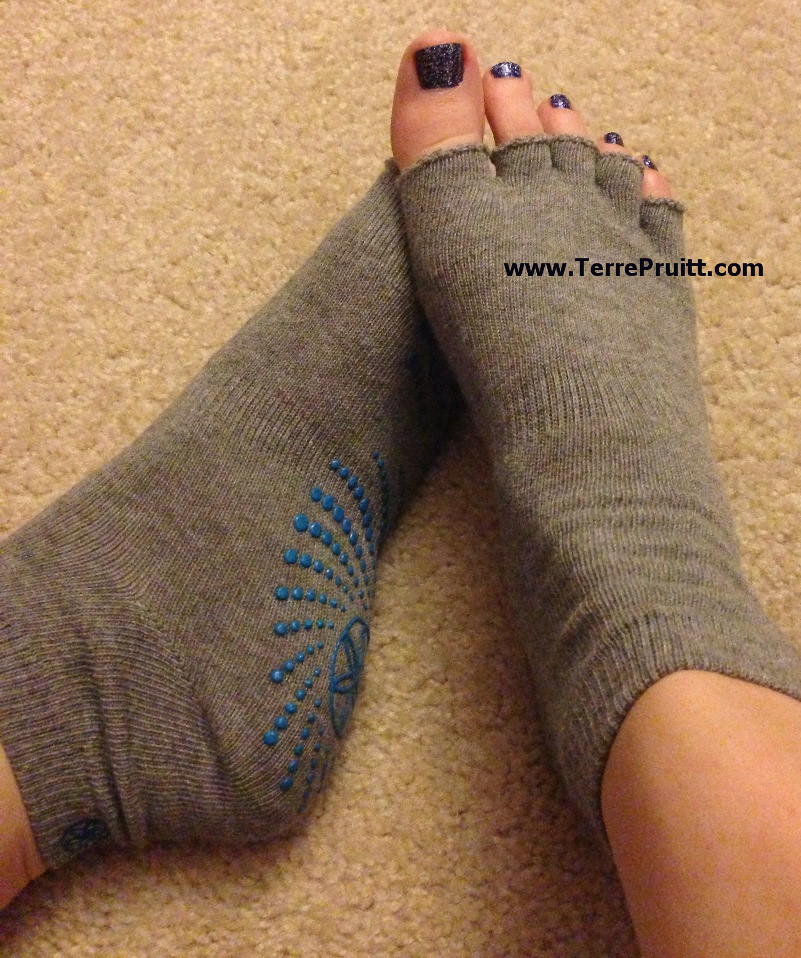
Nia was designed to be done in bare feet. I believe that yoga is also supposed to be practiced in bare feet. But there are many reasons as to why people want to have something on their feet. Many reasons why people don’t like “naked feet“. Some people don’t like to be barefoot in public places (and with that there could be many reasons). Some people need support of shoes for their comfort and health. Some people like to have traction built into their footwear. Since Nia is designed to be done in bare feet we do not spin on our feet we lift them up so having a little bit of traction does not interfere with our movement, whereas in a Zumba class where you are often twisting on your feet you do not want traction. What someone has come up with for yoga are toe less socks with traction on the bottom. I had a friend give me some as a gift. She was so sweet and said, “I know you do Nia barefoot, but I thought you might like these.”
While I love to do Nia barefoot there are some floors where the toe less socks come in handy. Some floors that I dance on or have danced on have a texture to them that is not very comfortable on the feet. Some floors are really dirty (without access to a dry mop or broom) and so the layer of fabric between the foot and the floor helps to keep the grit from digging into my feet and being uncomfortable. The fact that the toes are exposed give me a bit of a barefoot sensation. Allowing the toes to come in contact with the floor and keeping those nerves activated. The energy flowing from the earth and to the earth via the exposed toes.
For yoga these are great because the textured bottom of the sock allows for traction if sliding is an issue for you. The texture also assists in keeping you from spinning on the foot when doing Nia. Ha! I just realized it might help stop that altogether. It is possible to spin, twist, slide on your bare feet although you might end up with blisters. But with the traction on the bottom of the sock it stops you in your tracks. You are unable to spin, twist, or slide.
Maybe the yoga socks could act as “training wheels” for some. If at first exercising barefoot seems odd, maybe the socks can help ease you into it. Perhaps the socks could also assist in training people not to spin, twist, or slide, so when they do decide to go barefoot for their Nia workout they will already have the know-how of lifting the feet.
Whatever the person’s reason for not going barefoot, toe less yoga socks might be a great solution. I do want to say, just so you know, when in my Nia classes as long as the facility allows shoes (some yoga/dance studios do not allow shoes), everyone is encouraged to be comfortable so when wearing shoes allow people to be comfortable then they are invited to do so.
I found Nia back in 2008. I was looking for an exercise that was more like dance. I had several people in my life at that time that loved to dance, but their partners wouldn’t dance with them. They claimed they would love to do exercise if it was more like dance. I also had people in my life at that time that were younger than me, my age, and just slightly older and they couldn’t move very well. They moved with pain and/or it was an extreme challenge for them to balance and just a mixed bag of things. I believed that movement could help some of the issues facing them and many others. I also loved to dance and thought it would be great to have an exercise class that was dance. I looked at doing Jazzercise, but I think at the time the franchise thing (or however they did it/do it) was not something I wanted to do. And back then Zumba was not yet the rage and I had thought it was ALL Latin music (I know better now). I remember I came across a website that was talking about Trance Dance. So I researched that a bit. That sounded interesting, moving your body in your own way to music. But the information I found said that you kept your eyes closed and/or were blindfolded while dancing and someone would watch to make certain people didn’t injure themselves. That part and the fact that some sites stated there actually was a form of “Trance” that people entered into kept me from wanting to do that. But somewhere there was a mention of Nia. So I tried to find all the information I could on this Nia. Back then it might have even been NIA. I don’t remember when it changed and even now some places still call it Neuromuscular Integrative Action. It has gone through a few name changes, but at present it is just The Nia Technique or Nia.
It IS non-impact aerobics and it IS Neuromuscular Integrative Action, but the name is Nia and it no longer “stands” for anything. And in the four years that I have been doing it and learning about it, it has changed. It was originally created by Debbie Rosas and Carlos Rosas in the early 1980s from a desire to help people exercise in a different way, a way that addressed more than just the physical body.
When I joined Nia there were really starting to talk a lot about the next phase of Nia. You see, even though Nia remains true to the original concept of a Joyful workout, it does change and it does grow. Anything that wants to survive has to change or at least be flexible enough to endure the change that happens around it. Nia changes, they change the way they deliver training from the routines to the intensive — so the continued education changes. Nia’s training material is phenomenal. When you read through a newsletter or a manual or listen to a conference call you can sense the care taken in creating the material. It is nice to be a part of Nia.
It is interesting. It is amazing to see how far Nia has come and how much is has changed in the short time that I have been a teacher. The roots of Nia are still there they are just always finding new ways to share it.
As with any an all certifications I have earned I did my research beforehand. It is important to know how much the initial training cost and how the licensing and/or certifications works. It is important to know about continued education and re-licensing or re-certifiying. I liked everything I saw about Nia. It took me four classes before I decided to invest the time and money needed to teach.
I took the training in December of 2008. I started teaching in February 2009. I have been teaching Nia ever since. I have had the same Monday and Wednesday class since February 2009. I have had other classes at other studios and gyms on different days and different times. At this writing I am teaching Nia five times a week in San Jose – not including subbing dates. I have three classes for the City of San Jose; a Tuesday morning and a Tuesday evening class. I also have a Thursday evening class. My schedule is update regularly on www.HelpYouWell.
I am excited to have so many opportunities to share Nia with people each week. As I said, I have five classes and as I said things change. So when you are ready to join me in one check my site to confirm time and place and all those details. I would like for the number to grow. Just as Nia is growing, in leaps and bounds and for the better.

 There is a Nia Routine called Miracle. It is fun routine. Like many Nia Routines it has form and freedom. There are two songs in which the foot work is pretty much the same throughout each song (form), but within the sameness you have the freedom to switch it up and add your own style. The choreography gives you the steps, the area where your feet are to be in dancing to the music, but you can decide how to get there and how your foot will be placed into that area. Form and Freedom. There is also something in this routine that Carlos Rosas (NKA, Carlos Aya-Rosas) calls the “Nia Bundle”. It is basically where the entire class gets very close together and dances. This is not easy for people to do. Why? There are at least as many reasons why this challenges people as there are people. But there are many benefits to dancing in a “bundle” and as a group.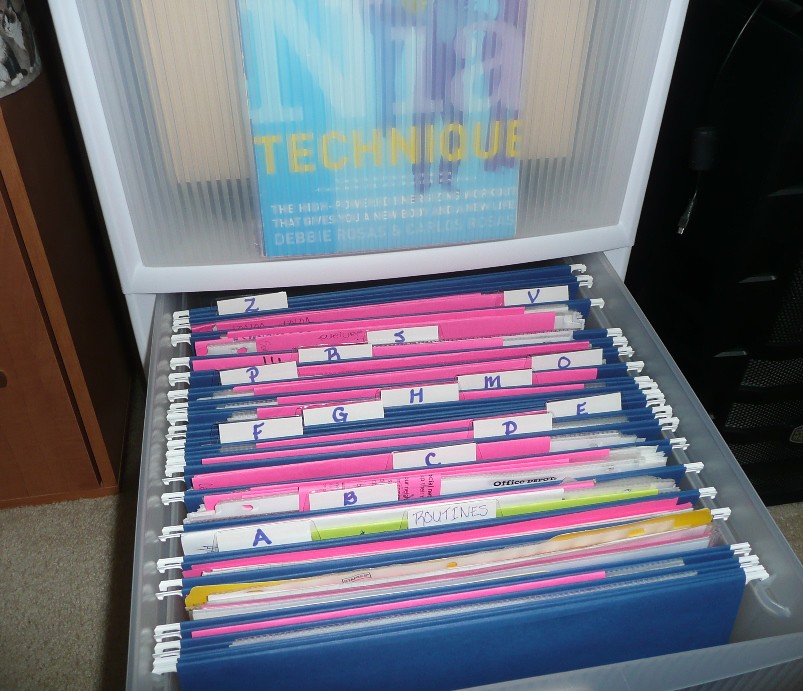



 Terre Pruitt's Blog