Terre Pruitt's Blog

In the realm of health, wellness, fitness, and the like, or whatever inspires me.

  • I teach yoga, Nia, and stretch online!

    ALL CLASSES ARE ON ZOOM AT 10:00 AM PDT

    Tuesday Gentle Yoga 

    Wednesday Nia

    Thursday Stretch

    Please see my website for details!

    I am also available for private Nia / yoga / Personal Training all virtual, of course!

  • Unknown's avatar

  • Enter your email address to subscribe to this blog and receive notifications of new posts by email.

  • My Bloggey Past

  • ******

    Chose a month above to visit archives, or click below to visit a page.

Posts Tagged ‘Yoga Practice’

FAMSS

Posted by terrepruitt on April 13, 2010

In Nia we refer to FAMSS.  We practice FAMSS.  We can use it for all types of things.  It stands for:

Flexibility
Agility
Mobility
Strength
Stability

And by “use” it I mean, it is often incorporated into each kata of a routine.  Or a kata might concentrate on just flexibility, the next one agility, the next one mobility, and so on.  Or we could use FAMSS as a focus OR an intention of a Nia class.  Either all of them (Flexibility AND Agility AND Mobility AND Strength AND Stability) or just one (Flexibility OR Agility OR Mobility OR Strength OR Stability).

But whatever we do with it or them, they are highly regarded as abilities needed to ensure one’s (high) quality of life.  So in Nia we honor them all.  In a Nia class we weave them into the workout.  In this post I am just referring to FAMSS in the physical.  They can certainly be applied to more than just our physical bodies, but that can be another post just by itself.

For now, I am just talking about our physical bodies needing to be flexible, agile, mobile, strong, and stable.  Just to move around in daily life these five things are very important.  In Nia we can bend down in a forward fold as in the familiar pose one might do in a yoga class, allowing our flexibility to be enhanced.  The music might encourage us to run, stop, run, stop, run, stop or move us to play the drums calling upon our bodies to display agility in legs, in arms, in our bodies as a whole.  We can move our bodies as if they are grass in a field or seaweed in the ocean, moving each part, each section, each muscle, and all major joints to help ensure their mobility.  We could crouch in a bow stance moving up and down exercising the strength in our legs.  Then we can we stretch, reaching to the sky as we look up, this can be stability practice, either on flat foot, on the ball of our feet, or in releve.  This could be one song in which all of this FAMSS is going on or it could be spread out over the entire routine.

Just tonight in my San Carlos class a woman told me that after her first class last week her hip felt better.  She said that after her hip felt better on that first night it encouraged her to do a few of the moves at home that we had done in class.  So she started working on her FAMSS in the first class, she was encouraged that movement was working to increase her FAMSS so she moved more.  With movement she felt more comfort and less pain.  FAMSS is necessary for a high quality of life.  Her ever day movements were better not because she did it once, but because she kept doing it.  Nia honors Flexibility and Agility and Mobility and Strength and Stability, so in Nia we practice it.

I hope one day you will attend one of my classes (I have two in San Jose and one in San Carlos*) to see how we can improve your FAMSS.

*Please see my website for my CURRENT class schedule.  Thank you!

Posted in Nia | Tagged: , , , , , , , , , , , , , , , , , , , , , , , , , , , , , , , | 4 Comments »

Friends For Life

Posted by terrepruitt on March 13, 2010

Ahhhh, so what are you thinking?  Friends that you have all your life?  Yeah, no.  This is about friends for LIFE.  As in friends for health.  As in friends for well being.  It is very important to have good friends.  The definition of “good friends” is vast and we can have a lot of “good friends”, but I believe that we all can benefit from friends that we can connect with.

Most of us have an array of friends in our life, we have people we call friends but they might REALLY be categorized as acquaintances.  We have friends that call us when they need something, and friends we call when we need something.  We have friends that annoy us and friends that don’t.  We have friends that we might not think of often, but that we are very fond of.  And, when we are lucky we have friends that fill us up.  That make us feel good.  They make us feel grounded and connected to humanity.

These friends could agree with us when we need it and tell us to get it together when we need that too.  They could agree with us on something and disagree with us on others.  They can see our faults and ignore them or try to help us with them, but either way, they are there and they are our friends.  I believe that is vital to our health.  I believe that sometimes life needs to be suspended—in between appointments, and kids athletic games, around the Nia classes, the gym, and the yoga practice, regardless of work and responsibilities–you need to be with those types of friends.

Enjoy time visiting with these friends no matter how frequent or infrequent it is important to connect, to refill, to recharge.  It is awesome.

It is as important as good nutrition and exercise . . . . .at least, I think so . . . . I think there are friends for life.

Do you believe that friendships play a role in life/health?

Posted in Misc | Tagged: , , , , , , , , , , , , , | 6 Comments »

Used My iPhone For My Nia 5 Stages Practice

Posted by terrepruitt on October 1, 2009

I believe that I cannot say it enough. Nia can be a lot of things. It can be a workout where you just go to class to move, dance, and have fun or it can be a practice, like Yoga. In the practice you can look at some of the elements that make up Nia and work and play with them. One of the movement practices of Nia is the Nia 5 Stages.

I think of the Nia 5 Stages as a practice because you can do it as often as you like and each time you do it you will sense improvement where your body can use improvement or “self-healing“.   And you can even do the 5 Stages with an actual focus on improving something. I am experimenting with it. Since I recently just took the training and want to share it with others in a class format and in one-on-one sessions, I am experimenting with multiple aspects of it. In addition to the DVD and CD that was part of my training, I am using my iPhone to assist me in my experimentation.

I have two applications on my iPhone that I am using. The first one is iDicto. It is a simple recording application. In teaching the Nia 5 Stages we use voice, language, and imagery to allow the participants to move through the stages in their own way. By recording my scripts into my iPhone I am able to do a lot of things, two of which are:

—–I am able to check all of the different points of my speaking that I need to learn and work on, for instance the timing of my speaking

—–I am able to play back my recordings and use them just as I do the CD and the DVD that I received with my training, as if I were taking a Nia 5 stages class

The other application I use is Chronology. First of all let me remind you that I am experimenting with the 5 Stages. So I am doing it different ways. One way is to do each stage until your body tells you to move onto the next stage. Another way is to do each stage for a minute. Now, while I am doing the 5 Stages I don’t want to be looking at the clock and I am not good at sensing when a minute is up, so that is where I LOVE Chronology. It allows me to set up six different timers. I set one up for six minutes, one for five minutes, one for four minutes, one for three minutes, one for two minutes, and one for one minute.

Then I start them all and I begin my practice by just  just relaxing. After a minute, the timer goes off and I move into the first stage, then went the next time goes off, I move into the next stage and so on. This way I know that am spending a minute in each stage. After doing each stage for a minute, I can adjust each timer for any amount of time I would like.

This is just ONE way of doing it. It is up to you if you want to do a timed stage or do it more naturally and move from one stage to the next when you are ready. As I said, I am experimenting and trying all different ways to do it. I think when I do it without a timer I spend more time on the first stage. But I don’t know, I am not being timed. 🙂

What really makes me laugh is I do find myself thinking, “There really IS an (iPhone) application for everything.”

This is just one way to do the Nia 5 Stages.  When I acquired these applications they were free.  Looks like Chronology is $2.99 now, but I bet you can find one for free that does the same thing.  It needs to be able to allow you to set up multiple timers (at least 5) and run them all at once.  And I did a search for iDicto and I don’t see it at all, but there are a lot of recording applications.  And I am sure you can find one that is perfect for you.

If you are interested in learning more about the Nia 5 Stages please let me know.  I am very excited to share this easy to do “exercise” that will allow you to move with ease and grace.

Posted in Nia | Tagged: , , , , , , , , , , , , , , , , , , , | 2 Comments »

Tips To Help You Move – Nia

Posted by terrepruitt on August 25, 2009

Here are the main points to the 12 tips to help you move with Nia.  These tips are taken from The Nia Technique a book written by the creators of Nia, Debbie Rosas and Carlos Rosas.  The book can help you better understand how Nia can be is a great workout and can be just a workout or practice, like yoga and Pilates are practices.   

~Use visual imagery to make movements feel natural.

~Combine small movements with large movements.

~Use your Base, Core, Upper Extremities, breath and voice to add energy and power to your moves.

~Use a variety of speeds.

~Use your joints to move energy.

~Use breath to start and stop the flow of energy.

~Add intensity to your movements by sinking lower and rising higher.

~Shift your body weight–don’t drop it—

~Add emotion to every motion.

~Use your fingers and hands to express how movements make you feel.

~Use your voice as you move, to activate your abdominal muscles.

~Lead your head movements with your eye movements.

While nothing compares to the energy of a live class, the book is a great way to get started or to get you acquainted with Nia.  

These are great tips to help you get more from your workout yet also help it feel less like exercise.

Posted in Nia | Tagged: , , , , , , , , , , , , , , , , , , , | 8 Comments »

Nia Belt System

Posted by terrepruitt on July 4, 2009

I feel I need to clarify something.  I keep seeing these great articles on the internet about Nia.  They are so great I get excited and I want to share them, until I get to the part where it says something like, “Nia students work through levels akin to martial arts and the different belts”.  This is where my enthusiasm for the article dies.  To me this makes it sound like a participant of Nia™ has to earn a belt in order to participate.

Nia is a workout.  A person can go to a Nia class every day and workout and never have to think about belt levels.  Belt levels never come into play during a workout.  Nia as a workout is so beneficial you may never want to progress to anything beyond that.  Think of it like yoga, you can go to a yoga class every day and never have to participate in the meditation or yoga life-style of a yogi or yogini.

Dance Exercise, Nia, Nia in the City of San Jose, Nia classes in the South Bay, Nia Teacher, Nia Class, San Jose Nia, Nia San Jose, Nia workout, Nia, Gentle Yoga, Group Ex classes, YMCA, Zumba, Nia Technique, SJ City Fit, SJCityFit, City of San Jose Exercise Classes, Cambrian Yoga & Cardio Dance, CYCD, Yin Yoga, online exercise, Zoom classes, virtual yoga

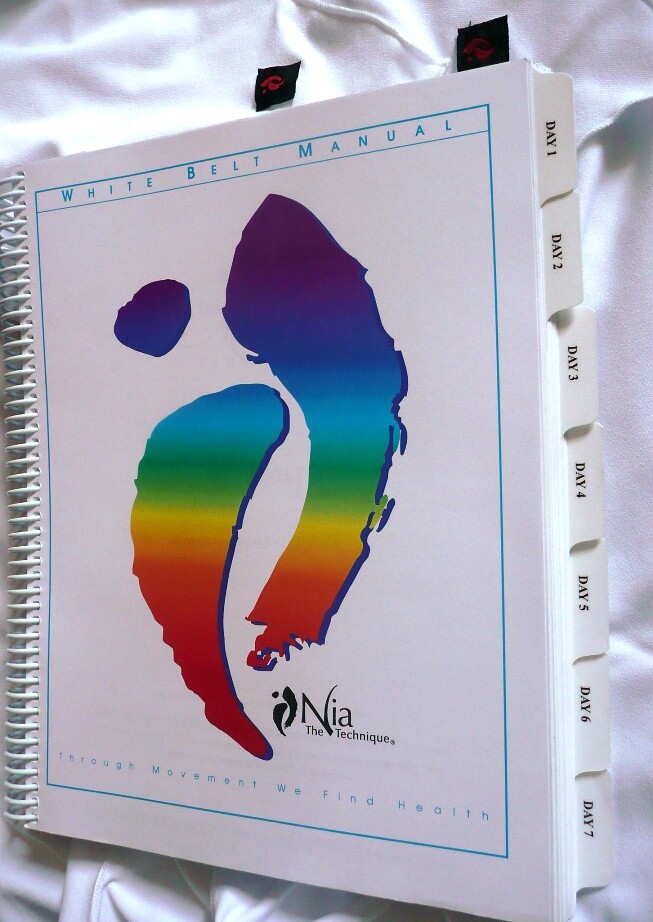
My Nia White Belt and my manual

IF someone is interested in learning more about Nia, aside from what the book and the DVDs, the classes, and the workshops have to offer, one can participate in an “Intensive”.  THIS is where the belts come into play.  Each intensive is about 40 hours of intenseness.  There is lectures and movement and workouts.  There are five belts.  Anyone can participate in the intensive, but they must be taken in order White, Blue, Brown, Black.  And they require a year in between each belt.

Each of the four belts mentioned has principles.  There are 13 principles for each belt, each belt also has a focus.

I am sure you noticed that I mentioned five belts but only named four, that is because one of the five belts is Green Belt.  Green Belt is newly added and it is for teachers.  So while any one can take an White, Blue, Brown, or Black belt intensive only teachers can take the green.  That is because Green is focused on assisting teachers.  It is just another aspect of the continuing education that Nia offers and recommends.

So, again I will say, anyone can participate in Nia as a workout and that is great and that is fine.  You will gain many, many benefits from it.  No one has to think about belts and the levels.  Only if you are interested in making Nia a practice and learning more about it do you need to even think about the belts.  Just come and enjoy the way your body feels during and after a Nia workout.  Then if you arrive at wanting more you will do so . . . in your own time . . . in your own way.


Posted in Nia | Tagged: , , , , , , , , , , , , , , , | 3 Comments »

Nia Or Nia Technique Is A Specific Practice

Posted by terrepruitt on April 11, 2009

I want to remind everyone that Nia or Nia Technique® is a specific practice.**  It was created in 1983 by Debbie Rosas and Carlos Rosas.  They were married and now they are not, but Nia is such an important part of their lives and so important to them, that they continue to work together.

Nia has different belt levels; White Belt, the newly added Green Belt, Blue Belt, Brown Belt, and Black Belt.  Each Belt has its own set of principles, except for Green.  You must wait a year in between belts before you can take the next intensive.  (Except for green because it a newly added in the system to assist teachers.)

Click here for more info on classes and Nia

I am a White Belt, so I continue to work with the thirteen White Belt Principles:

1–The Joy of Movement
2–Natural Time and the Movement Forms
3–Music and the 8BC System
4–FreeDance
5–Awareness – Dancing Through Life
6–The Base; Feet and Legs
7–The Three Planes and the Three Levels of Intensity
8–The Core of the Body; Pelvis, Chest, and Head
9–Creative Arm and Hand Expressions
10–X-Ray Anatomy
11–Business and Marketing
12–Continuing Education
13–Dance What You Sense / Teach What You Sense

When I talk about Nia it is based on what Debbie and Carlos have created.  They have been working and growing with Nia for 25 years.  And if you look at their work and information you will see that it has morphed a little.  It is the same basic practice but I believe it gets refined as they grow and change.

So please keep in mind when I talk about Nia, I am talking about something wonderful and specific and it is entirely based on the work of Debbie Rosas and Carlos Rosas.

Please join me in San Jose for a Nia class.  Visit my website for the schedule http://www.helpyouwell.com/

**This post is to explain that “Nia” and “Nia-things” I talk about are primarily from the creators of Nia BUT please keep in mind . . . . Nia is also a workout that can be experienced, just like a Yoga, Zumba, Jazzercise, or any group exercise class.  One can show up to class and just move and get a great workout.  One does not have to participant in the intensive and the belt levels.

Visit Nia’s main website at:  www.nianow.com

Posted in Nia, Nia White Belt Principles | Tagged: , , , , , , , , , , , , , , , , , , , , , , , , , , , | 3 Comments »