Posts Tagged ‘Debbie Rosas’
Posted by terrepruitt on January 5, 2013
There are a few posts on my blog about sounding in Nia. I even have a separate category for it. See over there to the left under categories, under Nia? Sounding is what we call making noise in a Nia class. Sounding is great for many reasons. Sounding is a release. It can help release tension, emotions, spirit . . . whatever needs “releasing”. Sounding is fun. Sounding can assist in the stabilization of the torso. Sounding can help ground you . . . physically, emotionally, and your spirit. Often times when I am doing Nia both when I am teaching and when I am a student, my spirit just makes a sound. I don’t plan it, I don’t think about it, a noise just comes out. I “woo” a lot. But sometimes other sounds comes out. Sometimes the sound I make makes me laugh because I really don’t think about the sound, something just comes out. I could be thinking of something, for example, maybe the move we are doing reminds me of a swirling skirt, so then the sound could be a “whosh” as in the sound of a skirt, or it could be a giggle of a girl twirling in a skirt. I don’t always think about the sound I just let it out. Sometimes I do think of the sound. Sounding can be purposeful. The noise can have a purpose. I have posted about healing sounds and sounds associated with the chakras. This post is about the sounds that are associated with Nia stances, which are part of Nia’s 52 moves.
The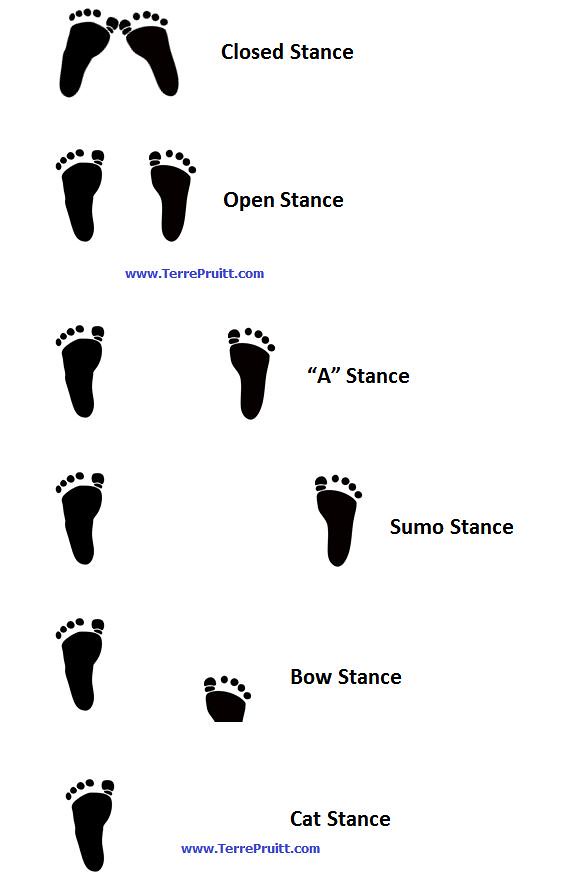 picture in this post is an approximation of how MY feet would be placed in the various stances. Remember that your stances would probably be slightly different. The width would be according to YOUR body and your body’s way. The picture is just to give you an idea and maybe help remind you of the various stances. At this time I have a post associated with four of the six stances.
In Nia’s closed stance the sound is the vowel sound “o”. The sound is made to “create volume in your chest cavity”.
In Nia’s open stance the sound is (to say) “balance” or “ground”. Saying the word “balance” can assist you in your balance. The word “ground” can assist with allowing you to feel grounded and sense balance.
The sound for Nia’s “A” stance is “aaaaahh!”. You say it on an exhale. Letting out all your breath until you are ready to inhale.
Sumo stance or riding stance (feet as wide apart as if you were riding a horse) has an explosive sound. Say “ha!” To me this helps with stabilization.
The bow stance has a sound of “u”. The bow stance is done with either foot in front, not just with the left foot in front as shown in the example.
The cat stance (standing on one foot, with the other foot pressed against the standing leg) has the sound “wooooooo” associated with it. This is done on the exhale. This stance is also done on the other foot and not just the left one as in the example.
So as you are practicing the Nia stances you can use the sounds associated with them for added benefit and fun. It is just fun to make noise. To me it adds to the experience. In my classes I encourage people to make any noise they want. I also like to play with the noises, sounds, and words associated with the move.
Do you attend a dance exercise class or exercise that encourages you to make noise?
Information regarding the sounds made with the Nia stances can be found in The Nia Technique book written by Debbie Rosas and Carlos Rosas (NKA, Carlos AyaRosas). The book can be purchased from Amazon.
Posted in Nia, Sounding | Tagged: A Stance, Amazon, Bow Stance, Carlos AyaRosas, Carlos Rosas, Cat Stance, closed stance, core stabilization, Debbie Rosas, making noise is fun, Nia, Nia class, Nia Sounds, Nia Stances, Nia Teacher, Nia teaching, open stance, Riding Stance, sounding, Sumo Stance, The Nia Technique book | Leave a Comment »
Posted by terrepruitt on August 30, 2012
Now, I know that I’ve been doing the knee sweep a lot longer than I have been doing Nia. So it is true that Nia’s 52 moves are not necessarily unique to Nia, but they are part of the core of Nia. You will find a large portion of Nia’s 52 moves in every routine. There are correct ways to do them, but Nia allows for the body’s way and also, I believe Nia allows for the move to be incorporated into the dance. For instance, The Nia Technique book states that the starting position for a knee sweep is the sumo stance. I am sure that I have done a knee sweep from a sumo stance at one time, but the first dance that pops into my head where we do the knee sweep it is not from a sumo position. But the by the book (oh, yeah, that reminds me, “BUY THE BOOK!” 🙂 ), anyway, the by-the-book version of the knee sweep starts from a sumo position, complete with arms in ready position and everything. Then the body rises as you come up on one leg bringing the other leg up with a bent knee. The knee crosses the midline of the body, the opposite hand “pushes” the knee out. The knee swings out so the pelvis is open. Then the leg comes down and the foot lands on the earth. That is the knee sweep of Nia’s 52 moves.
The book does not indicate that when your foot comes down it is in the toes-to-the-front position, but that is how I teach it. I don’t want my students landing on their foot with their knee out to the side. If we are just doing knee sweeps as an exercise, maybe I would have them do that, because they would be aware of the torque in their hip, but probably not.
When I was first doing this move in Nia I was trying to do it as the book shows and as many of the people on the Nia instructional DVDs do and as the instructor does (whether it be Debbie Rosas or Carlos AyaRosas). And that was with the knee out to the side very wide. REALLY opening the pelvis. But when I did that I noticed a “something” – I don’t know what it was, but it was something – in my lower back. So I decided that opening my hip that wide and having my leg out that far was not MY body’s way, so I do not do that. I share with my students that I found the comfortable spot to be about as far as my forearms can reach. I “glue” my elbows to my sides and hold my forearms out to the side. As far as they can go is as far as I allow my knee to go. That is what works for me.
Some of the time that we are doing the knee sweep it is at the end of a “up-two-three-four (knee sweep), back-two-three-four (knee sweep)”. So that would not allow for the sumo position to be the start. Other times we are standing upright. As I said, I am sure I have done it from the sumo position because I bet it is in a routine I am not thinking of. But the ones I am thinking of it is done from a walking or standing position.
The amazing thing about the knee sweep is that it calls for the knee to cross the midline of the body. So that means that if you were doing a left knee sweep (with your left leg) your left knee would enter into the right hemisphere of your body. If you were doing a right knee sweep (with your right leg) your right knee would enter into the right hemisphere of your body. It is a great thing when your limbs cross the midline. It helps stimulate the brain. So there is a reason in many exercise routines and cardio classes that we have you do “cross overs”.
The knee sweep is one of those moves that requires balance. Since at one point you are standing on one leg, you will be able to improve your balance or practice what you have. Also the moving of the leg helps with that stability. Standing on one leg helps with strength and opening the hip helps with mobility and flexibility. The knee sweep of Nia’s 52 moves does a body and brain good!
Are you familiar with this move? Have you done it before in your exercise class? Did you give it a try?
Posted in 52 Moves (of Nia), Nia | Tagged: Cardio classes, cardio dance class, Carlos AyaRosas, cross the midline of the body, dance, Debbie Rosas, exercise routines, flexibility, improve balance, Knee Sweep, Mobility, my body's way, Nia, Nia instructional DVDs, Nia routine, Nia students, Nia's 52 Moves, stability, strength, Sumo Stance, the Nia Technique books | Leave a Comment »
Posted by terrepruitt on May 12, 2012
We move our hips A LOT in Nia. With all the hip movements we do I say we have juicy hips. Not only do we shake and shimmy our hips we take time to stretch and open our hips. Hip flexors are a group of muscles that move the thigh towards the chest. These muscles can get short and tight, especially from sitting. Office jobs usually mean sitting in a chair all day while at work. Add the commute time to the sitting on the job and many people end up sitting over eight hours a day. Sometimes the hip flexors can become so short and tight they can keep an individual from standing up straight. In addition, the origin of one of the muscles in the hip flexor group is in the lower back, if this set of muscles is short and tight it can sometimes result in lower back pain. For many individuals stretching and lengthening these muscles can bring relief from back pain and help individuals stand up straighter.
There are a lot of stretches that can help lengthen this group of muscles. The yoga Pigeon Pose comes to mind. This is a great pose because the leg that is straight out towards the back get the lengthening benefit and sensation, while the bent leg assist in opening the groin area and stretching those muscles. The butterfly stretch really stretches the groin area, too. The closer you can get your feet to your pelvis the bigger the stretch, and the close the knees to the ground the bigger the stretch. This is a great stretch you will definitely feel in the inner thighs. The spinal twist both supine and seated can bring great relief. So whether you are laying down and allowing your legs to be on one side of you or whether you are sitting up with one leg out and hugging one bent knee, you still get a nice stretch for the pair of muscles whose origins starts in the lower back.
One stretch I love to do is somewhat like a spinal twist in that you let the legs twist to one side, but instead of bringing them over to one side as a pair you let one leg start its journey to the other side of your body and the other one follows in its own time. Think of your legs as pages in a book.** One leg goes then the other leg flips (as a page) slowly. No rush. Also if you allow one leg to fall to one side while the other is on the first side (think open book) it is similar to the butterfly stretch but with hips completely open. Then “close the book” having your legs end up on one side while gently twisting to the other, you get the nice gentle stretch in your back. In Nia our floorplay cycle often includes many of these.
Swinging your leg from front to back either in a standing position or lying down on your side can stretch the muscles. Let the leg swing as far to the front as comfortable and then as far back as is comfortable. In both the standing and lying position you want to keep you back straight. Don’t let it get into the swing of things, just let your leg swing.
Some exercises can assist in stretching the muscles too. The lunge, especially a long lunge, helps stretch and lengthen the muscles and open the hips a bit. The leg that is stretch back with get the stretch in the front. You can either do the lunge stepping forward or back, but the longer the step the bigger the stretch.
These are just some simple stretches that might help loosen up your hips if you have tight hip flexors. If you tend to sit at a desk that could be something that is happening. Make your hips juicy and happy by stretching them a bit. It might even help you walk taller and with more ease.
**This image I learned from Debbie Rosas at my Nia White Belt Intensive. I use it all the time in class.
Do you ever sit so long when you stand up you kind of are bent over at the hips?
Posted in Exercise and Working Out | Tagged: back pain, butterfly stretch, Debbie Rosas, groin area, groin muscles, Hip flexors, hip movements, hip muscles, hip shake, hip shimmy, lunge, Nia, Nia cycles, Nia exercise, Nia floorplay, Nia White Belt, Pigeon pose, spinal twist | 3 Comments »
Posted by terrepruitt on April 7, 2012
In Nia we do something that is called cooking all four sides. When I first learned this I thought it to be just when we were on the ground. “Cooking” to me was the “side” of the body that was on the ground. When you “cook” all four sides you allow your belly, your back, your left side, and your side to “cook” on the ground. So basically you are lying on a different “side” at one point in the dance. In one routine, I can’t remember which one, while we are standing we turn and face one wall, then turn again, then turn again, then turn again and Debbie called it cooking all four sides. I thought, “Wow! I hadn’t thought to call THAT cooking all four sides, because (as I mentioned) I think of ‘cooking’ as being on the floor.” But it works. We are “cooking” or facing all sides, all walls. In country line dancing we call it a four-wall dance. Often times there are a few steps then a turn, a few steps, then a turn, and so on, eventually you face all four walls. There are two wall dances and maybe even three, but the point is you face a different direction. Generally the back becomes the front and the front becomes the back.
 I’ve posted about Nia Routines before. I explained a bit about how the routines are created and teachers can purchase them. Nia routines used to be choreographed and performed on the training DVD by Debbie Rosas or Carlos Rosas or both. I’ve also posted about the fact that Nia morphs and changes. At the end of 2010 Carlos AyaRosas, the male co-creator of Nia retired. As with any company that wants to continue on after a founder retires Nia had to make some changes. To me it seems as if Nia had been thinking about this for a while. I know when I attended my Nia White Belt Intensive both Debbie and Carlos talked about Nia continuing on after they leave. So it seems to me that they had plans and ideas for how Nia will change. I think it is evident in the way that Nia does not seem to be a flag flapping in the wind, it has true direction. With the exit of Carlos a new era has been born. Debbie is now co-creating routines with Nia Black Belt Trainers. I love Nia and enjoy both the routines Debbie created and the ones Carlos created. There are some I like more than others. I am not saying that I like the new one I have seen more than I liked the “old” ones, I am just saying, “Yay! Nia is not disappointing me.” The new routine I have looked at is just as fabulous as the old routines I love.
As a little background: In order to teach Nia we must pay a licensing fee. When we pay the fee we are purchasing the right to teach, continued education, and four Nia routines. We are free to purchase additional routines when they are available, but four are included in the licensing fee and we are obligated to learn at least four a year. I just recently renewed my license and ordered my routines. I ordered two that are older (from 2007 and 2008) and two that are considered our new ones, dated 2011. Usually I skim through all four before deciding which one to learn next. One of them I ordered I have done once before in a class so I know that I like it and I was planning on learning that next, but my curiosity about one of the new ones got to me. I decided to learn it next after having watched it.
I am very excited about this routine because it has the “four-wall” or cooking all four sides technique in it. The routine I am currently teaching has it too but only briefly, this new routine has this technique in more than one song. Since a Nia class is not a dance lesson we just lead follow like other cardio workout classes the cooking all four sides is to not a series of complicated steps, but it does allow us to face other directions. In FreeDance there is always opportunities to face many directions and sometimes in the Nia movements alone one can be turning far enough to achieve facing another wall, but this is choreographed to have the entire class turn. It allows the class to see a different perspective. I think it is fabulous.
It could be making me nostalgic and thinking of country dancing days . . . but more so, I am excited to have this technique used in a Nia routine so my students can see things from the front if they are always in the back or the back, if they are always in the front. It will help move the class in new directions and Beyond!
Have you ever thought about the fact that a cardio dance class is pretty much like a line dance?
Posted in Nia | Tagged: cardio class, cardio dance, cardio workout, Carlos Aya Rosas, Carlos retired, Carlos Rosas, CEU, continued education, cooking all four sides, country line dancing, dance class, dance technique, Debbie Rosas, four wall dance, freedance, Nia, Nia Black Belt, Nia class, Nia DVD, Nia education, Nia license, Nia routine, Nia students, Nia teachers, Nia Technique, Nia White Belt | Leave a Comment »
Posted by terrepruitt on March 8, 2012
Have you ever heard about doing a random act of kindness? We are often encouraged to commit acts of kindness. The acts can be simple and they could be random. Pay the toll on the bridge for the person behind you, pay for the coffee for the person behind you in line at the coffee shop, help someone whose car is broken down, things like that. Always for other people. But how often do you hear about doing small acts of kindness for yourself? Small acts of kindness for your body? I’m going to go out on a limb and say not often. I am not talking about getting a massage or buying something new that will add to our happiness. I am not talking about the “take time for yourself” kind of kindness. I am talking about little things that we probably don’t even realize would be a small act of kindness to ourself and to our body.
I was listening to a Nia Continuing Education recording and Debbie Rosas said to do small acts of kindness for ourselves throughout the day. In this Nia training she briefly mentioned the act being a shift in posture, something having to do with the body. The reference to an adjustment in the body reminded me of the information in my post about Dance Conditioning Tips. In reading the tips I thought they were not just for dance and could be applied to everyday living. The tip was to sense your body while doing a task and see if is in alignment. Well there are more things than just “off” alignment that could cause discomfort, so I was thinking of things that we could do to be kind to the body. Maybe some of them are just adjustments in the way we are sitting that can be made. If your neck is tense is your keyboard to high? Can it be lowered or can your seat be raised? Would the small act of sitting straighter be kind to you back? How about the much talked about and needed break? Taking just a few minutes away from the desk for a little stretch or shake out.
What about a glass of water? A small and simple way to be kind to your body. Would you object to closing your eyes for a moment and taking deep breaths? It’s a great way to show some body kindness. I bet you could go for taking off your shoes and wiggling your toes and flexing your feet moving your ankles—-I bet your feet would LOVE you for that small kindness.
Ok, I have one, it is a big one, and don’t deny you have done it because I would bet we ALL have done it at one time or another . . . . . don’t wait! Don’t hold it. Get up and go to the restroom. I bet more of us have done that than not. We have to go to the restroom because of that small kindness of a glass of water, but we just want to finish one more thing, then we will go. Then that one thing turns into another and next thing you realize you are sprinting to the restroom. Do your bladder a small kindness and don’t “do one more thing”. Stop what you are doing and go to the restroom.
These are all little things, so small, you might not even realize how big of an impact they can have until you try one. The “small” part allows you to do them without much or any interruption to your day. Just little adjustments or small acts of kindness for yourself to fit in easily to your day.
So what do you think? Do you think you any of these would be something you can do? Can you think of a small act of kindness that you can do? Can you think of a small act of kindness that you can do for your body? Do tell.
Posted in Helpful Hints, Misc | Tagged: body kindness, dance conditioning tips, Debbie Rosas, kind to the body, Nia, Nia Continuing Educations, Nia training, Random acts of kindness, small act of kindness, take a break, taking time for yourself | 6 Comments »
Posted by terrepruitt on December 8, 2011
I was talking about Nia with my Nia students recently after our Nia Class. They were telling me what they think Nia is. They said that Nia should come up if they were doing a search on the internet using the term dance exercise. I was really happy to hear that. I always get stuck when people ask me what Nia is because to me it is a lot of things. If you have read any of my posts on this blog about Nia you know how its principles can be applied to life and how at its very basic level it is a workout. But way beyond that it is a practice. When people ask me about it my enthusiasm takes over and I want to tell them ALL about Nia, when I could just stick to the basic level – it is dance and dance is exercise.
Even though it is exercise and it is a workout it is fun. I love that “Dancing With The Stars” really helped show people what a great workout dancing is. Dancers have always known that dancing is a great workout–both aerobic and strength. I think people have always known to some extent that PROFESSIONAL dancers get a workout, but I think that show opened the door to more people understanding that dancing even if you aren’t a professional is a workout. Yes, the “stars” do end up dancing as much as professionals to learn the dances, but still for some reason it seems like it enabled people to see that dancing is exercise—but it is fun!
As with any workout the participants can put what they want into it. If you really want to get a workout you can move bigger, farther, higher, lower, faster . . . whatever works for you to get the workout you need and want. The possibility to move small, slow, and just be mellow is always there. It is very versatile. It is cardio but if you really move — especially during floorplay — it can be a great strength training workout.
I actually started teaching Nia because it was a dance exercise. I don’t know if I have mentioned that before in this blog, but I was looking for something to teach that was very dance-y yet was exercise. I knew a lot of women who said they loved to dance and they would like to dance but their partners didn’t like it, so they thought that a workout that was dance would be great. It is. It is very fun. We dance to all types of music. There is a lot of opportunity for self-expression. Even when we are doing specific steps there is a lot of room for one’s own movements.
Nia was created to be fun, to address the entire being. Debbie Rosas-Stewart and Carlos Aya-Rosas brought us this wonderful movement practice through years of hard work and research, that started in 1983. Carlos retired at the end of 2010, and Debbie is moving Nia forward in a great direction. Body-centered, spirit-filling, and mind-blowing. We are dancing up a storm and loving it. It is dance, it is exercise, it is dance exercise and if you try it you will love it.
Posted in Nia | Tagged: aerobic workout, cardio workout, Carlos Rosas, dance exercise, dance practice, Dance Workout, Dancing with the stars, Debbie Rosas, Nia, Nia class, Nia Dance, Nia Practice, Nia students, Nia teachers, Nia workout, professional dancers, professional dancing, strength training workout, White Belt Principles | 4 Comments »
Posted by terrepruitt on October 25, 2011
Nia is a body centered practice. Nia came about partly because at that time, in the 80’s, popular exercise classes were very hard on the body and the industry in which the creators of Nia worked produced a lot of injuries. The couple that brought us Nia spent a lot of time examining many different forms of movement which in turn shaped Nia into a body-centered movement practice. Nia is a cardio dance workout that moves the body as it was designed to move. Debbie Rosas-Stewart, one of the creators of Nia, wanted to be a doctor, she has always been interested in the human body. Nia’s training material often refers to the science of the body. The body is fascinating and fantastic. I believe that Debbie’s love of medicine and the human body is evident in Nia. Here are some facts that I found interesting. They are facts easily found on the internet so they might not be new to you. Even if you have heard them before I hope you marvel at the human body as I do.
- There are 10 human body parts having only three letters. (Can you name all 10 human body parts having only 3 letters?)
- Food is moved through the digestive tract by muscular contractions.
- The pressure created from the human heart can squirt blood 30 feet.
- Hydrochloric acid found in the stomach can dissolve certain metals.
- The surface area of a human lung is equal to a tennis court.
- Half of our taste buds are gone for most of us, by the time we are 60 years old.
- The human brain is capable of storing everything it is exposed to, but it is the ability to recall the information that might be the challenge.
- We are shorter at the end of the day due to cartilage being compressed throughout the day.
- Kneecaps aren’t developed in a human until the child is between 2-6 years old.
- The longer the finger the faster the nail grows.
- Hair and nails do not continue to grow after death, but it appears as if they do since the skin shrinks and recedes as the moisture dries up.
- The skin of a human body contains 45 miles of nerves.
- The average human will breathe 23,040 times in a 24 hour period.
- People with dark hair have less hair than blondes.
- The stomach produces a new layer of mucus every 14 days in order to keep from digesting itself.
- The “funny bone” is actually the ulnar nerve.
- About 8% of the human body weight is blood.
- A human snore can be a loud as a jack hammer.
- Starvation takes a few weeks, but a total lack of sleep would cause death in roughly 10 days.
- A human sneeze has been measured to exceed 100 miles per hour, whereas the average cough is only 60 miles per hour.
- “Veins in the skin appear blue for a variety of reasons only weakly dependent on the color of the blood. Light scattering in the skin, and the visual processing of color play roles as well.” **
The 10 human body parts with only three letters: eye, ear, lip, gum, jaw, arm, rib, hip, leg, and toe.
Aside from what was **copied directly from Wiki, the above information was gleaned from the following sites:
The Nurse Nut, Yes, ICantSeeYou, Mawlana Faizani International, and ESZlinger. I have seen many sites contain the same information and more. I just found these ones particularly fascinating. I think the body is fantastic.
Posted in Just stuff, Misc | Tagged: body centered practice, cardio dance workout, Debbie Rosas, Debbie Rosas Stewart, facts about the body, how fast is a sneeze, human body, Nia, Nia cardio dance, Nia class, Nia creator, Nia Practice, Wiki | 4 Comments »
Posted by terrepruitt on July 21, 2011
When we possess a better understanding of things it allows us to work better with them. By “work” I mean anything from enhancing, to changing, to bettering, to “dealing with”, to molding, to melding, whatever. It just is that the better we understand something the better “it” can be. There are personality types, as an example Type A and Type B. When there is an idea of how a specific personality acts, sometimes there can be ways of interacting with that personality to allow for harmony. With any “typing” there is variation, so nothing is exact, it just can give us an idea. In Nia, we have a little bit more in-depth approach to “types”. It is energy type. Now no energy is necessarily better than the other. What is better or “best” is to have BALANCE of all the types. So this form of “typing” can be utilized to allow you to learn what type you tend towards and give you a chance to work at balancing your types. The system of energy typing Nia uses is connected with the nine basic Nia movement forms; T’ai chi, Tae Kwon Do, Aikido, Jazz Dance, Modern Dance, Duncan Dance, Feldenkrais, the Alexander Technique, and Yoga.
In The Nia Technique, a book written by Debbie Rosas and Carlos Rosas, there are questionnaires that can guide you to understanding what your particular energy type might lean towards. They are “True/False” questions. Here are some examples from each energy type:

(T’ai Chi) “I am often, soft, relaxed, and internally calm” and “I breathe with great ease”
(Tae Kwon Do) “I love speed and power” and “I am physical, conscious, precise, focused, and directed in my life, getting what I want through hard work and precision”
(Aikido) “In life, I am all about win-win” and “I move with grace and seamless dynamics, turning lines into circles”
(Jazz Dance) “I am impulsive, lusty, sassy, demonstrative, showy, alive, fun, and electrifying to my friends” and “I love to shimmy, get dressed for the party, and be uninhibited”
(Modern Dance) “I love playing with extremes and contrasts” and “I love contrasts, gravity, surprise, and the start and stop of life, as well as moments of continuity”
(Duncan Dance) “I am all about the soul, and in life I move in childlike ways” and “I flow spontaneously through my life”
(Teachings of Moshe Feldenkrais) “I am all about sensation” and “I am healthy and love anything that is healing”
(Alexander Technique) “I explore life with ease and flexibility” and “I seek the simple, useful, authentic, and organic ways”
(Yoga) “I can be gentle, powerful, focused, conscious, and receptive” and “I love lying down, sitting, being prone, and playing with back bend motions.”
There are nine questionnaires with nine statements you mark as true or false. After answering each one there is information for those with “mostly true” answers and “mostly false”. The idea is to be able to identify which energy is stronger and which one is weaker. Then you can work on strengthening the weaker energy during your Nia workout and in your life. It is interesting to find out where your tendencies lie. If you are interested in finding out what your Energy Type done the Nia way is, get a copy of The Nia Technique. It is a great way to get to know Nia and you’ll probably learn a lot about yourself on the way.
Posted in Movement Forms of Nia, Nia | Tagged: Aikido, Carlos Rosas, Debbie Rosas, Duncan Dance, Energy types, Feldenkrais, Jazz Dance, modern dance, Nia, Nia energy, Nia Energy Type, Nia flow, Nia workout, nine basic Nia movement forms, personality questionnaires, personality types, Tae kwon do, Tai Chi, the Alexander Technique, The Nia Technique, Type A personality, Type B personality, win-win, Yoga | 4 Comments »
Posted by terrepruitt on March 12, 2011
I believe that I have mentioned before Nia allows us—even encourages us—to do routines with different focuses. I know I have posted about focuses before. This past week I led my classes in the Nia routine called Sanjana. I believe this is a routine created by Debbie Rosas NKA Debbie Rosas-Stewart. It is an awesome routine (well, yeah . . . its Nia). I decided that I would do one of the nine movement forms per class. I know I have posted about Nia’s Nine Movement Forms before, too. I had used some of the movement forms previously with this routine, so I decided the ones we did this week would be ones I had not paired up with Sanjana. Monday in my San Jose Nia class we did the ideas of Moshe Feldenkrais. For Wednesdays Nia class in San Jose we utilized the energy of Tae Kwon Do. My Los Gatos class on Friday experienced Sanjana with the Modern Dance flair.
I love this about Nia. I love that doing the same routine, but doing it with different energies allows for different movement, different sensations. Each movement form has its own energy, that is how we apply them to a routine and come up with something unique. I chose Feldenkrais for Monday because often times participants are a bit sleepy on Monday mornings. Sometimes we prefer something that moves us but something more along the lines of a stretch or a healing art. It could be that too much was done over the weekend or not enough, so Mondays are a little different. With this conscious movement as our guide we were able to focus on the sensation of the body as we moved. The dance was conscious. We could concentrate on areas that needed attention, either from the over-use during the weekend or lack of use. Whatever the case, the idea is ease. Move with ease into one’s own power and strength. This is a gentle movement form but that does not mean it is not intense. We can still move our bodies to get a great strength and/or cardio workout when playing with the healing arts, but it is with greater awareness.
By the middle of the week, Wednesday’s class was perfect for Martial Arts. Nia students have “recovered” from the weekend so the whole body can be used. We have the strength to utilize the power of the Tae Kwon Do energy. The dance can be precise, by this time of the week. Two days are behind, only three are left (class is in the morning), the desire and focus needed to push on is there. Sanjana has great opportunity for dynamic ease to be exercised. There are katas that allow for the fluid moves of martial arts with dance, kicking, punching, blocking, and striking. In fact the “Exercises” listed in The Nia Technique White Belt Manual* under the Tae Kwon Do craft seems as if they were written expressly for Sanjana.
Friday, unknown to me at the time I planned my dance week, was a great day to do Modern Dance. With the tsunami that hit Japan over the night (Thursday night for us, Japan’s Friday) it was a great time for dance. Modern Dance calls you to express yourself. This movement form is one of imagination. You can be big and/or small, fast and/or slow, a tree, a rock, sand, water, air, even a feeling. People can truly dance whatever they want. So while we are still practicing our stances the feelings put into it are those of the participant. Movements led by me are executed by whatever sense is being experienced. Many people had different issues and feelings to work through. Even if some of those feelings were a celebration with the understanding that life is short and precious so we need to celebrate what we have while we have it. This form is that of balance–both on and off, flexibility, strength, power, drama, emotions . . . whatever fits. It was a great way to let our bodies move while our hearts went out to all that were affected.
Nia is awesome like that. We danced the same routine for all three classes this week. With each class it was different while we paired up the routine with different movement forms. While the movement forms were able supply the energy, the “feel”, the sensation that was required for the day.
(Thoughts and prayers go out to ALL that are/were/and will be affected by the earthquake in Japan on March 12, 2011 and the subsequent tsunami.)
*March 2001, V# Page 2-19 thru 2-20
Posted in Nia | Tagged: 2011 tsunami, cardio dance, cardio exercises, cardio workout, Debbie Rosas, Debbie Rosas Stewart, dynamic ease, Feldenkrais, Japan's Tsunami, Los Gatos Nia, Los Gatos Nia Class, March 12, Mondern Dance, Moshe Feldenkrais, Nia cardio, Nia class, Nia Dance, Nia exercise, Nia focus, Nia katas, Nia Los Gatos, Nia Practice, Nia routine Sanjana, Nia routines, Nia San Jose, Nia Technique, Nia White Belt, Nia White Belt Manual, Nia workout, Nia's movement forms, Nine Movement Forms, San Jose Nia, San Jose Nia class, Sanjana, Tae kwon do, White Belt | 3 Comments »
Posted by terrepruitt on October 9, 2010
 In my last post about the Nia workout I referenced an index I created for the Nia Technique Book. I want to point out that some of the section titles you see might be different than some of the information you hear now coming from Nia. The Nia Technique Book was published in 2004. The creators of Nia – Debbie Rosas and Carlos Rosas wrote the book to explain how Nia came about and to share its principles and moves. As you read the book you will see how Nia was not just thought up over night — actually it wasn’t thought up at all — it was born and it was grown and continues to grow and change. That is my point here, the names you might see of sections or principles in the index and in the book, might be different now because Nia is always moving, changing, and growing.
The basics remain the same. The core principles themselves have not changed but, they might have morphed a bit. In my post about Principle #11, I have said some of this before. I try not to repeat myself in entirety but often times it is ok to repeat some things. I like to repeat that Nia has been around for 26 years, the main ideas of moving to increase health, moving as the body was designed, and many more are still the same, but at the same time Nia has changed.
As I was typing up the index for the Nia Technique Book I noticed that, aside from Principle #11, Principle #9, #12, and #13 had different names then when I learned them and as we move forward the names change. But that is just a natural way of things. Things need to adapt a bit in order to survive. The core of it does not have to change, but it might need to be tweaked a bit. Even as the things have changed the book is still great information. Things have not changed enough for the book to be obsolete or have to be rewritten. The book is still an excellent starting point if you are just beginning and an excellent tool if you’ve been doing Nia for years.
Another thing I like to remind people is that I am a Nia Teacher and Nia Student. I post information on my website and blog about Nia. I might voice my opinion or my understanding about Nia, but the concept and the idea of Nia originated with Debbie Rosas and Carlos Rosas. I am just helping to promote Nia. It is a workout, an exercise, a dance that makes one feel energized and happy. It is something I love to share. Come to one of my Nia classes or find one near you!
Posted in Nia | Tagged: Carlos Rosas, concept of Nia, dance exercise, Dance Workout, Debbie Rosas, exercise dance, how Nia originated, Nia, Nia book, Nia class, Nia Dance, Nia exercise, Nia Principle #11, Nia Principle #12, Nia Principle #13, Nia Principle #9, Nia principles, Nia student, Nia Teacher, Nia Technique, Nia workout, The Nia Technique book | 7 Comments »

 Terre Pruitt's Blog