My last post was about the Garland Pose or Malasana. That is a yoga pose. The Garland Pose post was long enough so I didn’t talk about the advanced positions of that pose. In Nia the pose could be compared to “Standing” which is the fourth stage in Nia’s 5 Stages. In Nia it is also a little different. Nia’s 5 Stages is a movement practice through the five stages of human development. While I have mentioned Nia’s 5 Stages before in my blog I have not written about them in depth and this post will not be in depth either. I am just touching upon the fourth stage, including it in my little series about squatting. Squatting is important and Nia knows that. Nia recognizes it as a stage of human development. Although Nia does not believe it should be abandoned and that is why we have the 5 Stages as a movement practice and why we include squatting in many of our routines. As I said standing is the fourth stage and it is somewhat like a squat.
The Nia 5 Stages are the stages we go through in development. Stage one is Embryonic. Stage two is Creeping. Stage three is Crawling. Stage four is Standing. Stage five is Walking. First we are in the womb, then most of us creep, then we crawl, we stand (squat), then walk. Stages of human development. Stage four, “Standing”, is a low or full squat.
I have posted about squats before. In fact when I did I mentioned that we don’t do them in Nia. And we don’t — or I hadn’t done the type of squats I was writing about. I was writing about squats done in a way that is more in line with weight training. Using weights and other equipment. I believe there are weight lifting competitions where people do really low squats with weights, but . . . I am not going to go there. There are a lot of things that elite athletes do that I would STRONGLY recommend the average person NOT do . . . . EVER.
I DO recommend full squats (without weights) . . . providing your body is able to do them I believe you should. And by able I mean there is no medical reason you can’t, you have joints and body parts that will allow you to do them. Doing squats will help you in so many ways.
With Nia’s fourth stage – standing – we are coming from a crawling position. The way we move from crawling to “standing” is we open our feet wider than our knees while our knees are still on the ground. Then curl our toes then push back onto our feet. Since the 5 stages of human development are based on the way the body was designed to move and how we develop ideally, the idea is to push back onto feet that are flat on the ground. However, Nia is a practice done in YOUR OWN BODY’S WAY so it is possible that both feet cannot be flat on the ground. So we take the stages in stages. What works for many is to have ONE foot flat on the ground while the other one has a heel up. Then we just alternate. This allows for each foot to engage in ankle flexibility.
The next stage in this stage is to raise the torso up, have the chest facing forward and not down . . . if you are doing the alternating of the feet. If both feet are flat on the earth the chest is probably already facing mostly forward because the buttocks are lowered and the legs are folded over so the chest is somewhat up against the thighs. In both positions lift the chest up further, sternum to the sky. When ready the arms also come up, reaching to the sky.
We stay in this stage as long as the present workout dictates. Could be just a second or two . . . could be a bar (of a song) . . . whatever is appropriate for the moment. Then we rise up – nose leading the way – onto our toes and into the fifth stage which is walking.
Squatting is important because of the benefits it provides. Being able to come up from a squat provides even more benefits. Like push-ups and/or planks, squats could easily be one of the “must haves” in ANY workout or exercise program. Nia understands the benefits. So when I said we didn’t do squats in Nia, I wasn’t talking about this type of squat or what Nia’s 5 stages calls standing.
What benefits can your body receive from Nia’s standing/squatting?
Did you sing it? When I began to write this post the first thing I thought of is what I often think of when I sit down to share something on my blog and that is WHICH way do I want to describe it. As I have said numerous times there are different ways to do things and you can check the web, books, magazines, and other places and you will see different instructions. So while I was glancing at the different pictures what popped into my head was “GET DOWN ON IT!” There really is no “it” in this position. That is just what popped into my head, then as I was typing it . . . I was singing. Of course, you were singing too as you read it right? Please stop here and take a few minutes to Get Down On It!
Ok, now that you are back. Let’s talk about the Garland Pose. This is an instinctive position for the human body and one that gets abandoned as we age. As I type, I see myself writing at least three posts about it, not the Garland Pose specifically, but this position. I am starting with the Garland Pose.
The Garland Pose or Malasana is a yoga asana. This pose can easily be described as a low, deep, or full squat. I have posted about squats before, but the squats I was talking about previously were not full squats. I think of those ones more as “weight training” squats. Either doing them with weights or on a BOSU and not going all the way down. The legs are not fully “folded” in that type of squat.
In the Garland Pose the legs are folded to where the back of the calf touches the back of the thigh.
Remember there are different ways to do this, the main goal for ankle and hip flexibility is full foot on the floor, legs folded with knees wide. So these instructions are going to start with feet flat on the floor. Place your feet about shoulder width apart (not wider than). Have your toes pointing just slightly out on the diagonal. Then lower your buttocks down, keeping your knees wide.
If it is not just a matter of “lowering your buttocks down” as in, this is not easy for you there are things to do to allow you to practice getting into that position. One way is to fold over, bending at the hips, and place your hands on the ground then lower your tush down. If that is not a comfortable option you can put your hands on the seat of a chair and lower your butt until it is comfortable. With each try, go lower. Eventually you will be using elbows on the chair. With this method you have to be cautious with the chair. If you are using it to hold your weight you have to make certain it will not move or tip over on you. So use a secure chair.
If not the fold over or chair technique, you can use a strap or something secured around a door knob. Hold onto that as you learn to lower yourself down. There are many precautions to take when using a door knob so make sure you think about all of them (strap not slipping off, door knob not popping off, door secure – not opening, no one walking in the door you are using — and more, so please be careful if using this technique). With a secure strap you can work your way down slowly or in increments.
Once down, center your torso in between your knees and thighs. Your knees are wide. Place your elbows at your knees hands in Añjali Mudra or prayer position. Embrace the beauty of posture that is yoga and lengthen your spine. Lift the crown of your head up, reach the neck longer, lower the shoulders as they pull back, lift the ribs off of the hips, all the while your tail reaching for the earth. Stay as long as you are comfortable.
Another modification to practice is to put a folded towel or blanket under your heels until you are able to put your heels down. One of the reasons this position gets abandoned as we get older is our calf muscles get shortened and/or tight. In some people high heels are the cause of that.
This pose is beautiful for some many reasons. To name a few; it helps with balance, it opens the hips, it improves flexibility in the ankles, it can transport you back to when you were a child and did not hesitant to squat to see what was on the ground!
When you are done push up to standing. If that is not an option, I recommend getting up any way that is comfortable for you. Eventually with practice you will get stronger and find many ways to rise. Also with practice you might find yourself using the squat to pick things up instead of just bending over. Remember it is a practice so you don’t have to save all the moves for the mat, incorporate them into your day.
So did you sing? When practicing this pose how far can you get down? Are you utilizing either the chair or the door knob technique?
Nia is a cardio dance workout. Come to a class, dance, sweat, get a workout. Nia is also a practice, like yoga is a practice. Just like yoga you can go to a class, participate, and get a good workout in and go home. Or you can take some of the ideas and principles with you into your daily life. If you chose, you can decide to apply some of the body mind “stuff” to your daily life. All up to you. Now the reason I explain all that is because – keeping in mind that Nia is a practice (for those that want to take it that far) – there are a lot of things to, well, practice. And Nia HQ is great about creating and supplying continue education for its members. Also, it is great about writing articles to help people learn more about the practice of Nia. One such article that was recently posted is Move Beyond Your Comfort Zone.
It talks about how each individual has different comfort zones so that “moving beyond” would be something different to each individual. It reminds us that moving beyond the place where we feel comfortable is “the best thing to keep the body and brain strong”. It shares a story and gives examples of comfort zones. I do hope you click the link above and pop over to NiaNow to read it.
Here I am going to share other ways that Nia helps us do “the best thing to keep the body and brain strong” by helping us out of our comfort zone. One way is dancing to music we don’t like. I know . . . I can hear a lot of people say, “But WHY?” Well, that is part of moving out of our comfort zone. There seems to be some beats that just call to everyone. That one song that is popular on the radio that gets everyone’s foot tapping and head bobbing. Those songs are easy to dance to. The universal dance song. But the songs that come on that you might find yourself reaching for that tuning knob are great songs to step out of the comfort zone to dance to. They are the ones that your regular, normal, COMFORTABLE dance moves just might not fit with. The song that might have you using different muscles than you are used to. The song that might have you moving in an entirely different way . . . . away and out of your comfort zone. That is one reason why that Nia routine might have one of THOSE songs in it.
Then there is the song you just love. The second it begins to play in class you are so ready to just sink into it, then your teacher says to move in a way that is in COMPLETE contradiction to the tone of the song. “WHAT? You want me to do a strong block to this sweet, sweet melody?” Moving in a way that seems opposite from what the music is “telling” you can be WAY out of some people’s comfort zones. It is a great way to keep the body and brain strong.
Playing with emotions and acting “as if” can be beyond some comfort zones. Allowing yourself to just let go and dance without caring what you look like or if your “form” is perfect can be a big step away from some people’s comfort zones. In one of my posts recently, I wrote about “messing up” . . . . . that can be MILES away from some people’s comfort zones. Sounding can really be a big stretch for some individuals. Not everyone is used to making noises while they workout.
These are just a few examples of what we do in Nia classes to help us step out of our comfort zones. As stated, the reason is to work the brain as well as the body. Moving out of our comfort zone helps mix it up. Keeps the body and brain moving in different ways. So the next time you feel resistance, let go and know you are doing something good for your body and brain.
Sometimes in Nia we do yoga poses, I have yet to do the sphinx in a Nia class, but I do include it in the Gentle Yoga class I am teaching. I think of it as a nice gently backbend. I think of it as a regal pose. I think of it as a spine lengthener and a back strengthener. I like the Sphinx Pose.
Although, according to Wiki, the Sphinx is not nice:
“A sphinx is a mythical creature with, as a minimum, the body of a lion and a human head. In Greek tradition, it has the haunches of a lion, the wings of a great bird, and the face of a woman. She is mythicised as treacherous and merciless. Those who cannot answer her riddle suffer a fate typical in such mythological stories . . . ”
Ha, I think I will stick with the idea of regal.
The Sphinx Pose is another prone pose, where you are lying on your belly. Your legs are together, touching, and straight out behind your body. Start face down, with your arms stretched out on the ground above you, as if you are reaching above your head. Before bending back, gently press your pelvis towards the earth, lengthening your tailbone towards your feet. As you lift your head and chest up off the ground, bring your arms back. Stop when your elbows are directly underneath your shoulders. Or you can bring your hands up by your ears and gently push up into the backbend. Adjusting your hands so that your elbows are directly under your shoulders. You are resting on your elbows and forearms, palms down, fingers together.
Continue to keep your legs together, while your toes are reaching toward the opposite wall/direction. Your back is active, while your arms are supportive. Reach with your chest somewhat upward and open. Your shoulders are back and your shoulder blades are pressing gently toward the earth.
Your gaze is forward and your posture is regal. You are strong and confident. Breathe into the pose. Hands, arms, neck, back, and legs are all active yet not tightly clenched.
Stay for a few breaths or as long as your practice dictates. Release and lower to the floor, allowing your head to turn to the side. Rest your head on your hands and repeat as desired.
This is a nice gently backbend that can be the next backbend after learning the locust pose, if your practice is one in which you are progressing from a small backbend to a “bigger” backbend. These (the Locust Post and the Sphinx Pose) can be preludes to the Cobra and the Upward Facing Dog. Of course, this is a great pose to practice even if you are already doing the other backbends.
This pose is great to help strengthen the muscles in the back.
If necessary a rolled towel can be placed under your pubic bone in the shape of a U to provide cushion. The U would be “hugging the belly”.
Do you have backbends in your practice? Is sphinx one that you do? What backbends do you practice?
I really like the locust pose itself, I don’t care for the name. I think this pose is really nice because it is so easily modified so it fits well into the Gentle Yoga class I am teaching. Everyone can do it because there are so many versions of it. Since every body is so different and in different states of health and flexibility most yoga poses can be modified to accommodate. Some poses require props; straps, bolsters, blocks, etc. This one is really nice because of its simplicity. It is a prone posture, where you lie on your stomach, and it is considered a back bend. Locust pose or Salabhasana is the pose in which you lift your legs and chest up off the ground.
To do the Locust pose you lie on your stomach. Your arms are at your side, hands near your hips with the palms facing the ceiling. Forehead is on the floor allowing the back of your neck to lengthen. Your legs are hip joint width apart. Reach with your toes toward the opposite wall. Firm your thighs. Exhale as you lift your thighs off of the ground using your hamstrings and glutes. Your legs remain straight. There is no bend at the knees. Your pelvis and lower ribs are pressing into the earth.
At the same time you lift your legs you lift your head and chest off of the ground. Either looking down or up, with your chin parallel to the ground. Wherever it is comfortable for your gaze to rest be sure to keep the neck lengthened so as not to crush the back of the neck. Lift your arms off of the ground, keeping your palms toward the ceiling. Throughout the lift of your upper body and while you are lifted, you are keeping your shoulders back with your shoulder blades down – toward your hips. There is space between your shoulders and your ears.
While up in this back bend you can turn your big toes toward each other, this will rotate the front of your thighs inward. The back of your legs are firm, muscles squeezing but not clenched, so that the back of the body is active but not cramping.
Breathing into the active muscles will help keep them active yet relaxed. As you breathe imagine the oxygen traveling to the tense areas.
This pose is meant to be held. So hold the pose for as long as is comfortable. Then repeat as your routine allows.
There are many ways to modify this. You could just lift one leg at a time, keeping your forehead and arms on the ground. Or you could lift both of your legs, with your arms and forehead down. Or you could lift your chest, and let your arms and legs stay on the ground. Or you could lift just your arms. Or you could lift one arm and one leg, or you could, lift your legs and your chest and keep your arms on the ground. You probably see all the different ways it can be modified. The key is to find the area of your body that is the most difficult to lift and focus on learning to lift that area. Then once you master the difficult area you will be able to add it to the easiest one and progress from there into the back bend.
Another way to modify this which can be in addition to the aforementioned modifications is to place a folded towel or blanket under your pelvis and/or ribs.
Remember whether you do the full pose (as described here) or any modification of it, your spine is lengthening and you are keeping your shoulders back and down towards your hips throughout the entire pose. To help with keeping your shoulders back and down, imagine opening your chest as you lift it off of the earth.
This pose helps strengthen the muscles along the backside of the body including the triceps, lats, glutes, and hamstrings.
Do you like this pose? Do you include this pose in your practice?
When I typed in the word practice this is what came up in Google:
prac·tice /ˈpraktəs/
noun
1. the actual application or use of an idea, belief, or method as opposed to theories about such application or use. 2. repeated exercise in or performance of an activity or skill so as to acquire or maintain proficiency in it.
verb 1. perform (an activity) or exercise (a skill) repeatedly or regularly in order to improve or maintain one’s proficiency. 2. carry out or perform (a particular activity, method, or custom) habitually or regularly.
Nia is a practice. Yoga is a practice. Playing a musical instrument takes practice. One does not just step into a Nia class and do it exactly right the first time. One does not move into a yoga pose and get it exactly right the first time. One does not start to play a song and do it exactly right the first time. It all takes practice. With Nia the emphasis is on the body’s way. I have said it before, but I will say it again, there is a right way to do the moves, the body’s way, the way the body was designed to move. But every body is different. Some bodies do not move the way they were designed. Some bodies never will, but some just need time. Yoga is a little different in that the positions are a bit more exact, but still, if your body does not move or bend that way do not force it. It could be that your body needs to work toward that pose, it needs to practice or it could be that the actual structure of your body will not allow for the exact post to be attained. Either way it is a practice.
Nia is more forgiving. Since it is a dance there is a lot of room for freedom. With yoga people expect there to be one way to do the pose but again, not exactly true. The individual’s body needs to be taken into account. Some bodies will just not bend or fold certain ways. They might be able to bend more or fold more than the first time a yoga asana is attempted, but it might never look exactly like that magazine picture. Most pictures of people in yoga positions are just like that of high fashion and/or make up models. They are the exception not the norm. They are showing an example of what the pose in its absolute perfection is supposed to look like. They should be required to disclose how many years that person has been doing yoga or how long they were actually in that pose. JUST like people are telling young girls to give up the idea of looking like the women in magazines, some people need to go a little easier on themselves when it comes to yoga poses.
The idea is not “to look like the picture” but to be better and more comfortable at doing the pose as time goes on. In the picture the person might have their elbows on the ground and when you start you can barely touch the floor. Well, the proper way to learn (at least one way . . . another is props, but for this example we are using progression) is to practice until you can touch the floor. Practice with good form. Then practice until you can stay touching the floor – with good form. Then practice until you can stay longer each time at touching the floor – with good form. Don’t injure yourself trying to put your elbows on the ground and all the while not achieve good form.
I do not believe that practice makes perfect. Practice just makes time get used up. But good practice, practice with good form, practice that allows you to get better than you were is good. “Perform (an activity) or exercise (a skill) repeatedly or regularly in order to improve or maintain one’s proficiency.” Yeah that. Being patient with oneself and allowing one to practice and make it good practice will get one further on a the path of proficiency than just trying to get to that pose without working into it. While we all know this, I was reminded that many of us need to be reminded of this.
Nia is a practice. Yoga is a practice. Playing a musical instrument takes practice.
How are you are practicing? Do you like the process of learning or do you like to just jump right in and do it right and all the way the first time?
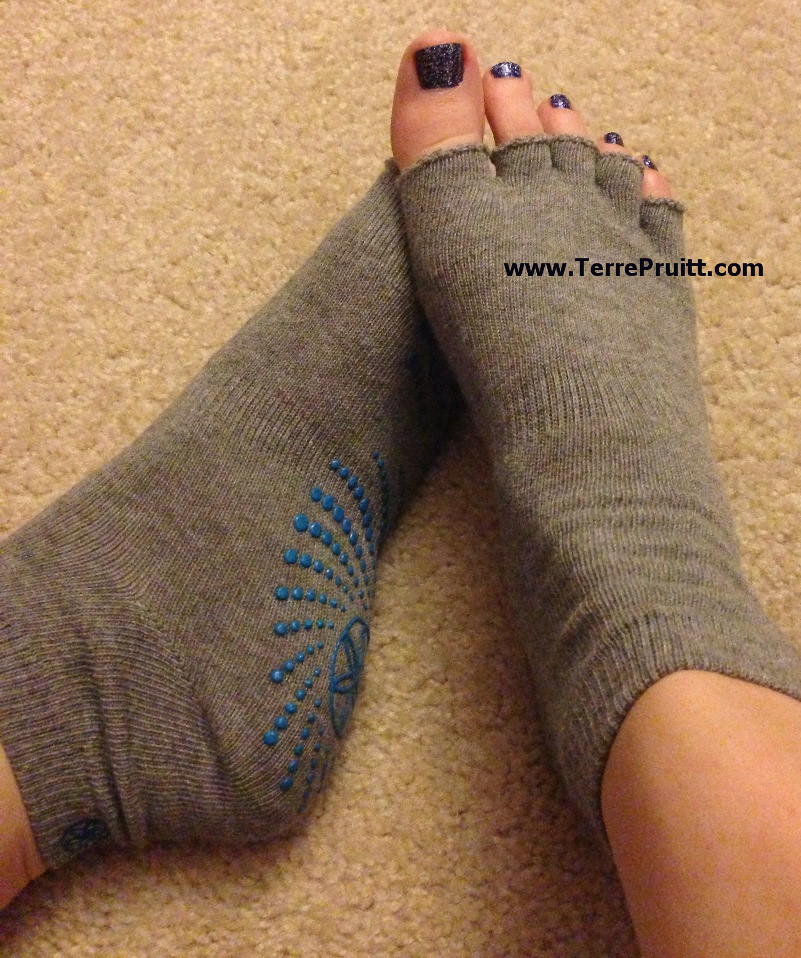
Nia was designed to be done in bare feet. I believe that yoga is also supposed to be practiced in bare feet. But there are many reasons as to why people want to have something on their feet. Many reasons why people don’t like “naked feet“. Some people don’t like to be barefoot in public places (and with that there could be many reasons). Some people need support of shoes for their comfort and health. Some people like to have traction built into their footwear. Since Nia is designed to be done in bare feet we do not spin on our feet we lift them up so having a little bit of traction does not interfere with our movement, whereas in a Zumba class where you are often twisting on your feet you do not want traction. What someone has come up with for yoga are toe less socks with traction on the bottom. I had a friend give me some as a gift. She was so sweet and said, “I know you do Nia barefoot, but I thought you might like these.”
While I love to do Nia barefoot there are some floors where the toe less socks come in handy. Some floors that I dance on or have danced on have a texture to them that is not very comfortable on the feet. Some floors are really dirty (without access to a dry mop or broom) and so the layer of fabric between the foot and the floor helps to keep the grit from digging into my feet and being uncomfortable. The fact that the toes are exposed give me a bit of a barefoot sensation. Allowing the toes to come in contact with the floor and keeping those nerves activated. The energy flowing from the earth and to the earth via the exposed toes.
For yoga these are great because the textured bottom of the sock allows for traction if sliding is an issue for you. The texture also assists in keeping you from spinning on the foot when doing Nia. Ha! I just realized it might help stop that altogether. It is possible to spin, twist, slide on your bare feet although you might end up with blisters. But with the traction on the bottom of the sock it stops you in your tracks. You are unable to spin, twist, or slide.
Maybe the yoga socks could act as “training wheels” for some. If at first exercising barefoot seems odd, maybe the socks can help ease you into it. Perhaps the socks could also assist in training people not to spin, twist, or slide, so when they do decide to go barefoot for their Nia workout they will already have the know-how of lifting the feet.
Whatever the person’s reason for not going barefoot, toe less yoga socks might be a great solution. I do want to say, just so you know, when in my Nia classes as long as the facility allows shoes (some yoga/dance studios do not allow shoes), everyone is encouraged to be comfortable so when wearing shoes allow people to be comfortable then they are invited to do so.
Last week I cancelled my Monday and Wednesday Nia class and got a substitute for my Tuesday Nia class with the City of San Jose. I decided to take the next level of Nia training. I was a White Belt, now I am a Blue Belt. Nia calls their trainings intensive. I cannot assume to know why, but I am glad they do. They are very intense. The training is part lecture and part moving. The moving can be dancing or types of exercises to further the learning process. People tend to learn better when they are doing, so there is a lot of doing. In my rough calculations it was about 53 hours of instruction, including the Master Classes. It was Saturday through Friday. It was exhausting. It was energizing. It was incredible. As I have mentioned before and I will continue to mention Nia is a cardio dance exercise. Come to a class. Move. Have fun. Sweat. Get your workout in. But Nia is also a practice. I compare it to yoga in that a person can go into a yoga class and work out and do the exercise and then leave and not give it a second though. Or they could give it a second thought. They could take on some of the aspects of yoga, they could practice breathing and/or meditating or anything else that might be attached to their yoga class on a deeper level. That is what a person can do with Nia too. So some people take the intensives for self-growth with no intention of teaching at all. Even if they are not planning on teaching or are not currently doing so, the training is just as intense.
Each belt level has its own focus and intent. Blue Belt focus is Communication, Relationship and Intimacy with the intent to energize personal connection through self-discovery and communication by following The Body’s Way. Sounds like a lot. Ok, it IS a lot. LOL!
In addition to a focus and intent, each belt level (aside from Green) has its own set of principles. With the Blue Belt, the principles were made to layer onto or over the White Belt Principles. Some of the information is very close to being the same, but with a little more added to it. It is very interesting the way Nia does things. It is very amazing the training they come up with and the delivery of it.
In this training we were shown many things, one was an enlightened way to use the Nia 5 Stages or the Developmental Anatomy to measure all types of things and where we might be in a process. It is a pretty cool tool. It is part of the Body’s Way.
I am 100% positive I will have more posts regarding the Blue Belt Intensive, the Blue Belt Principles, and my thoughts on it all. I am still processing it right now. My mind is racing with thoughts, ideas, things I learned, things I didn’t learn, just a lot of things. There is so much that I want to share. There is also a lot I don’t want to share. Nia is not a secret society by any means. There are no secrets to the intensives, in fact most of the information is things that have been around for as long as I can remember. The information is stuff you have probably heard before. It is just the WAY they deliver it. And the way it is connected to the body that is somewhat unique. If I decide not to share something or talk vaguely about some things it is because I don’t want to ruin the surprise of some things for those of you that will be taking the Blue Belt. Since the Blue Belt Principles are layered onto the White Belt Principles I will probably write more post about them too. And we will see what comes up. I have chosen to participate in Nia as a practice. For now, I will revel in Blue!
Is there something that you have in your life you consider a practice?
Nia is both a dance exercise and a life practice. Kind of like yoga. You can go to a class and get the exercise you want and have it end there or you can learn about its principles and take them into your life. There are levels of the practice. Nia has chosen to use a “belt” system as their levels. Instead of just having numbers or names, they have assigned belt colors to the levels. There are five levels; White Belt, Green Belt, Blue Belt, Brown Belt, and Black Belt. The intensives to gain the belts can be taken and enjoyed by people who aren’t teaching. Each belt has 13 principles, except Green. Green does not have its own set of principles because green is the belt level that is actually designed specifically for teachers and helps them hone their teaching skills. It delves into the 13 principles of the White Belt. The White Belt’s principle #4 is FreeDance. FreeDance as a practice has eight stages. I have posted about eight through two. This post is about stage one. Stage #1 of Nia’s 4th White Belt Principle is Freedance – Anything Goes (movement wise).
While you are dancing any movement is great if it is authentic movement. With Nia there is choreographed moves, but within the patterns of movement there is the ability to freedance. Also with many routines there is sometimes just freedance where we are allowed to dance free to the music without any choreography. Stage one: Freedance, anything goes, allows us the greatest of freedoms. You can dance using the wall, the mirror, a chair, the floor, or a ballet barre that might be in the room. You can dance fast, slow, high, low, or in the middle. Anything that you sense your body wants to do to the music. It is up to you.
The idea with freedance is to just let the body go. Don’t think about it. When you think about it often comes the judgment. Sometimes the judgment can interfere with movement, especially if it is judgment along the lines of, “Oh I must look silly doing this.” “Oh that probably isn’t pretty.” “Oh, I am not graceful enough to spin.” “Oh, I need to do this or that.” This is all inner dialog that clogs up the muscles and their movements.
Freedance also, as I believe I’ve mentioned before, in not club dancing. We are NOT just bouncing or undulating to the beat, we are moving to the music. We are moving our bodies towards as pleasurable sensation of health and well being.
Freedance is also not patterned dancing, we save the patterns for our choreographed movements. Freedance is just free. It is spinning twirling, diving and whirling. It could be hopping or dropping. It really is whatever your body does.
Freedance is not easy. It takes practice. It is not easy to just be on the floor and not think about how you are going to move and just let your body go. It is a challenge. But once you can stop thinking and talking in your head you will find yourself moving to the music. Sometimes you might even notice that you are moving in a way that you didn’t think about and it is really amazing to have that sensation. But don’t think too much, just keep moving.
I would like to invite and encourage you to make some space in your home or if you are so inclined find a space to dance outside . . . find a space turn on some music and just dance. Let yourself go. Let yourself be free. Allow the time, space, frame of mind and spirit to freedance. Remember, anything goes!
Wahoo! I have to add that in the middle of typing this up I secured another class to sub for the City of San Jose. So exciting to be able to share Nia through the city! Yay!
Nia is a cardio dance workout. We turn on music and we dance. We have Nia routines that we do to certain music or we can put the patterns to different music. We are not limited to these two choices this is just an example. We dance to music, we have fun, we don’t even realize we are exercising. To me, it is “like” Zumba in that way. But Nia is a practice. Nia has different levels and each level has principles. If you choose to experience the different levels you can, but even if not the principles of Nia can be applied to the workout and to life. To me, Nia is like Yoga because of the fact that some of the “stuff” you do in a workout can be applied to life. Since the ideas and principles of Nia can be applied to life they are not necessarily “new”, most of it is not made up by the creators of Nia. Some of it you might recognize and have heard elsewhere. It is the way it is applied and put together. I have stated this before . . . that things are not new, so you aren’t imaging that. I do like to repeat it because a lot of people have not heard of Nia so they might think it is something new and “way out there”, but it is not, it is based on science and things you know. Some of the things I am learning are things that I have to continue to “practice”. 🙂
Here are a few of the things, in no particular order:
–It is ok not to be perfect. That is not really the way we state it when we talk about it, but I have started many posts with what we really say and maybe one day I will post one, but I am not ready to deal with the spam and odd comments I might receive from our actually verbiage of this same idea. But basically we don’t have to do things perfectly. Which is really great because there really is no such thing.
—The Four Engery Allies are always something I am having to practice. (Speak with impeccability / Don’t assume anything / Don’t take anything personally / Always do your best)
–Even silence is music. We actually practice listening for the silences in our music. A lot can happen in a silence, it could be a birthing place for something spectacular. Or it could just be a place of rest and calm. Either way it is sometimes something to look forward to.
–Natural Time is a gift. Moving and living in ones own natural time and not having to do everything by the clock that society runs on, is not always possible. There are some things you just have to do, so when there is an opportunity to move and live in natural time I take advantage of it and I consider it a treasured gift.
–Live in the moment. I am always doing one thing and thinking another. We live in a society of multi-tasking. It is celebrated and even rewarded, but it is not joyful nor rewarding. Sometimes I forget why I walked into a room because I started walking there to do something and then after the first two steps my brain has already jumped to the next task. So I arrive in the room thinking, “What am I doing here? I know what I want to do when I am done with why I came in here, but I don’t know why I am here.” So this is something I am always having to practice.
All of these things are things we learn in our Nia workout. We don’t have to dance perfect, we have our energy allies when we dance, silence can be part of our movement, we move in our own natural time, and we move in the moment and dance to the music. All of these things work in and off the dance floor. So Nia teaches me a lot and it continues to teach me.

 The Nia 5 Stages are the stages we go through in development. Stage one is Embryonic. Stage two is Creeping. Stage three is Crawling. Stage four is Standing. Stage five is Walking. First we are in the womb, then most of us creep, then we crawl, we stand (squat), then walk. Stages of human development. Stage four, “Standing”, is a low or full squat.

 Terre Pruitt's Blog