Posts Tagged ‘Nia Practice’
Posted by terrepruitt on November 30, 2013
I am certain that I have mentioned the fact that Nia changes. Like many things it grows, it morphs, it improves, it changes, yet it remains the same. The basics stay the same. The core of it stays the same, but as time goes on it morphs. Sometimes it is the verbiage and the names of things, but it basically stays the same. It has been a year since I have taken the Nia Blue Belt Intensive. In that intensive we were given a Manual from August 2006 and while we were being trained we were told that a new manual was soon to be released along with some new ways of explaining, talking, and learning things. So part of what I quote here might be a little different from what is being taught now, but the idea and the process is the same. The process is Creating Space.
In an intensive, before every session we gather and create the space. This practice was discovered as something done in martial arts. Debbie Rosas and Carlos Rosas, the creators of Nia, recognized its value and brought it into Nia. It is the responsibility of the participants to create the space. It is the responsibility of trainers to hold the space.
The Blue Belt Manual states: “Creating space is the conscious act of preparing the environment, which includes your body.”
It is an incredibly powerful act that enables an individual and a group to become prepared for receiving. It is — at its core — coming into stillness. In preparation for creating the space we use a prescribed process. There is a schedule that is kept. A bell is rung seven to ten minutes before we are to start creating the space. This allows for people to wrap up any conversations they might be involved in and to do any last minute things that need to be done. Then there is a five minute bell and another one at one minute. Then, the students create a circle in which we sit quietly while we create the space. The things we do is quiet the mind, stop the inner dialog and just let the mind rest and become open to hearing and receiving the teaching that is about to happen. The body is also stilled. The emotions are balanced and not taking over. We are connected to our higher self . . . the manual says, “open, but you are not seeking at the moment”.
A main point is to not allow for distractions of any kind. No physical distractions . . . that is one reason why we sit still. No mental distractions . . .that is one reason why we stop the inner dialog and the thinking. All four bodies, Body-Mind-Emotion-Spirit (BMES), are stilled.
The space we create is “a way to set up an energy environment that supports your practice and learning.” It really is a very helpful and powerful tool to help with the learning process. We continue to sit in the space until the trainer interrupts us by thanking us.
I believe that many things could benefit from the creation of space; a meeting, family dinner time, Nia classes, a yoga practice, any exercise, and many more. I think it is a good idea sometimes to clear your head and body of distractions in order to concentrate fully on the “task” at hand. I know that for me this practice really works well in the intensives.
Is this something that you think you could benefit from? What types of tasks or activities do you think you could create space for?
Posted in Nia | Tagged: BMES, Body-Mind-Emotion-Spirit, Carlos Rosas, creating space, Debbie Rosas, inner dialog, martial arts, Nia, Nia Blue Belt, Nia class, Nia creators, Nia Intensives, Nia manual, Nia participants, Nia Practice, Nia sessions, Nia students, Nia trainers | 2 Comments »
Posted by terrepruitt on November 5, 2013
Nia is a cardio dance workout. Come to a class, dance, sweat, get a workout. Nia is also a practice, like yoga is a practice. Just like yoga you can go to a class, participate, and get a good workout in and go home. Or you can take some of the ideas and principles with you into your daily life. If you chose, you can decide to apply some of the body mind “stuff” to your daily life. All up to you. Now the reason I explain all that is because – keeping in mind that Nia is a practice (for those that want to take it that far) – there are a lot of things to, well, practice. And Nia HQ is great about creating and supplying continue education for its members. Also, it is great about writing articles to help people learn more about the practice of Nia. One such article that was recently posted is Move Beyond Your Comfort Zone.
It talks about how each individual has different comfort zones so that “moving beyond” would be something different to each individual. It reminds us that moving beyond the place where we feel comfortable is “the best thing to keep the body and brain strong”. It shares a story and gives examples of comfort zones. I do hope you click the link above and pop over to NiaNow to read it.
Here I am going to share other ways that Nia helps us do “the best thing to keep the body and brain strong” by helping us out of our comfort zone. One way is dancing to music we don’t like. I know . . . I can hear a lot of people say, “But WHY?” Well, that is part of moving out of our comfort zone. There seems to be some beats that just call to everyone. That one song that is popular on the radio that gets everyone’s foot tapping and head bobbing. Those songs are easy to dance to. The universal dance song. But the songs that come on that you might find yourself reaching for that tuning knob are great songs to step out of the comfort zone to dance to. They are the ones that your regular, normal, COMFORTABLE dance moves just might not fit with. The song that might have you using different muscles than you are used to. The song that might have you moving in an entirely different way . . . . away and out of your comfort zone. That is one reason why that Nia routine might have one of THOSE songs in it.
Then there is the song you just love. The second it begins to play in class you are so ready to just sink into it, then your teacher says to move in a way that is in COMPLETE contradiction to the tone of the song. “WHAT? You want me to do a strong block to this sweet, sweet melody?” Moving in a way that seems opposite from what the music is “telling” you can be WAY out of some people’s comfort zones. It is a great way to keep the body and brain strong.
Playing with emotions and acting “as if” can be beyond some comfort zones. Allowing yourself to just let go and dance without caring what you look like or if your “form” is perfect can be a big step away from some people’s comfort zones. In one of my posts recently, I wrote about “messing up” . . . . . that can be MILES away from some people’s comfort zones. Sounding can really be a big stretch for some individuals. Not everyone is used to making noises while they workout.
These are just a few examples of what we do in Nia classes to help us step out of our comfort zones. As stated, the reason is to work the brain as well as the body. Moving out of our comfort zone helps mix it up. Keeps the body and brain moving in different ways. So the next time you feel resistance, let go and know you are doing something good for your body and brain.
Are you ready to step out of your comfort zone?
Posted in Nia | Tagged: cardio dance workout, cardio workout, comfort zone, Mind-body practice, mind-body workout, Move Beyond Your Comfort Zone, Nia, Nia class, Nia HQ, Nia Practice, Nia principles, Nia routine, sounding, Yoga, Yoga class, Yoga Practice | 6 Comments »
Posted by terrepruitt on October 31, 2013
Sometimes in Nia we do yoga poses, I have yet to do the sphinx in a Nia class, but I do include it in the Gentle Yoga class I am teaching. I think of it as a nice gently backbend. I think of it as a regal pose. I think of it as a spine lengthener and a back strengthener. I like the Sphinx Pose.
Although, according to Wiki, the Sphinx is not nice:
“A sphinx is a mythical creature with, as a minimum, the body of a lion and a human head. In Greek tradition, it has the haunches of a lion, the wings of a great bird, and the face of a woman. She is mythicised as treacherous and merciless. Those who cannot answer her riddle suffer a fate typical in such mythological stories . . . ”
Ha, I think I will stick with the idea of regal.
The Sphinx Pose is another prone pose, where you are lying on your belly. Your legs are together, touching, and straight out behind your body. Start face down, with your arms stretched out on the ground above you, as if you are reaching above your head. Before bending back, gently press your pelvis towards the earth, lengthening your tailbone towards your feet. As you lift your head and chest up off the ground, bring your arms back. Stop when your elbows are directly underneath your shoulders. Or you can bring your hands up by your ears and gently push up into the backbend. Adjusting your hands so that your elbows are directly under your shoulders. You are resting on your elbows and forearms, palms down, fingers together.
Continue to keep your legs together, while your toes are reaching toward the opposite wall/direction. Your back is active, while your arms are supportive. Reach with your chest somewhat upward and open. Your shoulders are back and your shoulder blades are pressing gently toward the earth.
Your gaze is forward and your posture is regal. You are strong and confident. Breathe into the pose. Hands, arms, neck, back, and legs are all active yet not tightly clenched.
(11/17/21: Click Picture The Great Sphinx for a picture.)
Stay for a few breaths or as long as your practice dictates. Release and lower to the floor, allowing your head to turn to the side. Rest your head on your hands and repeat as desired.
This is a nice gently backbend that can be the next backbend after learning the locust pose, if your practice is one in which you are progressing from a small backbend to a “bigger” backbend. These (the Locust Post and the Sphinx Pose) can be preludes to the Cobra and the Upward Facing Dog. Of course, this is a great pose to practice even if you are already doing the other backbends.
This pose is great to help strengthen the muscles in the back.
If necessary a rolled towel can be placed under your pubic bone in the shape of a U to provide cushion. The U would be “hugging the belly”.
Do you have backbends in your practice? Is sphinx one that you do? What backbends do you practice?
Some Benefits Of Doing Back Bends
Posted in Yoga/PiYo/Pilates | Tagged: back strengthener, Cobra pose, gentle yoga, Greek tradition, mythical creature, Nia, Nia class, Nia Practice, regal pose, sphinx pose, spine lengthener, Upward Facing Dog, Wiki, Yoga class, Yoga Practice | Leave a Comment »
Posted by terrepruitt on September 5, 2013
When I typed in the word practice this is what came up in Google:
prac·tice /ˈpraktəs/
noun
1. the actual application or use of an idea, belief, or method as opposed to theories about such application or use.
2. repeated exercise in or performance of an activity or skill so as to acquire or maintain proficiency in it.
verb
1. perform (an activity) or exercise (a skill) repeatedly or regularly in order to improve or maintain one’s proficiency.
2. carry out or perform (a particular activity, method, or custom) habitually or regularly.
Nia is a practice. Yoga is a practice. Playing a musical instrument takes practice. One does not just step into a Nia class and do it exactly right the first time. One does not move into a yoga pose and get it exactly right the first time. One does not start to play a song and do it exactly right the first time. It all takes practice. With Nia the emphasis is on the body’s way. I have said it before, but I will say it again, there is a right way to do the moves, the body’s way, the way the body was designed to move. But every body is different. Some bodies do not move the way they were designed. Some bodies never will, but some just need time. Yoga is a little different in that the positions are a bit more exact, but still, if your body does not move or bend that way do not force it. It could be that your body needs to work toward that pose, it needs to practice or it could be that the actual structure of your body will not allow for the exact post to be attained. Either way it is a practice.
Nia is more forgiving. Since it is a dance there is a lot of room for freedom. With yoga people expect there to be one way to do the pose but again, not exactly true. The individual’s body needs to be taken into account. Some bodies will just not bend or fold certain ways. They might be able to bend more or fold more than the first time a yoga asana is attempted, but it might never look exactly like that magazine picture. Most pictures of people in yoga positions are just like that of high fashion and/or make up models. They are the exception not the norm. They are showing an example of what the pose in its absolute perfection is supposed to look like. They should be required to disclose how many years that person has been doing yoga or how long they were actually in that pose. JUST like people are telling young girls to give up the idea of looking like the women in magazines, some people need to go a little easier on themselves when it comes to yoga poses.
The idea is not “to look like the picture” but to be better and more comfortable at doing the pose as time goes on. In the picture the person might have their elbows on the ground and when you start you can barely touch the floor. Well, the proper way to learn (at least one way . . . another is props, but for this example we are using progression) is to practice until you can touch the floor. Practice with good form. Then practice until you can stay touching the floor – with good form. Then practice until you can stay longer each time at touching the floor – with good form. Don’t injure yourself trying to put your elbows on the ground and all the while not achieve good form.
I do not believe that practice makes perfect. Practice just makes time get used up. But good practice, practice with good form, practice that allows you to get better than you were is good. “Perform (an activity) or exercise (a skill) repeatedly or regularly in order to improve or maintain one’s proficiency.” Yeah that. Being patient with oneself and allowing one to practice and make it good practice will get one further on a the path of proficiency than just trying to get to that pose without working into it. While we all know this, I was reminded that many of us need to be reminded of this.
Nia is a practice. Yoga is a practice. Playing a musical instrument takes practice.
How are you are practicing? Do you like the process of learning or do you like to just jump right in and do it right and all the way the first time?
Posted in Exercise and Working Out, Nia | Tagged: body's way, dance practice, Google, Nia, Nia class, Nia exercise, Nia Practice, practice makes perfect, practice methods, yoga asanas, yoga poses, Yoga Practice | 2 Comments »
Posted by terrepruitt on June 29, 2013
 Nia was designed to be done in bare feet. I believe that yoga is also supposed to be practiced in bare feet. But there are many reasons as to why people want to have something on their feet. Many reasons why people don’t like “naked feet“. Some people don’t like to be barefoot in public places (and with that there could be many reasons). Some people need support of shoes for their comfort and health. Some people like to have traction built into their footwear. Since Nia is designed to be done in bare feet we do not spin on our feet we lift them up so having a little bit of traction does not interfere with our movement, whereas in a Zumba class where you are often twisting on your feet you do not want traction. What someone has come up with for yoga are toe less socks with traction on the bottom. I had a friend give me some as a gift. She was so sweet and said, “I know you do Nia barefoot, but I thought you might like these.”
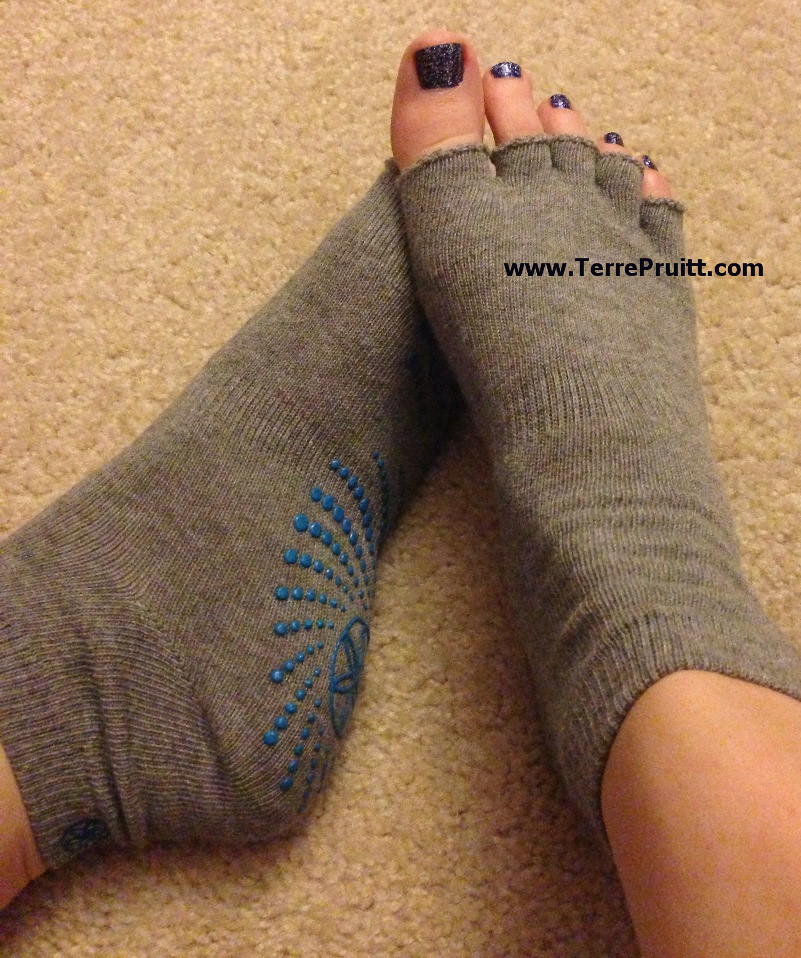 While I love to do Nia barefoot there are some floors where the toe less socks come in handy. Some floors that I dance on or have danced on have a texture to them that is not very comfortable on the feet. Some floors are really dirty (without access to a dry mop or broom) and so the layer of fabric between the foot and the floor helps to keep the grit from digging into my feet and being uncomfortable. The fact that the toes are exposed give me a bit of a barefoot sensation. Allowing the toes to come in contact with the floor and keeping those nerves activated. The energy flowing from the earth and to the earth via the exposed toes.
For yoga these are great because the textured bottom of the sock allows for traction if sliding is an issue for you. The texture also assists in keeping you from spinning on the foot when doing Nia. Ha! I just realized it might help stop that altogether. It is possible to spin, twist, slide on your bare feet although you might end up with blisters. But with the traction on the bottom of the sock it stops you in your tracks. You are unable to spin, twist, or slide.
Maybe the yoga socks could act as “training wheels” for some. If at first exercising barefoot seems odd, maybe the socks can help ease you into it. Perhaps the socks could also assist in training people not to spin, twist, or slide, so when they do decide to go barefoot for their Nia workout they will already have the know-how of lifting the feet.
Whatever the person’s reason for not going barefoot, toe less yoga socks might be a great solution. I do want to say, just so you know, when in my Nia classes as long as the facility allows shoes (some yoga/dance studios do not allow shoes), everyone is encouraged to be comfortable so when wearing shoes allow people to be comfortable then they are invited to do so.
Do you ever exercise barefoot?
Posted in Nia | Tagged: bare feet, barefeet, dance class, dance studio, naked feet, Nia, Nia class, Nia Practice, toe less yoga socks, training wheels, Yoga, Yoga Practice, yoga socks, yoga studio, Zumba, Zumba class | Leave a Comment »
Posted by terrepruitt on June 27, 2013
Stepping Back Onto The Ball Of Your Foot is certainly not unique to Nia. Many dance modalities incorporate this move. In fact this move is incorporated into every day life. How often are you moving forward only have to stop and move back? You could be in line at the store or anywhere when the person in front of you moves back towards you so you take a step back. While you might not “hang” out on the ball of your foot as we do in Nia you more than likely don’t take a step backwards heel first.  So, yes, Nia has taken moves that might be done in other dance practices, martial arts, and even everyday life and put them in their list of Nia’s 52 Moves. Nia then weaves the moves into the Nia Routine choreography. This move Stepping Back Onto The Ball Of Your Foot is part of our Base Moves. It is done with the feet and legs and they are a part of the base.
This move is described on page 123 of the Nia Technique book written by Debbie Rosas and Carlos Rosas and you can purchase it from Amazon.
As I have said many times there is a proper way to do all moves and while you are practicing them and learning them you do it the proper way. Then as you come across it in a Nia class while doing a Nia routines your body will know the proper way yet be able to adapt to the choreography that you are dancing at the moment.
So to practice this move you can start in Open Stance. Then with one leg step back onto the ball of foot. When stepping back pull the leg straight behind not to either side. Keep the foot parallel to the stationary foot, don’t turn the heel. As is indicated step back onto the ball of the foot. Keep the spine up and the heel high off of the earth. Then shift your weight onto the foot of which you just stepped back on and take the other foot off the ground.  Your torso is upright, pelvis, chest, shoulders, chin, eyes facing forward. Do the same movement with the other foot. You don’t necessarily always have to start in open stance.
After you are comfortable with the stationary start, walk around and stop and step into the move.
This move helps with the mobility and flexibility in the foot. It also helps create or improve stability in the ankle. It helps with balance, especially if you hang out for a measured amount of time on the ball of your foot!
At the moment I can think of one routine in which we step back onto the ball of foot as a large portion of one of the dances. I know we step back all the time, but in this routine I think of one of the songs as “showcasing” this move. The choreography calls for lifting the leg of the foot that is off the ground. Or doing a knee lift. So that is a good example of the variations that Nia choreography uses with its 52 Moves.
Well, what do you think about this move? Can you see how it helps with mobility and flexibility in the foot?
Posted in 52 Moves (of Nia), Nia | Tagged: Amazon, Base Moves, Carlos Rosas, dance modalities, dance practices, Dancing, Debbie Rosas, especially if you hang out for a measured amount of time on the ball of your foot, flexibility, helps with balance, improve stability, knee lift, martial arts, Mobility, Nia, Nia class, Nia Practice, Nia Routine Choreography, Nia routines, Nia Technique Book, Nia's 52 Moves, open stance, Stepping Back Onto The Ball Of Your Foot | Leave a Comment »
Posted by terrepruitt on June 8, 2013
In Nia we often say while dancing, “Everybody sense your . . . ” (For more see: Nia White Belt Principle #13 Teaching What You Sense.) This is to help bring attention to specific body parts. It could be because we are doing a specific move and we want to have the student’s attention on that body part. It could be that we feel a body part just needs attention. It could be that we want the students to move in a different way. Sensing a body part though does not require movement of that part. If I were to say right now, “Everybody sense your hand.” I wouldn’t necessarily mean for you to move your hand. I mean for you to sense it. Recently on Facebook I posted, “EveryBODY sense your trachea!!!!!! Breathe . . . . . . . .” and one of my friends asked HOW? Fabulous question. How do you sense your trachea? No, really how do YOU sense your trachea? How do you sense any of your body parts?
 As I said, sensing a body part does not necessarily mean moving it. It could, if that is how YOU bring attention to a part and if that is how YOU sense it. It could mean you LOOK at it. Maybe looking at it helps you sense it. It could mean you touch it because you want to cause it sensation so that you can sense it. There are many ways to sense a body part and we all have different ways of doing it. Some might start with closing their eyes and picturing it in their head. Some might just think of it and be able to sense it right away. Part of the practice is the discovery of how we sense different body parts.
For sensing your trachea I thought that one way an individual could do it was by breathing. That might help you sense your trachea. Sensing your breath coming in and out might help. Maybe coughing would help? Maybe meditating on it? Maybe touching it? There really are so many ways to do it and it is up to the individual. Sensing body parts could even take practice. Maybe each body part is different. Perhaps you can easily sense your hand without looking at it, moving it, or touching it, but since you might not often “sense your trachea” it could take a little bit of thought and practice. Again . . . . the wonderful journey that is Nia and sensing your body.
Often times we don’t even give a second thought to a body part, unless it is in pain. Unless it SCREAMS at us for attention we might never stop to listen to it. We might never stop to sense it. There are so many reasons to sense your body . . . I have already stated just a few that might come up while in a Nia Class. I am sure you can think of many others.
This is one of the things we do in Nia that can be carried out into life and as we like to call it as we “dance through life”. This is one of the things you can do that makes Nia “practice”. You can practice sensing your body parts throughout the day. Back to the “pain” part of attention . . . say you have pain in your knee, you are going to want to sense it as you move throughout your day so that you can move in a way as to not cause more pain. Another example if you’re wanting to straighten up your posture a little bit you might want to practice sensing your spine or your shoulders during your day. As I said, many reason to play with and practice sensing your body parts. And it really is an individual thing. You do it in your own way.
Starting with body parts you can see and touch might be a good place to start if you are needing a suggested starting point. That way looking or touching can be the beginning of the sensing journey. Either way, if you let yourself be open to it, I am sure you will find a way.
So how do YOU sense your trachea?
Posted in Nia | Tagged: Dancing, everyBODY, Facebook, Nia, Nia class, Nia Dance, Nia Practice, Nia students, Nia White Belt, Principle #13, Sense your, trachea | 2 Comments »
Posted by terrepruitt on May 9, 2013
I teach Nia. I actually like to say I lead Nia because to me teaching a dance is more instructive. What I think of as teaching is the type of class where the instructor demonstrates a step or two then the students do the steps a few times, then the instructor demonstrates more steps and the students practice them. Eventually the steps are strung together in a dance. But in my Nia cardio classes it is just lead follow. I do – you follow. I give verbal instructions and/or verbal guides but it is not the type of instructional class where I show you, then you do, then we practice and then we string all the steps together. So I guess it is not an “instructional” or “instructed” dance class. But I do teach by example. You follow my lead. In order to be a Nia teacher I had to take the Nia White Belt Intensive. I have talked about this before, but to review the White Belt is the first level of Nia. The White Belt Intensive is over 50 hours of instruction and is open to anyone. Individuals do not have to have the intent to teach. The Nia White Belt Intensive is about the body so anyone is welcome to join and learn. In order to be a Nia teacher there is an additional licensing fee. The fee is due annually and it includes four routines that we, as teachers, agree to learn per year. I was just looking at my DVDs. I have two routines that I have not learned. I have 19 that I have learned. I have been teaching almost four and half years so I am keeping up with the four per year schedule.
Now, I want to clarify that I have learned 19 routines. That means that I basically did the bars and have shared 19 routines with my students. That means I roughly know those 19 routines. I could stand up right now and lead you through some of them, but some of them I would have to look at my bars, and some of them I would have to study my bars. But I also feel I am better at just doing. While I want to do the routine as per the choreography, I am not as afraid as I once was to just DO the routine.
 When I am preparing to do a different routine for my class sometimes I have a chance to practice and sometimes I don’t. I will look at my bars for each song. Sometimes I look at the first few lines and think, “Oh yeah, I know this one.” Then when I am leading it my body and my mind don’t remember it as well as I thought and I just dance through it, but then when I get home I look more closely at my bars or re-watch the DVD. It really is about moving and having fun. As long as we are moving and we are doing it close enough then it is good. Then, like I said, I come home to get the choreography better established in my head and body!
The routines I have learned are:
Alive – Carlos AyaRosas
Amethyst – Debbie Rosas
Aya – Carlos Rosas
Beyond – Debbie Rosas and Ann Christiansen
Birth – Debbie Rosas and Collaborators
Canta – Carlos Rosas
Clarity – Carlos Rosas
White Belt Dream Walker – Carlos Rosas
Earthsong – Carlos Rosas
Global Unity
Humanity – Carlos AyaRosas
Miracle – Carlos Rosas
Opal – Debbie Rosas
Passion – Debbie Rosas and Carlos Rosas
Sanjana – Debbie Rosas
San Medusa – Helen Terry
Sexi – Carlos Rosas
Velvet – Debbie Rosas
Vibe – Debbie Rosas
The names of the routines that I have on my shelf that I need to learn are Butterfly and Oshun. I just renewed so I have four routines that I need to pick out as my new routines. Picking routines is always a challenge because everyone has such different tastes. Some people LOVE, LOVE, LOVE some of the routines I have and I don’t love them. So for me it is a difficult decision. I try to pick routines that I think my students will like, but then that is just a guess. I know which ones they like out of the ones I teach because they request them often.
If you were just picking a routine from the name which one would you pick? As a Nia student which one out of this list is your favorite? What about Nia teachers, which is your favorite out of this list?
Posted in Nia | Tagged: Ann Christiansen, Canta, cardio class, cardio dance exercise, Carlos AyaRosas, Carlos Rosas, dance exercise, dance instructor, dance teacher, Debbie Rosas, Dream Walker, Earthsong, Global Unity, Nia, Nia bars, Nia choreography, Nia Dance, Nia DVDs, Nia licensing, Nia Practice, Nia routines, Nia stuents, Nia Teacher, Nia White Belt, Nia White Belt Intensive, Opal, Sanjana, Sexi | 10 Comments »
Posted by terrepruitt on March 28, 2013
Nia is a great dance exercise. Go to a Nia Class and get a great workout. It is also a practice. As with any practice there are workshops. In one particular workshop produced by Danielle Woermann and led by Helen Terry we were reminded to go slow. Helen was here teaching us her adaptation of a Nia Routine to a specific album. Helen is hilarious. She is down to earth, professional, wonderful to listen to (she has an English accent), and currently living in Texas. The “currently living in” needs to be mentioned because of one of the stories she shared with us . . . but before I get to that let me tell you something she reminded us of. She reminded us to go slow. I know often times I want to rush moves . . . that could mean doing it faster than it needs to be done or not “staying through my enoughs”. But either way the idea is to slow down. When I slow down I can be aware of more. I can pay more attention to a move or even to my class. There seems to a tendency to rush, could be our lifestyles and/or society, whatever, so the lesson was to slow down and the result could be catching a chicken.
There is one song in particular in her adapted routine that I am severely challenged in slowing down. It just seems so incredible slow. I have not yet been able to FEEL/SENSE the music and I have been doing the routine for a month. Which, with the current way I am structuring my San Jose Nia classes, equates to eleven times, thus far. I have done it correctly, but only when I am COUNTING. Yes, I am having to COUNT in order to get it. For this song I really have to learn to listen, sense, feel, taste, hear, smell, become the music in order to slow down. I have even announced to the class so I have a better chance of doing it, “We have to go really incredibly slow here.” Sometimes I have to close my eyes so I don’t see them rushing through and join them. S L O W. (Where’s that chicken?)
 Slow down. Work the muscles. Enjoy the song. Enjoy the movement. EnJOY. SLOW. Geez . . . it seems so difficult to slow down sometimes. Sigh. But really often times slowing down in combination with “staying with the enoughs” (as I already mentioned) helps in catching those chickens! Ah-ha, here we are . . . . at the chicken story . . . (remember this is coming from a person who is currently living in Texas!).
I might not have the details exactly right, but you will get the point. Helen said that one day her husband and her neighbor were going to work on building a table. The neighbor says, “Let’s go catch some chickens.” This sounded very odd to Helen because they were building a table not catching chickens. So she asked her neighbor what he meant. He said that when he was young his mother used to send him out to get dinner. He said that he would go outside to do the task, sometimes he would end up with a handful of feathers and sometimes he would end up with a chicken. A handful of feathers means not quite getting it. So catching the chicken is when task is accomplished! Makes sense!
In dancing this routine all month, I have enough feathers to fill a king sized down comforter! So . . . see there? Feathers really aren’t all THAT bad. Feathers can be useful. Feathers can be fun. A handful of feathers does not ruin a Nia class or even the moment, but it is NOT a chicken. When you hit the mark, the music, the cue just right that is catching a chicken.
Whatever it is, whether it is slowing down or staying with the enoughs, or learning the music really well, it is a great feeling to catch that chicken. When you attend one of my Nia classes you might hear me sputter and/or you might hear me “bacbac”. When you do, you will know either I grabbed a handful of feathers and the escaped ones are floating at me causing me to sputter or I caught that chicken!
You know what we’re talking about when we say, “Catch a Chicken”, right? Isn’t that a great feeling? Do you ever feel the need to slow down?
Posted in Nia | Tagged: catch some chickens, dance exercise, Dannielle Woermann, handful of feathers, Helen Terry, Nia, Nia chickens, Nia class, Nia Practice, Nia routine, Nia trainer, Nia workout, Nia workshop, staying through your enoughs, Texas Nia teacher | 8 Comments »
Posted by terrepruitt on January 10, 2013
There are six stances in the 52 Moves of Nia. Closed Stance, Open Stance, “A” Stance, Riding (Sumo) Stance, Bow Stance, and the Cat Stance. Each stance has a sound associated with it for practice. There are benefits to doing each stance. All of them help with balance. With the cat stance the balance is on one foot. The cat stance is a stance in which you stand on one leg, using your whole foot. The leg you are standing on is not rigid, but the knee is soft, as if you were going to pounce. The spine is upright, hips are level, not pointing down nor up. The foot that is off the ground is pressing with the side against the standing leg, the foot relaxed, toes hanging towards the earth. Elbows are bent, relaxed. Either both elbows are at the sides or one slightly forward. The arms and hands are engaged. The cat stance is done on alternating legs. These are the specifics of Nia’s Cat Stance.
 There are specific ways to do a stance, the body’s way. But your body’s way is also recognized. So different bodies will do it different ways. Some will do it their own way until the body can adjust to the specifics and some bodies will continue in their own way. For instance some bodies will use the power finger/balance finger hand technique to assist them in standing on one leg. In addition to each body having its own way to do each move sometimes the way the move is done in a routine alters the specifics. The specifics stated above are according to The Nia Technique book, however in the routine Birth, the cat stance in one of the katas consists of hooking the bent leg’s foot around the standing leg. In this particular dance, while we are in the cat stance with our foot hooked around the standing leg, our hands and arms are different from is described in the ideal cat stance stated above. One of our hands “hooks” around our face.
This is often the case. There is a specific way to do each of Nia’s 52 Moves, but each individual has their own body’s way that adjust the specifics AND the specifics are sometimes adjusted according to move in the routine. But it is important to know the specifics and the basics. It is also fun to practice the specifics and the basics.
The basics of the cat stance help with balancing on one leg. This can also be considered a strengthener, the standing leg’s muscles can be strengthened through the practice of supporting all of one’s weight. If this move is being done solely as a practice of the move, then agility can come into play. The practice of walking then stopping and moving quickly into cat stance would allow for the agility. Alternating with a light hop from whole-foot-cat-stance on one leg to the other is an exercise in agility. While this type of movement might also be something we do in a Nia routine it is not always the case. Sometimes we move into cat stance and from there do kicks.
As with all of Nia’s 52 Moves we play with them. All of Nia’s routines consist of playing with movement and music. With the cat stance you have the specific way to do it, then just like a cat you can play as you practice. You can “meow” and use claw hands. The cat stance is a fun way to play with balance and sounding. Practice the specifics then let the animal in you out!
Posted in 52 Moves (of Nia), Nia | Tagged: 52 Moves of Nia, A Stance, Balance Finger, Bow Stance, closed stance, hand technique, Nia katas, Nia Practice, Nia routine Birth, Nia routines, Nia's 52 Moves, Nia's Cat Stance, open stance, power finger, Riding Stance, standing on one leg, Sumo Stance, the body's way, the Cat Stance, The Nia Technique book | 2 Comments »

 Terre Pruitt's Blog